 NihontoWatchNihontoWatch
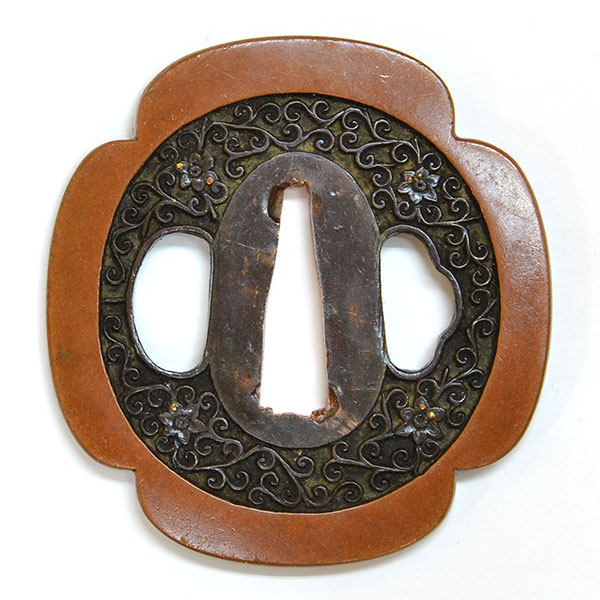
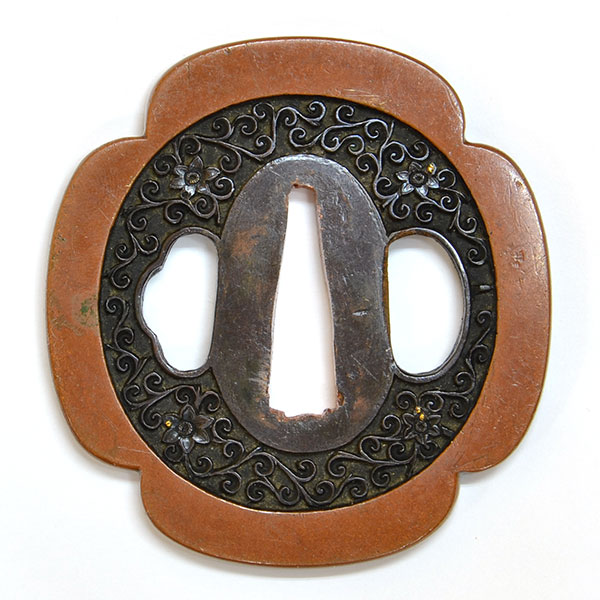
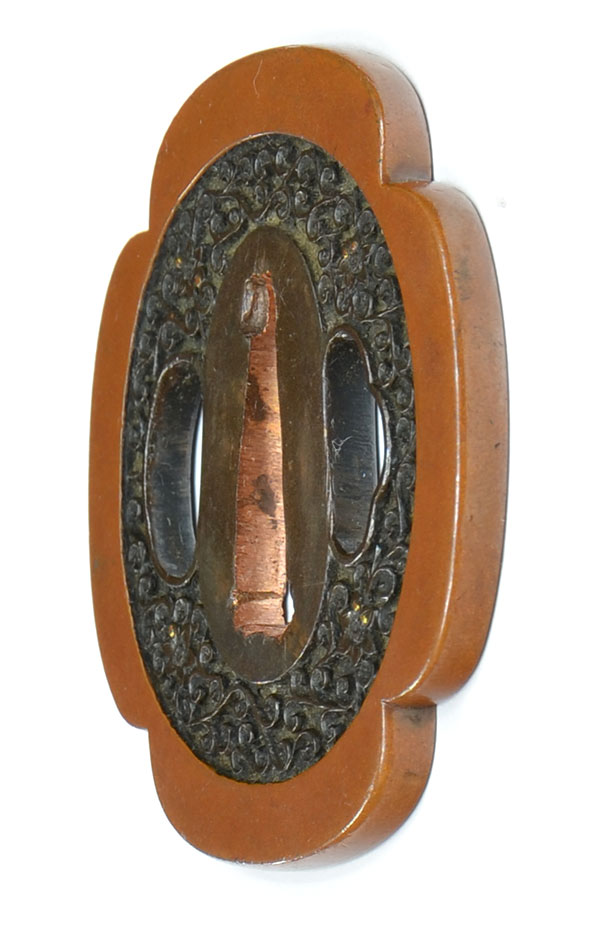
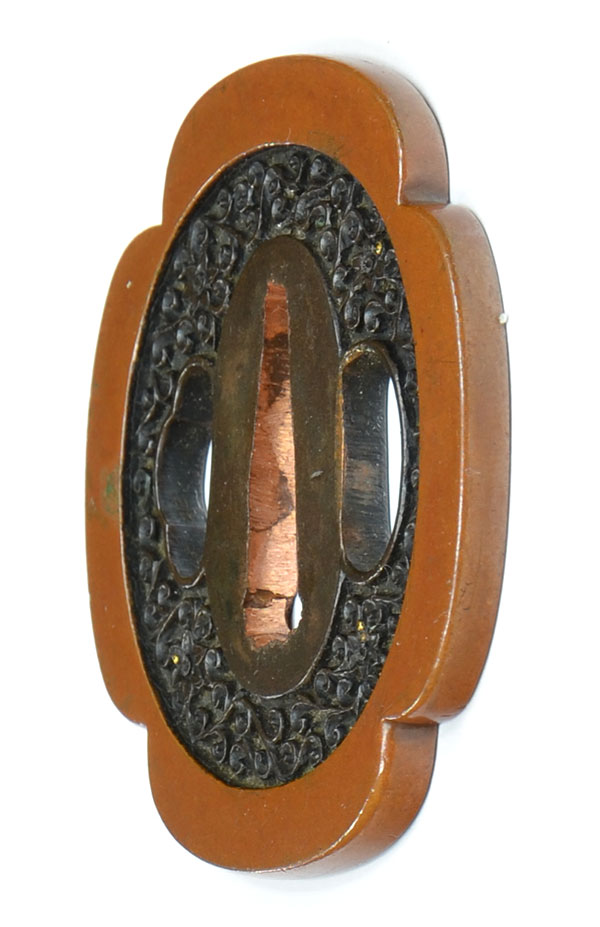
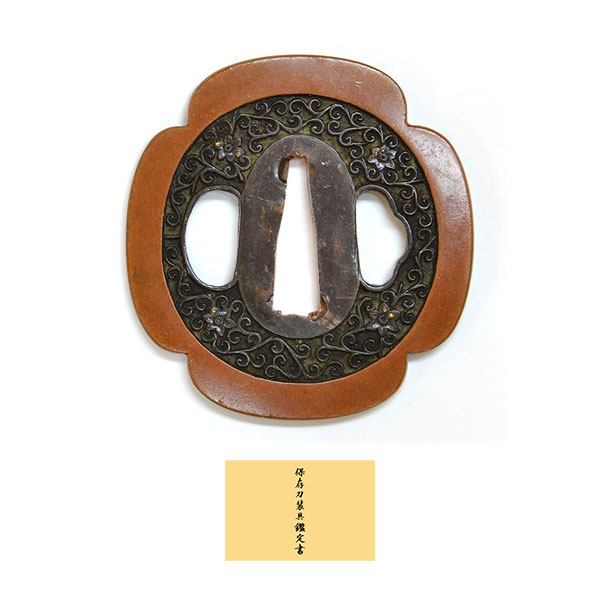
Hirado kinko refers to sword fitting metalworkers who developed in Hirado, Hizen Province, and Kunishige, known as its representative figure, is thought to have been active mainly around the Kyoho era of the mid-Edo period, leaving behind works using irogane such as shinchu, suakagane, and shibuichi, as well as unique pieces incorporating dragons, karakusa, and foreign-style characters. During the Edo period, Hirado was a place with many opportunities to come into contact with foreign cultures through overseas exchange, and designs suggesting Namban tastes are known in the works of Kunishige, showing that a distinctive style of sword fitting metalwork reflecting the character of the region developed in Hirado. This work, while mumei, is a piece that has been given a Hozon Tosogu Kanteisho with a kiwame to "Hirado," and what first catches the eye is the vivid contrast created by two types of irogane: the warm suakagane-ji forming the outer part and the lustrous black, high-quality shakudo-ji arranged on the inside, and by skillfully incorporating the colors of the different jigane themselves into the design, it creates a strong presence and sense of style within its dimensions of 69.2 mm. On the inner shakudo-ji, fine karakusa is wound around, and tessenka are arranged in four directions between the vines; the composition where the supple karakusa and the neatly blooming tessenka unite to surround the seppa-dai is truly elegant, with the minute patterns standing out vividly against the deep black shakudo-ji, and by effectively using gold for the tessenka, it creates a beautiful landscape unique to irogane where the soft redness of the suakagane, the glossy black of the shakudo, and the brilliance of the gold complement each other. In particular, the highlight of this work lies not only in the delicate expression of the patterns by the karakusa and tessenka, but also in the bold jigane composition that establishes even the outer suakagane-ji that envelops them as a single design, where the suakagane-ji extending softly in four directions enhances the central shakudo-ji like a frame, and the clear contrast between the warm suakagane color and the black shakudo color further accentuates the beauty of the detailed hana-karakusa. The tessen is a plant that extends thin vines and blooms elegant flowers, and its appearance harmonizes well with the flowing curves of the karakusa; in this work, by arranging the tessenka in four directions, balance is given to the entire tsuba, while the karakusa extends supplely to connect them, resulting in a composition that allows one to feel soft movement within the regularity, and while boldly using two types of jigane, shakudo and suakagane, it never flows into gaudiness, but rather creates dignity through the color of the materials and the neatness of the patterns, revealing the maker's excellent sense of design. This work is accompanied by a Hozon Tosogu Kanteisho with a kiwame to "Hirado" despite being mumei, and the impressive tsukurikomi combining suakagane and shakudo, the elegant karakusa and tessenka unfolding on the stage of the black shakudo-ji, and the brilliance of the gold added there show a magnificent harmony, possessing both the joy of gazing at the details and a beauty of color that leaves an impression at a glance. If mounted on a koshirae, the vivid contrast of suakagane and shakudo is guaranteed to add a special splendor to the entire sword mounting, and it is a deeply charming piece recommended for both collecting and for the production of koshirae, allowing one to fully enjoy the characteristic use of irogane and the excellent design sense of Hirado kinko.
Offered by Toushin

Machine translation of the shop's Japanese ·
Machine translation from the shop's Japanese · may contain errors ·
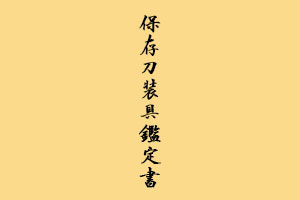
Certifies a genuine fitting worth preserving: a correct signature, or, if unsigned, an identifiable era and school, with recognized artistic and craft value.
The NBTHK (Nihon Bijutsu Tōken Hozon Kyōkai, the Society for the Preservation of Japanese Art Swords) is a public-interest incorporated foundation founded in 1948 and supervised by Japan’s Agency for Cultural Affairs (Bunkachō); it is based at the Japanese Sword Museum in Tokyo. Its expert panels physically examine each submitted work (shinsa) and issue a certificate (kanteishō) ranking it by artistic and historical merit. NBTHK papers are the most widely recognized standard of authentication for Japanese swords and fittings.
NBTHK official siteAs a rule we do not accept returns, except when we have sent a different item from the one ordered or when there is a significant discrepancy between the description and the item. If you wish to return an item, please contact us within 3 days of its arrival and then send it back.
¥385,000