The twentieth century nearly killed the craft twice: wartime distortion, then the occupation ban. The NBTHK’s founding in 1948 and licensed forging from 1953 rebuilt the sword as an art, crowned by Living National Treasures and the mukansa rank.
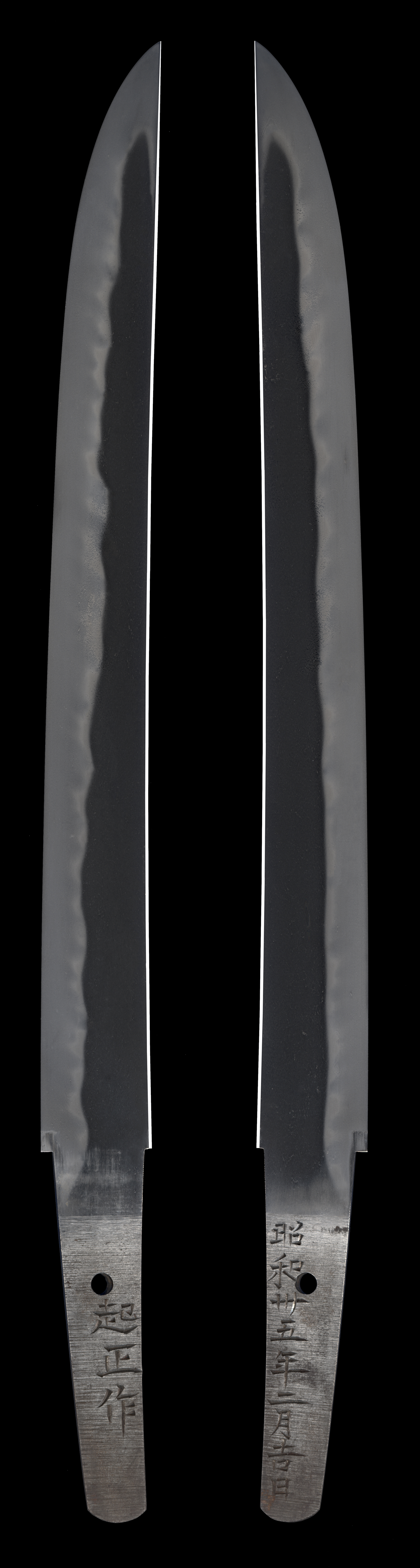
Tsukamoto Okimasa, whose real name was Tsukamoto Shinpachi, was born in Koriyama City, Fukushima Prefecture in Taisho 4. He is said to be a descendant of Echigo Yamamura Masanobu. In Showa 8 (1933), he became a disciple of Kasama Ikkansai Shigetsugu, and later became his son-in-law. He used the go Ikkansai, the same as his master and father-in-law Kasama Ikkansai Shigetsugu. He was an army commissioned swordsmith (Showa 18). After the war, he received the Special Prize at the New Sword Exhibition and the Minister of Education Award, and further success was expected of him, but he died young in 1960 (Showa 35). In the pre-war rankings of contemporary swordsmiths, he was such a master craftsman that he reigned as the Yokozuna of the East; his style showed workmanship like Minamoto Kiyomaro, and it was said that among contemporary swordsmiths at the time, no one could surpass him. This work shows a suguha style mixed with gunome, notare, and choji in a midare pattern, with a quality that makes it look exactly like a tanto by Minamoto Kiyomaro, and the workmanship is extremely good.
Offered by Katanahanbai
This piece has sold
Get an email when a new Okimasa piece hits the market.


As written by the shop
Machine translation from the shop's Japanese · may contain errors ·
Tokyo · around 1926-1989
Shōwa to the present: destruction and revival
The twentieth century nearly killed the craft twice: wartime distortion, then the occupation ban. The NBTHK’s founding in 1948 and licensed forging from 1953 rebuilt the sword as an art, crowned by Living National Treasures and the mukansa rank.
Certifies a genuine blade worth preserving: a signature confirmed correct, or, if unsigned, an era, province, and school that the NBTHK can reliably identify.
The NBTHK (Nihon Bijutsu Tōken Hozon Kyōkai, the Society for the Preservation of Japanese Art Swords) is a public-interest incorporated foundation founded in 1948 and supervised by Japan’s Agency for Cultural Affairs (Bunkachō); it is based at the Japanese Sword Museum in Tokyo. Its expert panels physically examine each submitted work (shinsa) and issue a certificate (kanteishō) ranking it by artistic and historical merit. NBTHK papers are the most widely recognized standard of authentication for Japanese swords and fittings.
NBTHK official siteFor cooling-off, contact us within 3 days including the day you received the item, and ship it so that it arrives within 8 days. After 8 days a return cannot be accepted. Returning an item after 8 days will be treated as a buy-back.