NihontoWatch Mon

NihontoWatchBETA

MarketAuctions
Encyclopedia
NihontoWatch Mon

NihontoWatchBETA

MarketAuctions
Encyclopedia

Description

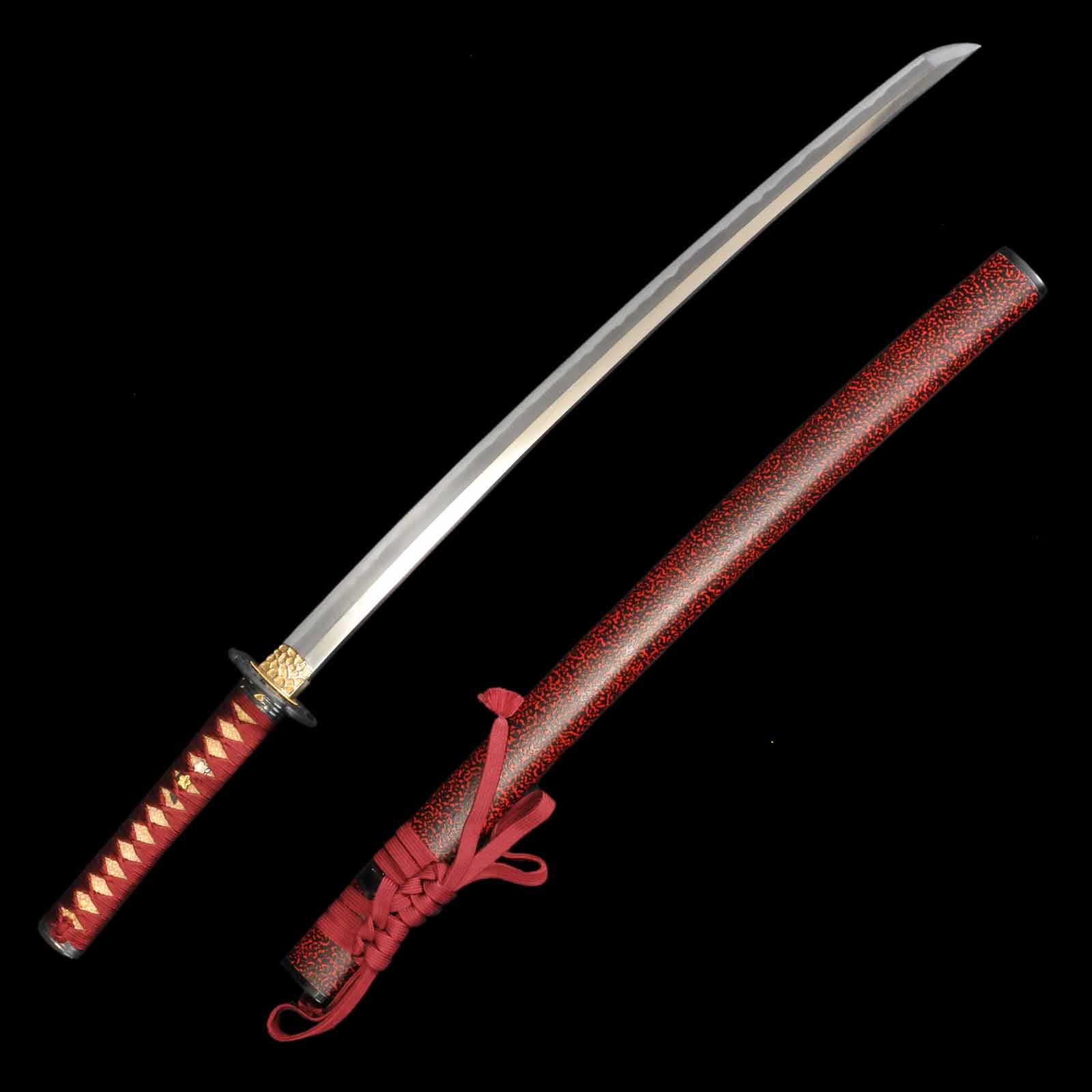
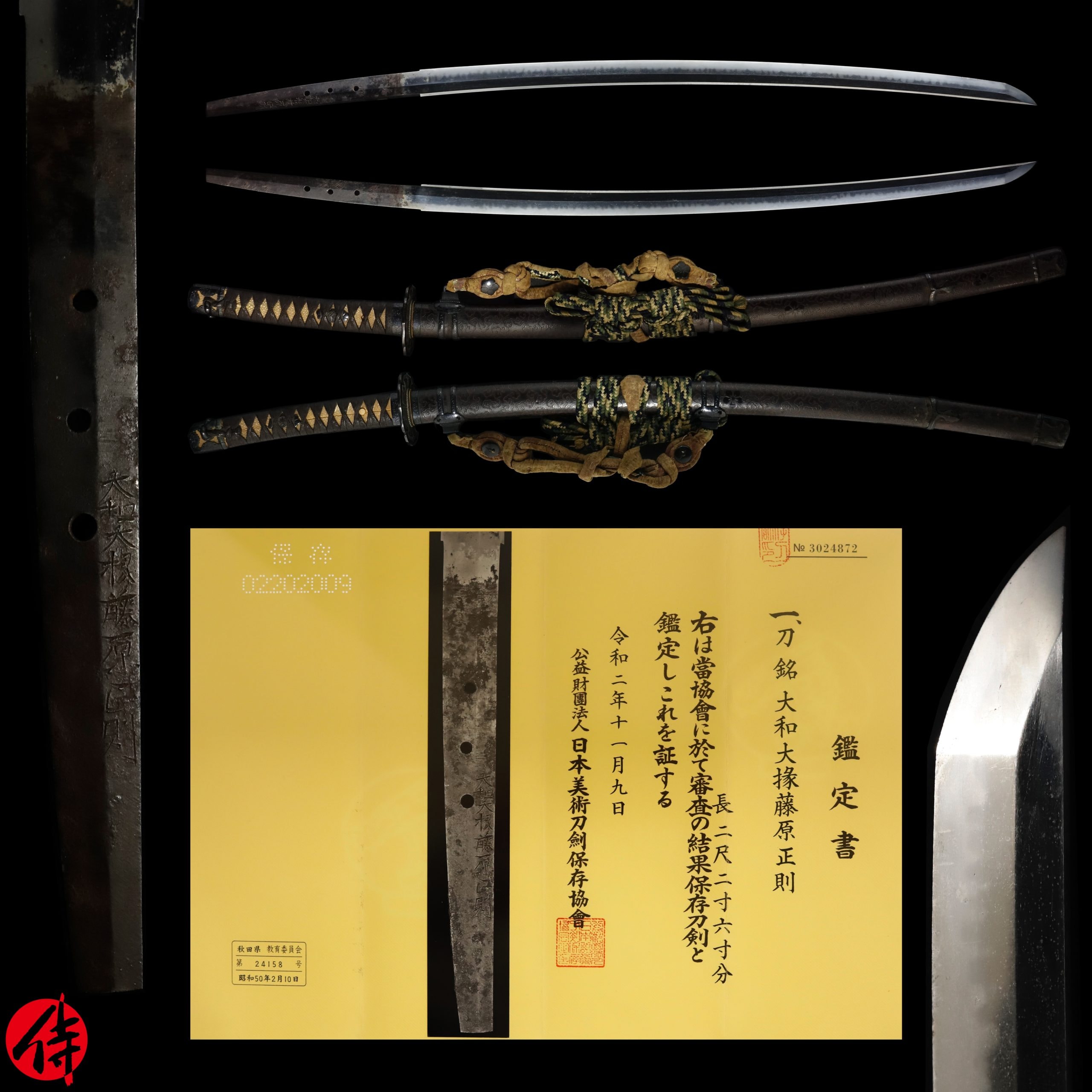
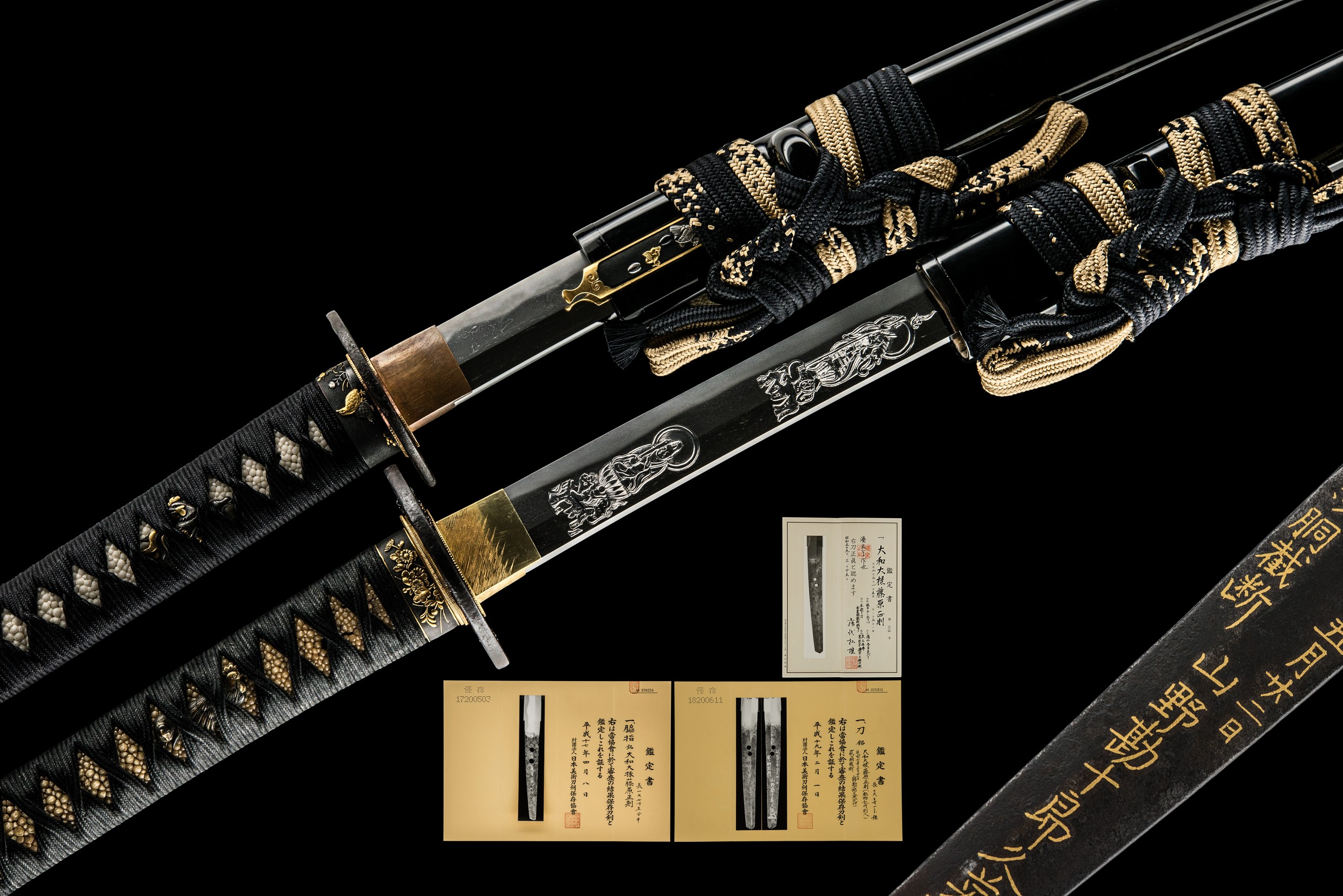
This is a custom daishô (matching katana and wakizashi) by Shodai Yamato no Daijô Fujiwara Masanori, a smith active at the transition from Kôtô to Shintô periods. The katana features a gold-inlaid cutting test inscription and horimono of Buddhist deities, while the wakizashi has a consistent gunome midare hamon and ko-itame jihada. The daishô is presented with a 'past meets present' koshirae, combining an Edo-period katana koshirae with a newly commissioned matching wakizashi koshirae, featuring fittings by Itô Masatoyo and Ichinomiya Tsuneyuki.

NihontoWatch MonNihontoWatchBETA
MarketAuctionsEncyclopedia
Swords›Masanori›A Shodai Yamato no Daijô Masanori Custom Daishô
daishoHozon
Masanori

A Shodai Yamato no Daijô Masanori Custom Daishô

mei · Shintô – keichô Era (circa 1596-1615)

SOLD
Masanori — 1 of 1
Masanori — 1 of 1
Measurements & details
Smith
Masanori
Type
Daisho
Period
Around 1596–1615(Keicho)
Province
Echizen
Signature
Signed(100% of this smith's designated works are signed)
Description

This is a custom daishô (matching katana and wakizashi) by Shodai Yamato no Daijô Fujiwara Masanori, a smith active at the transition from Kôtô to Shintô periods. The katana features a gold-inlaid cutting test inscription and horimono of Buddhist deities, while the wakizashi has a consistent gunome midare hamon and ko-itame jihada. The daishô is presented with a 'past meets present' koshirae, combining an Edo-period katana koshirae with a newly commissioned matching wakizashi koshirae, featuring fittings by Itô Masatoyo and Ichinomiya Tsuneyuki.

About the maker

Masanori

正則

Echizen Shinto (Fukui, Echizen); signing Yamato Daijo Fujiwara Masanori · Echizen · around 1596-1615

2 pieces on the market now

›

Masanori signed his work in full as Yamato Daijo Fujiwara Masanori[[c:1]], and the earliest of his dated blades carries the year Keicho 13 (1608), with later pieces reaching Genna 2 (1616), Kan'ei 1 (1624) and Keian 4 (1651). That span sets him squarely in the first generation of Echizen smiths working at Fukui in the opening decades of the Edo period, active alongside the first and second generations of Echizen Yasutsugu. The published sources transmit, as one view only, that he descended from Sanjo Yoshinori of Yamashiro, that his native province was Miyazu in Tango, and that he afterward moved to Fukui in Echizen. They place him in the immediate orbit of Yasutsugu, perhaps as a pupil, and add that even where that cannot be shown it is difficult to deny that he came under that smith's influence[[c:2]]. The name continued through several more generations after him, but it is this first Masanori, with his long signature and his ubu nakago, whose hand the four designated blades record.

His everyday manner is read first off the jigane. Over an itame that flows and stands a little (板目 on all four blades, hada-dachi on three, with flowing grain entering on two) he lays ji-nie, and on the larger katana chikei (地景) appears; the steel is sometimes blackish. The hamon that runs above it is a midareba built from gunome, large gunome, pointed togariba and yahazu-like (矢筈) heads, with ko-nie attaching, the boshi running midare-komi to a small round turnback. What the published sources return to, however, is not any single feature of the line but the character of the nioiguchi: it tends to sink, somewhat subdued, and they sum the whole up by saying that his is a subdued-nioiguchi blade generally close to the Seki smiths, 「匂口の沈んだ刃で, 一般に関物に近い」. That sinking quality, paired with the flowing standing jigane, is the closest thing he has to a constant tell across the busier work.

Not every blade is busy. On one of the naginata the hand quiets entirely: the kitae is a fine ko-itame with only a slight tendency to stand, ji-nie appearing, and the hamon settles into a suguha (直刃) with ashi and ko-nie, the boshi straight to a ko-maru. The published sources name this suguha alongside the midareba as the other thing he often produces, and they judge the piece refined in its forging, with the ji and ha well ordered throughout, 「地鉄が精美で地刃の出来がよく整った」. It is the disciplined counterpart to the flowing midare manner, and it shows that his Echizen training carried a calmer register as readily as the showier one.

The ceiling of his work lies elsewhere again. His seventh-session designated katana, the oldest of the four on record, is the height of his ambition: a wide blade running to a large point, cut on the omote in single-bevel construction (片切刃) and on the ura in shinogi-zukuri, modeled after the so-called Kiriba-Sadamune (切刃貞宗). Above a standing itame with frequent muneyaki runs a paired so-mon in a large midare (双文大乱) mixed with gunome, ashi and yo entering freely, sunagashi running through, and the ura passing into full tempering (皆焼), the boshi thrusting up with hakikake and nie. A sankoken (三鈷剣) is carved on the omote. Of this blade the published sources write that the workmanship is excellent, very nearly reaching the first-generation Yasutsugu, and that among Masanori's own works there is none to set beside it, 「殆んど初代康継に迫るものがあり, 同作中これに比すべきものがない」. The katakiriba construction is itself a recurring trait of his record rather than a one-off, appearing on a naginata as well, but it is on this katana that the Sadamune model is named and the ambition fully realized.

What distinguishes Masanori within the crowded field of Echizen Shinto is best drawn from his own grounded features rather than by contrast with his neighbors. The flowing, standing itame and the sinking nioiguchi are the marks the published sources tie to his closeness to the Seki tradition, and they are what hold his everyday work together; against them, the katakiriba blades and the Sadamune-modeled showpiece are the reach toward an older and grander manner. The judges note on the twenty-third-session naginata that his own characteristic features show densely in the ji and ha of that piece, 「地刃に正則の特色が濃く」, and on the same blade that the carving is splendid besides. He is, in the school's reckoning, a smith whose typical work sits close to Seki yet who could, on his best day, turn out a katana that approached the founder of his own province's Shinto tradition.

Masanori's designated record stands at four Juyo blades, two katana and two naginata, every one signed in full and on an ubu nakago; his record reaches the Juyo tier and no higher, and none of the four carries a recorded line of provenance or a named owner. The seventh-session katana, the Sadamune-modeled piece the published sources rank without equal in his output, is the work by which he is best known, and the two naginata, one quiet in suguha and one densely his own, round out a small but coherent body. For the collector this is a smith whose work surfaces only occasionally and whose finest blade is a landmark when it appears; the signed Echizen katana and naginata of his hand are not beyond reach in the way a designated cultural property would be, but they come to market rarely, and a piece in which his subdued nioiguchi and flowing standing jigane are clearly present rewards patience more than it does pursuit.

Historical importance

Where Masanori stands among comparable artisans: across all of nihontō, and within tradition, era, and period. The tiers (Foremost · Leading · Major · Notable) weigh official designations from the NBTHK and Japan's Agency for Cultural Affairs, together with historical honors of lasting repute such as the Sansaku and Meibutsu-chō.

随一
Foremost
屈指
Leading
有数
Major
著名
Notable

Select a lens to see how it's measured.

Designation record
4 designated works
Jūyō
4
2 works by Masanori on the market→
Masanori — full profile
NBTHK Certificate
Hozon Tōken保存刀剣
Sword Worthy of Preservation
›

Certifies a genuine blade worth preserving: a signature confirmed correct, or, if unsigned, an era, province, and school that the NBTHK can reliably identify.

About the NBTHK›

The NBTHK (Nihon Bijutsu Tōken Hozon Kyōkai, the Society for the Preservation of Japanese Art Swords) is a public-interest incorporated foundation founded in 1948 and supervised by Japan’s Agency for Cultural Affairs (Bunkachō); it is based at the Japanese Sword Museum in Tokyo. Its expert panels physically examine each submitted work (shinsa) and issue a certificate (kanteishō) ranking it by artistic and historical merit. NBTHK papers are the most widely recognized standard of authentication for Japanese swords and fittings.

NBTHK official site→
Seller
U
Unique Japan
Established 2006 · 20 yrs on the market
🇯🇵Ships from Japan
›
✓Verified dealeruniquejapan.com
✓Ships worldwide✓English supportWire transfer
Return policy

All swords come with a three-day inspection period beginning from the date of delivery. If not satisfied, the sword may be returned within this period for a full refund of the purchase price. Outside of this period, all sales are final. Swords purchased on a layaway payment plan are not eligible for the three-day inspection period.

View all of Unique Japan’s listings→View this item on the dealer’s site→

More works by Masanori

View all →
Nihonto Australia
Hozon
Katana - Hozon - by Masanori - Masanori Katana with NBTHK Hozon CertificateKatana - Hozon - by Masanori - Masanori Katana with NBTHK Hozon Certificate

Katana

ByMasanori
¥10,000
Nipponto
Katana - by Masanori - Katana by Yamatodaijo Fujiwara MasanoriKatana - by Masanori - Katana by Yamatodaijo Fujiwara Masanori

Katana

ByMasanori
¥780,000

Previously sold by Masanori

World Seiyudo
Hozon
Katana - Hozon - by Masanori - Yamato Daijo Fujiwara MasanoriKatana - Hozon - by Masanori - Yamato Daijo Fujiwara Masanori
Sold

Katana

ByMasanori
SOLD
Nipponto
Hozon
Katana - Hozon - by Masanori - Katana by Fujiwara Masanori, YamatodaijoKatana - Hozon - by Masanori - Katana by Fujiwara Masanori, Yamatodaijo
Sold

Katana

ByMasanori
SOLD
Tozando
Tokubetsu Kichō
Katana - Tokubetsu Kichō - by Masanori - Unsigned Masanori, Uchigatana Koshirae, Shinto EraKatana - Tokubetsu Kichō - by Masanori - Unsigned Masanori, Uchigatana Koshirae, Shinto Era
Sold

Katana

ByMasanori
SOLD
Samurai Museum
Hozon
Katana - Hozon - by Masanori - Antique Japanese Sword Katana Signed by Masanori NBTHK Hozon CertificateKatana - Hozon - by Masanori - Antique Japanese Sword Katana Signed by Masanori NBTHK Hozon Certificate
Sold

Katana

ByMasanori
SOLD
Nihonto Antiques
NTHK
Tanto - NTHK - by Masanori - Tanto by Yamato no Daijo Masanori with NTHK KanteishoTanto - NTHK - by Masanori - Tanto by Yamato no Daijo Masanori with NTHK Kanteisho
Sold

Tantō

ByMasanori
SOLD
Samurai Museum
Tokuho
Daisho - Tokuho - by Masanori - Antique Japanese Sword Daisho Signed by Masanori NBTHK Tokubetsu Hozon CertificateDaisho - Tokuho - by Masanori - Antique Japanese Sword Daisho Signed by Masanori NBTHK Tokubetsu Hozon Certificate
Sold

Daishō

ByMasanori
SOLD
Nihonto Antiques
NTHK
Katana - NTHK - by Masanori - Katana by Den Yamato Masanori with NTHK KanteishoKatana - NTHK - by Masanori - Katana by Den Yamato Masanori with NTHK Kanteisho
Sold

Katana

ByMasanori
SOLD

Swords

  • Katana
  • Wakizashi
  • Tantō
  • Tachi
  • Naginata
  • Yari

Fittings

  • Tsuba
  • Fuchi-Kashira
  • Kozuka
  • Menuki

By Certification

  • Tokujū
  • Jūyō
  • Tokuho
  • Hozon

Resources

  • Dealer Directory
  • Artist Directory
  • Glossary
  • Browse All
Nihontowatch© 2026
TermsPrivacyCookiesAbout

Description

This is a custom daishô (matching katana and wakizashi) by Shodai Yamato no Daijô Fujiwara Masanori, a smith active at the transition from Kôtô to Shintô periods. The katana features a gold-inlaid cutting test inscription and horimono of Buddhist deities, while the wakizashi has a consistent gunome midare hamon and ko-itame jihada. The daishô is presented with a 'past meets present' koshirae, combining an Edo-period katana koshirae with a newly commissioned matching wakizashi koshirae, featuring fittings by Itô Masatoyo and Ichinomiya Tsuneyuki.

NihontoWatch MonNihontoWatchBETA
MarketAuctionsEncyclopedia
Swords›Masanori›A Shodai Yamato no Daijô Masanori Custom Daishô
daishoHozon
Masanori

A Shodai Yamato no Daijô Masanori Custom Daishô

mei · Shintô – keichô Era (circa 1596-1615)

SOLD
Masanori — 1 of 1
Masanori — 1 of 1
Measurements & details
Smith
Masanori
Type
Daisho
Period
Around 1596–1615(Keicho)
Province
Echizen
Signature
Signed(100% of this smith's designated works are signed)
Description

This is a custom daishô (matching katana and wakizashi) by Shodai Yamato no Daijô Fujiwara Masanori, a smith active at the transition from Kôtô to Shintô periods. The katana features a gold-inlaid cutting test inscription and horimono of Buddhist deities, while the wakizashi has a consistent gunome midare hamon and ko-itame jihada. The daishô is presented with a 'past meets present' koshirae, combining an Edo-period katana koshirae with a newly commissioned matching wakizashi koshirae, featuring fittings by Itô Masatoyo and Ichinomiya Tsuneyuki.

About the maker

Masanori

正則

Echizen Shinto (Fukui, Echizen); signing Yamato Daijo Fujiwara Masanori · Echizen · around 1596-1615

2 pieces on the market now

›

Masanori signed his work in full as Yamato Daijo Fujiwara Masanori[[c:1]], and the earliest of his dated blades carries the year Keicho 13 (1608), with later pieces reaching Genna 2 (1616), Kan'ei 1 (1624) and Keian 4 (1651). That span sets him squarely in the first generation of Echizen smiths working at Fukui in the opening decades of the Edo period, active alongside the first and second generations of Echizen Yasutsugu. The published sources transmit, as one view only, that he descended from Sanjo Yoshinori of Yamashiro, that his native province was Miyazu in Tango, and that he afterward moved to Fukui in Echizen. They place him in the immediate orbit of Yasutsugu, perhaps as a pupil, and add that even where that cannot be shown it is difficult to deny that he came under that smith's influence[[c:2]]. The name continued through several more generations after him, but it is this first Masanori, with his long signature and his ubu nakago, whose hand the four designated blades record.

His everyday manner is read first off the jigane. Over an itame that flows and stands a little (板目 on all four blades, hada-dachi on three, with flowing grain entering on two) he lays ji-nie, and on the larger katana chikei (地景) appears; the steel is sometimes blackish. The hamon that runs above it is a midareba built from gunome, large gunome, pointed togariba and yahazu-like (矢筈) heads, with ko-nie attaching, the boshi running midare-komi to a small round turnback. What the published sources return to, however, is not any single feature of the line but the character of the nioiguchi: it tends to sink, somewhat subdued, and they sum the whole up by saying that his is a subdued-nioiguchi blade generally close to the Seki smiths, 「匂口の沈んだ刃で, 一般に関物に近い」. That sinking quality, paired with the flowing standing jigane, is the closest thing he has to a constant tell across the busier work.

Not every blade is busy. On one of the naginata the hand quiets entirely: the kitae is a fine ko-itame with only a slight tendency to stand, ji-nie appearing, and the hamon settles into a suguha (直刃) with ashi and ko-nie, the boshi straight to a ko-maru. The published sources name this suguha alongside the midareba as the other thing he often produces, and they judge the piece refined in its forging, with the ji and ha well ordered throughout, 「地鉄が精美で地刃の出来がよく整った」. It is the disciplined counterpart to the flowing midare manner, and it shows that his Echizen training carried a calmer register as readily as the showier one.

The ceiling of his work lies elsewhere again. His seventh-session designated katana, the oldest of the four on record, is the height of his ambition: a wide blade running to a large point, cut on the omote in single-bevel construction (片切刃) and on the ura in shinogi-zukuri, modeled after the so-called Kiriba-Sadamune (切刃貞宗). Above a standing itame with frequent muneyaki runs a paired so-mon in a large midare (双文大乱) mixed with gunome, ashi and yo entering freely, sunagashi running through, and the ura passing into full tempering (皆焼), the boshi thrusting up with hakikake and nie. A sankoken (三鈷剣) is carved on the omote. Of this blade the published sources write that the workmanship is excellent, very nearly reaching the first-generation Yasutsugu, and that among Masanori's own works there is none to set beside it, 「殆んど初代康継に迫るものがあり, 同作中これに比すべきものがない」. The katakiriba construction is itself a recurring trait of his record rather than a one-off, appearing on a naginata as well, but it is on this katana that the Sadamune model is named and the ambition fully realized.

What distinguishes Masanori within the crowded field of Echizen Shinto is best drawn from his own grounded features rather than by contrast with his neighbors. The flowing, standing itame and the sinking nioiguchi are the marks the published sources tie to his closeness to the Seki tradition, and they are what hold his everyday work together; against them, the katakiriba blades and the Sadamune-modeled showpiece are the reach toward an older and grander manner. The judges note on the twenty-third-session naginata that his own characteristic features show densely in the ji and ha of that piece, 「地刃に正則の特色が濃く」, and on the same blade that the carving is splendid besides. He is, in the school's reckoning, a smith whose typical work sits close to Seki yet who could, on his best day, turn out a katana that approached the founder of his own province's Shinto tradition.

Masanori's designated record stands at four Juyo blades, two katana and two naginata, every one signed in full and on an ubu nakago; his record reaches the Juyo tier and no higher, and none of the four carries a recorded line of provenance or a named owner. The seventh-session katana, the Sadamune-modeled piece the published sources rank without equal in his output, is the work by which he is best known, and the two naginata, one quiet in suguha and one densely his own, round out a small but coherent body. For the collector this is a smith whose work surfaces only occasionally and whose finest blade is a landmark when it appears; the signed Echizen katana and naginata of his hand are not beyond reach in the way a designated cultural property would be, but they come to market rarely, and a piece in which his subdued nioiguchi and flowing standing jigane are clearly present rewards patience more than it does pursuit.

Historical importance

Where Masanori stands among comparable artisans: across all of nihontō, and within tradition, era, and period. The tiers (Foremost · Leading · Major · Notable) weigh official designations from the NBTHK and Japan's Agency for Cultural Affairs, together with historical honors of lasting repute such as the Sansaku and Meibutsu-chō.

随一
Foremost
屈指
Leading
有数
Major
著名
Notable

Select a lens to see how it's measured.

Designation record
4 designated works
Jūyō
4
2 works by Masanori on the market→
Masanori — full profile
NBTHK Certificate
Hozon Tōken保存刀剣
Sword Worthy of Preservation
›

Certifies a genuine blade worth preserving: a signature confirmed correct, or, if unsigned, an era, province, and school that the NBTHK can reliably identify.

About the NBTHK›

The NBTHK (Nihon Bijutsu Tōken Hozon Kyōkai, the Society for the Preservation of Japanese Art Swords) is a public-interest incorporated foundation founded in 1948 and supervised by Japan’s Agency for Cultural Affairs (Bunkachō); it is based at the Japanese Sword Museum in Tokyo. Its expert panels physically examine each submitted work (shinsa) and issue a certificate (kanteishō) ranking it by artistic and historical merit. NBTHK papers are the most widely recognized standard of authentication for Japanese swords and fittings.

NBTHK official site→
Seller
U
Unique Japan
Established 2006 · 20 yrs on the market
🇯🇵Ships from Japan
›
✓Verified dealeruniquejapan.com
✓Ships worldwide✓English supportWire transfer
Return policy

All swords come with a three-day inspection period beginning from the date of delivery. If not satisfied, the sword may be returned within this period for a full refund of the purchase price. Outside of this period, all sales are final. Swords purchased on a layaway payment plan are not eligible for the three-day inspection period.

View all of Unique Japan’s listings→View this item on the dealer’s site→

More works by Masanori

View all →
Nihonto Australia
Hozon
Katana - Hozon - by Masanori - Masanori Katana with NBTHK Hozon CertificateKatana - Hozon - by Masanori - Masanori Katana with NBTHK Hozon Certificate

Katana

ByMasanori
¥10,000
Nipponto
Katana - by Masanori - Katana by Yamatodaijo Fujiwara MasanoriKatana - by Masanori - Katana by Yamatodaijo Fujiwara Masanori

Katana

ByMasanori
¥780,000

Previously sold by Masanori

World Seiyudo
Hozon
Katana - Hozon - by Masanori - Yamato Daijo Fujiwara MasanoriKatana - Hozon - by Masanori - Yamato Daijo Fujiwara Masanori
Sold

Katana

ByMasanori
SOLD
Nipponto
Hozon
Katana - Hozon - by Masanori - Katana by Fujiwara Masanori, YamatodaijoKatana - Hozon - by Masanori - Katana by Fujiwara Masanori, Yamatodaijo
Sold

Katana

ByMasanori
SOLD
Tozando
Tokubetsu Kichō
Katana - Tokubetsu Kichō - by Masanori - Unsigned Masanori, Uchigatana Koshirae, Shinto EraKatana - Tokubetsu Kichō - by Masanori - Unsigned Masanori, Uchigatana Koshirae, Shinto Era
Sold

Katana

ByMasanori
SOLD
Samurai Museum
Hozon
Katana - Hozon - by Masanori - Antique Japanese Sword Katana Signed by Masanori NBTHK Hozon CertificateKatana - Hozon - by Masanori - Antique Japanese Sword Katana Signed by Masanori NBTHK Hozon Certificate
Sold

Katana

ByMasanori
SOLD
Nihonto Antiques
NTHK
Tanto - NTHK - by Masanori - Tanto by Yamato no Daijo Masanori with NTHK KanteishoTanto - NTHK - by Masanori - Tanto by Yamato no Daijo Masanori with NTHK Kanteisho
Sold

Tantō

ByMasanori
SOLD
Samurai Museum
Tokuho
Daisho - Tokuho - by Masanori - Antique Japanese Sword Daisho Signed by Masanori NBTHK Tokubetsu Hozon CertificateDaisho - Tokuho - by Masanori - Antique Japanese Sword Daisho Signed by Masanori NBTHK Tokubetsu Hozon Certificate
Sold

Daishō

ByMasanori
SOLD
Nihonto Antiques
NTHK
Katana - NTHK - by Masanori - Katana by Den Yamato Masanori with NTHK KanteishoKatana - NTHK - by Masanori - Katana by Den Yamato Masanori with NTHK Kanteisho
Sold

Katana

ByMasanori
SOLD

Swords

  • Katana
  • Wakizashi
  • Tantō
  • Tachi
  • Naginata
  • Yari

Fittings

  • Tsuba
  • Fuchi-Kashira
  • Kozuka
  • Menuki

By Certification

  • Tokujū
  • Jūyō
  • Tokuho
  • Hozon

Resources

  • Dealer Directory
  • Artist Directory
  • Glossary
  • Browse All
Nihontowatch© 2026
TermsPrivacyCookiesAbout
NihontoWatch Mon

NihontoWatchBETA

MarketAuctions
Encyclopedia
NihontoWatch Mon

NihontoWatchBETA

MarketAuctions
Encyclopedia