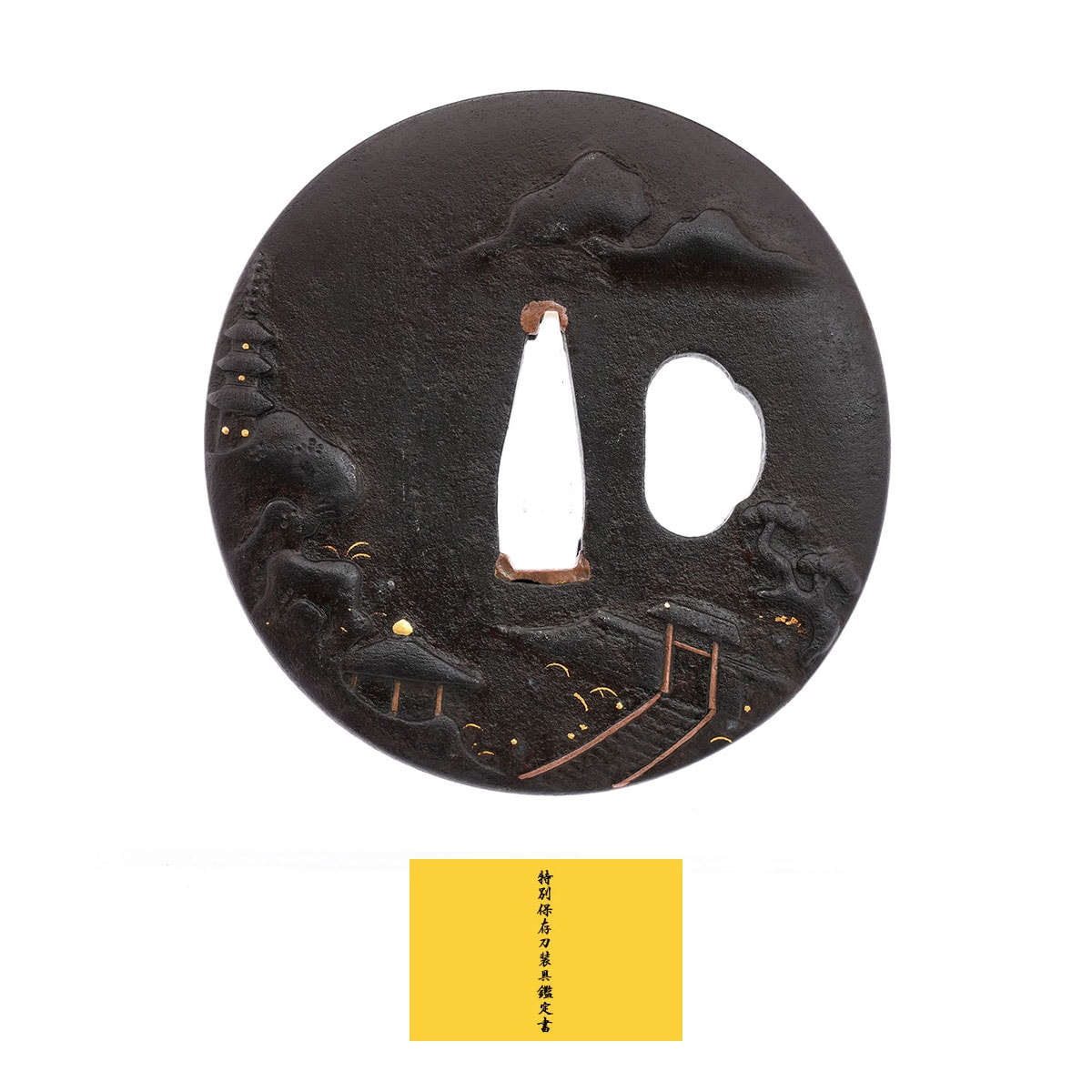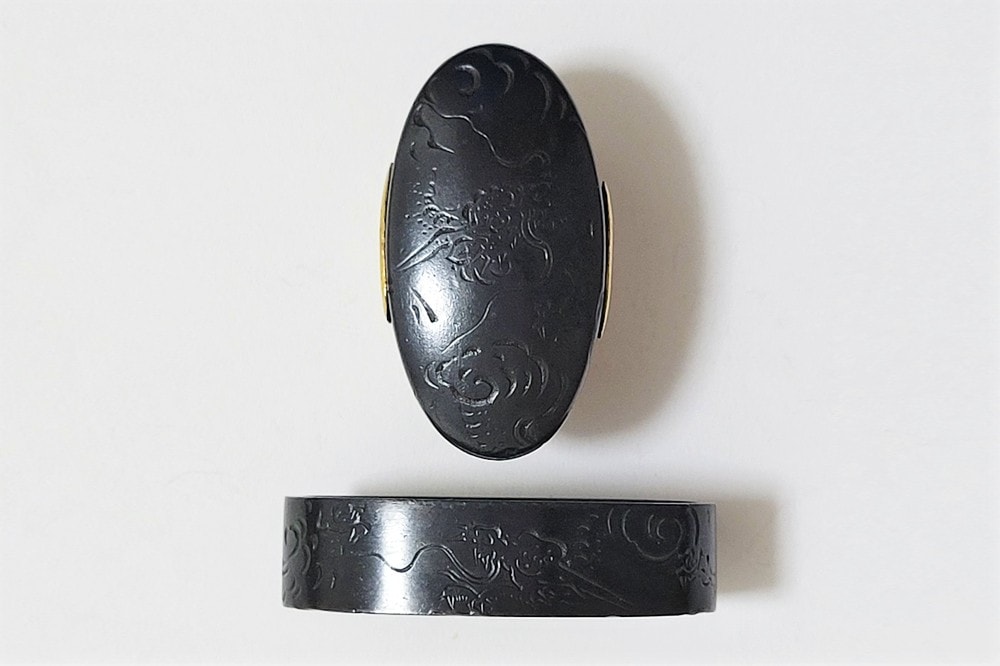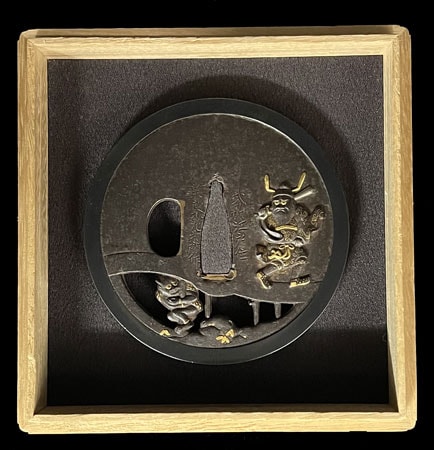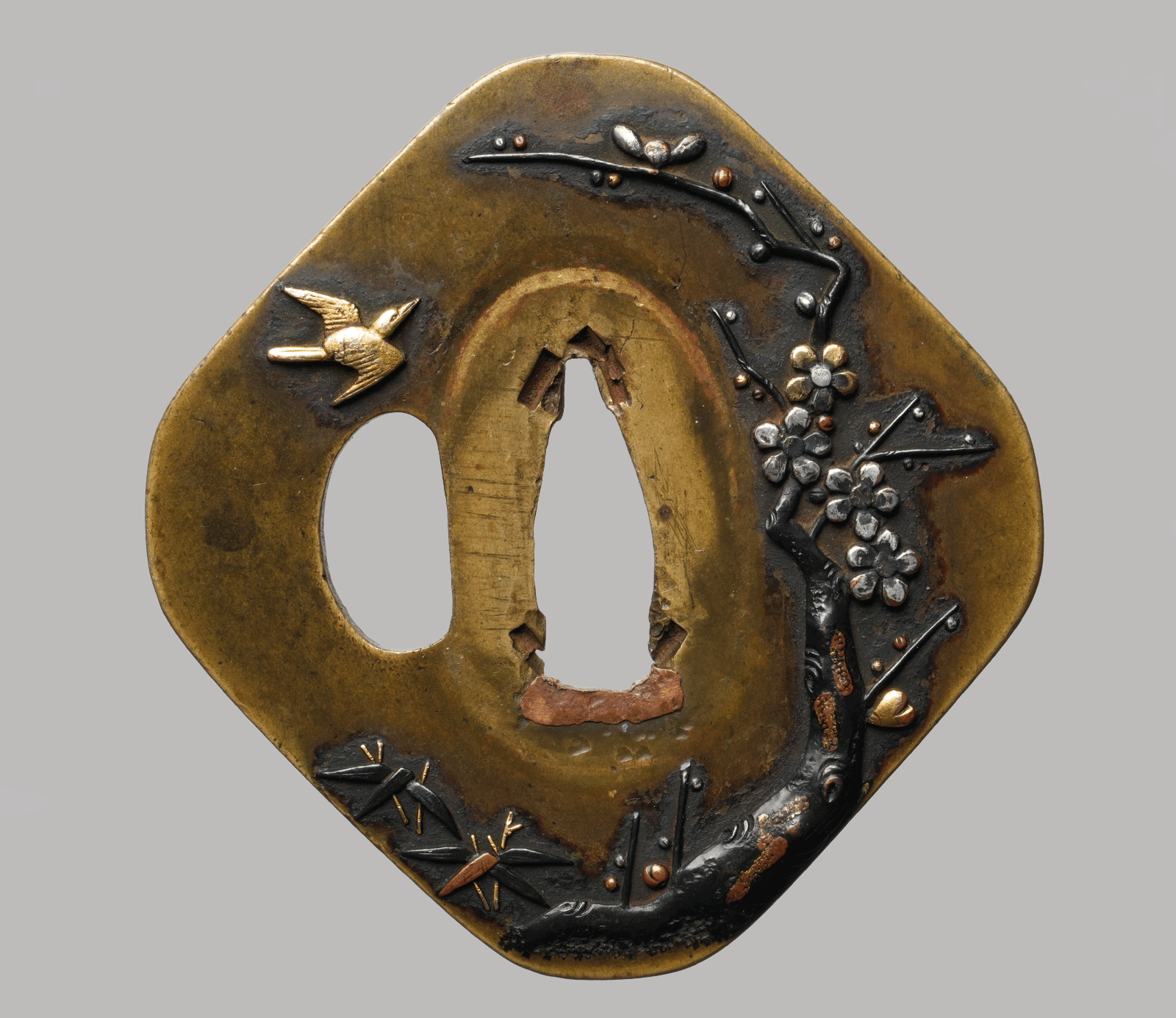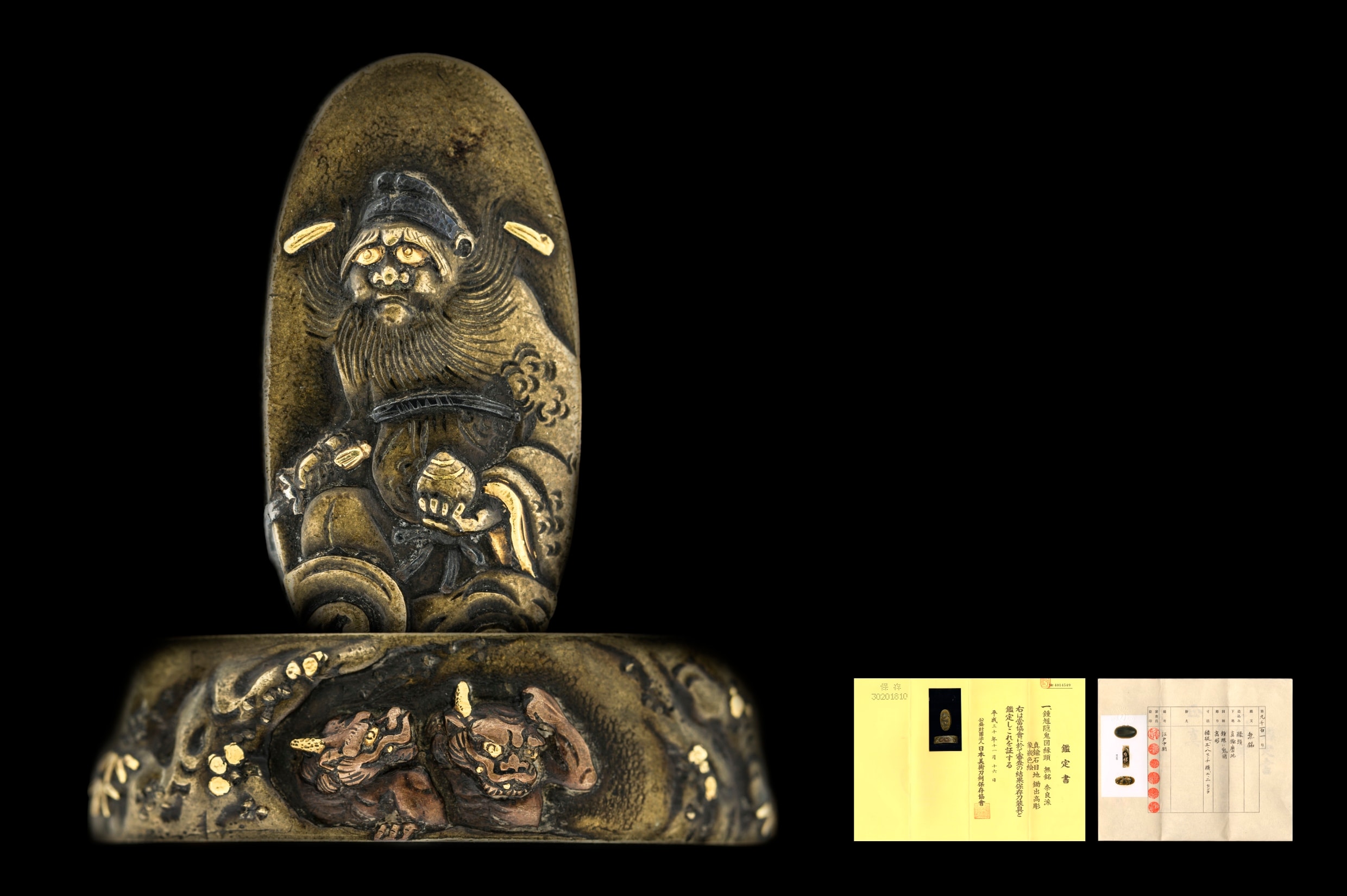
A NARA SHOKI FUCHI KASHIRA (鍾馗隠鬼図縁頭)
SOLD
Tracked across 76 dealers worldwide · price history · sold archive
Mid-edo Period (circa 1750-1780)
About the school
Nara School奈良派
The Nara school of *kinko* (metalwork) emerged in the mid-Edo period as one of the most celebrated independent traditions of sword-fitting craftsmanship, its masters working outside the patronage structures that governed the Goto house. The school coalesced around the figure of Nara Toshihisa (1667--1736), also known as Tahee, who as head master during its creative zenith defined the mature idiom of the lineage. Though the school's origins are often traced through the successive generations of the Nara family beginning with Toshiharu, its lasting fame rests upon the *Nara sansaku* — the Three Masters of Nara: Toshihisa, Tsuchiya Yasuchika, and Sugiura Joi. Yasuchika, born in Kanbun 10 (1670) in Dewa Province, trained first under Shoami Chinku before traveling to Edo in Genroku 16, where he undertook further study under Nara Tatsumasa — at which point, as the NBTHK consistently observes, "his innate talent fully blossomed." Joi (1701--1761), trained under Juei in the lineage of Toshiharu, rose to become the third pillar of this triumvirate. Together, and joined by masters of allied lineages such as Hayashi Shigemitsu of the Higo *kinko* tradition, the Nara school and its circle represent the highest achievement of independent metalwork in the Edo period. The collective technical vocabulary of the Nara school encompasses an extraordinary breadth of materials and methods. Its masters worked in iron, *shakudo*, *shibuichi*, brass (*shinchu*), refined copper (*suaka*), and *oborogin*, treating surfaces as polished grounds (*migaki-ji*), hammered textures (*tsuchime-ji*), and stone-grain finishes (*ishime-ji*) — the latter developed by Toshihisa into a distinctive personal manner. The school's carving methods span the full spectrum: *sukidashi-bori* modeled relief, *takabori* high relief, the thread-fine line work of *kebori*, and the single-stroke *katakiribori* incision. Polychrome metal inlay (*iroe*) in gold, silver, shakudo, shibuichi, and suaka is deployed with what the NBTHK describes in Yasuchika's case as "an unrivaled equilibrium in compositional planning." Yet individual specialties distinguish the masters within this shared vocabulary. Toshihisa's art finds its fullest expression in *sukidashi takabori* — relief carving in which figures are raised with subtly graduated heights to produce an illusion of spatial depth — executed against his richly textured ishime-ji grounds. Joi developed *nikuaibori*, a modulated relief technique of unrivaled refinement, producing entire compositions through chisel work alone on polished oborogin grounds, dispensing with inlay and colored-metal accents. Yasuchika's range is perhaps the broadest, encompassing the distinctive *daigaku-gata* iron tsuba conceived for his patron and kozuka that "draw forth a small universe" within a confined surface, while his late works signed with the art name Tou achieve an austere, detached realm the NBTHK terms *kotan*. The legacy of the Nara school rests on the singular ability of its masters to transcend decorative function and achieve genuine artistic expression within the confines of sword fittings. Toshihisa, as the senior figure among the sansaku, established the standard of dignified, powerfully carved relief against richly textured grounds, and his figural subjects — gamecocks, tigers, Bishamonten — consistently achieve what NBTHK scholarship identifies as the philosophical duality of *do* (movement) and *sei* (stillness) within a single composition. Yasuchika's narrative scenes are likened to hanging paintings, unfolding atmospheric effects "akin to watercolor," while his treatment of figures conveys what examiners consistently term a "warm, humane sentiment" and "gentle humanism." Joi, working primarily in the intimate format of the kozuka, achieved expressive authority through the sheer subtlety of his nikuaibori chisel work — his celebrated lion-and-cub compositions existing in closely related versions across multiple designations and published in the canonical reference *Tagane no Hana*. That the school also attracted masters of allied provincial traditions — Hayashi Shigemitsu of Higo, whose iron tsuba display the characteristic *murasaki-sabi* patina and "somewhat gentler feeling" that distinguishes the second generation from the founder Matahichi — attests to its gravitational influence on Edo-period metalwork as a whole. Across the school's production, the NBTHK's evaluative language converges on a consistent theme: compositional intelligence, technical command across the full range of materials and carving methods, and an expressive depth that elevates the finest works from accomplished craft to art of the highest order.