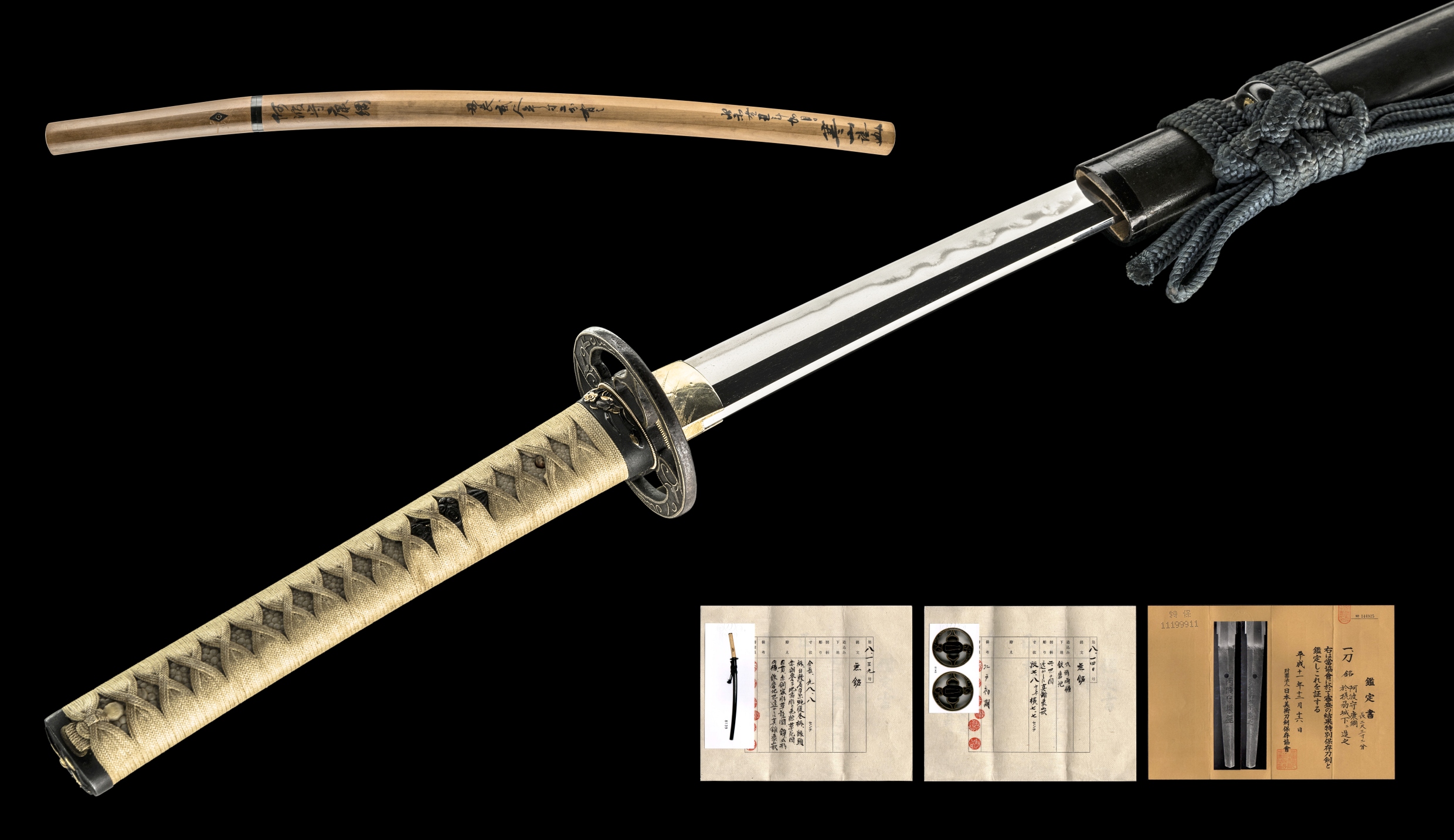
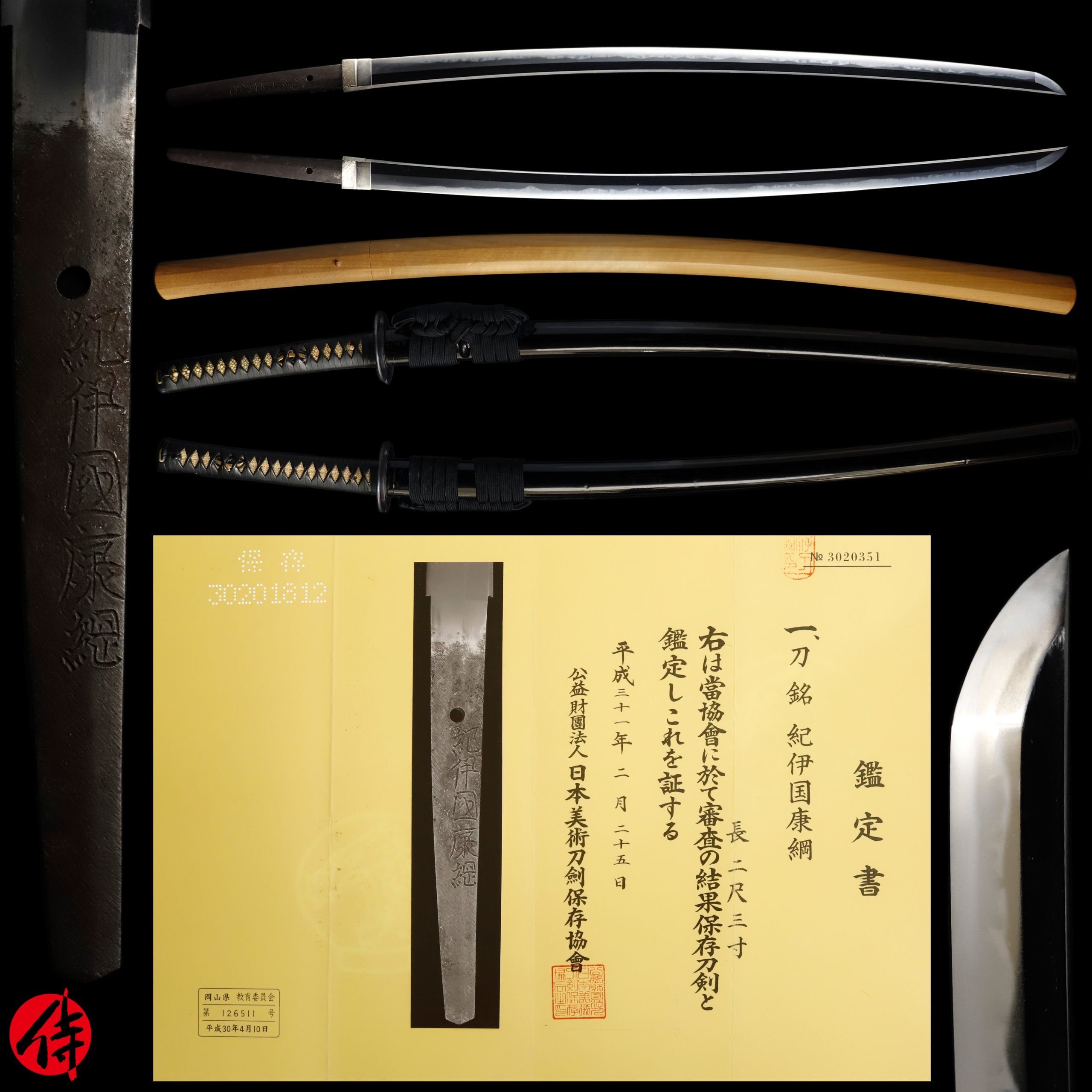
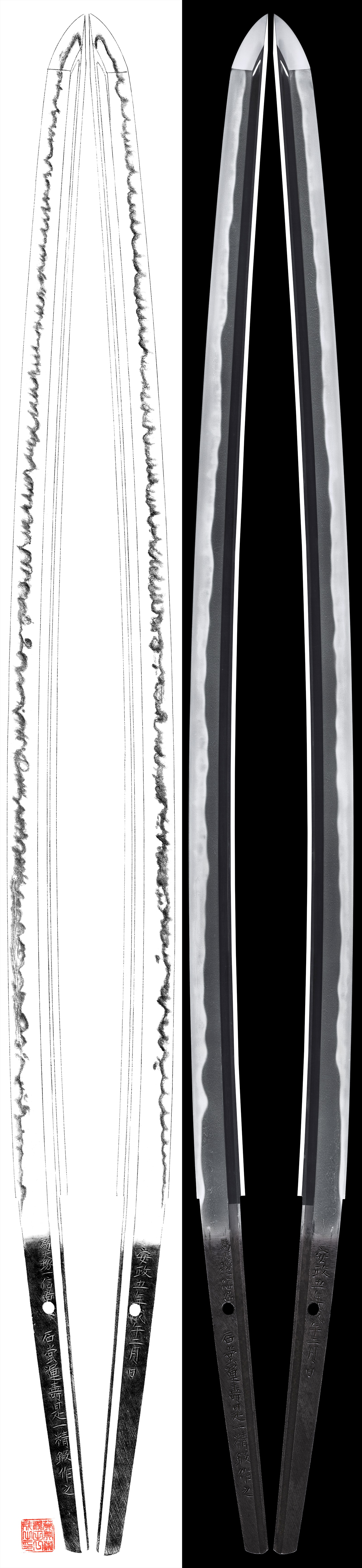
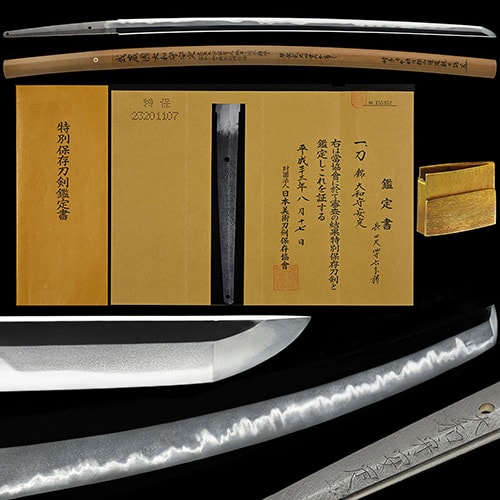
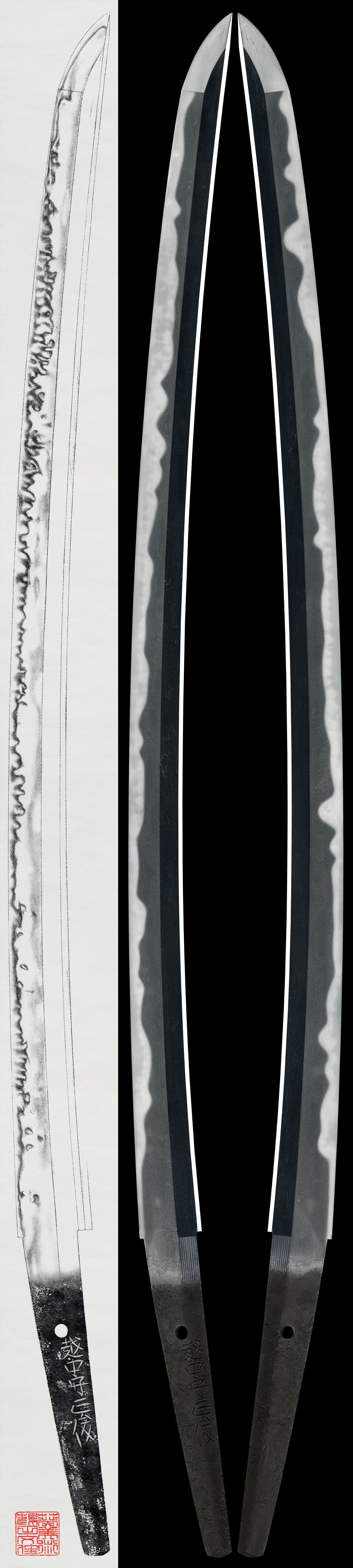
The Ishido school (石堂) traces its root to Omi Province, where smiths surnamed Hioki and bearing names such as Ishido worked before the line dispersed across the country in the early Edo period. From that Omi stem grew four principal branches: the Fukuoka Ishido of Chikuzen, the Edo Ishido carried east by makers who had first gone up from Omi to Kyoto, the Osaka Ishido seeded by smiths who settled in the merchant city, and the Kishu Ishido working under the Kii daimyo. What bound these scattered workshops was a single, deliberate program: the recovery of the choji-midare of the old Ichimonji and Ko-Bizen, complete with the utsuri that the medieval Bizen masters had carried in their steel. The school's very name records this revival as a historical project rather than an imitation, for its smiths set out to recover the bright, reflection-bearing Bizen jigane that most shinto makers of the seventeenth century could no longer produce. Korekazu, Tsunemitsu, Moritsugu, and Tameyasu stand among the names by which the branches are known, alongside Bicchu no Kami Yasuhiro, who bridged the Kishu and Osaka lines, and Tatara Nagayuki of Osaka. The shared vocabulary of the school begins with the temper. Over a tightly forged itame, often a well-packed ko-itame mixing mokume and a little nagare-hada, the Ishido smiths cut a choji-midare crowded with double-flower juka-choji, fukuro-choji, large and small choji, gunome, and pointed elements, so the line shows pronounced height as it crests and falls. Ashi and yo enter in profusion, the work turning nioi-dominant with attached ko-nie, sunagashi running through and kinsuji appearing here and there. Beneath sits the surer half of the recognition: a well-forged itame carrying ji-nie in minute particles, across which stands a midare-utsuri.
Utsuri on a new-sword blade is rare and deliberate, and its recovery was the school's whole purpose, so a flamboyant choji standing over a clear irregular reflection is the first thing that separates an Ishido blade from any other shinto choji. The published sources name the school's two Bizen models directly: the Ichimonji-copy choji-midare and the Sue-Bizen-copy gunome with an opened lower contour, both worked in nioi-deki. Within these constants the branches diverge. Tsunemitsu of the Edo group holds his bright, height-varied juka-choji over a vividly standing reflection across every blade on record; Yasuhiro of the Kishu and Osaka lines tells himself by a saka-gokoro, a reverse slant in the choji and ashi most marked in his early work, and by the chrysanthemum crest of his titled years; Nagayuki of Osaka, reckoned the leading Bizen-den hand among the shinto makers, divides cleanly between his Ichimonji choji and a gunome modeled on Yosazaemon no Jo Sukesada, the boshi entering midare-komi, pointed at the tip, and turning back deeply. To kantei an Ishido blade is to read revived Bizen choji on a shinto ground: the flamboyant clove temper above, the midare-utsuri standing below, but a jigane whose nie and forging belong unmistakably to the new-sword period rather than to any true koto reflection. The recurring verdict the judges return to is that the best work recalls the old Ichimonji of classical times, brought vividly to mind by Tsunemitsu's Edo pieces in particular. Among the school's members the first-rank names carry the recognition: Korekazu and his fellows of the Fukuoka and Edo branches, Tsunemitsu by his standing utsuri and juka-choji, Yasuhiro at the junction of two branches, and Nagayuki at the head of the Bizen-den shinto hands. Provenance attaches to a portion of the school's record; Yasuhiro's broad pre-title wakizashi was transmitted in the Shimazu house of Satsuma, and one of his katana is recorded in the Imperial collection, while much of the wider Ishido output sits in the Juyo tier, more often kept than traded. A securely signed Ishido blade, showing the bright clove over a standing reflection, remains the document of how a shinto school brought the old Ichimonji choji back to life. Learn more →