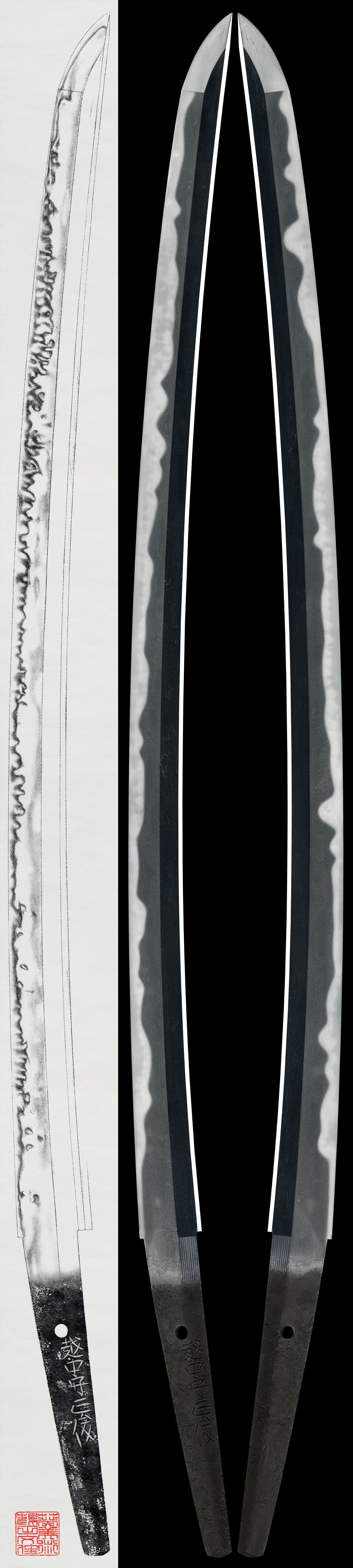
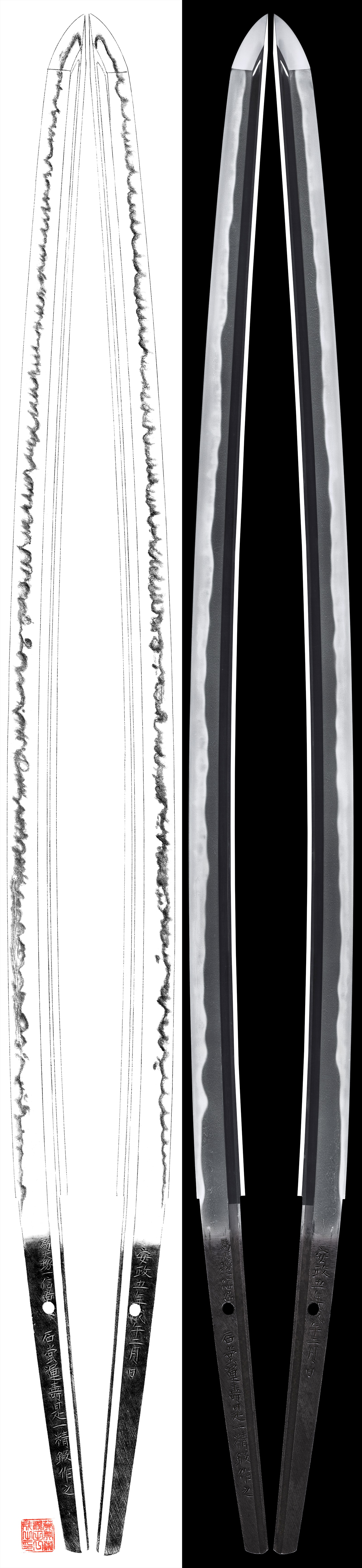
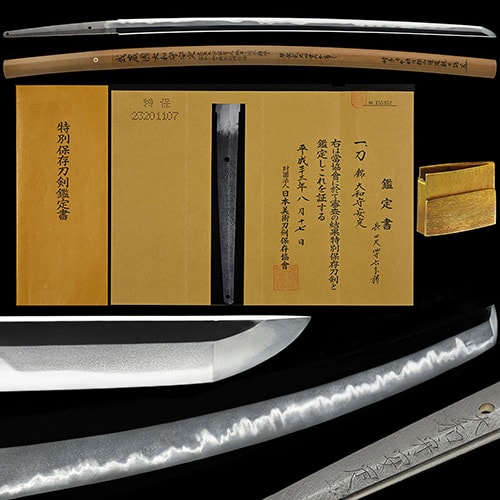
Ishido Unju Korekazu (石堂運寿是一), commonly known as Masataro, was a nephew of Kato Chounsai Tsunatoshi. He first studied the craft of swordmaking under Tsunatoshi, and later succeeded as the seventh-generation head of the Ishido line, thereafter taking the name Korekazu. He served the Yonezawa domain in Uzen Province and cut signatures such as "Ishido Unju Korekazu Seitan ," "Ishido Fujiwara Korekazu Seitan," and "Fujiwara Korekazu Seitan." He died in Meiji 24 (1891) at the age of seventy-five. The Ishido house traces its origins to Daijo Koreichi, who was born in Ishido Village, Gamo District, Omi Province, later went to , and is regarded as the founder of the Ishido line; together with smiths such as Hioki Kohei and Tsunemitsu, he greatly enhanced the reputation of the school. As one of the leading masters among smiths, Korekazu stood shoulder to shoulder in skill with such figures as Jirotaro Naokatsu and Hosokawa Masayoshi.
Korekazu's works may broadly be divided into two modes — - and - — yet his true strength lay in the tradition, which the calls "the hereditary specialty of the Ishido house." His characteristically display wide with thick and a sense of , often with shallow and extended . The shows tightly forged or mixed with , with thickly formed, extremely fine and plentiful fine , producing a refined yet textured surface; may stand out prominently. The is a flamboyant mixed with , , , , and -style elements, with vigorously entering ; the is deep and adheres well, with areas of kogo-ri where slightly coarser is mixed in. runs strongly, long and appear, and the is notably bright and clear. The enters with , turning back in with , at times showing a slightly pointed tendency. Critically, whereas many -period smiths producing -style blades tempered in , Korekazu instead produced them in — a distinction in which the perceives his originality.
It is precisely through this that the individuality of Korekazu is displayed: the temper is brilliantly irregular, the deep, and the and richly covered in while incorporating coarser ; within the temper, and stand out, and the is bright and clear, lending his works "an exceptional strength and a spirited, forceful presence." The handling of the sometimes reveals mannerisms associated with his master Tsunatoshi, from which one may infer the stylistic relationship between teacher and student. His rarer works in a gentle, restrained -based mode — with deep , abundant , and a bright — demonstrate the full breadth of his ability within the Ishido house tradition.