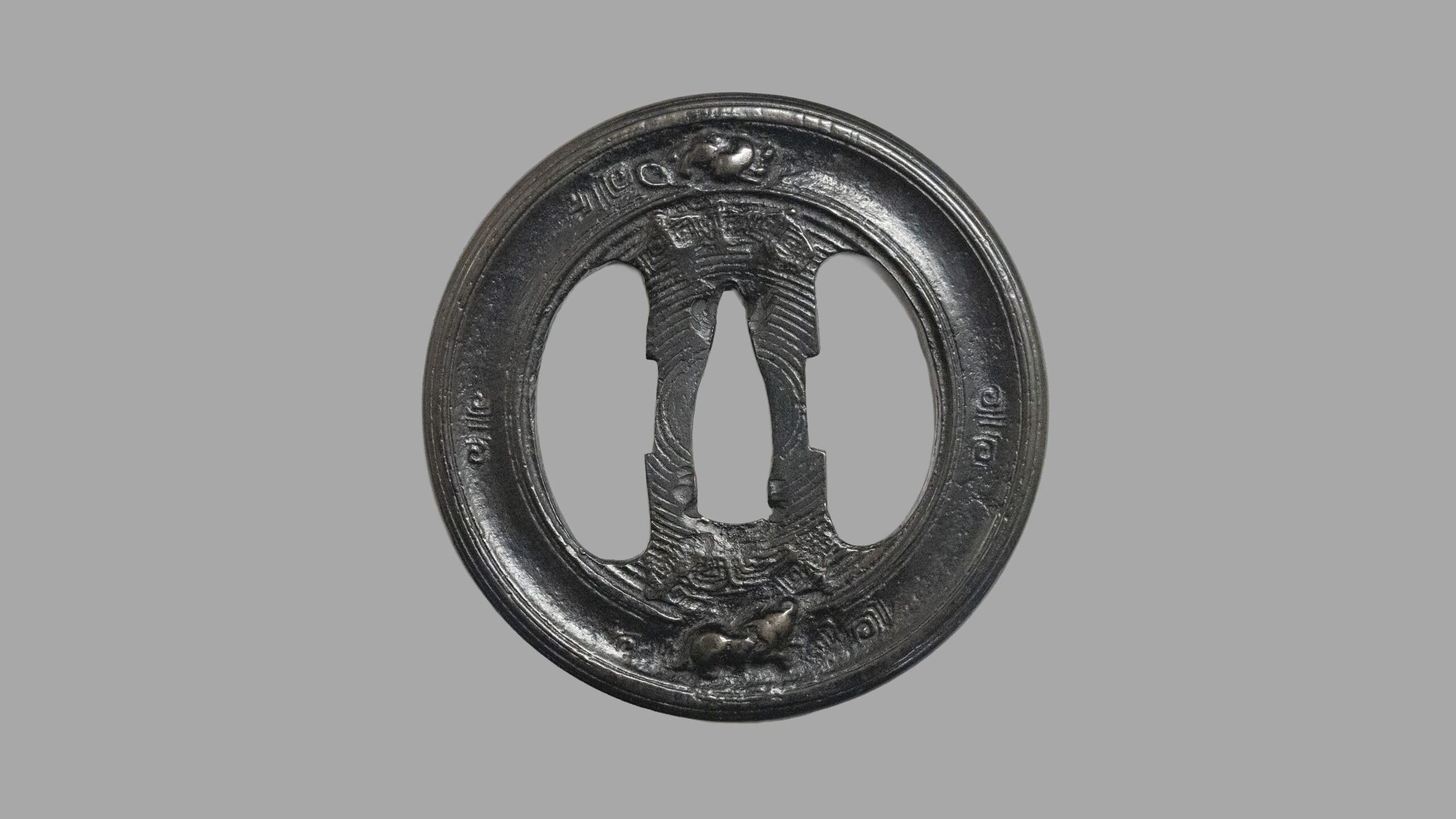
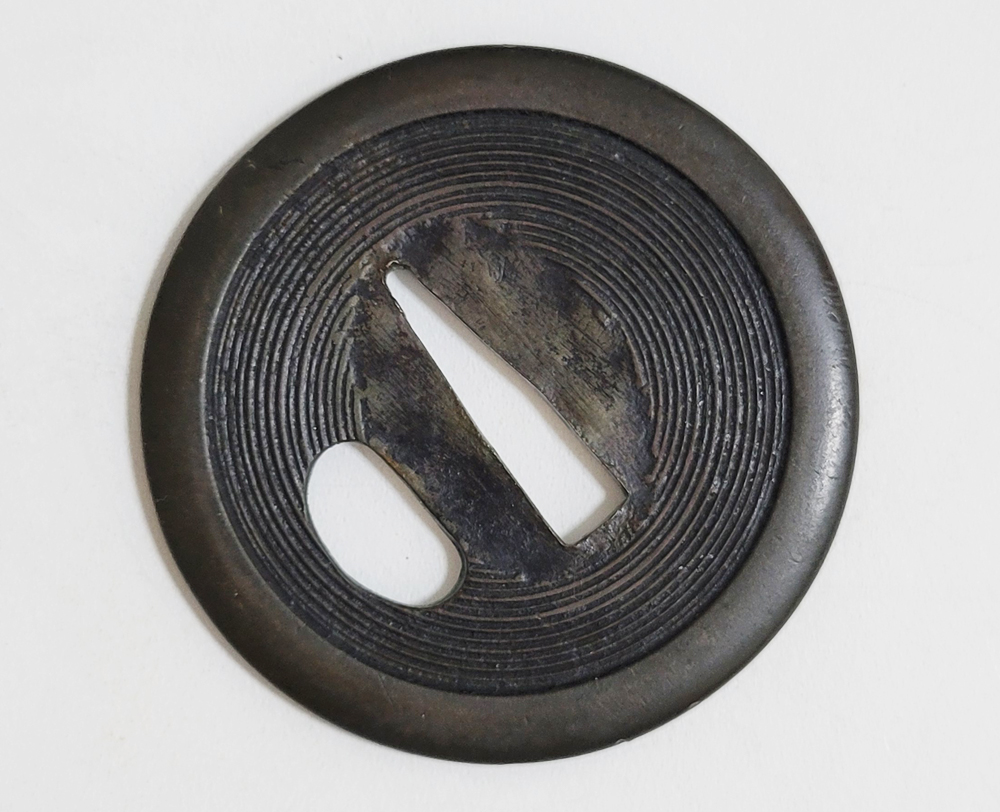
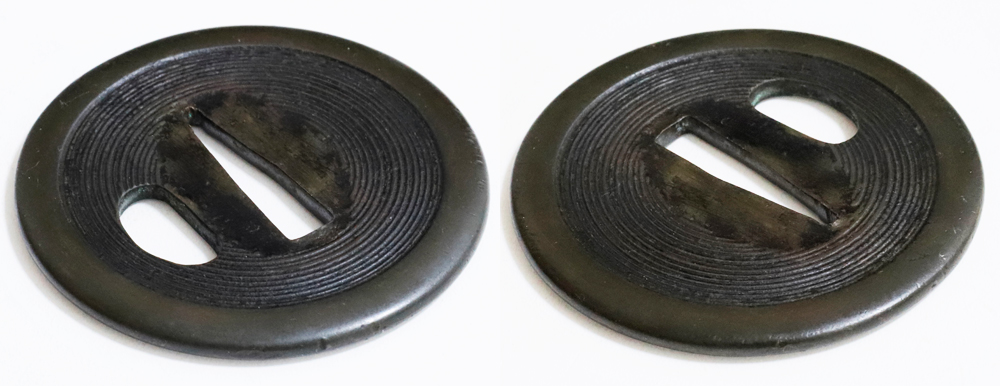
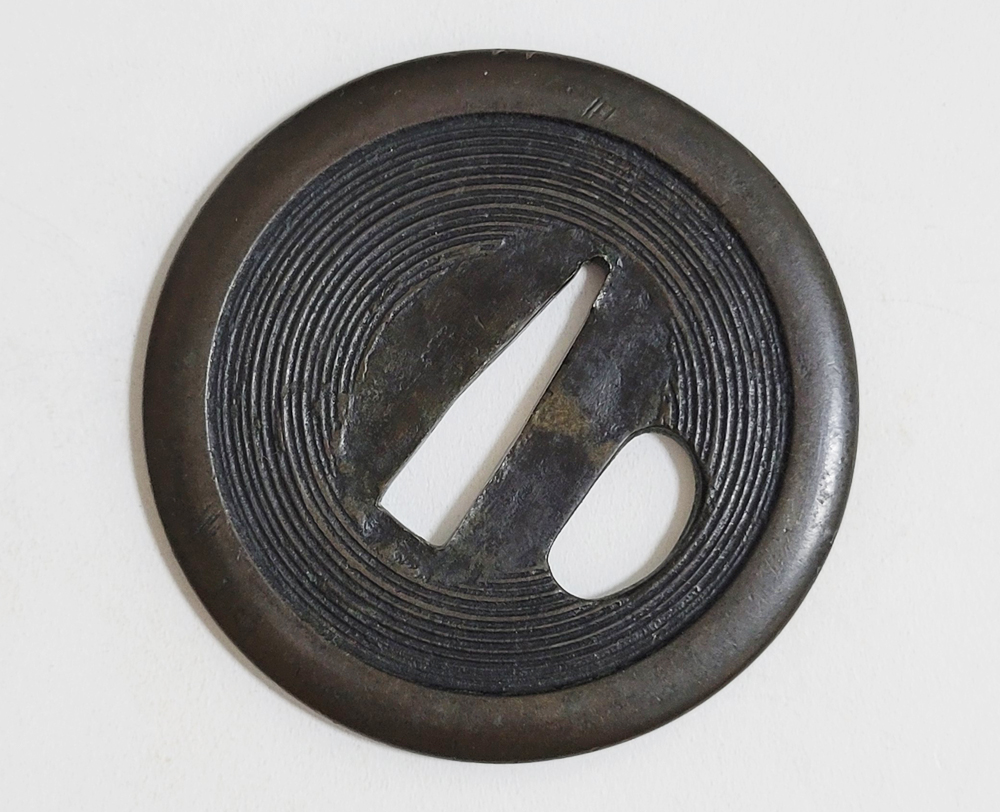
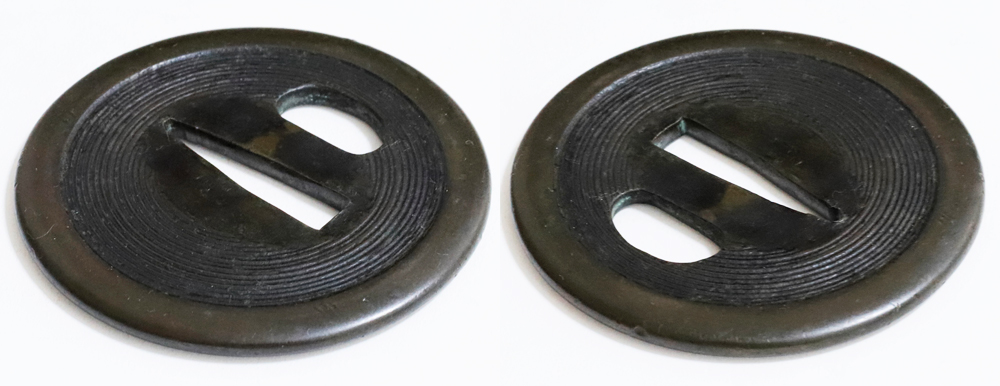
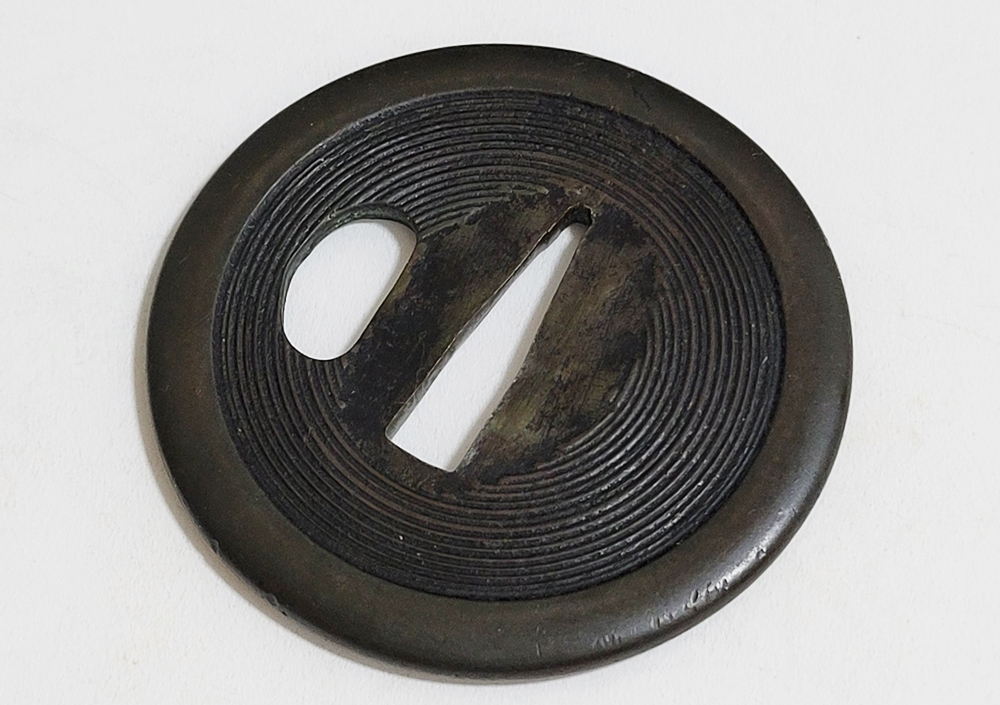
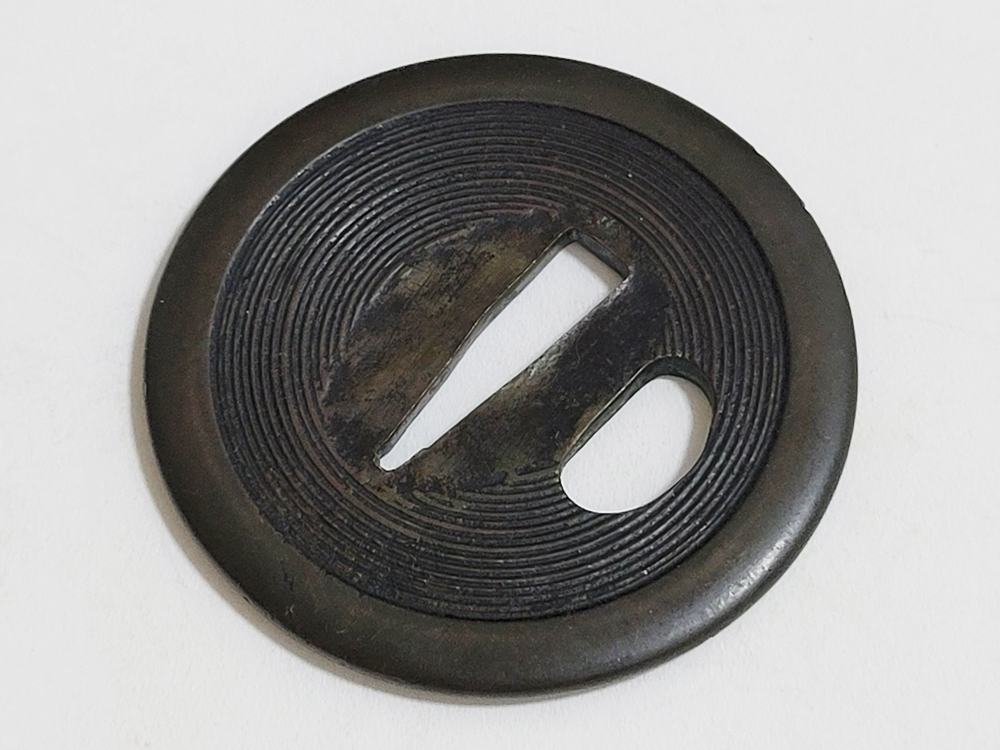
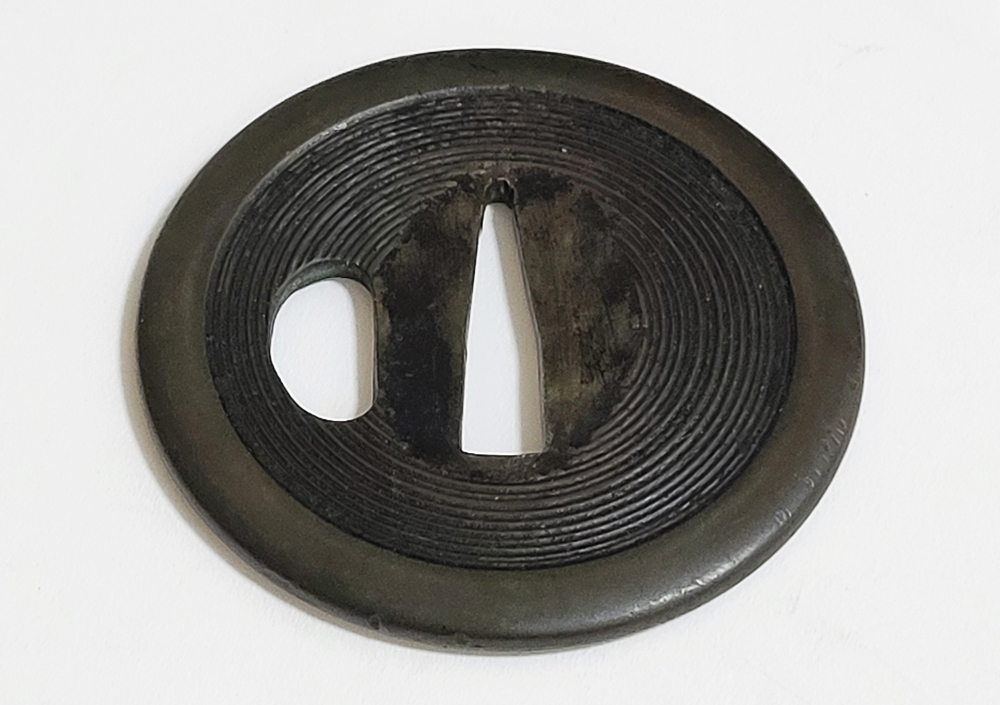
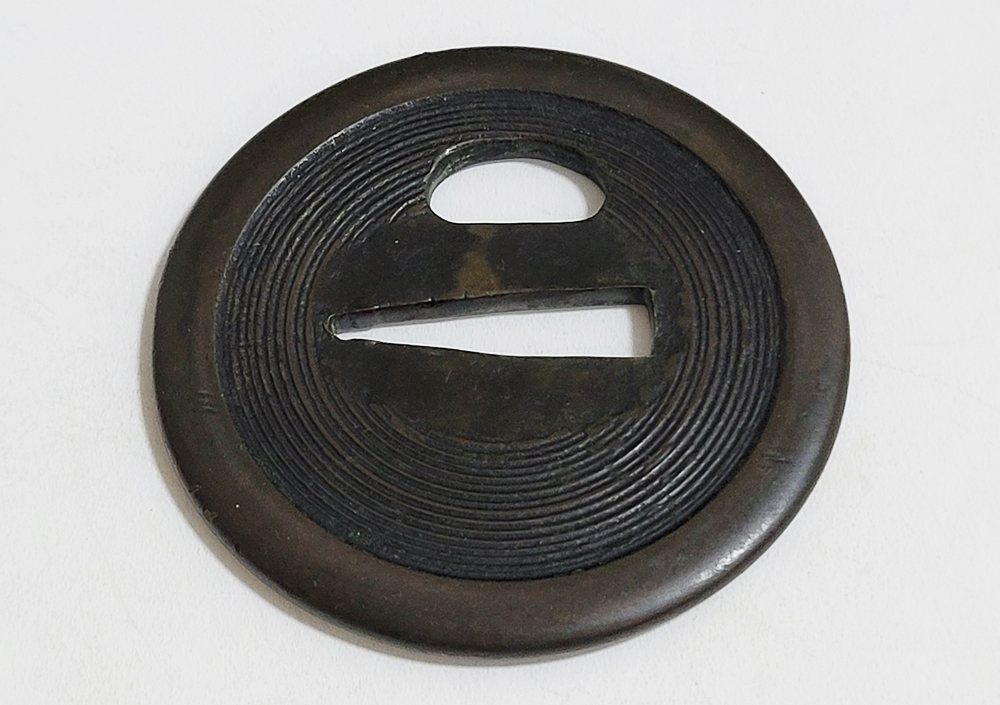
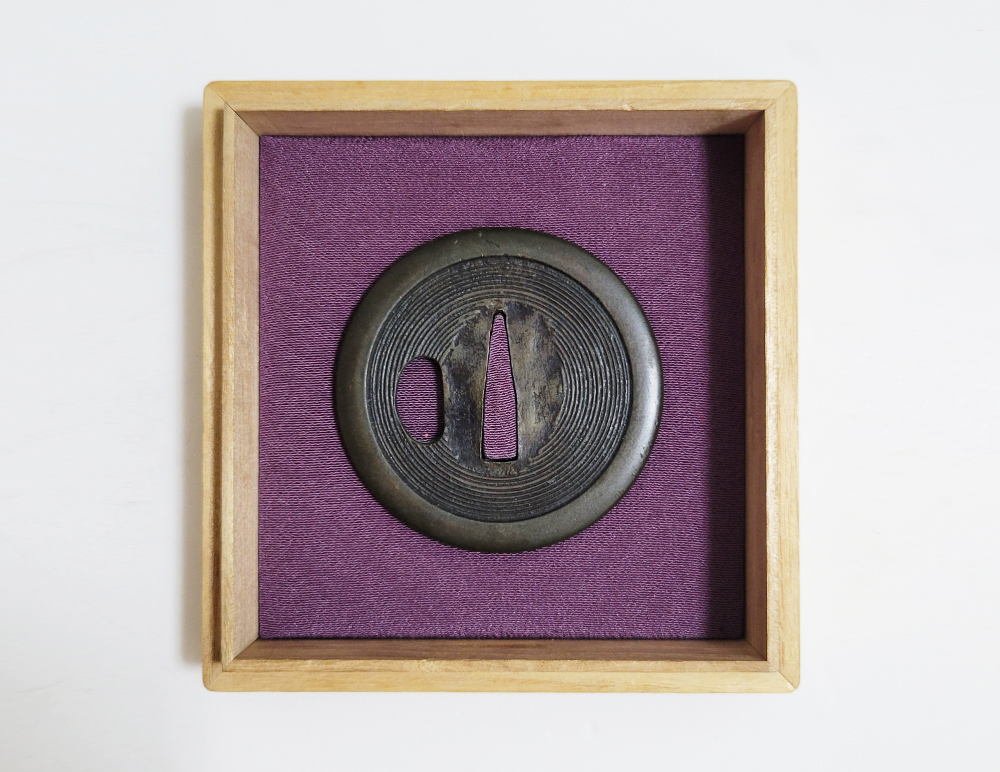
This is an Ensozu tsuba attributed to Kagami-shi. Kagami-shi tsuba are made of yamagane (crude copper) and are named for their designs resembling Japanese mirrors. Due to their copper construction, they are not robust and are believed to have been made for ceremonial use rather than combat. This piece is from the Momoyama period, with a charmingly archaic feel.
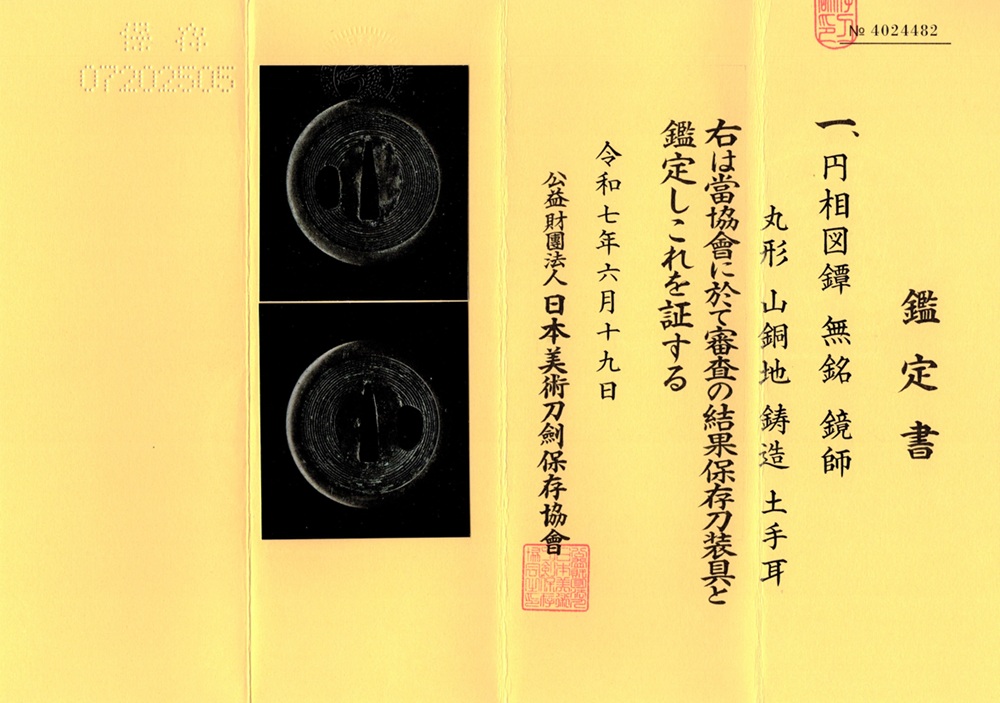
Certificate reading — 無銘(鏡師)
 NihontoWatch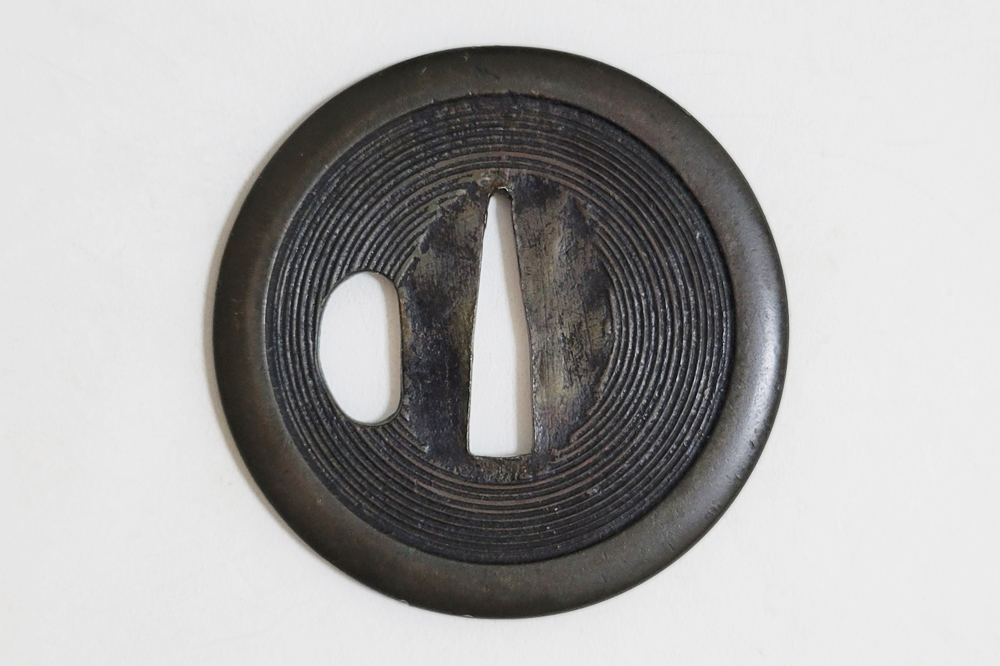
Kinko
The tsuba traditionally attributed to kagamishi (mirror makers) form a distinctive category within the Muromachi-period tosogu canon. "[[c:2]] The attribution thus reflects a longstanding connoisseurial convention rather than documented workshop provenance, linking these pieces to the mirror-making craft through perceived affinities in casting technique and formal vocabulary. " The kagamishi-attributed tsuba share a coherent technical and aesthetic profile. All are maru-gata (round) in form, executed on yamagane or brass (shinchu) grounds. Their primary technique is cast relief -- sukidashi-takabori (modeled raised relief) and uchidashi (repousse) -- sometimes finished with supplementary chisel work (tagane) or kebori line engraving over the casting. Rims frequently employ the dote-mimi (raised bank rim), which itself may carry cast floral-pattern motifs in relief.
The decorative repertoire draws on heraldic and geometric vocabulary: chrysanthemum crests (kikuka), paulownia crests (kiri-mon) in unconventional arrangements, lattice patterns (koshi) enclosing peony blossoms, and scattered tortoise-shell and whirlpool motifs (kikko-uzumaki mon chirashi). Construction ranges from single-plate (ichimai) to two-plate (nimai-awase) assembly. " The NBTHK assessments accord these pieces a measured but genuine esteem. The workmanship is judged "excellent," and the chrysanthemum-crest tsuba is singled out as possessing "a particular elegance"[[c:3]] and being "well made"[[c:4]] among works of similar taste. " Though the question of actual kagamishi authorship remains open, the designation itself attests to the recognition that these cast-relief tsuba occupy a place apart from the mainstream tosho and katchushi traditions -- works of considerable age whose bold, large-format compositions and distinctive casting idiom constitute an important chapter in the study of early tosogu production. Learn more →
Certifies a genuine fitting worth preserving: a correct signature, or, if unsigned, an identifiable era and school, with recognized artistic and craft value.
The NBTHK (Nihon Bijutsu Tōken Hozon Kyōkai, the Society for the Preservation of Japanese Art Swords) is a public-interest incorporated foundation founded in 1948 and supervised by Japan’s Agency for Cultural Affairs (Bunkachō); it is based at the Japanese Sword Museum in Tokyo. Its expert panels physically examine each submitted work (shinsa) and issue a certificate (kanteishō) ranking it by artistic and historical merit. NBTHK papers are the most widely recognized standard of authentication for Japanese swords and fittings.
NBTHK official siteDomestic: items may be returned within 7 days in original condition for a full refund (buyer covers transport). Overseas orders: no-refunds, no-returns.
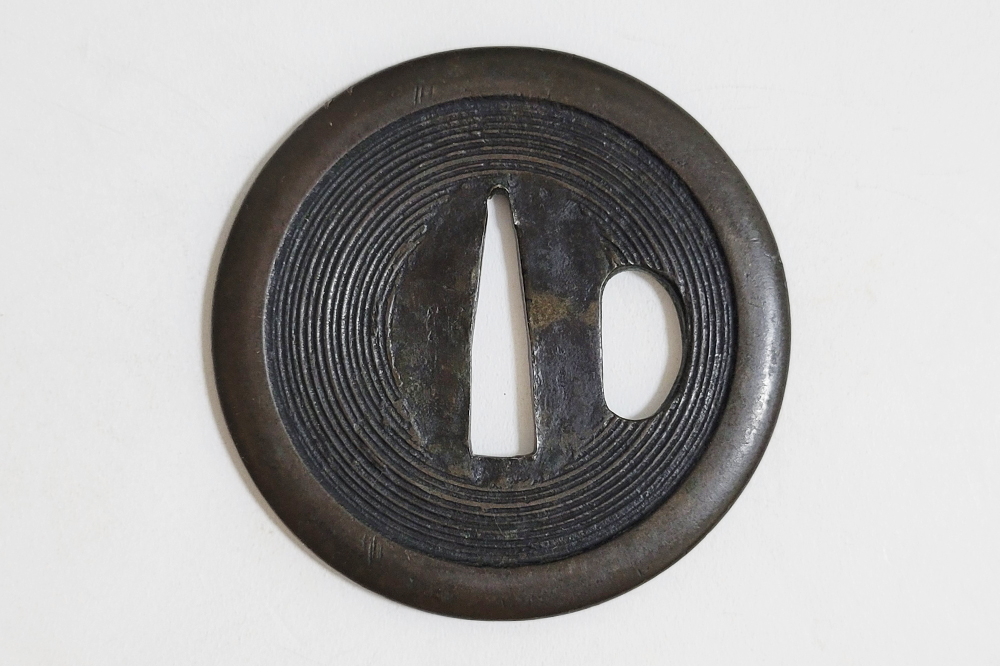
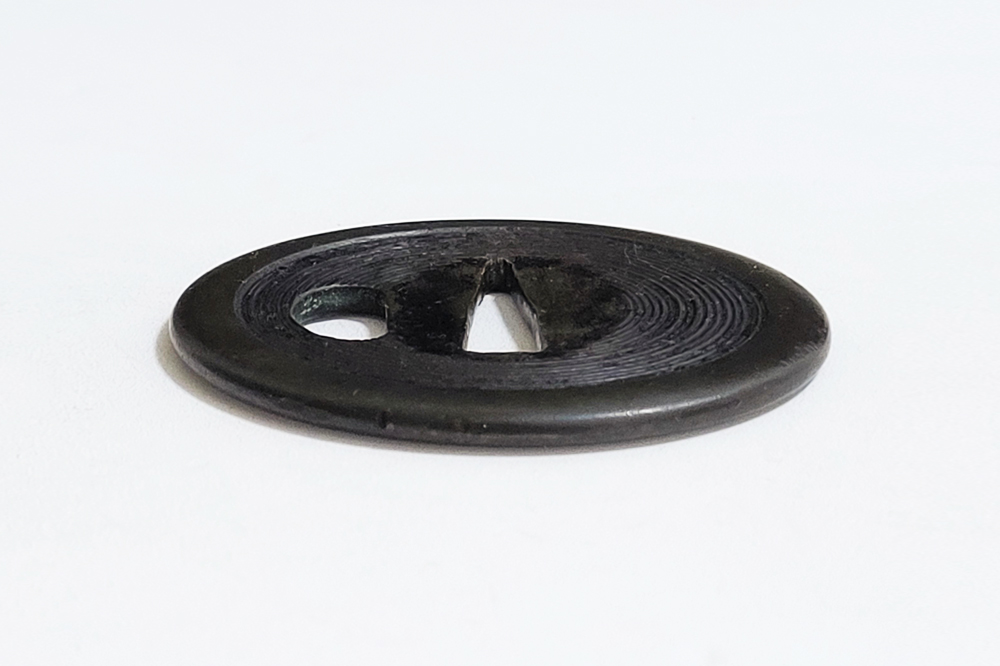
This is an Ensozu tsuba attributed to Kagami-shi. Kagami-shi tsuba are made of yamagane (crude copper) and are named for their designs resembling Japanese mirrors. Due to their copper construction, they are not robust and are believed to have been made for ceremonial use rather than combat. This piece is from the Momoyama period, with a charmingly archaic feel.
Certificate reading — 無銘(鏡師)
NihontoWatchKinko
The tsuba traditionally attributed to kagamishi (mirror makers) form a distinctive category within the Muromachi-period tosogu canon. "[[c:2]] The attribution thus reflects a longstanding connoisseurial convention rather than documented workshop provenance, linking these pieces to the mirror-making craft through perceived affinities in casting technique and formal vocabulary. " The kagamishi-attributed tsuba share a coherent technical and aesthetic profile. All are maru-gata (round) in form, executed on yamagane or brass (shinchu) grounds. Their primary technique is cast relief -- sukidashi-takabori (modeled raised relief) and uchidashi (repousse) -- sometimes finished with supplementary chisel work (tagane) or kebori line engraving over the casting. Rims frequently employ the dote-mimi (raised bank rim), which itself may carry cast floral-pattern motifs in relief.
The decorative repertoire draws on heraldic and geometric vocabulary: chrysanthemum crests (kikuka), paulownia crests (kiri-mon) in unconventional arrangements, lattice patterns (koshi) enclosing peony blossoms, and scattered tortoise-shell and whirlpool motifs (kikko-uzumaki mon chirashi). Construction ranges from single-plate (ichimai) to two-plate (nimai-awase) assembly. " The NBTHK assessments accord these pieces a measured but genuine esteem. The workmanship is judged "excellent," and the chrysanthemum-crest tsuba is singled out as possessing "a particular elegance"[[c:3]] and being "well made"[[c:4]] among works of similar taste. " Though the question of actual kagamishi authorship remains open, the designation itself attests to the recognition that these cast-relief tsuba occupy a place apart from the mainstream tosho and katchushi traditions -- works of considerable age whose bold, large-format compositions and distinctive casting idiom constitute an important chapter in the study of early tosogu production. Learn more →
Certifies a genuine fitting worth preserving: a correct signature, or, if unsigned, an identifiable era and school, with recognized artistic and craft value.
The NBTHK (Nihon Bijutsu Tōken Hozon Kyōkai, the Society for the Preservation of Japanese Art Swords) is a public-interest incorporated foundation founded in 1948 and supervised by Japan’s Agency for Cultural Affairs (Bunkachō); it is based at the Japanese Sword Museum in Tokyo. Its expert panels physically examine each submitted work (shinsa) and issue a certificate (kanteishō) ranking it by artistic and historical merit. NBTHK papers are the most widely recognized standard of authentication for Japanese swords and fittings.
NBTHK official siteDomestic: items may be returned within 7 days in original condition for a full refund (buyer covers transport). Overseas orders: no-refunds, no-returns.