The Takada school is said to have originated with Tomoyuki, who resided in Takada-no-sho, Bungo-no-kuni during the Nanbokucho period, and it formed a major school by harboring many swordsmiths from the Muromachi period through the Edo period. Many swordsmiths of this school use the characters "Shizu," "Yuki," or "Mune" in their names, and prominent smiths include Muneyuki, Munekage, Yukinaga, Shigeyuki, Sadayuki, Masayuki, Tadayuki, Teruyuki, Yukimitsu, and Toyomasa. Since many Takada swordsmiths of the Muromachi period prefixed their mei with the "Taira" surname, and those of the Edo period with the "Fujiwara" surname, works from the Muromachi period are generally called "Taira-Takada" and works from the Edo period are called "Fujiwara-Takada" to distinguish them. Takada Yukinaga is a swordsmith of the same province's Takada school who was active from around the Keicho era to around the Manji era. Although his rank among swordsmiths is Shinto Chujo-saku, his works have an established reputation for sharpness, and he is ranked as a Wazamono among the Ryowazamono. Other variations of his mei include "Hoshu Takada-ju Fujiwara Yukinaga" and "Fujiwara Yukinaga."
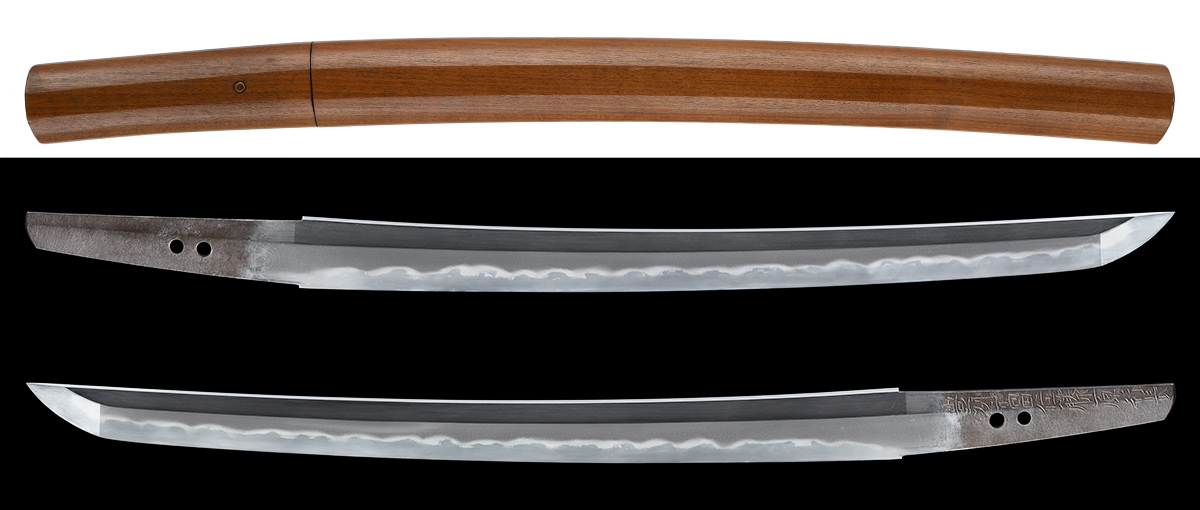
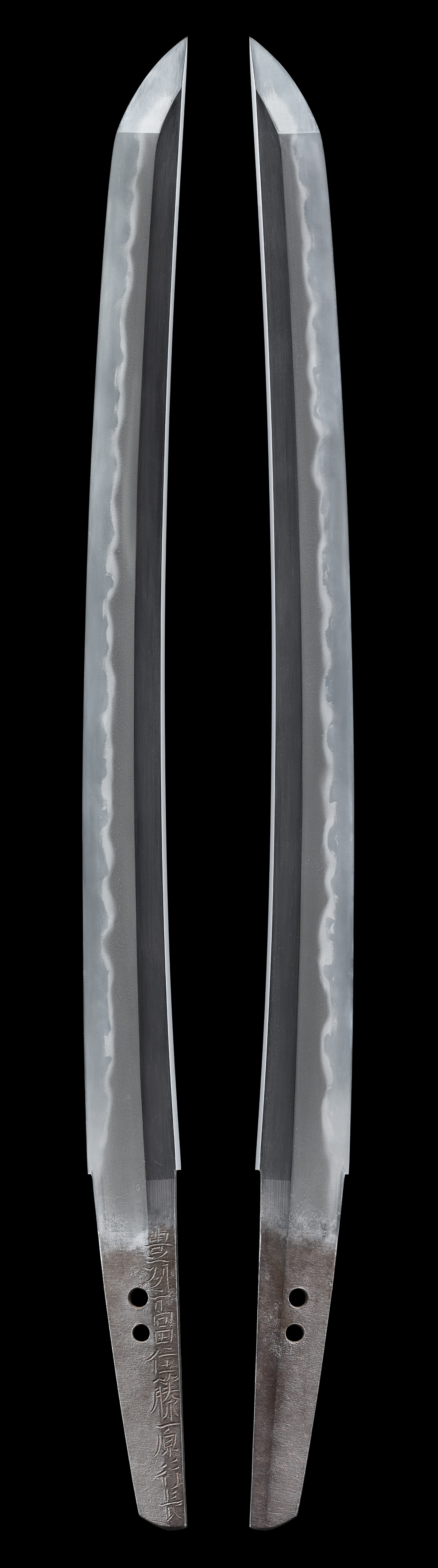
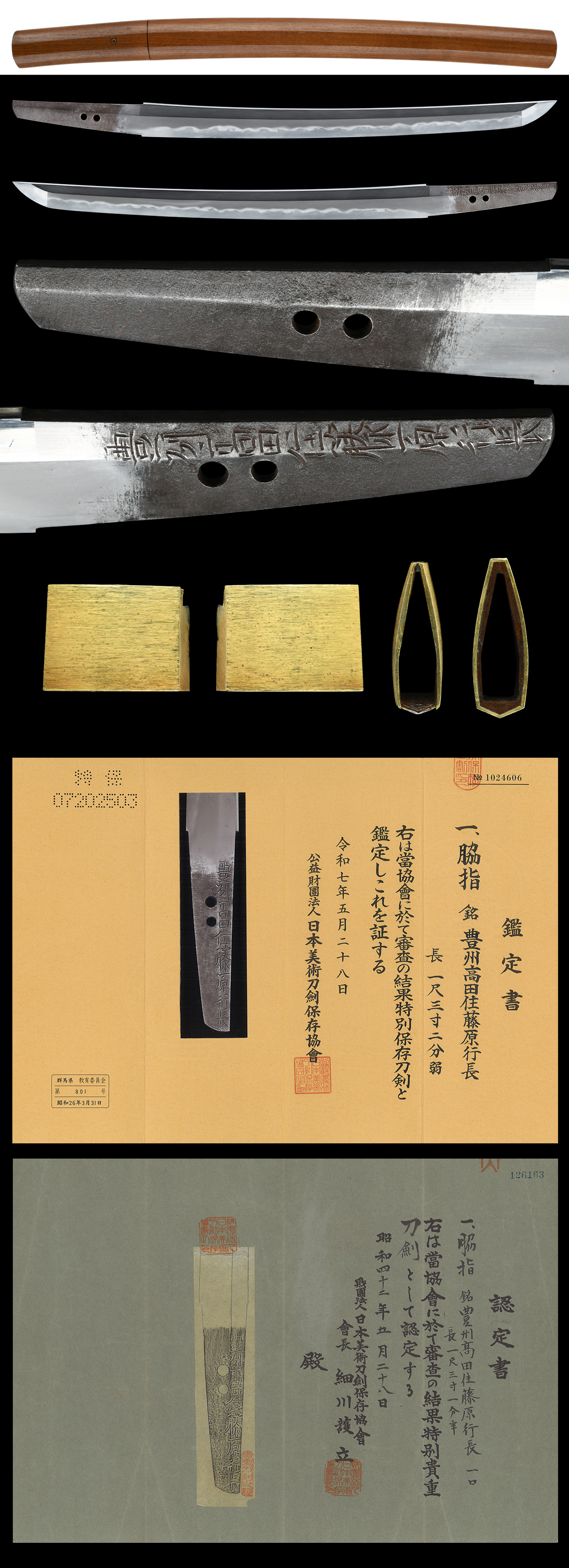
The sugata of this work has a nagasa of just under 1 shaku 3 sun 2 bu, with a wide mihaba, thick kasane, and hiraniku, featuring a sharp shinogi-suji and a chu-kissaki, making it a robust sword. The kitae is itame-hada that is well-kneaded and dense, with ji-nie attached. The hamon is gunome mixed with angular blades, with a nioiguchi that is slightly tight and bright and clear. Inside the blade, ashi and yo appear and are active. The boshi continues as midare-komi and turns back in a saki-ko-maru. The nakago is finished with katte-sagari yasurime, and the swordsmith mei is inscribed. This is a work by the Bungo-no-kuni Takada school swordsmith Fujiwara Yukinaga. It is an excellent sword with a robust and powerful sugata, forged without any flaws in the ji or ha. Shirasaya, gold-plated single-layer habaki, Tokubetsu Hozon Token kanteisho.
Machine translation from the shop's Japanese · may contain errors ·
The Takada school is said to have originated with Tomoyuki, who resided in Takada-no-sho, Bungo-no-kuni during the Nanbokucho period, and it formed a major school by harboring many swordsmiths from the Muromachi period through the Edo period. Many swordsmiths of this school use the characters "Shizu," "Yuki," or "Mune" in their names, and prominent smiths include Muneyuki, Munekage, Yukinaga, Shigeyuki, Sadayuki, Masayuki, Tadayuki, Teruyuki, Yukimitsu, and Toyomasa. Since many Takada swordsmiths of the Muromachi period prefixed their mei with the "Taira" surname, and those of the Edo period with the "Fujiwara" surname, works from the Muromachi period are generally called "Taira-Takada" and works from the Edo period are called "Fujiwara-Takada" to distinguish them. Takada Yukinaga is a swordsmith of the same province's Takada school who was active from around the Keicho era to around the Manji era. Although his rank among swordsmiths is Shinto Chujo-saku, his works have an established reputation for sharpness, and he is ranked as a Wazamono among the Ryowazamono. Other variations of his mei include "Hoshu Takada-ju Fujiwara Yukinaga" and "Fujiwara Yukinaga."
The sugata of this work has a nagasa of just under 1 shaku 3 sun 2 bu, with a wide mihaba, thick kasane, and hiraniku, featuring a sharp shinogi-suji and a chu-kissaki, making it a robust sword. The kitae is itame-hada that is well-kneaded and dense, with ji-nie attached. The hamon is gunome mixed with angular blades, with a nioiguchi that is slightly tight and bright and clear. Inside the blade, ashi and yo appear and are active. The boshi continues as midare-komi and turns back in a saki-ko-maru. The nakago is finished with katte-sagari yasurime, and the swordsmith mei is inscribed. This is a work by the Bungo-no-kuni Takada school swordsmith Fujiwara Yukinaga. It is an excellent sword with a robust and powerful sugata, forged without any flaws in the ji or ha. Shirasaya, gold-plated single-layer habaki, Tokubetsu Hozon Token kanteisho.
For two and a half centuries of peace the sword was the warrior’s legal badge rather than his weapon. Each great city developed its own manner, Edo’s tested strength against Ōsaka’s polished brilliance, until demand thinned in the era’s last decades.
A Hozon-certified blade judged to show notably superior workmanship and a better state of preservation. The bar is higher: re-tempered blades and most unsigned Muromachi/Edo works are excluded.
About the NBTHK›
The NBTHK (Nihon Bijutsu Tōken Hozon Kyōkai, the Society for the Preservation of Japanese Art Swords) is a public-interest incorporated foundation founded in 1948 and supervised by Japan’s Agency for Cultural Affairs (Bunkachō); it is based at the Japanese Sword Museum in Tokyo. Its expert panels physically examine each submitted work (shinsa) and issue a certificate (kanteishō) ranking it by artistic and historical merit. NBTHK papers are the most widely recognized standard of authentication for Japanese swords and fittings.
No cooling-off period or returns; refund only if the purchased sword is proven fake, capped at purchase price (excludes commission sales, accessories, auction items).

 NihontoWatch