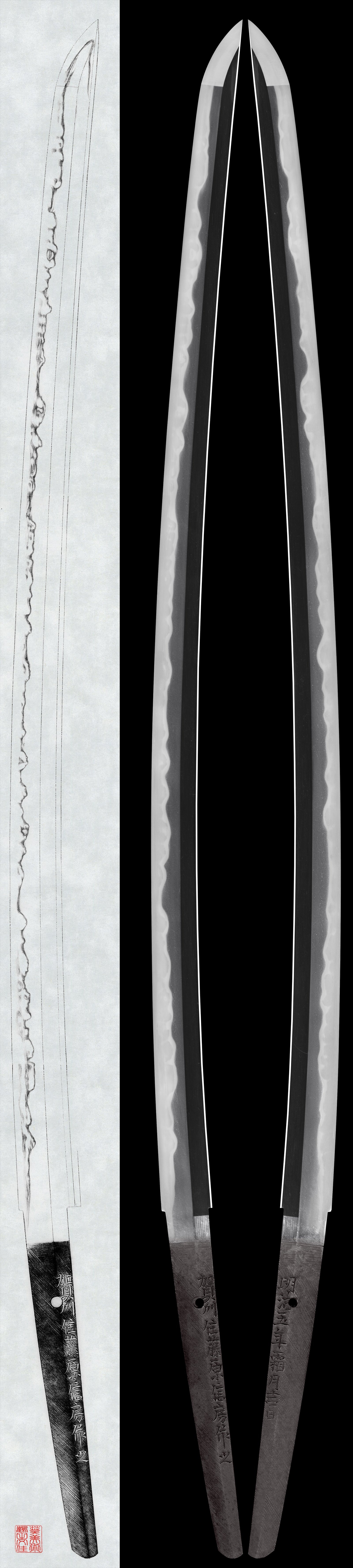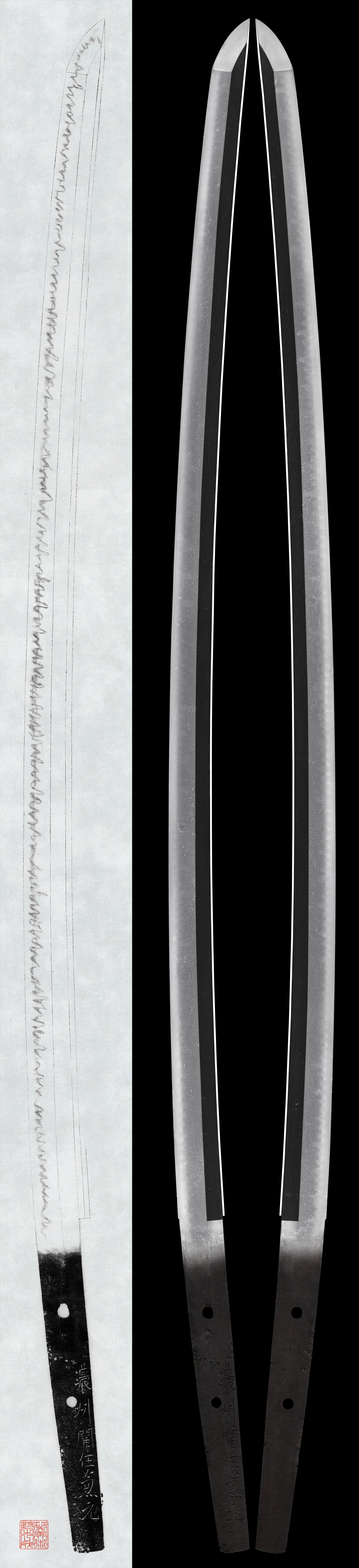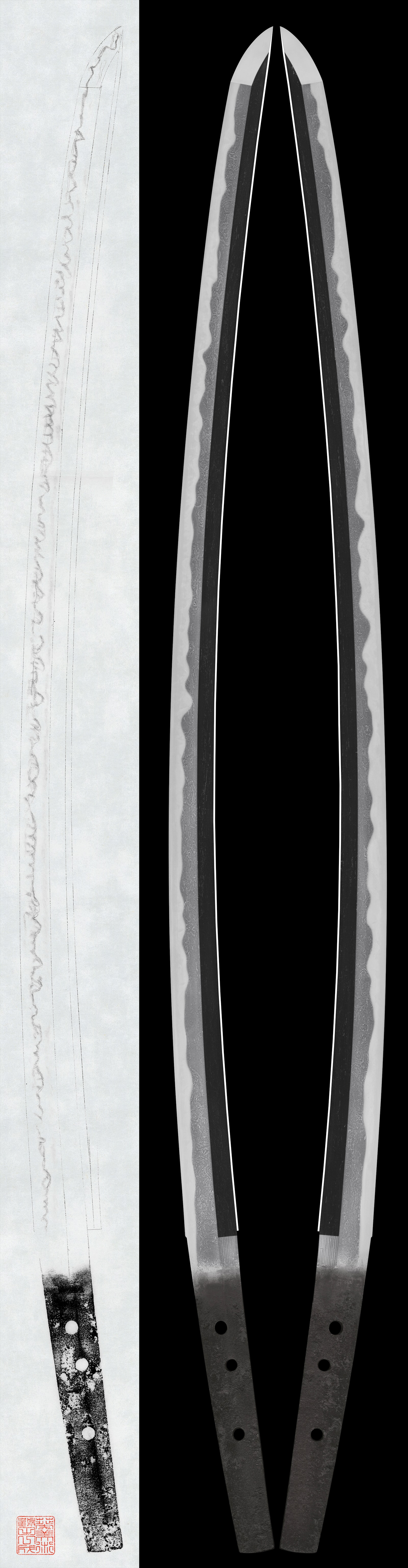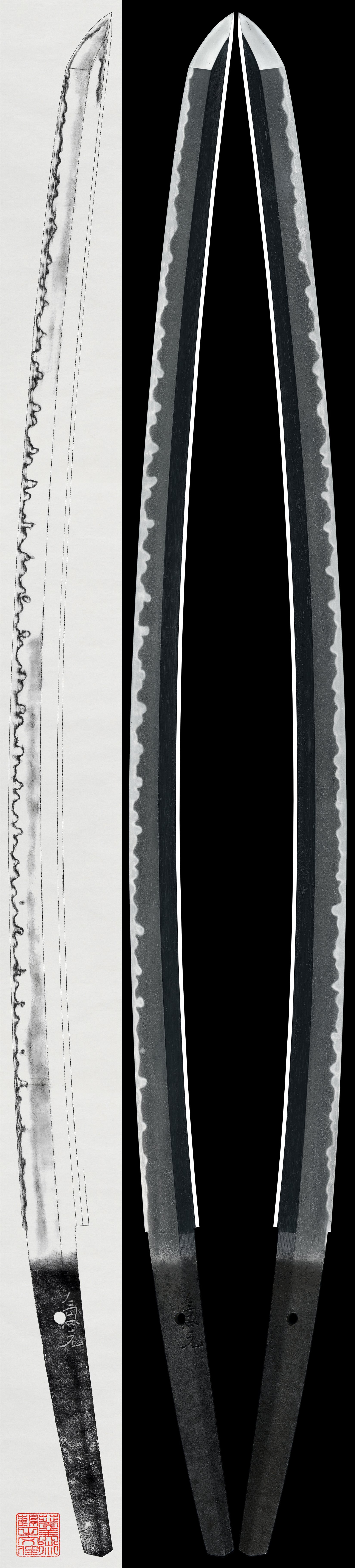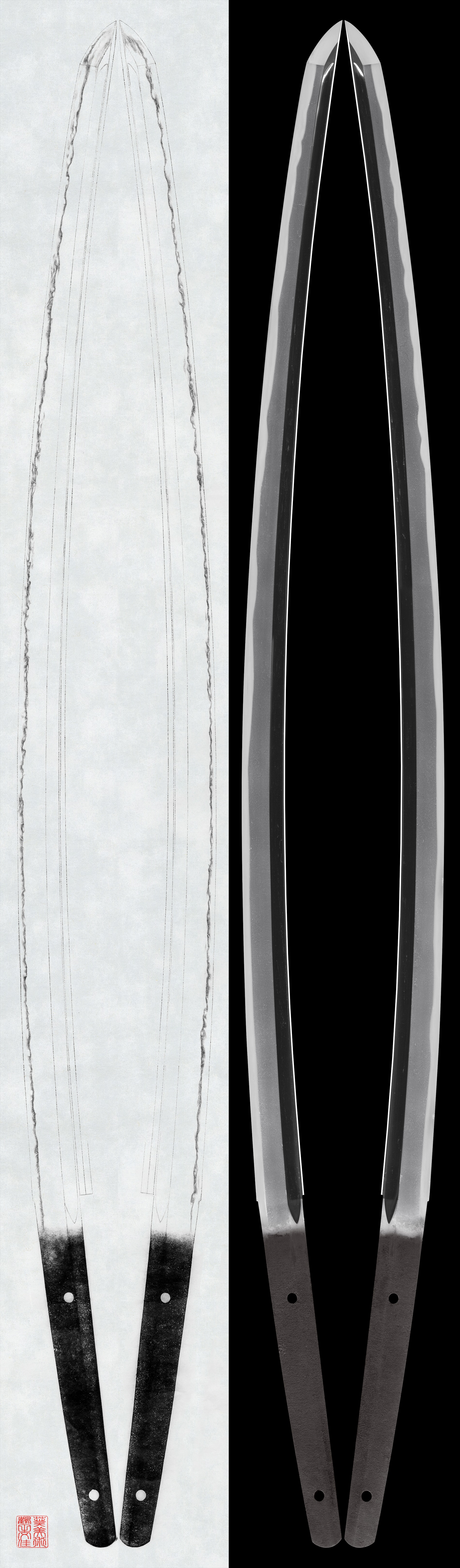
刀:無銘(末左・大左一門)(特別保存刀剣)(拵え:保存刀装具)
SOLD
Tracked across 76 dealers worldwide · price history · sold archive
Specifications
72.2 cm
2.1 cm
3.06 cm
1.89 cm
About the school
Sa School左派
In Chikuzen Province, on the northern coast of Kyushu, the Sa school (左, the Samonji line) took shape in the early Nanbokucho period as a deliberate break with the Kyushu work that came before it. Its founder, the smith who cut the single character 左 on his tang, is read in the published sources as Saemon Saburo, commonly called O-Sa or Samonji; he is placed as the grandson of Sairen and son of Jitsua, the old Chikuzen line whose steel, in the words the NBTHK restates blade after blade, ran sunken and rustic in a restrained *suguha* inherited from Yamato. The Muromachi sword books count O-Sa among the pupils of Masamune, and his study under the *Soshu-den* masters of Sagami is the pivot of the school's identity: against his forebears' provincial manner he is the reformer who established a clear, unprovincial *midare*, lifting Chikuzen work to a rank it had not before held. The single-character 左 signature, often paired with 筑州住 on the reverse, became the mark of a lineage rather than one hand, and around the founder a large body of pupils formed. What the Sa smiths held in common is a steel that runs bright and clear where the older Kyushu work ran dark. The shared vocabulary is a well-knit *itame*, tight *ko-itame* on the small *tanto* and standing more open on the grand *katana*, carrying dust-fine *ji-nie* and frequent dark *chikei*, the recurring institutional verdict being that *ji* and *ha* alike run limpid and lucid, free of the whiteness or blackness of lesser Kyushu steel. Over that ground the school tempers a *Soshu-den* *notare* mixed with *gunome* and *ko-gunome*, the *nie* deep and the *nioiguchi* bright, with *ashi* and *yo* entering and fine *kinsuji* and *sunagashi* drawn through the *ha*; the *boshi* thrusts up (*tsukiage*) to a pointed tip with a long brushed return, the one structural trait the judges look to across the whole line. Within that idiom the hands diverge by degree. O-Sa stands alone for the brilliance of his bright Chikuzen *ji-nie* and forceful pointed *boshi*; among the pupils and the later Sue-Sa generations the published sources read individual registers, Yukihiro set nearest the master in refined *ko-itame*, Yasuyoshi carrying a Bizen temperament with a whitish *utsuri* that strays toward Kanemitsu, Kunihiro the boldest and highest-tempered *midare*, Yoshisada the smallest and most compact pattern, Sadayoshi and Hiroyasu the quieter *suguha*-toned manner, and Hiroyuki a continuous restrained *gunome*. The school as a whole carries the Sagami manner into Kyushu and transforms it. A collector seeks Sa-mon work for what the founder accomplished and for how legibly the school can be read. Kantei proceeds first through the ji and the point: the bright, clear *ji-nie* free of whiteness is what tells a Sa blade from its Soshu fellows when the thrusting, pointed *boshi* alone will not, and the whole record divides cleanly into signed *hira-zukuri* *tanto* of fine flowing chisel and *osuriage-mumei* *katana* papered as Den Sa or simply to the school. O-Sa's own standing is the highest the Kyushu tradition reached, a Sai-jo saku hand whose register runs from the small signed *tanto* to the wide Nanbokucho *katana* held together as one hand by that limpid *ji* and *ha*; signature works such as the Kosetsu Samonji, his only signed *tachi* to survive, and named *meibutsu* held in the Owari Tokugawa, Date, Sakai, Tachibana, and Uesugi houses anchor his place, one *katana* having passed through Hideyoshi's hands. The pupils support that standing as members of the line rather than rivals to it: a signed Yasuyoshi, Yukihiro, or Yoshisada, or a securely papered Den Sa *katana* attributed to Kunihiro, Hiroyasu, Hiroyuki, or Sadayoshi, comes to open hands only rarely, and a signed O-Sa *tanto* is a landmark of a collection when it appears. For the student of *Soshu-den*, the Sa school is the place where the Sagami manner becomes a Kyushu one, and a Sa-mon blade in private keeping is a tangible record of that transformation.