
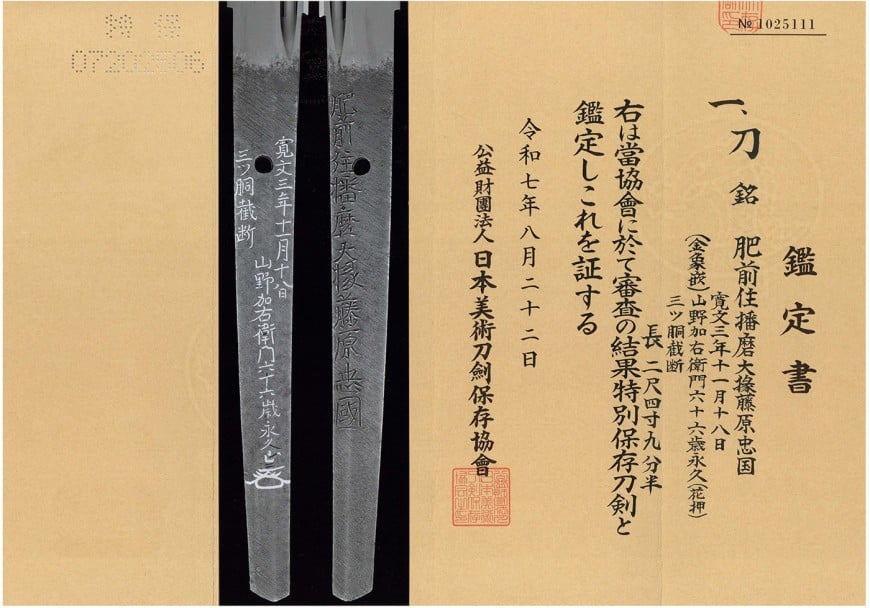
刀 肥前住播磨大掾藤原忠国 (三ツ胴金象嵌裁断銘)
SOLD
Tracked across 76 dealers worldwide · price history · sold archive
Specifications
65.9 cm
0.19 cm
3.25 cm
2.2 cm
About the maker
Hizen Tadakuni忠國
The first-generation Harima Daijo Tadakuni was the second son of Soemon Hirosada (also known as Yoshiie), who was a disciple of the first-generation Tadayoshi, and styled himself Hashimoto Rokurozaemon; his elder brother was Kunihiro. Because he shared the Hashimoto surname with Tadayoshi, it is thought they may have been of the same lineage. The earliest extant dated work bearing the title Harima Daijo is from Kan'ei 13 (1636), indicating he received that court title before that year; he was later promoted to Harima no Kami. He was retained by the Ogi domain, one of the three branch domains of the Saga Nabeshima house, and served as an Ogi-domain smith. In his later years he took tonsure and adopted the *go* Kyutetsu, with works extending into the Tenna era (1681-1684). The second-generation Tadakuni, his son, styled himself Danzaemon and initially signed Harukuni before succeeding to the name Tadakuni, with dated works spanning Enpo 5 through Jokyo 2; in the great majority of his swords he cut a chrysanthemum crest on the *omote* and a crab-and-peony crest (*kani-botan-mon*) on the *ura*, likely indicating a close connection with the Konoe family. The Tadakuni lineage is distinguished by two principal modes of workmanship. In *midareba*, the characteristic expression is a *choji*-dominant pattern mixed with *gunome*, angular elements, and *yahazu*-like forms, with long *ashi* entering well and *yo* intermingled. The *nioi* is deep, *nie* adheres thickly, and conspicuous *sunagashi* runs vigorously throughout the tempered area with *kinsuji* appearing -- this profusion of *sunagashi* being the most striking habitual trait of the Tadakuni hand and the feature by which this smith is most readily distinguished within the Hizen school. In his most ambitious works, *tobiyaki* and *muneyaki* combine to produce *hitatsura*, a manner scarcely seen in the *shinto* period. The *jigane* is an excellent, finely compacted *ko-itame* with extremely fine *ji-nie* adhering thickly without forming *nie-mura*, and fine *chikei* entering -- clearly displaying the Hizen school's hallmark forge. In *suguha*, the *nioiguchi* is bright, *ko-nie* attaches evenly, and fine *kinsuji* and *sunagashi* appear, producing a calm and restrained *dekiguchi* that is likewise highly accomplished. The first-generation Tadakuni's *o-choji-midare* with strikingly high *yakihaba* is described as deliberately evoking the manner of old Ichimonji works, blending boldness with florid brilliance and commanding spirit. Even when the temper extends nearly to the *shinogi-ji*, the *jigane* remains refined and the *nie* adheres evenly, showing no breakdown in the relationship between *ji* and *ha*. The second generation, while producing comparatively few surviving works, demonstrates technique that in places surpasses that of his father, establishing him as one of the foremost Hizen smiths of his time. Together, the two generations represent a lineage in which the technical mastery of the Tadayoshi school is expressed with distinctive individuality, their works consistently praised as clear in both *ji* and *ha* and of outstanding workmanship.
