 NihontoWatchNihontoWatch
Katsutsugu was the eighth generation of the Nakagawa family, who were metalworkers in the service of the Matsudaira family of Sakushu. His children included Shoami Katsuyoshi, who represented the end of the Edo period, as well as Nakagawa Issho and Itteki (Katsutaka); he excelled in expressions consisting of steady Goto-style takabori iroe inherited from Yasuda Michitsune, under whom he studied in Edo. These mitokoro-mono also feature finely uniform shakudo nanako-ji fashioned into three-dimensional takabori with high peaks and low valleys, supplemented with gold and silver iroe; the surfaces are finished smoothly so that no traces of the tagane remain, elegantly carving and expressing a bouquet of narcissus flowers that gives a neat and clean impression.
NihontoWatchOffered by Choshuya

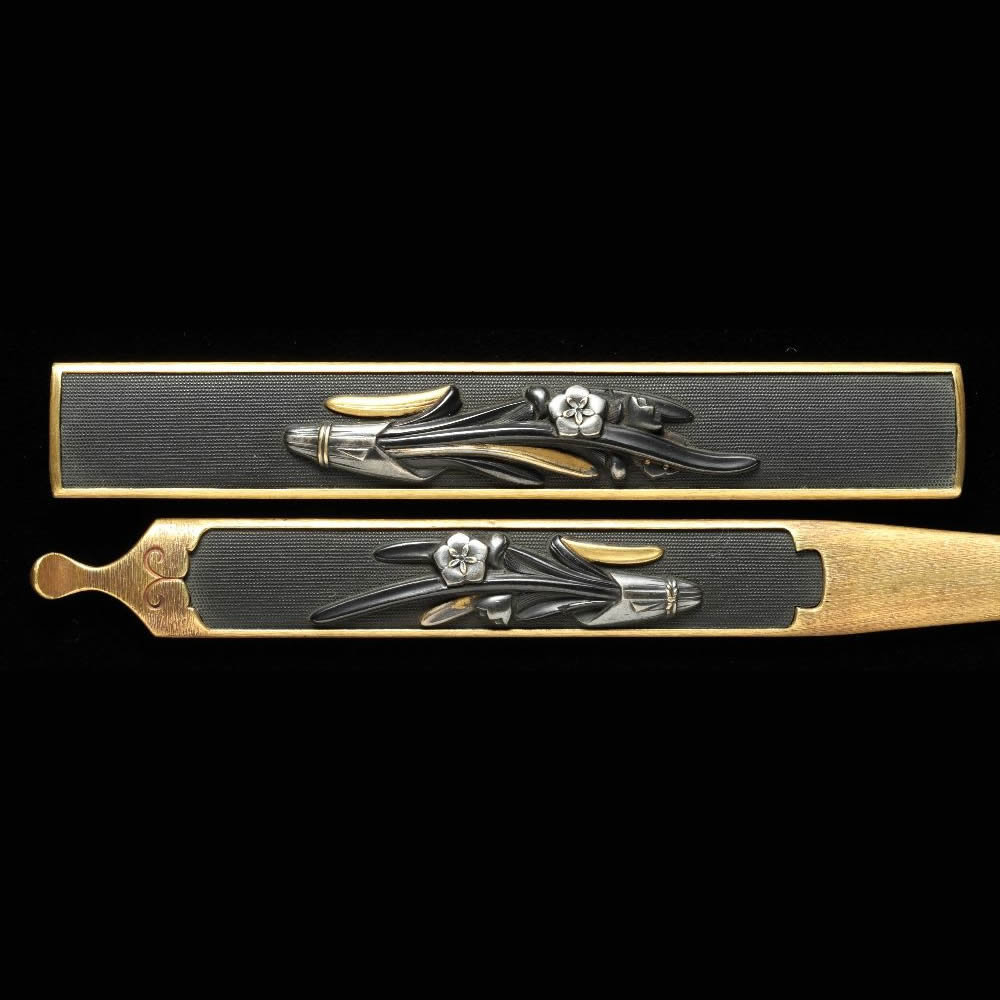
Katsutsugu
Edo
Mimasaka
Signed
Tokuho (NBTHK)
Machine translation of the shop's Japanese ·
Machine translation from the shop's Japanese · may contain errors ·
Mimasaka
2 pieces on the market now
A Hozon-certified blade judged to show notably superior workmanship and a better state of preservation. The bar is higher: re-tempered blades and most unsigned Muromachi/Edo works are excluded.
The NBTHK (Nihon Bijutsu Tōken Hozon Kyōkai, the Society for the Preservation of Japanese Art Swords) is a public-interest incorporated foundation founded in 1948 and supervised by Japan’s Agency for Cultural Affairs (Bunkachō); it is based at the Japanese Sword Museum in Tokyo. Its expert panels physically examine each submitted work (shinsa) and issue a certificate (kanteishō) ranking it by artistic and historical merit. NBTHK papers are the most widely recognized standard of authentication for Japanese swords and fittings.
NBTHK official siteIf, due to our fault, the item differs significantly from its proper condition, the item may be returned. Cooling-off is within one week of the item's arrival.
¥550,000