NihontoWatchNihontoWatch
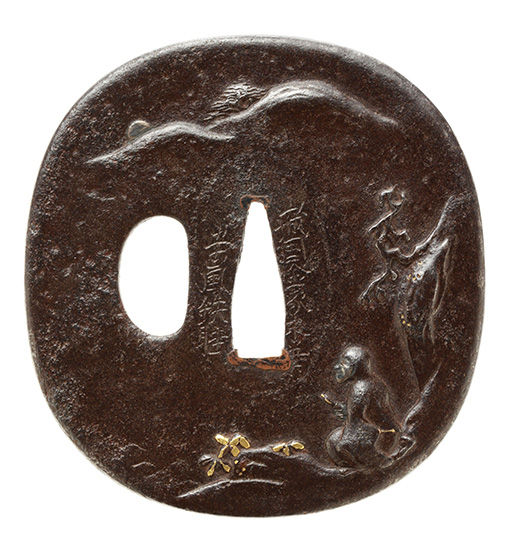
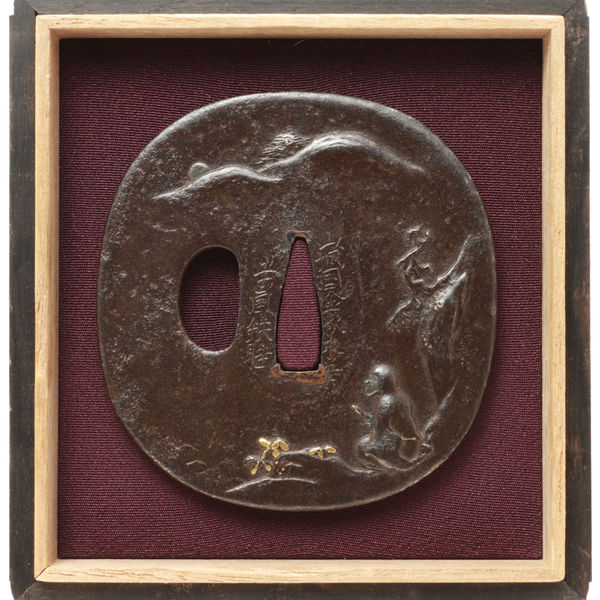
This tsuba features a moon viewing design, crafted by Igarashi Tetsumutsu, a descendant of the Kaneie school. Made in Yamashiro province during the Mid-Edo period, it showcases an iron base with tatemaru gata and zogan inlay. The piece is published in 'Zabo Tansen' and comes with an NBTHK Tokubetsu Hozon Tosogu certificate.
NihontoWatchOffered by Choshuya

Iron-tsuba · Yamashiro
7 pieces on the market now
Kaneie is celebrated as the founder of pictorial-style tsuba (e-fū tsuba), having introduced explicitly painterly subject matter into guard design during the Momoyama period. Working from Fushimi in Yamashiro Province, he pioneered an approach that moved beyond ornamental patterns to embrace landscapes, figures, and Zen themes as primary compositional elements. His innovations extended beyond subject matter to form itself: while producing guards in standard mokko-gata, nadekaku-gata, and maru-gata shapes, he also devised original silhouettes including double-mokko and the distinctive ken-gata (fist-shaped) form. Each work demonstrates careful integration between chosen motif and outline, with design and form considered together as a unified aesthetic conception. The collective technical vocabulary attributed to works in the Kaneie manner reflects an unsurpassed mastery of forged iron. Plates are invariably iron, worked with tsuchime hammering to create richly textured grounds that impart an elegant, refined character. The compositional method employs perspective with deliberate economy: broad spatial intervals are reserved, and particular emphasis is placed upon the layers of air that fill empty space, achieving an elevated, dignified tone throughout. Carving is executed through forceful iron takabori-zōgan (high-relief inlay using the same metal—a demanding technique termed tomogane suemon), while fine kebori engraving animates details such as waves and reeds.
Colored metals—gold, silver, shakudō—are restrained to the minimum necessary, deployed as sparse accents that heighten both chromatic effect and pictorial refinement. This disciplined restraint allows the intrinsic beauty of the iron itself and the viewer's contemplation of negative space to dominate the visual experience. Works attributed to the Kaneie school encompass a distinctive repertoire of themes drawn from Zen Buddhism, Chinese lore, and the natural world. Recurring subjects include Daruma shown in profile with piercing gaze, the "Monkey Trying to Grasp the Moon" (enkō takugetsu), solitary fishermen beneath crescent or full moons, Taikōbō at his suspended line, and the ascetic figures Shide and Chao Fu. Landscapes feature distant pagodas partially concealed by mountain ridges, withered trees, temple halls, and thatched boats drifting amid waves rendered in point-inlay. The nozarashi theme—three skulls and exposed bones laid bare upon an infinite empty ground—conveys the impermanence of all things (shogyō mujō) with stark severity. Across this body of work, one perceives a human spirit that reveres great nature and honors the kami and buddhas, expressing the infinite through perspectival depth and unhurried, composed atmosphere. Within the confines of small plates, boundless space is evoked, suffused with inexpressible stillness and lofty poetic resonance. Learn more →
| Smith | Era | Designated |
|---|---|---|
| Kaneie金家 | — | 40 |
| Tetsujin鉄人 | — | 0 |
| Tetsujin鉄人 | — | 0 |
| Kanesada金定 | — | 0 |
A Hozon-certified fitting of notably superior craftsmanship and condition, often with signature or workmanship of high reference value.
The NBTHK (Nihon Bijutsu Tōken Hozon Kyōkai, the Society for the Preservation of Japanese Art Swords) is a public-interest incorporated foundation founded in 1948 and supervised by Japan’s Agency for Cultural Affairs (Bunkachō); it is based at the Japanese Sword Museum in Tokyo. Its expert panels physically examine each submitted work (shinsa) and issue a certificate (kanteishō) ranking it by artistic and historical merit. NBTHK papers are the most widely recognized standard of authentication for Japanese swords and fittings.
NBTHK official siteIf, due to our fault, the item differs significantly from its proper condition, the item may be returned. Cooling-off is within one week of the item's arrival.