Stock No:SKA-030123Paper(Certificate): [N.B.T.H.K] Hozon TokenCountry(Kuni)・Period(Jidai): Kumamoto・Showa eraBlade length(Cutting edge): 69.0cmCurve(SORI): 2.0cmWidth at the hamachi(Moto-Haba): 3.47cmThickness at the Moto-Kasane: 0.85cmWide at the Kissaki(Saki-Haba): 2.65cmThickness at the Saki-Kasane: 0.65cmSword tang(Nakago): Kiriyasuri file patternRivet Holes(Mekugiana): 1Registration Card: Kumamoto
【Additional Information】
The history of the Moritaka family, who originate from Fukuoka Prefecture, is ancient, and the lineage is said to begin with Kongo Hyoe Minamoto Moritaka of Mount Homan around the Ennin era (1293) of the Kamakura period.
The smith of this work, Moritaka Yasuhiro, was born in Yatsushiro City, Kumamoto Prefecture in Meiji 41 (1908), and his real name was Moritaka Yoshio.
As the 25th generation of Kongo Hyoe Minamoto Moritaka, he engaged in the family blacksmithing trade upon graduating from higher elementary school (equivalent to the current 1st or 2nd year of junior high school).
He received numerous awards such as Nyusen and Yusushu at sword exhibitions, and the swords forged by this smith are highly evaluated as being sharp and unbreakable; in Showa 29 (1945), at the young age of 36, he became a swordsmith ranked as the "Yokozuna of the West" in the contemporary swordsmith rankings.
After the war, he retired from active duty, devoted himself to training successors, and passed away in Showa 57 (1982).
The nakago of Kongo Hyoe swords, including this one, are made in the shape of a "Sotoba" (stupa), and it is said that a prayer is imbued within so that "those who are cut may find peaceful Buddhahood."
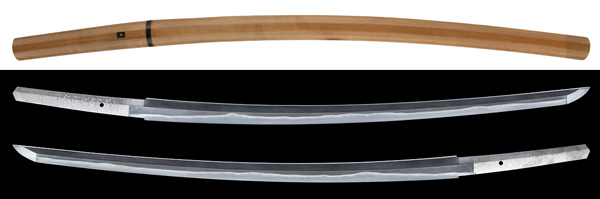
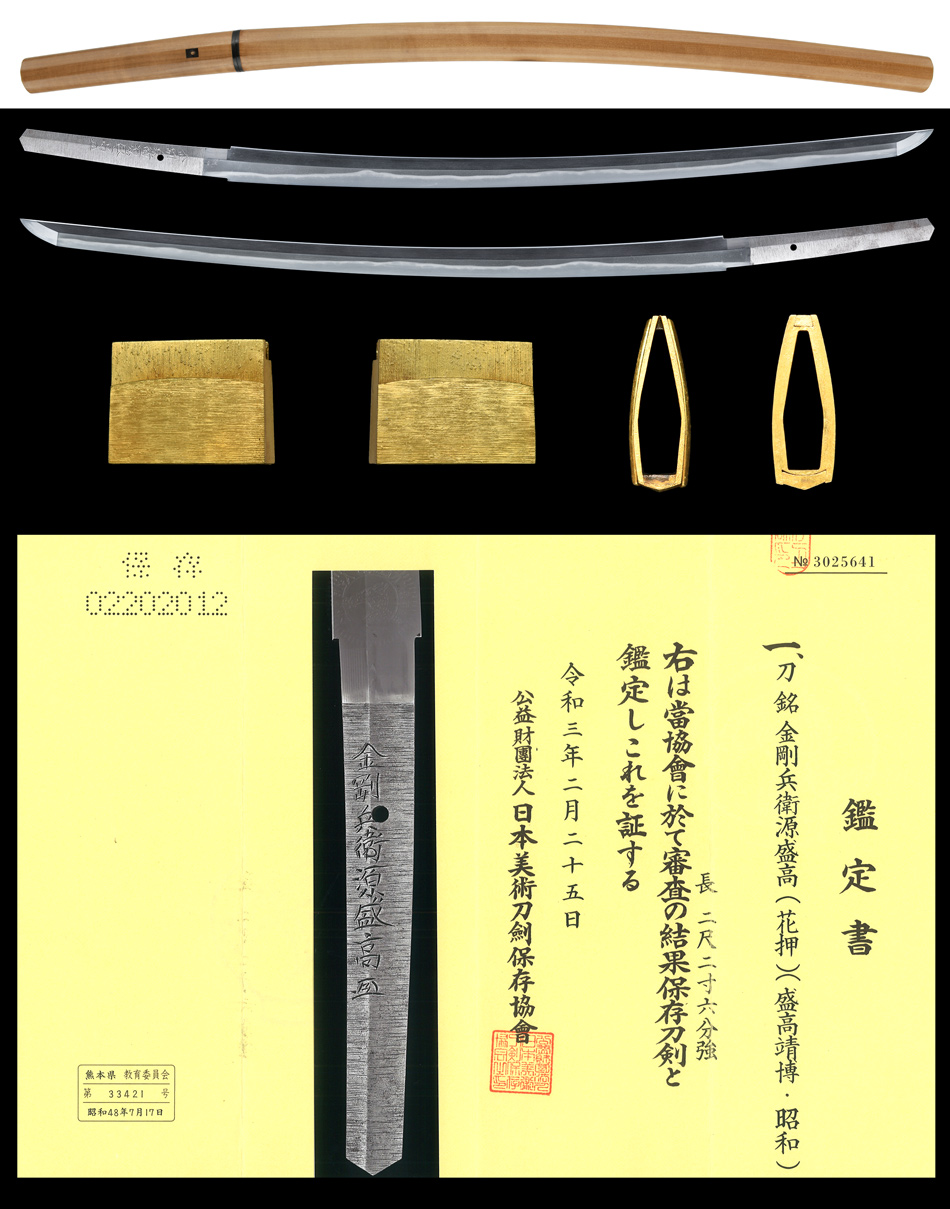
The taihai of this work has a nagasa of slightly over 2 shaku 2 sun 6 bu, with a wide mihaba and thick kasane providing a solid feel, a moderate sori, and a grand, powerful sugata with a fukura that is slightly karesansui-style in the chu-kissaki.
The jigane is itame hada with a flowing tendency, well-covered in jinie, with a forging that shows chikei along the hadame.
The yakiba is in nie-deki, featuring a hamon of gunome in a notare tone.
Inside the ha, there are active workings such as sunagashi and kinsuji in various places.
The boshi is hakikake and returns shallowly to a komaru tip.
The nakago has a sotoba-shaped nakago-jiri with kiriyasuri, and bears the mei of the swordsmith.
This work has a heavy, substantial feel when held in the hand, and with the powerful deki of the ji and ha, it is an excellent masterpiece by Kongo Hyoe Minamoto Moritaka.
Shirasaya, gold-plated niju habaki. Hozon Token Kanteisho.
Machine translation from the shop's Japanese · may contain errors ·
Stock No:SKA-030123Paper(Certificate): [N.B.T.H.K] Hozon TokenCountry(Kuni)・Period(Jidai): Kumamoto・Showa eraBlade length(Cutting edge): 69.0cmCurve(SORI): 2.0cmWidth at the hamachi(Moto-Haba): 3.47cmThickness at the Moto-Kasane: 0.85cmWide at the Kissaki(Saki-Haba): 2.65cmThickness at the Saki-Kasane: 0.65cmSword tang(Nakago): Kiriyasuri file patternRivet Holes(Mekugiana): 1Registration Card: Kumamoto
【Additional Information】
The history of the Moritaka family, who originate from Fukuoka Prefecture, is ancient, and the lineage is said to begin with Kongo Hyoe Minamoto Moritaka of Mount Homan around the Ennin era (1293) of the Kamakura period.
The smith of this work, Moritaka Yasuhiro, was born in Yatsushiro City, Kumamoto Prefecture in Meiji 41 (1908), and his real name was Moritaka Yoshio.
As the 25th generation of Kongo Hyoe Minamoto Moritaka, he engaged in the family blacksmithing trade upon graduating from higher elementary school (equivalent to the current 1st or 2nd year of junior high school).
He received numerous awards such as Nyusen and Yusushu at sword exhibitions, and the swords forged by this smith are highly evaluated as being sharp and unbreakable; in Showa 29 (1945), at the young age of 36, he became a swordsmith ranked as the "Yokozuna of the West" in the contemporary swordsmith rankings.
After the war, he retired from active duty, devoted himself to training successors, and passed away in Showa 57 (1982).
The nakago of Kongo Hyoe swords, including this one, are made in the shape of a "Sotoba" (stupa), and it is said that a prayer is imbued within so that "those who are cut may find peaceful Buddhahood."
The taihai of this work has a nagasa of slightly over 2 shaku 2 sun 6 bu, with a wide mihaba and thick kasane providing a solid feel, a moderate sori, and a grand, powerful sugata with a fukura that is slightly karesansui-style in the chu-kissaki.
The jigane is itame hada with a flowing tendency, well-covered in jinie, with a forging that shows chikei along the hadame.
The yakiba is in nie-deki, featuring a hamon of gunome in a notare tone.
Inside the ha, there are active workings such as sunagashi and kinsuji in various places.
The boshi is hakikake and returns shallowly to a komaru tip.
The nakago has a sotoba-shaped nakago-jiri with kiriyasuri, and bears the mei of the swordsmith.
This work has a heavy, substantial feel when held in the hand, and with the powerful deki of the ji and ha, it is an excellent masterpiece by Kongo Hyoe Minamoto Moritaka.
Shirasaya, gold-plated niju habaki. Hozon Token Kanteisho.
The twentieth century nearly killed the craft twice: wartime distortion, then the occupation ban. The NBTHK’s founding in 1948 and licensed forging from 1953 rebuilt the sword as an art, crowned by Living National Treasures and the mukansa rank.
Certifies a genuine blade worth preserving: a signature confirmed correct, or, if unsigned, an era, province, and school that the NBTHK can reliably identify.
About the NBTHK›
The NBTHK (Nihon Bijutsu Tōken Hozon Kyōkai, the Society for the Preservation of Japanese Art Swords) is a public-interest incorporated foundation founded in 1948 and supervised by Japan’s Agency for Cultural Affairs (Bunkachō); it is based at the Japanese Sword Museum in Tokyo. Its expert panels physically examine each submitted work (shinsa) and issue a certificate (kanteishō) ranking it by artistic and historical merit. NBTHK papers are the most widely recognized standard of authentication for Japanese swords and fittings.
No cooling-off period or returns; refund only if the purchased sword is proven fake, capped at purchase price (excludes commission sales, accessories, auction items).


 NihontoWatch