 NihontoWatchNihontoWatch
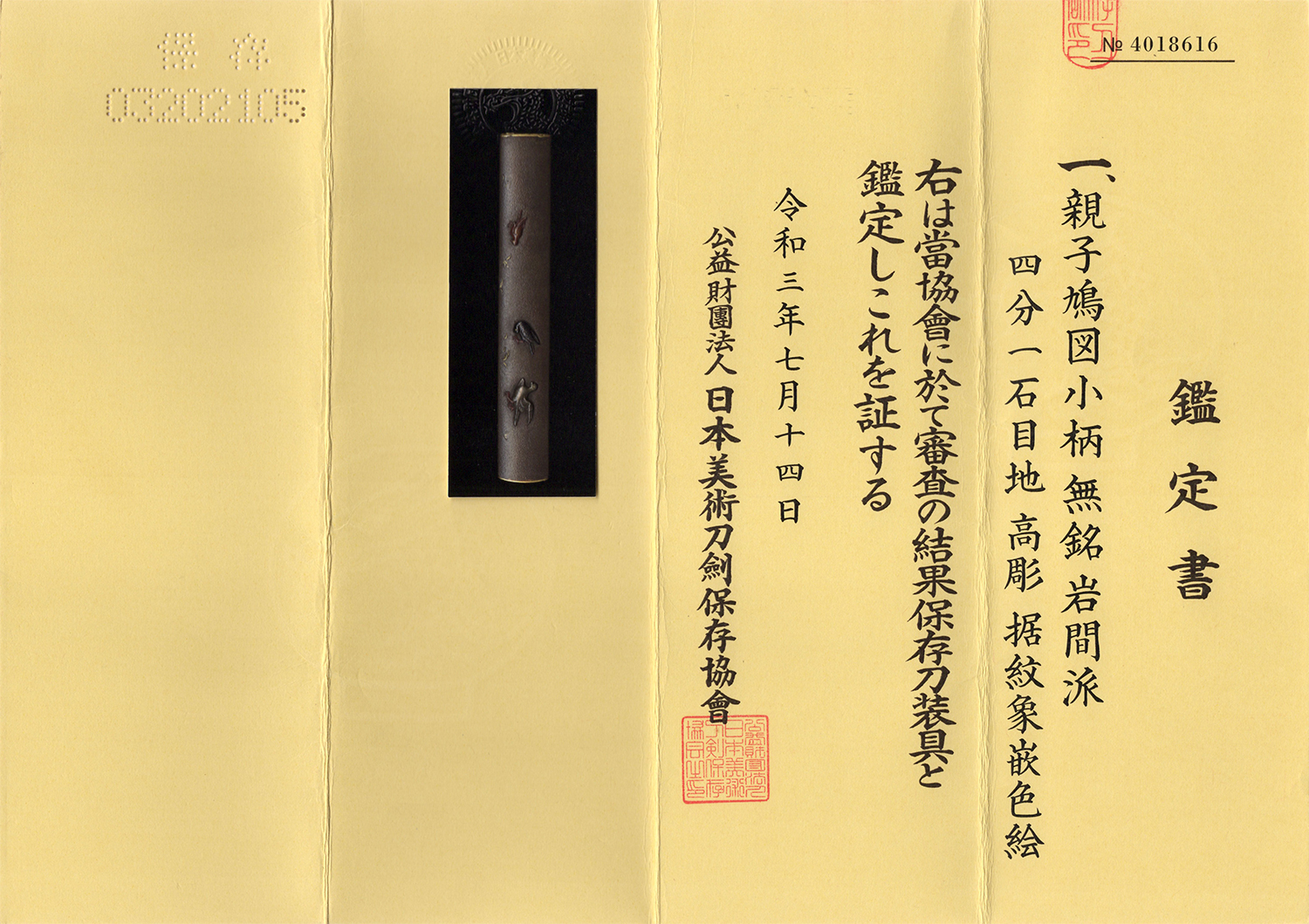
The Iwama school was a group that developed around the late Edo period kinkou Iwama Masayoshi, and its highlights lie in carvings that capture figures, flora, and fauna three-dimensionally, as well as expressions that make selective use of irogane. This item is mumei, but it is an Oyako Hato-zu kozuka attributed to the Iwama school by the Nihon Bijutsu Token Hozon Kyokai; it features suodou, shakudo, and silver pigeons arranged on a shibuichi ishimé-ji, skillfully capturing a peaceful scene of a parent and children within a small frame. Pigeons have been familiar to people since ancient times as birds close to human life, and there is a pleasure in appreciating their snuggling forms as a symbol of family harmony and peace. Here, rather than lining up the three birds in the same direction or posture, the suodou-colored pigeon is positioned low, the central shakudo pigeon leans forward, and the silver pigeon is given movement with slightly spread wings, creating a natural distance where they sense each other's presence, resulting in a warm expression appropriate for the theme of parent and child pigeons. Fine ishimé is applied to the shibuichi body, allowing the warmth of the suodou, the deep black of the shakudo, and the bright luster of the silver to emerge in sequence against the soft grayish-brown ji. Gold is dotted in the eyes of each of the three birds, the feather lines of the wings, tail feathers, and tips of the feet are carved separately within small undulations, and by scattering grass in gold to the side, the arrangement adds the presence of the ground even to the wide margins. The figures of the birds show different shadows every time the angle changes, allowing one to enjoy the volume of takabori and suemon zogan that cannot be experienced in a flat design. Gold borders are applied to both ends of the kozuka, neatly tightening the calm shibuichi-ji and the three-colored pigeons. On the ura of the kozuka, yasurime crossing in sujigai are layered to create a fine ground pattern with a different flavor from the soft expression of the birds on the omote; the workmanship, which extends even to parts difficult to see when stored in a koshirae, is also an attraction. The more one appreciates the contrast between the three birds and the irogane on the omote and follows the flow of the yasurime by turning it over, the more the sense of the maker, who carefully used every bit of the limited area, is conveyed. This is a piece that has elevated the approachable theme of pigeons into prestigious soken kinkou through ishimé-ji, takabori, suemon zogan, and gold details. A Hozon Tosogu Kanteisho and a special ochikomi kiribako are included, and it meets the pleasure of collecting as an example of the Iwama school, as well as the pleasure of producing a koshirae using a peaceful bird design or appreciating the expressions of the irogane at hand.
Offered by Toushin

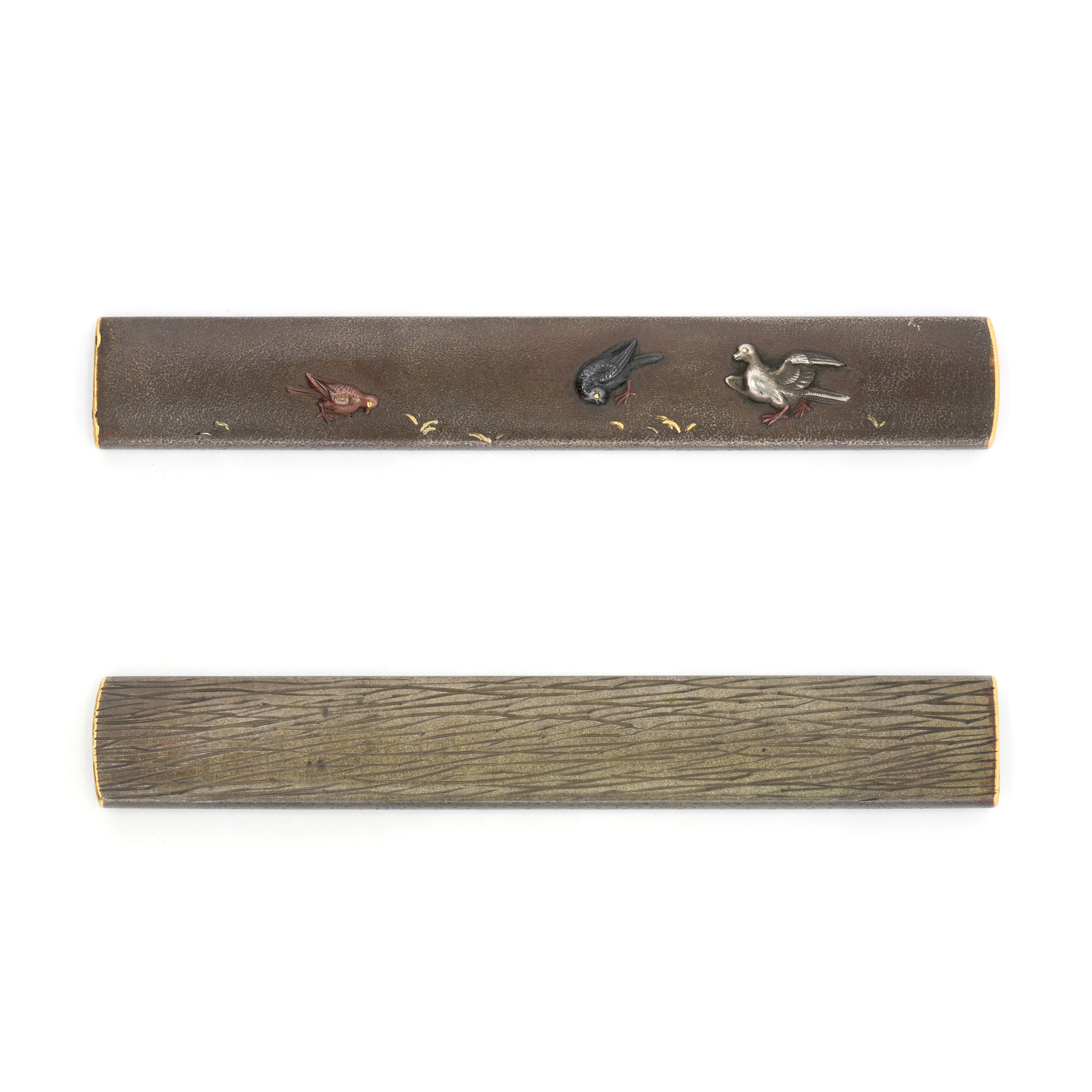
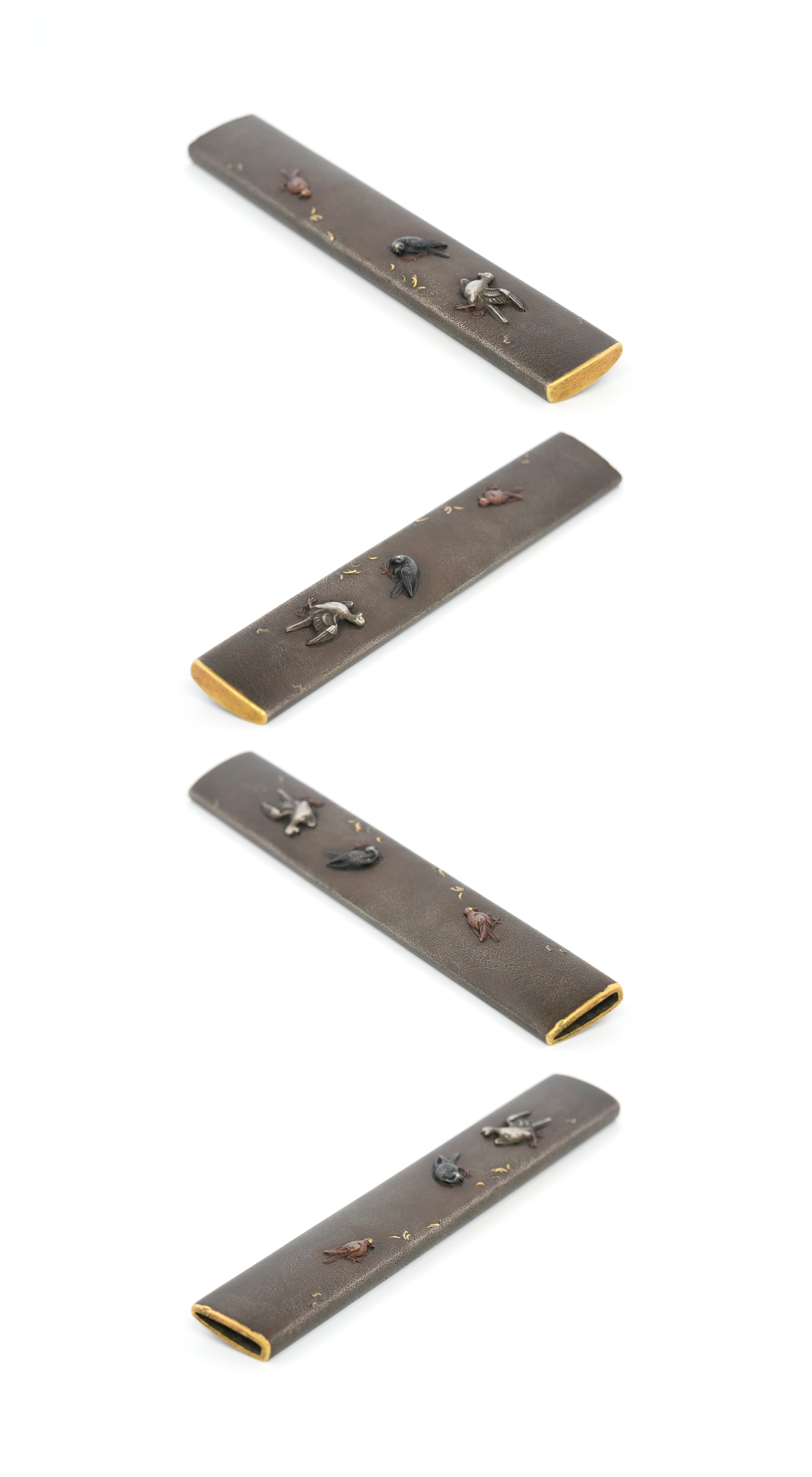
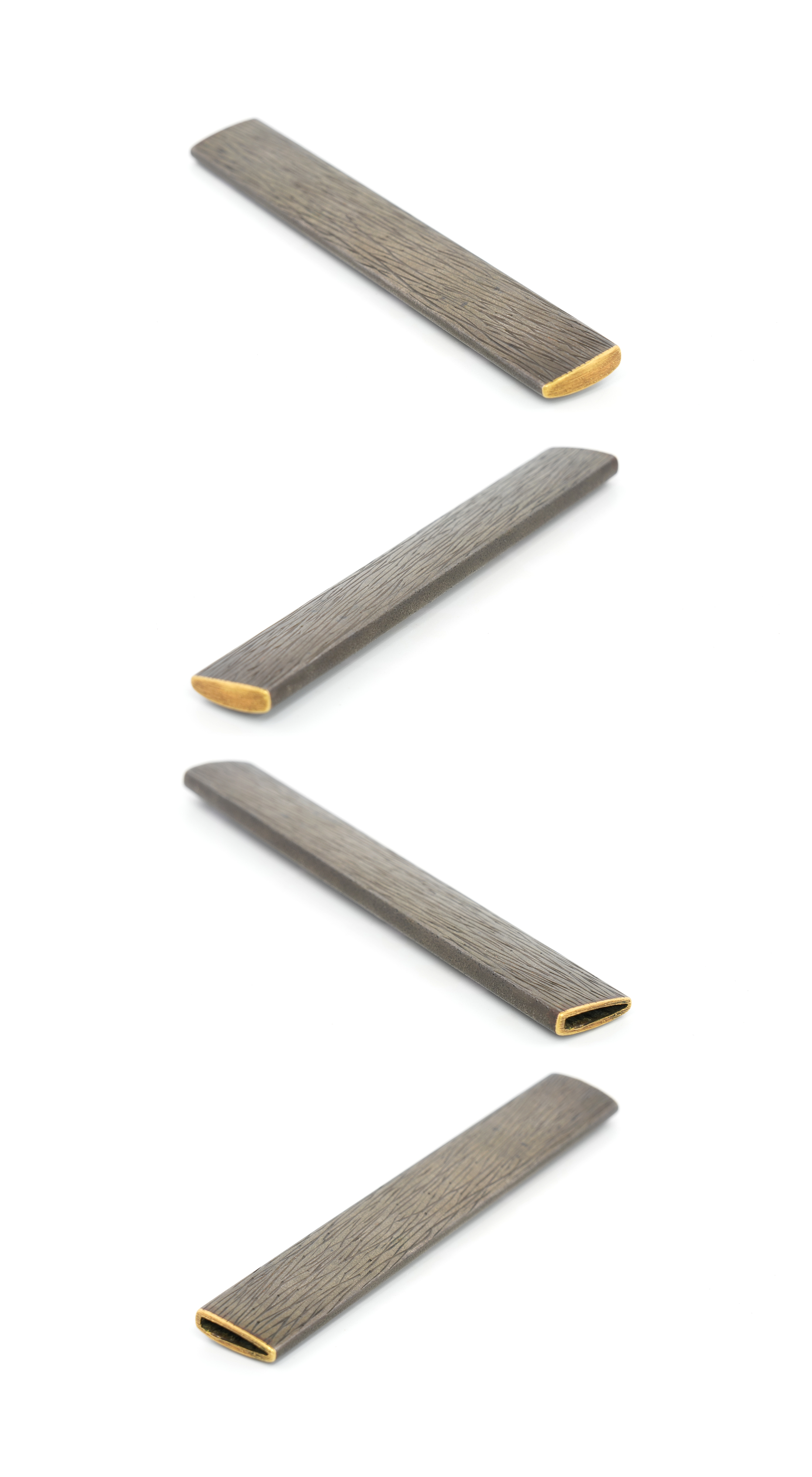
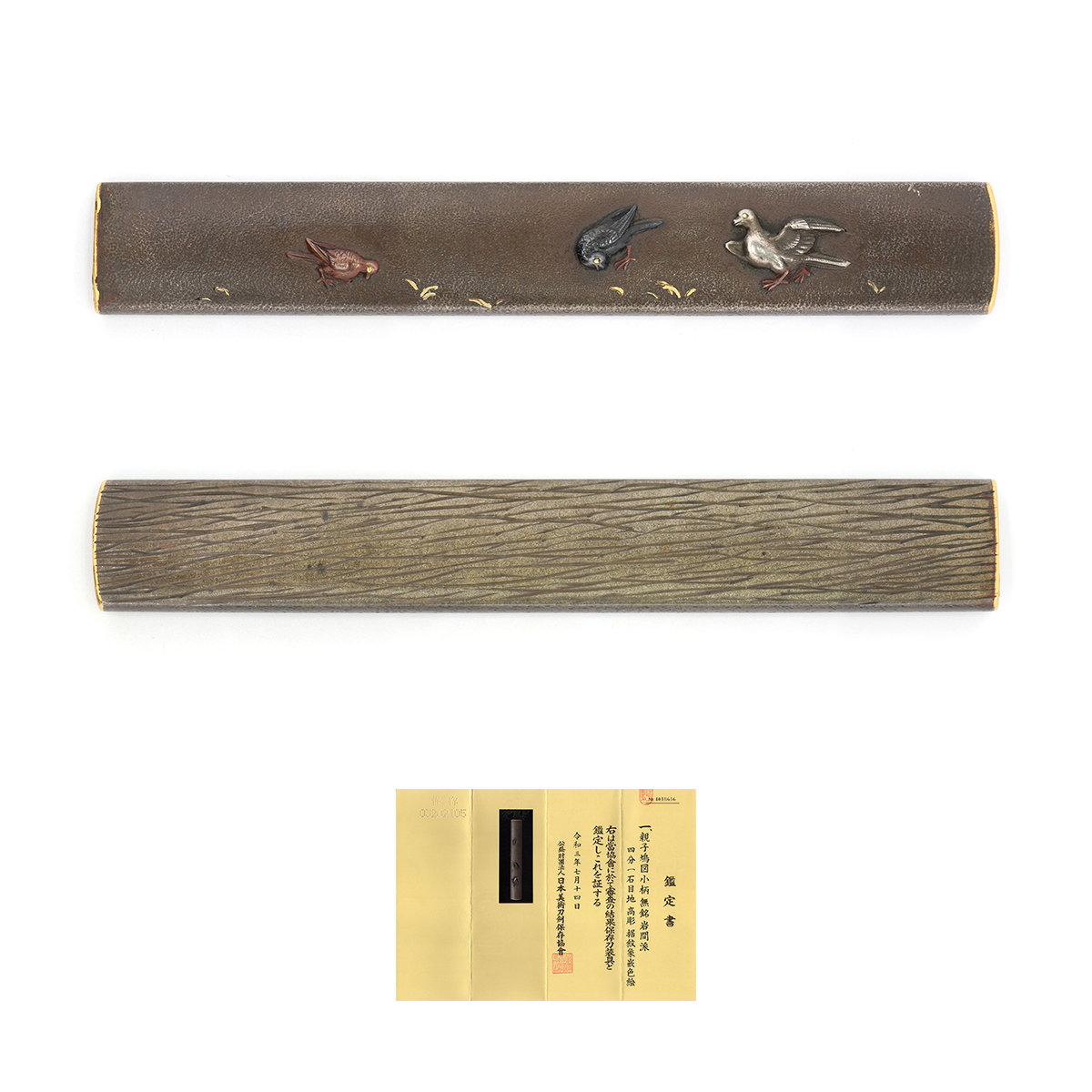
Iwama School
Edo
Unsigned
Hozon (NBTHK)
Machine translation of the shop's Japanese ·
Machine translation from the shop's Japanese · may contain errors ·
Certifies a genuine fitting worth preserving: a correct signature, or, if unsigned, an identifiable era and school, with recognized artistic and craft value.
The NBTHK (Nihon Bijutsu Tōken Hozon Kyōkai, the Society for the Preservation of Japanese Art Swords) is a public-interest incorporated foundation founded in 1948 and supervised by Japan’s Agency for Cultural Affairs (Bunkachō); it is based at the Japanese Sword Museum in Tokyo. Its expert panels physically examine each submitted work (shinsa) and issue a certificate (kanteishō) ranking it by artistic and historical merit. NBTHK papers are the most widely recognized standard of authentication for Japanese swords and fittings.
NBTHK official siteAs a rule we do not accept returns, except when we have sent a different item from the one ordered or when there is a significant discrepancy between the description and the item. If you wish to return an item, please contact us within 3 days of its arrival and then send it back.
¥275,000