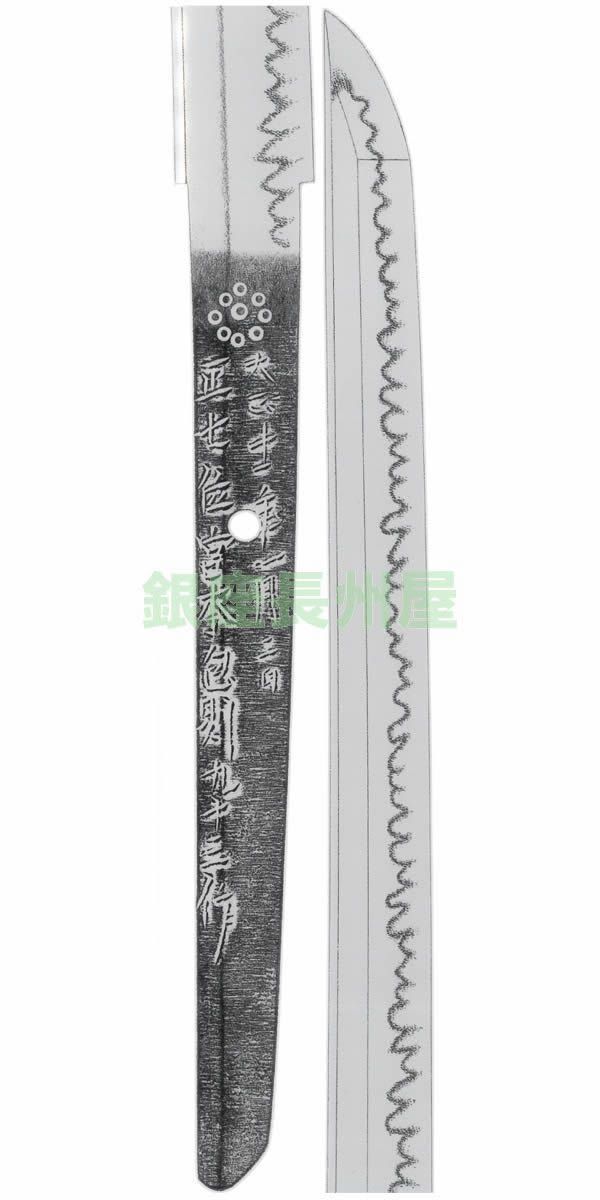
Mutsu no Kami Tachibana Tameyasu was called Tomita Rokuroemon (or Saemon), the son of Tosa no Sho Tameyasu and the younger brother of the first generation Yasuhiro (Note 1). It can be known from this work that he first signed his mei as Yasuhiro, and later changed it to Tameyasu upon succeeding to the family name. Because the school moved from Kii Province to Osaka, they are honorifically called Kishu Ishido or Osaka Ishido, and they specialized in juka-style choji midareba in imitation of their distant Ichimonji ancestors.
This katana is an example that clearly demonstrates these characteristics, and was likely intended as a formal daisho set; the nagasa of 2 shaku 3 sun has a moderate sori, and the motohaba and sakihaba are balanced accordingly, and since the machi remain deep, one can imagine it was passed down with great care. The densely packed itame kitae jigane is accompanied by nagare-hada, the shinogi-ji wavers in a masame tone, and overall chikei rise strongly to emphasize the hadame, and despite the deep yaki, the midare-utsuri that is a characteristic of this smith can be clearly observed. The hamon begins from a yakidashi with ko-gunome that gradually becomes higher, forming a state where complex, fluctuating ko-choji crowd together, combining small kawazuko-style patterns, karamata-ba, togari-ba, and small tobiyaki, while the boshi becomes sugu and returns in a neat ko-maru. The nioiguchi is distinct in the yakiba, where faint hotsure acting upon the hadame of the habuchi forms lightning-like kinsan in places, and within the nio-laden hachū, countless ko-ashi, yo, and tobiaishi enter to create a complex and magnificent scenery. The activity around the monouchi is particularly active, where the nie and nioi react to the itame in the ji, and utsuri rises as if smoldering from the yakigashira into the ji, with choji-shaped kuro-utsuri also distinct. In both ji and ha, the workmanship is reminiscent of old Ichimonji works.
Note 1 ...There is also a theory he was the older brother. A gassaku wakizashi by Mutsu no Kami Tameyasu and Bitchu no Kami Yasuhiro exists. Formerly in the collection of Ginza Choshuya.
Machine translation from the shop's Japanese · may contain errors ·
Mutsu no Kami Tachibana Tameyasu was called Tomita Rokuroemon (or Saemon), the son of Tosa no Sho Tameyasu and the younger brother of the first generation Yasuhiro (Note 1). It can be known from this work that he first signed his mei as Yasuhiro, and later changed it to Tameyasu upon succeeding to the family name. Because the school moved from Kii Province to Osaka, they are honorifically called Kishu Ishido or Osaka Ishido, and they specialized in juka-style choji midareba in imitation of their distant Ichimonji ancestors.
This katana is an example that clearly demonstrates these characteristics, and was likely intended as a formal daisho set; the nagasa of 2 shaku 3 sun has a moderate sori, and the motohaba and sakihaba are balanced accordingly, and since the machi remain deep, one can imagine it was passed down with great care. The densely packed itame kitae jigane is accompanied by nagare-hada, the shinogi-ji wavers in a masame tone, and overall chikei rise strongly to emphasize the hadame, and despite the deep yaki, the midare-utsuri that is a characteristic of this smith can be clearly observed. The hamon begins from a yakidashi with ko-gunome that gradually becomes higher, forming a state where complex, fluctuating ko-choji crowd together, combining small kawazuko-style patterns, karamata-ba, togari-ba, and small tobiyaki, while the boshi becomes sugu and returns in a neat ko-maru. The nioiguchi is distinct in the yakiba, where faint hotsure acting upon the hadame of the habuchi forms lightning-like kinsan in places, and within the nio-laden hachū, countless ko-ashi, yo, and tobiaishi enter to create a complex and magnificent scenery. The activity around the monouchi is particularly active, where the nie and nioi react to the itame in the ji, and utsuri rises as if smoldering from the yakigashira into the ji, with choji-shaped kuro-utsuri also distinct. In both ji and ha, the workmanship is reminiscent of old Ichimonji works.
Note 1 ...There is also a theory he was the older brother. A gassaku wakizashi by Mutsu no Kami Tameyasu and Bitchu no Kami Yasuhiro exists. Formerly in the collection of Ginza Choshuya.
For two and a half centuries of peace the sword was the warrior’s legal badge rather than his weapon. Each great city developed its own manner, Edo’s tested strength against Ōsaka’s polished brilliance, until demand thinned in the era’s last decades.
A Hozon-certified blade judged to show notably superior workmanship and a better state of preservation. The bar is higher: re-tempered blades and most unsigned Muromachi/Edo works are excluded.
About the NBTHK›
The NBTHK (Nihon Bijutsu Tōken Hozon Kyōkai, the Society for the Preservation of Japanese Art Swords) is a public-interest incorporated foundation founded in 1948 and supervised by Japan’s Agency for Cultural Affairs (Bunkachō); it is based at the Japanese Sword Museum in Tokyo. Its expert panels physically examine each submitted work (shinsa) and issue a certificate (kanteishō) ranking it by artistic and historical merit. NBTHK papers are the most widely recognized standard of authentication for Japanese swords and fittings.
If, due to our fault, the item differs significantly from its proper condition, the item may be returned. Cooling-off is within one week of the item's arrival.









 NihontoWatch