Edo was the sword’s age of connoisseurship: the Hon’ami appraisers, the shogunal register of famous blades of 1719, and a thriving literature turned the sword into an object of study even as it ceased to be drawn in war.
 NihontoWatchNihontoWatch
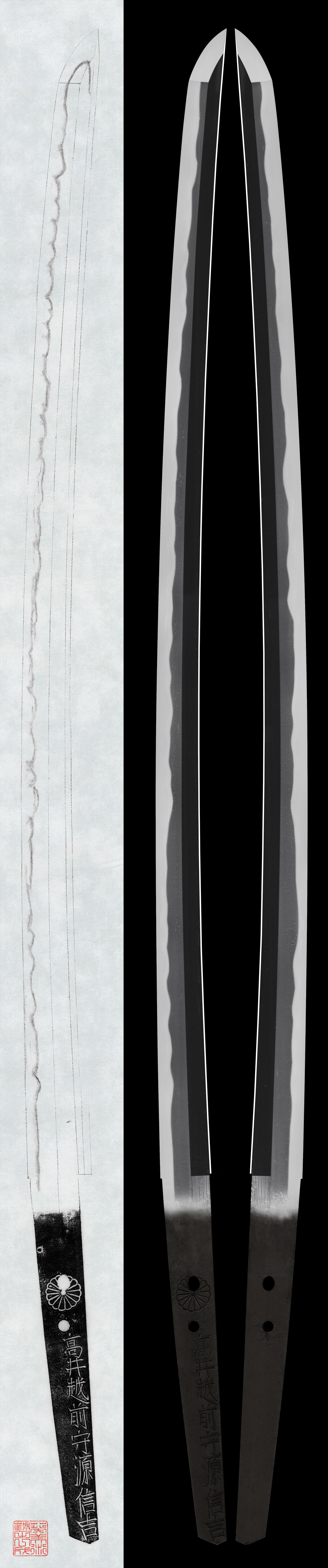
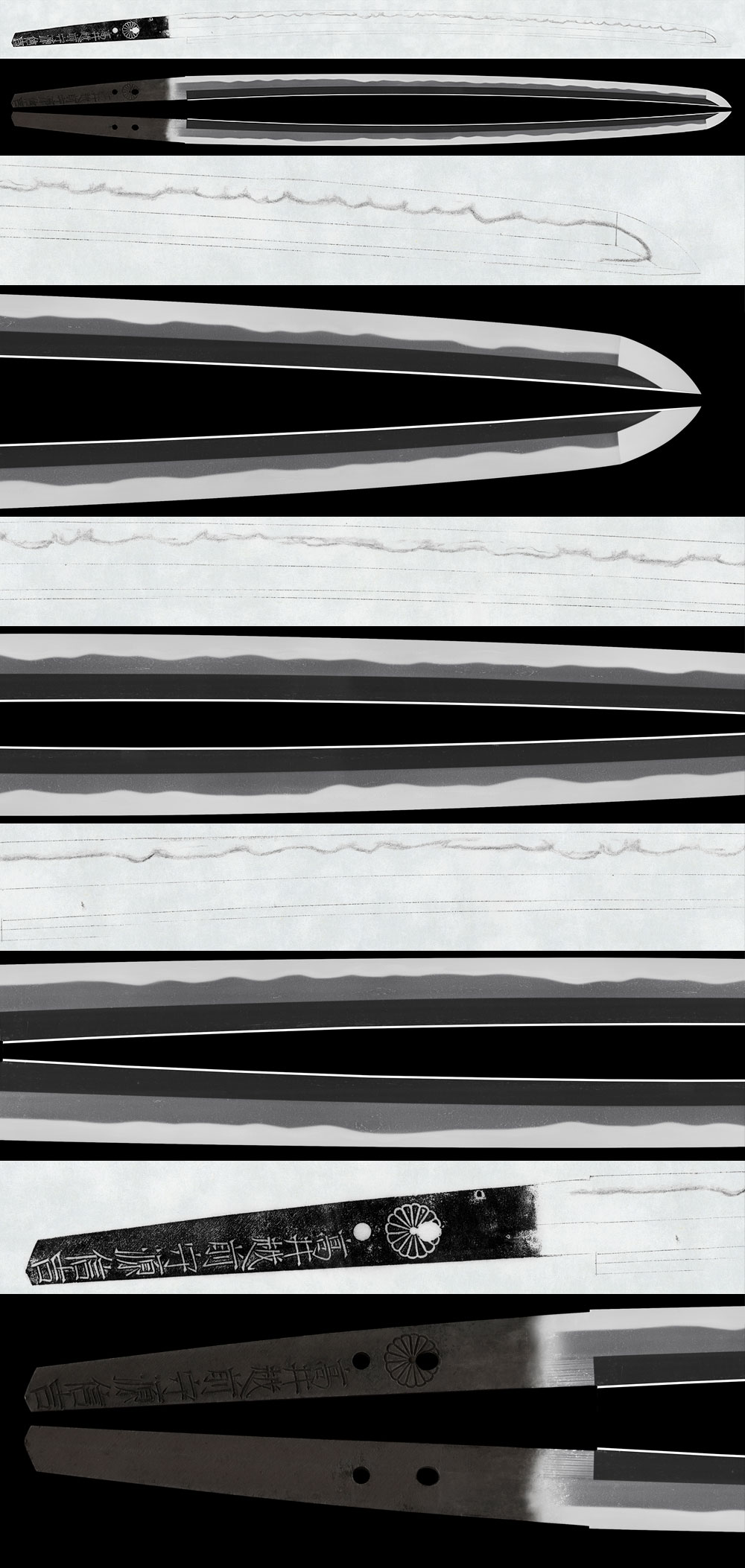
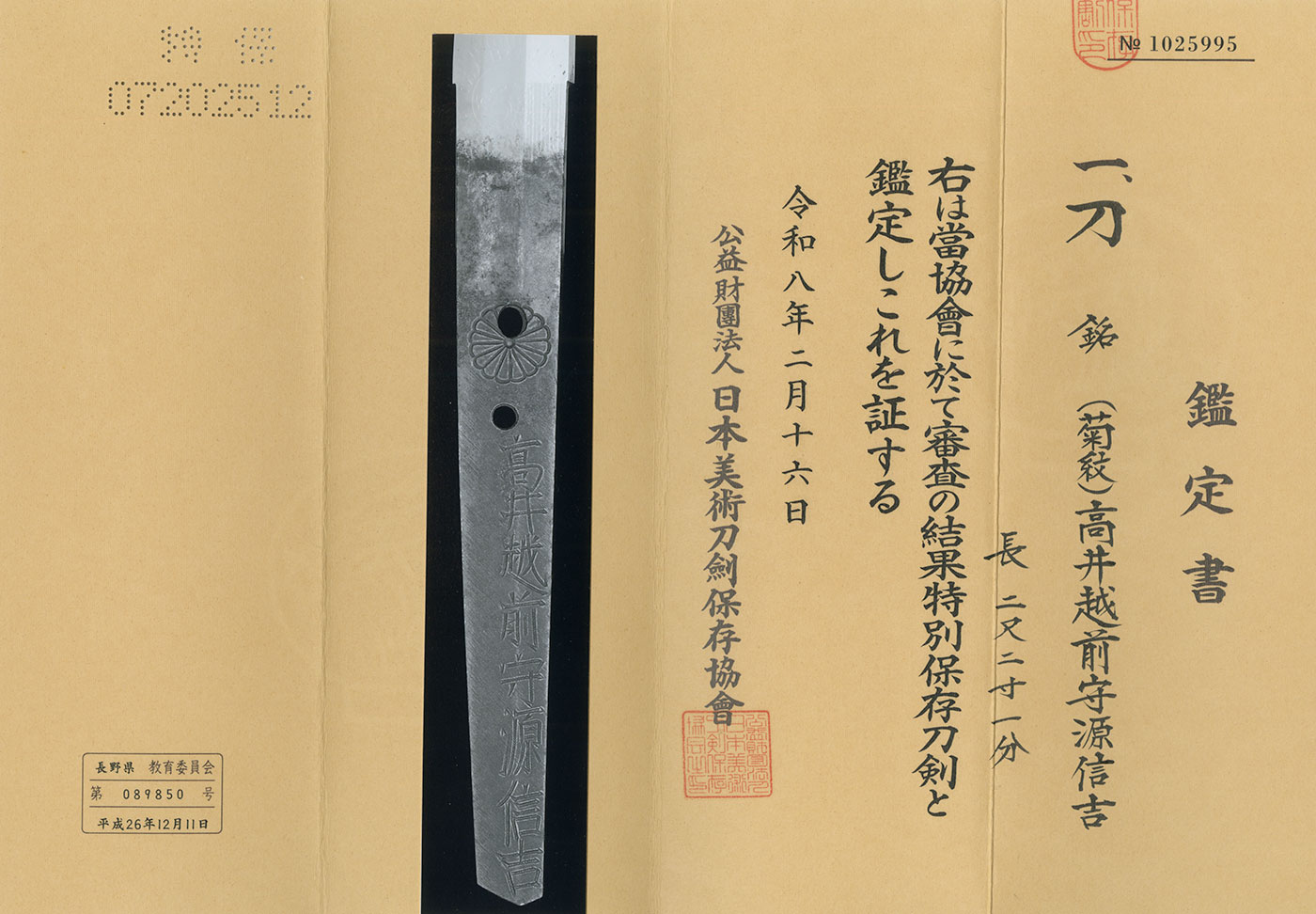
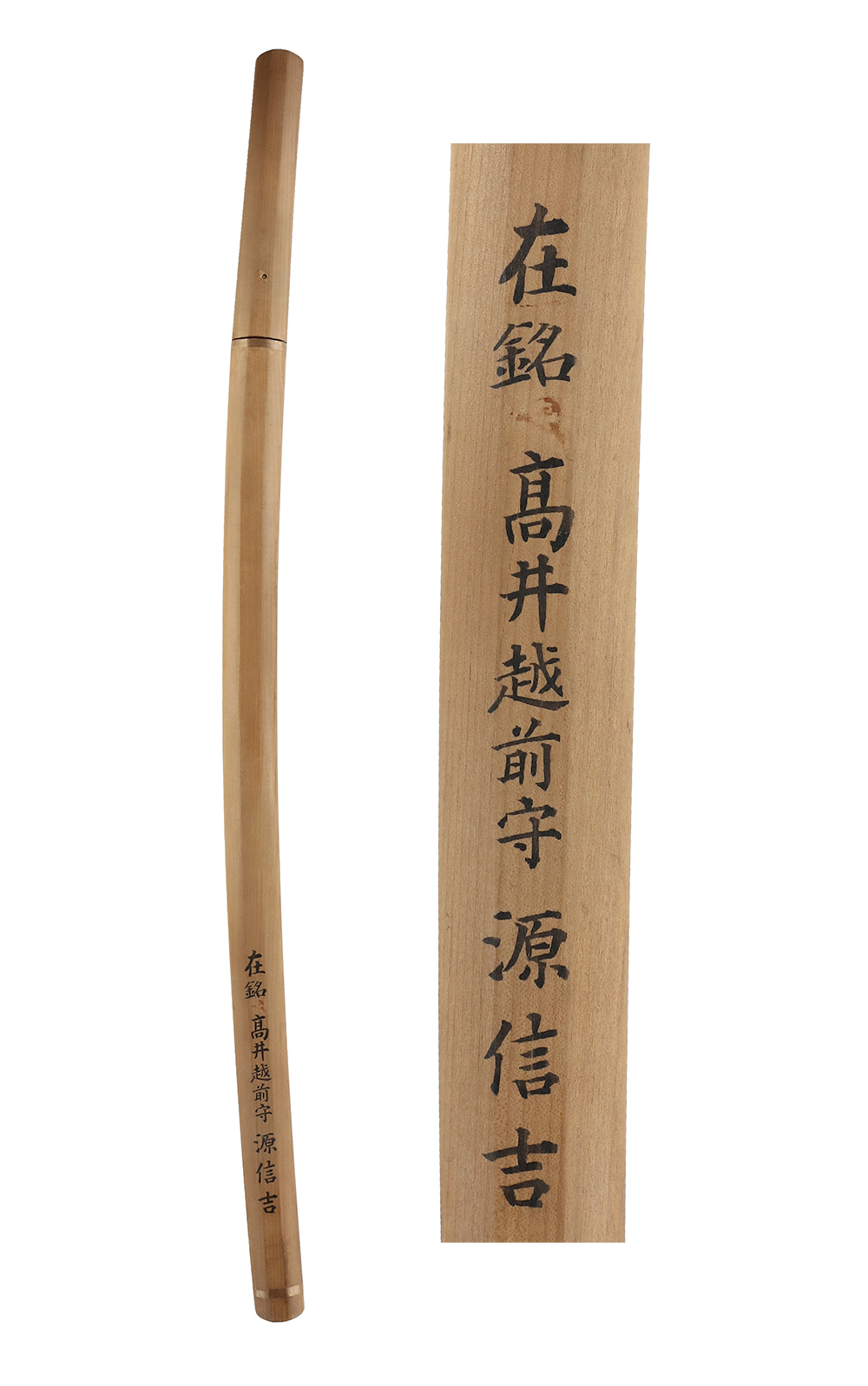
Katana in Shirasaya with Koshirae (NBTHK Tokubetsu Hozon Token) (We divide 4 sections for each sword as Saijyo Saku, Jyojyo Saku, Jyo Saku and Regular Saku). This blade is ranked as Jyojyo Saku among the works of (Kiku-mon) Takai Echizen no Kami Minamoto Nobuyoshi. Shape: A katana with standard mihaba and kasane. The blade has undergone approximately 3 cm (1.18 in) of machi-okuri (relocation of the notches at the base of the blade). Jigane: Beautifully refined and well-forged ko-itame hada, displaying fine-quality steel. Hamon: Gunome-midare with prominent ashi activity. The boshi forms a rounded tip with a turnback. Features: Echizen no Kami Nobuyoshi was the third son of the first-generation Shinano no Kami Nobuyoshi. He frequently produced blades with suguha hamon and was known for creating works resembling those of Inoue Shinkai. Historical Background: The Enpo era (1673–1681) of the Edo period was a time of significant political transition, marked by a change in shogunal leadership. It was also a period of remarkable commercial and cultural development that influenced modern Japan, alongside a series of major natural disasters. The Death of the 4th Shogun, Tokugawa Ietsuna, and the Accession of the 5th Shogun, Tokugawa Tsunayoshi (1680): In 1680 (Enpo 8), Tokugawa Ietsuna, the 4th Tokugawa shogun, passed away. He was succeeded by Tokugawa Tsunayoshi, who later became famous for the Shorui Awaremi no Rei (Edicts on Compassion for Living Things). This period marked an increasingly significant transition from budan seiji (military-oriented government) toward bunji seiji (civil government), which placed greater emphasis on scholarship, Confucian principles, and proper etiquette. The Establishment of Mitsui Echigoya (1673): In 1673 (Enpo 1), Mitsui Takatoshi opened the Echigoya kimono shop in Nihonbashi Honcho, Edo. The business eventually developed into what is now the Mitsukoshi department store. Mitsui introduced an innovative retail system based on cash sales at fixed prices, eliminating the traditional practice of selling primarily on credit and negotiating prices. This revolutionary approach transformed commercial practices in Edo and contributed significantly to the development of Japanese retail trade. The Development of Wasan (Japanese Mathematics, 1674): In 1674 (Enpo 2), the mathematician Seki Takakazu published Hatsubi Sanpo, an important mathematical treatise. He developed original algebraic methods known as Tenzan-jutsu, which used a distinctive system of written mathematical notation. His achievements greatly advanced Japanese mathematics and established him as one of the most influential mathematicians of the Edo period. NBTHK Tokubetsu Hozon Token.
Offered by Aoi Art



As written by the shop
Settsu · around 1661-1673
Tōken Taikan top 60%
1 piece on the market now
The Edo period (1615 to 1868)
Edo was the sword’s age of connoisseurship: the Hon’ami appraisers, the shogunal register of famous blades of 1719, and a thriving literature turned the sword into an object of study even as it ceased to be drawn in war.
A Hozon-certified blade judged to show notably superior workmanship and a better state of preservation. The bar is higher: re-tempered blades and most unsigned Muromachi/Edo works are excluded.
The NBTHK (Nihon Bijutsu Tōken Hozon Kyōkai, the Society for the Preservation of Japanese Art Swords) is a public-interest incorporated foundation founded in 1948 and supervised by Japan’s Agency for Cultural Affairs (Bunkachō); it is based at the Japanese Sword Museum in Tokyo. Its expert panels physically examine each submitted work (shinsa) and issue a certificate (kanteishō) ranking it by artistic and historical merit. NBTHK papers are the most widely recognized standard of authentication for Japanese swords and fittings.
NBTHK official siteIf you wish to return an item, please notify us within 3 days of receipt. After this period we cannot accept cancellations. Please ship the return to us within 5 business days. Cancellation is conditional on the item being kept in the same condition as at the time of sale, so please handle it with care.
Starting price
¥800,000