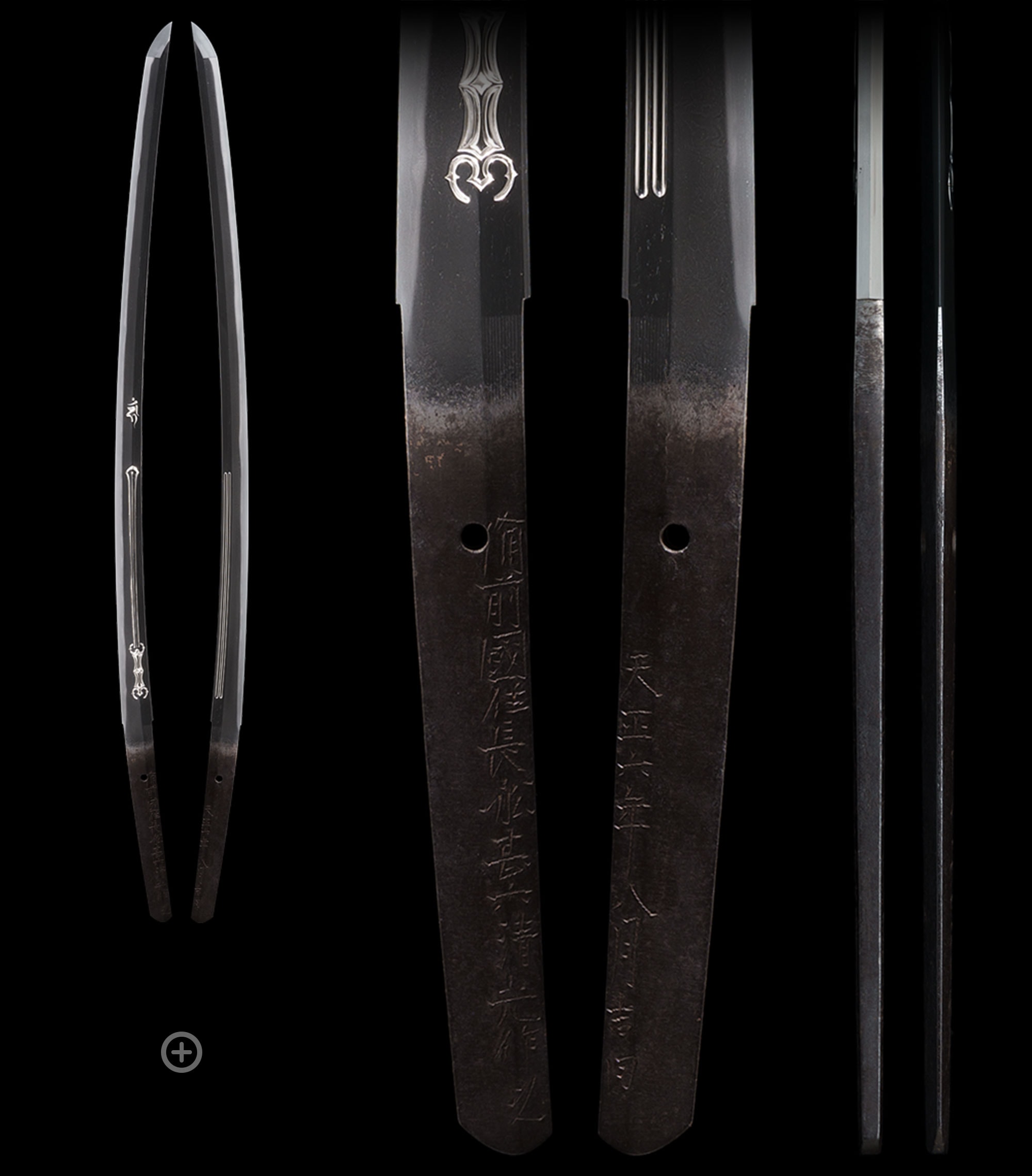
Bizen Kiyomitsu
SOLD
Tracked across 76 dealers worldwide · price history · sold archive
Specifications
69.09 cm
3.13 cm
2.24 cm
About the maker
Kiyomitsu清光
The katana dated Genki two (1571) and signed at full length "Bizen no Kuni ju Osafune Magouemon-no-jo Kiyomitsu saku kore" is the piece the published sources hold up as the measure of this smith, an *uchigatana* whose *jigane* they call extremely fine, the *suguha* broad with small *ashi* and *yo* well in, and which they call not only a masterwork of Kiyomitsu but a typical and representative work of the school in this period (「この時代の同派の典型的且つ代表作」). Kiyomitsu is one of the leading names of *Sue-Bizen*, the term used for the late-Muromachi Osafune workshops and their output collectively, and among the many smiths who signed the name the published sources single out two as the superior hands: Gorozaemon-no-jo and Magouemon-no-jo, the latter being the smith whose work fills this record. He bears the byname Magouemon-no-jo and works in the Eiroku years between 1558 and 1570, and the published sources note that the byname runs to a second generation, reading this Eiroku run as that second hand. Every blade here is a signed, dated katana on an *ubu* tang, a body of work as nearly knowable as a *Sue-Bizen* name can be, several of the signatures long enough to carry the Osafune residence in full. His reputation rests first on *suguha*. The published sources name Magouemon-no-jo, with Gorozaemon-no-jo, as the technically superior of the Kiyomitsu smiths, both of them excelling at the straight temper, and call the wide *suguha* itself the mark of the Kiyomitsu line (「清光一派の特色」). His characteristic blade is a sturdy *uchigatana*, the body broad and the *kasane* thick, the *shinogi* high and *saki-zori* standing toward a *chu-kissaki* that extends a little or a large *kissaki*, over which he lays a wide *suguha* mixed with small *gunome* and a *choji*-like wave. Within it the *ashi* and *yo* enter thickly, the *nioiguchi* tight to small *nie* and on his finest blades bright and clear, with fine *sunagashi* running. A robust shape tempered in this manner, the edge well worked and the *nioiguchi* shining, is what the published sources call the true forte of the smith who excelled at the straight temper (「直刃を得意とする清光の本領がよく示されている」). The *jigane* beneath that temper is as much a part of his recognition. He forges a packed *itame* and *ko-itame*, *ji-nie* applied, *chikei* entering in fine grain on the better pieces. What sets his *jigane* apart, and the published sources name it expressly, is that where Tadamitsu and Sukesada keep the *hada* close, Kiyomitsu mixes *mokume* into the *itame* so that the *ji* tends to stand, a distinguishing feature the sources call particular to him (「板目に杢が交じって肌立つ鍛えに特色がある」). The exception is telling. On his masterworks, including the Genki katana, the same sources remark that the *ko-itame* is unusually free of unevenness and finely packed (「小板目が叢なくつんで」), the refinement of those blades lifting them above his common work. The *boshi* runs straight to a small round with a sweep of *hakikake* on the *suguha* blades, and on the *midare* pieces it turns over in *midare* and points or doubles toward the back, a small round one side and a pointed return the other. Against that calm register he forges a showier second manner, and the published sources treat it as fully representative of him rather than as a departure. Its mark is the *koshi-no-hiraita gunome*, the *gunome* opened at the base, becoming complex and doubled, mixed with small *gunome* and pointed heads or set against a *notare* bearing square-shouldered heads, the *ashi* and *yo* in, *ko-nie* laid, with *sunagashi* and *kinsuji* running and *muneyaki* and *tobiyaki* entering. The published sources read the opened *gunome* with its small *nie* as resembling that of Yosozaemon-no-jo Sukesada (「与三左衛門尉祐定にも似て」), the other great *Sue-Bizen midare* hand, and call these blades his representative *midare* work (「孫右衛門尉清光の互の目乱れの代表作」), noting that like the other late-Bizen smiths his range is wide and extends to *o-notare*, *hitatsura* and full *gunome-midare*. The shapes themselves are part of the reading: the sources observe that by this period the blades grow long and the tang lengthens to suit two-handed use (「寸法も長くなり、茎も両手で使用するに適した」), the broad body and large *kissaki* of the latest pieces marking the very end of the Muromachi age. What sets Magouemon-no-jo apart within *Sue-Bizen* is read through his own work rather than by contrast. His wide *suguha* taking in small *gunome*, the *ashi* and *yo* coming in thickly, is the manner the sources tie to his name, the calmest of his registers, while the *koshi-no-hiraita gunome* with its *muneyaki* and *tobiyaki* extends his range toward Sukesada and toward the showy late-Bizen taste, the published sources calling one of these the representative straight-tempered work of his hand (「孫右衛門尉清光の直刃の代表作」). Tadamitsu and Sukesada share the *suguha*, but the standing *itame* with *mokume* is the tell that tells his straight temper from theirs. Several of his blades carry order-inscriptions that fix him in time and place, the most consequential naming the Bizen *shugodai* Urakami Munekage, one made as a treasured possession for him and another forged at Tenjinyama castle for his line; the published sources identify this patron with the deputy-governor of the province (「この紀宗景とは備前の守護代浦上宗景のことであろう」) and value the inscriptions as evidence of the smith's standing. The weight of designation behind his name is steady rather than vast. Ten of his blades hold the Jūyō rank, with nothing on record in the Tokubetsu Jūyō or the higher designated tiers, so his is a record built in the upper-middle reaches of designation rather than at its summit, and his designation factor places him well down the long roll of swordsmiths. Provenance is recorded thinly, the surest trace being the Urakami Munekage order-inscriptions carried on the blades themselves rather than a roll of later owners. Genuine signed, dated Magouemon-no-jo blades survive in fair number for a *Sue-Bizen* name, and an *ubu*, signed example in its original form, of the kind the published sources hold up as an outstanding piece of his hand (「清光作の傑作であるばかりでなく」), is among the more attainable of the great late-Bizen smiths for a collector who waits. The Jūyō tier appears from time to time and a fully signed, dated Eiroku katana with the standing *itame* and the bright *suguha* is a landmark when it does, the smith better met through one such honest, documented blade than sought in any rarer tier he never reached.