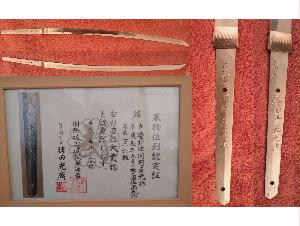
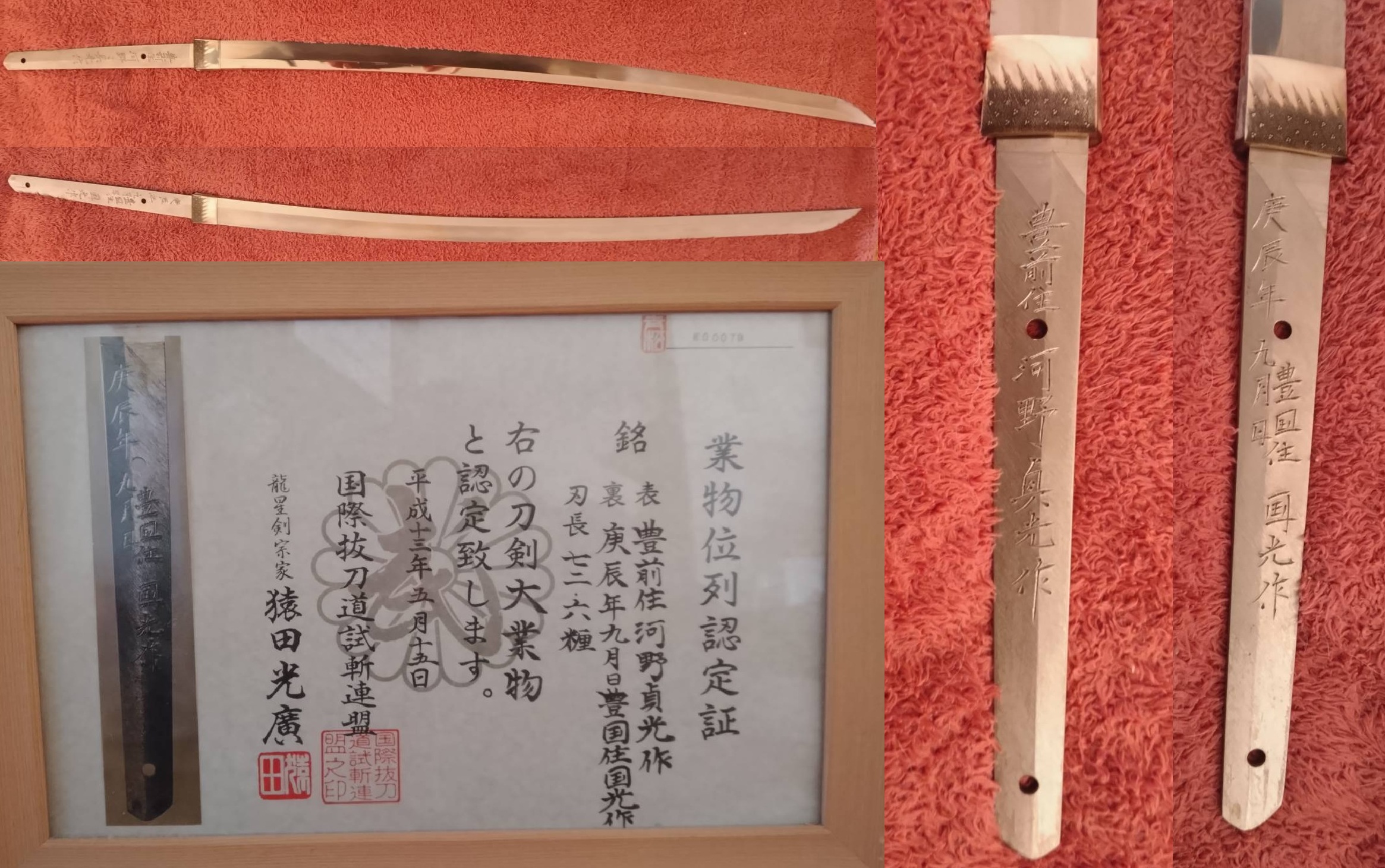
On a lucky day in October, Heisei 12, during a dedicatory tameshigiri at the Gokoku Shrine within the grounds of Kumamoto Castle, Kono Sadamitsu cut two pebbles clean in half with excess momentum. It was named Ishikirimaru by the late swordsman Murakami Ichiro. On April 30, Heisei 13, I received Ishikirimaru directly from Murakami in Nagoya. In May of the same year, I requested a tameshigiri of Ishikirimaru from Saruta Mitsuhiro, the Soke of Ryuseiken, who is the original Guinness World Record holder for cutting one thousand makiwara and who successfully performed kabutowari. He performed a kesagiri on five makiwara with green bamboo cores, and then cut five more with a tsubame-gaeshi. During the kesagiri, all five makiwara remained in place without falling over. I received the words, "A sharpness found perhaps once in a hundred swords; if you cut a person with a kesagiri using this sword, they would be split in two," and it was recognized as an Owazamono. To the question, "Would it not be a Saijo Owazamono?", the response was, "You probably could not cut iron with this." Since then, nothing has been cut with Ishikirimaru, and Soke Saruta remains the last user of Ishikirimaru.
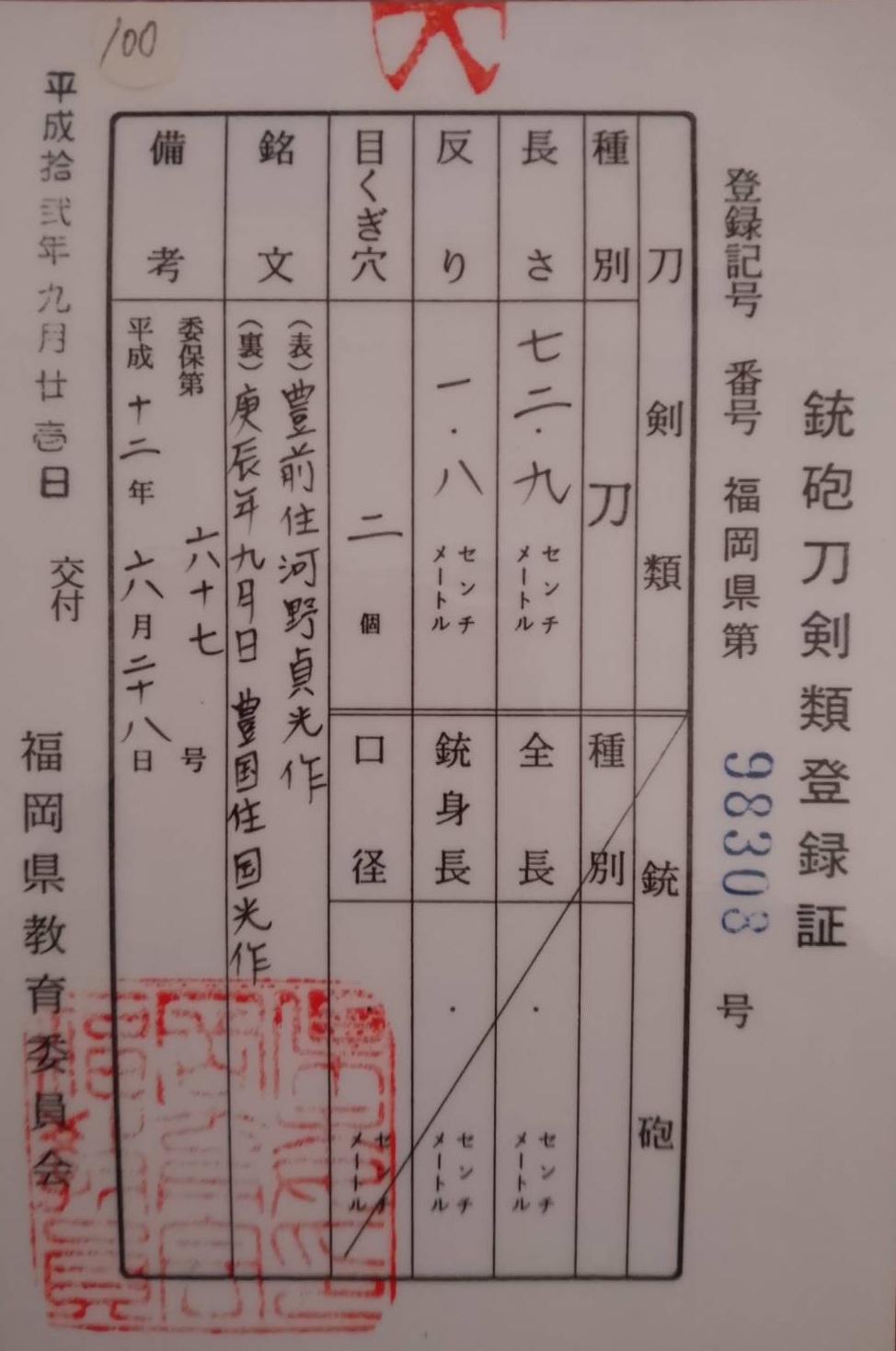
Kono Sadamitsu, born in Showa 25 and passed away in Heisei 25. I have owned Ishikirimaru for 25 years, but as this meito seemingly wishes to go to a fitting place, I have decided to part with it.
*Guarantee of Authenticity: If it is found to be a forgery, I will provide a full refund.
Machine translation from the shop's Japanese · may contain errors ·
On a lucky day in October, Heisei 12, during a dedicatory tameshigiri at the Gokoku Shrine within the grounds of Kumamoto Castle, Kono Sadamitsu cut two pebbles clean in half with excess momentum. It was named Ishikirimaru by the late swordsman Murakami Ichiro. On April 30, Heisei 13, I received Ishikirimaru directly from Murakami in Nagoya. In May of the same year, I requested a tameshigiri of Ishikirimaru from Saruta Mitsuhiro, the Soke of Ryuseiken, who is the original Guinness World Record holder for cutting one thousand makiwara and who successfully performed kabutowari. He performed a kesagiri on five makiwara with green bamboo cores, and then cut five more with a tsubame-gaeshi. During the kesagiri, all five makiwara remained in place without falling over. I received the words, "A sharpness found perhaps once in a hundred swords; if you cut a person with a kesagiri using this sword, they would be split in two," and it was recognized as an Owazamono. To the question, "Would it not be a Saijo Owazamono?", the response was, "You probably could not cut iron with this." Since then, nothing has been cut with Ishikirimaru, and Soke Saruta remains the last user of Ishikirimaru.
Kono Sadamitsu, born in Showa 25 and passed away in Heisei 25. I have owned Ishikirimaru for 25 years, but as this meito seemingly wishes to go to a fitting place, I have decided to part with it.
*Guarantee of Authenticity: If it is found to be a forgery, I will provide a full refund.
The twentieth century nearly killed the craft twice: wartime distortion, then the occupation ban. The NBTHK’s founding in 1948 and licensed forging from 1953 rebuilt the sword as an art, crowned by Living National Treasures and the mukansa rank.
We could not find an authenticity certificate on the seller’s listing. Japanese swords and fittings are normally papered by the NBTHK (or the NTHK). Without one, the attribution is the seller’s own assessment and has not been independently verified — treat it with caution and ask the dealer about certification before buying.
 NihontoWatch