説明
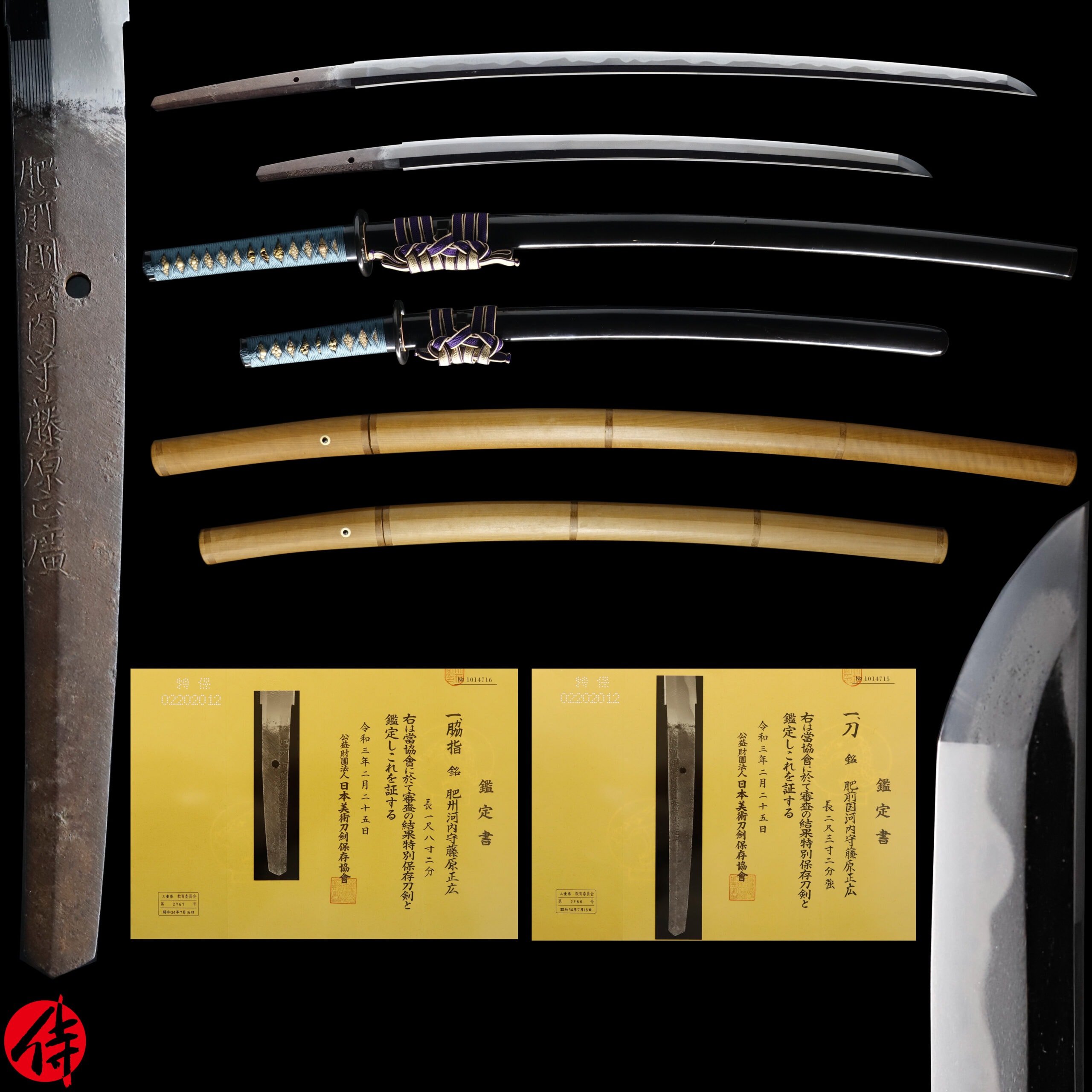
Antique Japanese Sword Daisho signed by Fujiwara Masahiro with NBTHK
Tokubetsu
Hozon
Certificate
【Description】
Hizenkoku Kawachi no kami Fujiwara Masahiro
This blade was signed by Hizenkoku Kawachi no kami Fujiwara Masahiro (肥前国河内守藤原正廣), also known as the second-gen Masahiro. He was especially active in sword-forging during the early Edo period (
Approx. 1658-1673
). He was born in the fourth year of Kan-Ei era (1626) as the child of the first-gen Masahiro.
The second-gen Masahiro received the honorable official title named Musashi Daijyo(武蔵大掾) in the third year of Manji era(1660) and promoted to Musashi no Kami(武蔵守) next year. He eventually received Kawachi no Kami(河内守) in the fifth year of Kan-Ei era (1665) after his father, first-gen Masahiro, was deceased. The second-gen died at the age of 73 in the 12th year of Genroku era(1699). We believe this blade was forged after 1665 as the signature includes Kawachi no Kami, his last title. Kami or Daijyo is an honorable official title given by the emperor for highly-skilled swordsmiths.
Hizenkoku, located in Saga prefecture, is the name of the place where the second-Masahiro forged swords. His linage dates back to the beginning of the Edo period, when the
first-gen Tadayoshi
, his great grandfather, founded the school. Tadayoshi is known as one of the greatest swordsmiths in the early Edo period in Japanese sword history.
His father, the first-gen Masahiro, is also a famous swordsmith in the province. The first-gen Masahiro started to serve Nabeshima Katsushige when he was 17 years old. Nabeshima Katsushige became the head of Saga Domain in Hizen in 1607.
The first-gen Masahiro was selected as Okakae Kaji for the Nabeshima clan, meaning he exclusively forged swords for the feudal family. The second-gen Masahiro, the swordsmith who forged this blade, was also an Okakaekaji for this clan. Nabeshima clan ruled Hizenkoku during the Edo period, which indicates that Masahiro served a powerful feudal lord.
The swordsmiths in the Hizen province worked under the auspices of the Nabeshima clan like the second-gen Masahiro. They were able to produce beautiful Jigane-patterned blades, also known as Hizen To, using and mixing carbon steel made in western countries. Hizenkoku had been flourishing by international trading. The geographic location of this domain made it possible to have easy access to western carbon steel.
The first-gen Tadayoshi (His grand grandfather)
The first-gen Tadayoshi was born and raised in the Saga domain. In 1596, under the domain’s order, he went to Kyoto to learn the sword-forging technique from Umetada Myojyu(埋忠明寿), one of the greatest swordsmiths in the early Edo period. He improved his craftsmanship and returned to the Saga domain two years later (1598). The first head of the Nabeshima clan, Nabeshima Katsushige, appreciated the work of the first-gen Tadayoshi very much. Then, Katsushige appointed him as his Okakaekaji, a swordsmith who exclusively forged swords for a specific domain or clan. And Tadayoshi started to stay near Saga castle, which is the headquarter of the Nabeshima clan. And, he founded Hizen Tadayoshi school, which trained more than 100 swordsmiths during the Edo period. Masahiro is one of them.
What is Daisho?
Daisho is a pair of two Japanese swords Samurai carried. During the Edo period, having Daisho in public places was considered social status for Samurai. Furthermore, Samurai were required to wear them under the law back then. Daisho is written as 大=Big and 小=Small. Dai part means Katana, and Sho part means Wakizashi. They have such a fancy appearance that we believe a high-ranked Samurai owned them. We are confident you would like this pair of Daisho Koshirae. And based on the style of the sword mounting, they are categorized as DENCHU KOSHIRAE(Sword mountings for entering a castle), which is very formal style of the mountings.
Appraisal
These blades are appraised as a
Tokubetsu Hozon Token
(特別保存刀剣) issued by NBTHK(Nihon Bijutsu Touken Hoz