NihontoWatch MonNihontoWatchBETA
MarketEncyclopedia
NihontoWatch Mon

NihontoWatchBETA

Market
Encyclopedia
Overview·Kantei·Honors·Designations·Provenance·Blade Forms·Signatures·Lineage
OverviewKanteiHonorsDesignationsProvenanceBlade FormsSignaturesLineage
  1. Schools
  2. Shizu
  3. Kaneuji

Shizu Kaneuji

兼氏

Tokujū
Vol. 25, No. 18 · Katana

Shizu Kaneuji

兼氏

156 ranked works

享保名物帳正宗十哲
ProvinceMinoEraGeno (1319–1321)PeriodKamakuraSchoolShizuTraditionMino-denGeneration1stTeacherMasamuneFujishiroSai-jo saku(Supreme Work)Toko Taikan2,000(top 2%)TypeSwordsmithCodeKAN2843
6Jūyō Bunkazai
9Jūyō Bijutsuhin
19Tokubetsu Jūyō122Jūyō Tōken

Overview

is in origin a place name in : because Masamune's pupil Kaneuji came to live and forge there, the name passed from village to man, and in the appraisal tradition a blade attributed simply means Kaneuji (単に志津と呼んだ場合は兼氏を意味することになる). He began in Yamato as a smith signing 包氏, entered the gate of Masamune, and at changed the writing to 兼氏. Counted from old among the Masamune Juttetsu, he is, in the sentence his designation texts repeat, the one whose manner stands closest to Masamune (それらの中にあって正宗に最も近い作風を示す刀工の一人). No dated work survives; the sources fix his period from the Kanno 1 (1350) date of his reputed pupil Kanetsugu, the very end of into early . One gold-inlaid goes further: in settling there he created the foundation of the smiths (美濃刀工の基を創造した).

The against the master is stated in one clause: what differs from Masamune is that mixes into the and the run linked within the (鍛に柾ごころが交じり、刃中に互の目が連れる点にある). His flows and leans toward far more often than in Masamune, Sadamune, Norishige or Yukimitsu, the Tegai hand surviving inside finished work. The pointed teeth are a second tell, -ba mixing into his across much of the corpus where on the homeland smiths they are an occasional accident. Where Masamune's never shows the form twice, Kaneuji lets two or three of one shape run linked in series, and the texts call the linked his habit of hand (処々小互の目が連れた手癖). The sweeps with and turns back gently round, the calm round return named among his traits.

The manner itself is grand work. The run wide with little taper, shallow in , the extended or grown to . The is mixed with and flowing , the thick, minute on the finest pieces, with fine entering incessantly. Over it he tempers a notare base with , and -ba, the deep, the thick and bright with rough in places; , , and work through and , and the runs or into or with . Yamato shows through this surface at the edge, in , , and . The first text settled a first-glance masterpiece on exactly these points, reading the flowing , pointed and swept, -like as a Yamato air (大和風が見られ); another finds the Yamato temperament (大和気質があらわれ) in the masa-leaning and shallow return; a recurring formula resolves the whole: with - added (大和伝に相州伝を加味し).

Signed works are exceedingly rare, the record repeating it in nearly the words across decades (兼氏有銘の作は極めて稀れ): eight signed records stand against one hundred thirty-six titled , the sustained by gold-inlaid and red-lacquer attribution inscriptions and by : the of Sugawara Naganori, a Kochu of Kyoho 3 (1718) at 1,500 , the whose gold-inlaid name Hanagatami is attributed to Koetsu. The rare signed pieces form a register of their own, , some carved with whose tips sit slightly low, and with , short for their era; the sources turn the point into a trait: builds that never become especially long are rather characteristic of Kaneuji. Within the corpus two poles stand apart. At the bold extreme the rises and falls strongly, and long scatter, and the fills with fire: one is called a blade of particular daring among attributions (志津極めの中でも殊に覇気のある一口); another, of Enbun-Joji build with a flame-form burning down the , is named the very finest of the smith's attributions (同工極め中の白眉); a third, gold-inlaid, is so daring that the text takes the Kaneuji as confirmed by the work itself. At the calm extreme the temper sits low and even, a shallow with ; one signed Jubi in stands apart even from his other signed blades. At least two Kaneuji are thought to have worked in ; Honma records that on the whole the large belong to the first generation, the small to the second and after, the first generation's signature angular and large in its cutting (初代銘は角張って大きいところが特徴である).

The appraisal tradition keeps a lattice of distinct targets around him. A attribution in the broad sense, the so-called O-, can reach past the first Kaneuji to the second and third generations and the direct pupils; blades of the direct line are marked as not descending to what is called Naoe (所謂直江志津と称するところまで下るものではなく). Naoe is the school after the move to Naoe in the province, its showing, against the master's, the feeling of less with growing fewer (地沸が少ない感があり地景も少なくなる); one published at session 15 as Naoe was raised at session 7 as . The boundary runs upward as well. The that opened his record had carried a Koyu to Sadamune and a to Masamune; the settled it as on the flowing , pointed and swept , calling it the finest among works (志津の作中の最高の出来). What he founded ran forward: the tradition the sources credit him with beginning, and, two and a half centuries on, the Keicho revival of - that Kunihiro built above all on the model of .

Fujishiro rates him Sai-jo . He has no National Treasures; six blades are Important Cultural Properties, patrimony outside the market, among them three signed and the Inaba , the his texts cite as the yardstick for his short blades. Nine works are prewar Bijutsuhin; nineteen and one hundred twenty-two make one hundred forty-one blades in those two tiers, of one hundred fifty-six designated works on record. Thirty-two blades carry recorded provenance, a roll running through Tokugawa Ieyasu and Hidetada, Maeda Toshitsune, Kuroda Nagamasa, the Date, Satake Yoshinobu, the Hosokawa marquis house, the Naito of Nobeoka, the Owari Tokugawa and the Choshu Mori; the Kuroda , a blade, carries the of Hirai Chiba. One , given by Ii Naomasa to Kimata Seizaburo Morikatsu after the Wakamiko standoff with the Hojo in Tensho 10 (1582), descended in the Kimata, first house of elders of the Hikone Ii. Of recorded whereabouts today, holders include Futarasan Jinja, the Tokugawa Art Museum and the Sano Art Museum. What a private collector may realistically encounter is the and tier; those blades are held closely, and one comes to market only rarely. When it does, the is almost always bare, the attribution reading simply , in this tradition the name of one man.

Kantei

one prime Soshu-Mino manner, the grand Nanbokucho build with notare-based gunome in heavy bright nie, carried almost entirely in o-suriage mumei katana with a rare signed-ubu register of short tachi and tanto; the Yamato substrate of his Tegai origin runs through everything as flowing hada and a swept, rounding boshi; a bold pole with tobiyaki and flame boshi and a calm low-temper pole stand at the extremes

Kaneuji, called Shizu Saburo, began as a Tegai smith in Yamato under the name 包氏, entered Masamune's gate, and settled at Shizu in Mino, where the place name became his own: in the kiwame tradition, a blade called simply Shizu means Kaneuji. Counted among the Masamune Juttetsu, the NBTHK's standing formula names him the one whose manner stands closest to Masamune. He carried the perfected Soshu-den into Mino with his Yamato hand still legible: the itame flows and leans masame, togari-ba mix into the gunome, runs of like-shaped gunome repeat, and the boshi rounds back with hakikake. Signed works are exceedingly rare; the corpus is o-suriage mumei katana settled by kinzogan, shu-mei and origami, active from the very end of Kamakura into early Nanbokucho.

Diagnostic discriminators

40% of his works · 17.9× vs Masamune

52% of his works · 2.6× vs Masamune

16% of his works

60% of his works

Observation by phase

Prime manner, the Soshu-Mino synthesis at Shizu

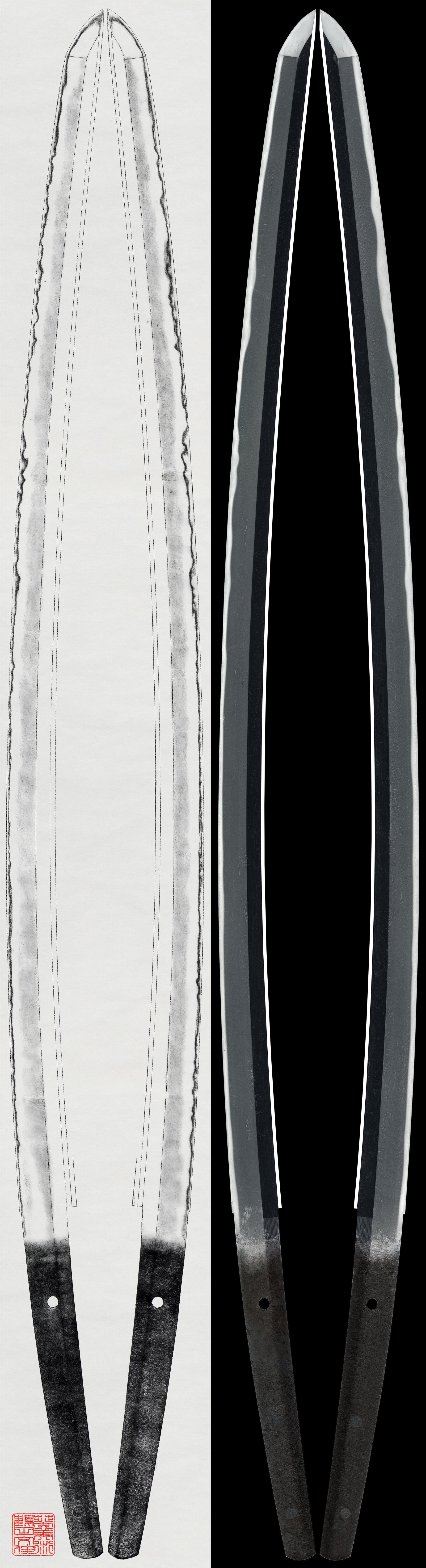
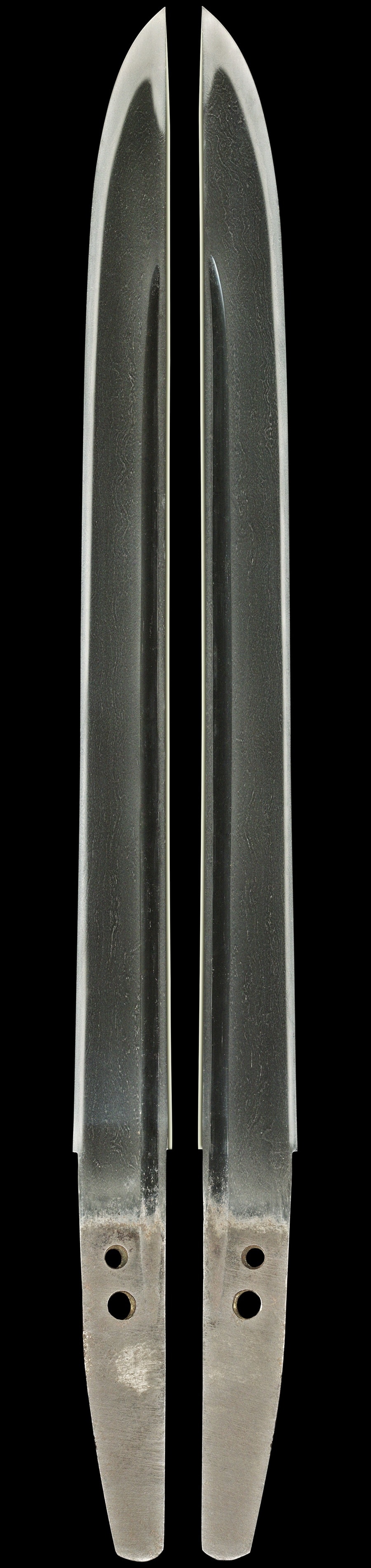
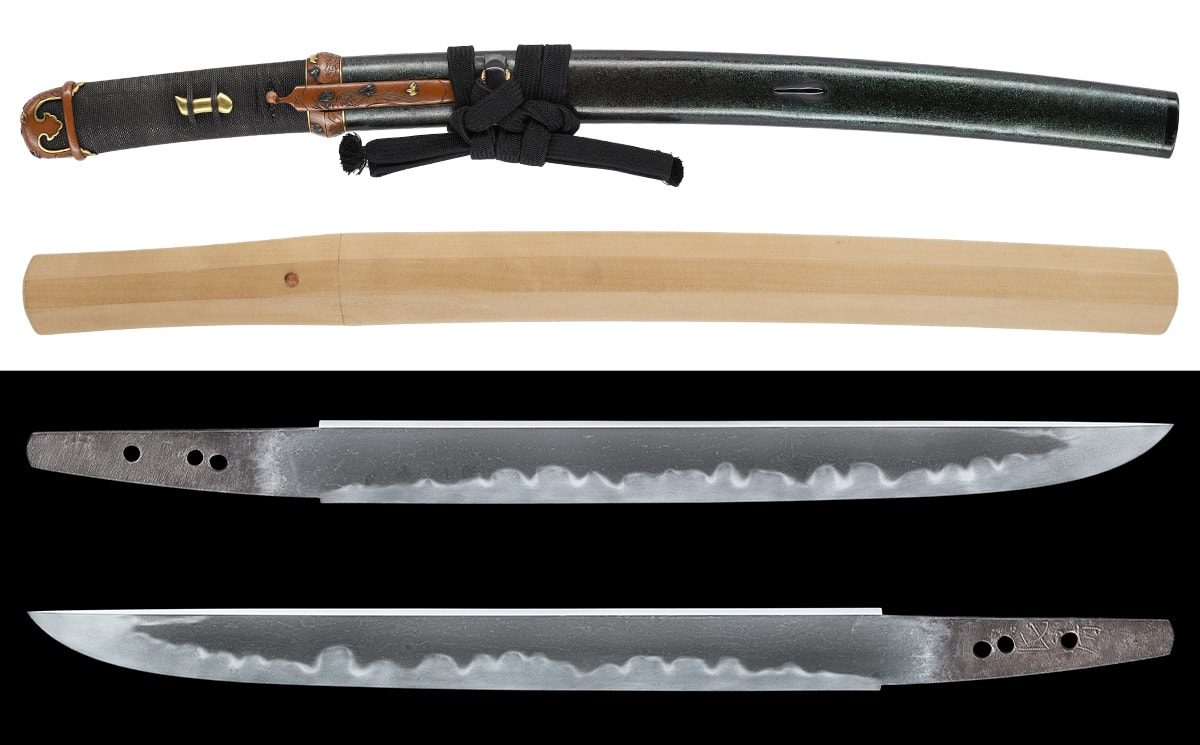
The mainstream of his surviving work and the heart of the Shizu kiwame. The sugata is Nanbokucho at full power: wide mihaba with little taper, shallow sori, the kissaki extended or o-kissaki. The jigane is itame, on the best pieces with ji-nie thick to dust-fine and chikei entering incessantly, mixing mokume and flowing hada, at times standing. The temper is a notare base with gunome, togari-ba mixing in, nioiguchi deep, nie thick and bright with rough nie in places, sunagashi and kinsuji working through the ha, yubashiri at the habuchi and tobiyaki over the ji. The boshi runs midare-komi or notare into a rounded return, ko-maru or o-maru, with hakikake. A first glance says top-rank Soshu; the flowing hada, the pointed and repeated gunome and the rounding swept boshi say Shizu.

Sugata 姿
Jigane 地鉄
Hamon 刃文
Bōshi 帽子
Rare signed-ubu register, short tachi and tanto— the rare signed works: niji-mei tachi, some with maru-mune and futasuji-hi whose tips sit slightly low, not long for the era, the texts noting that builds which never become grand are rather his characteristic; and ubu mitsu-mune tanto, some with suken or gomabashi
O-suriage mumei kiwame register— the o-suriage mumei katana, 156 of 171 records titled mumei and 143 o-suriage: the Shizu and den-Shizu attributions, settled by kinzogan (12), shu-mei (4) and Hon'ami origami

The Yamato substrate, the Tegai hand showing through

stated by the NBTHK across the corpus: the texts read his Tegai origin directly in the work, calling it the Yamato manner, the Yamato temperament, or Yamato-den tempered with Soshu-den

What separates him from the Soshu homeland is Yamato. The itame flows and leans masame, the habuchi shows hotsure, kuichigai-ba, nijuba and uchinoke, and the boshi sweeps with hakikake, at times yakizume or with only a short return. The NBTHK uses exactly these points to pull a blade away from Masamune and toward Shizu: one Tokuju text reads the flowing itame, the pointed gunome and the swept yakizume-like boshi as the Yamato manner that betrays the man who studied under Masamune after Tegai beginnings. A few works lean wholly this way, suguha-cho with a flowing or unflowing hada, which the texts accept from his career.

Jigane 地鉄
Hamon 刃文
Bōshi 帽子

The bold pole, tobiyaki, muneyaki and flame boshi

less firmly establishedthe works the texts call full of haki, daring, or the very finest of the Shizu kiwame: the yaki taken high with strong rises and falls, tobiyaki scattering over the ji, the boshi sweeping into flame and burning down the mune

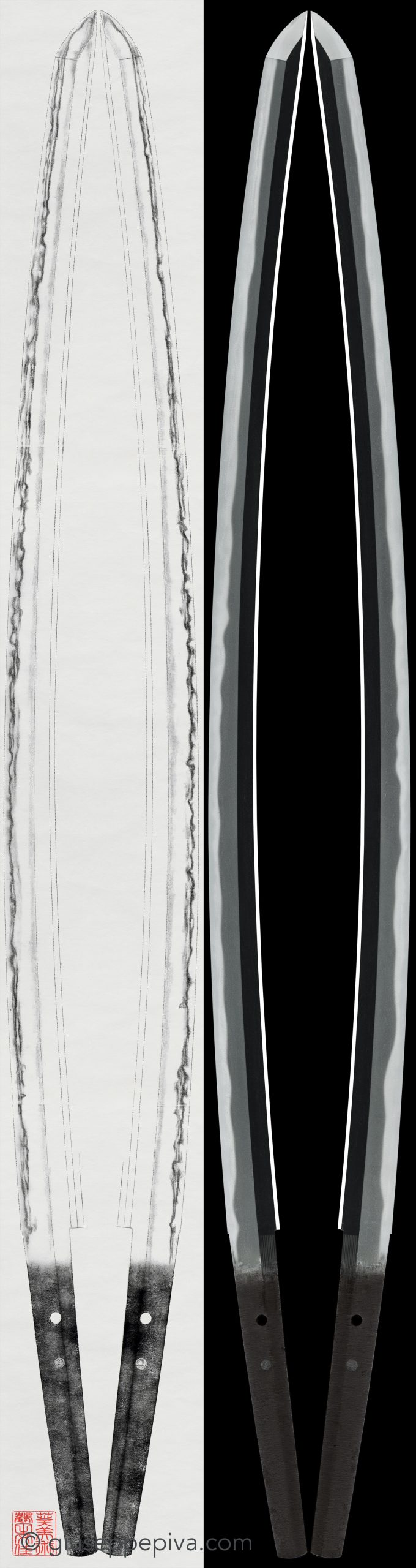
At the bold extreme the midare grows large and various, the yaki rises and falls strongly, rough nie mixes, tobiyaki and long yubashiri scatter, and on the most daring pieces the boshi fills with fire, sweeps into a flame form and runs long down the mune. The texts single these out: one Tokuju katana of Enbun-Joji build is called the very finest among Shizu attributions, and the signed kinzogan katana of Juyo 63 is read as so daring that the attribution to Kaneuji is confirmed by it.

Hamon 刃文
Bōshi 帽子

The calm pole, low quiet temper and suguha-cho

less firmly establishedthe works the texts call calm in style: the yaki kept low, a shallow ko-notare with ko-gunome, the ji given the stage; among the signed works one Jubi tachi is suguha-cho with ko-gunome, which the text itself sets apart from his other signed blades

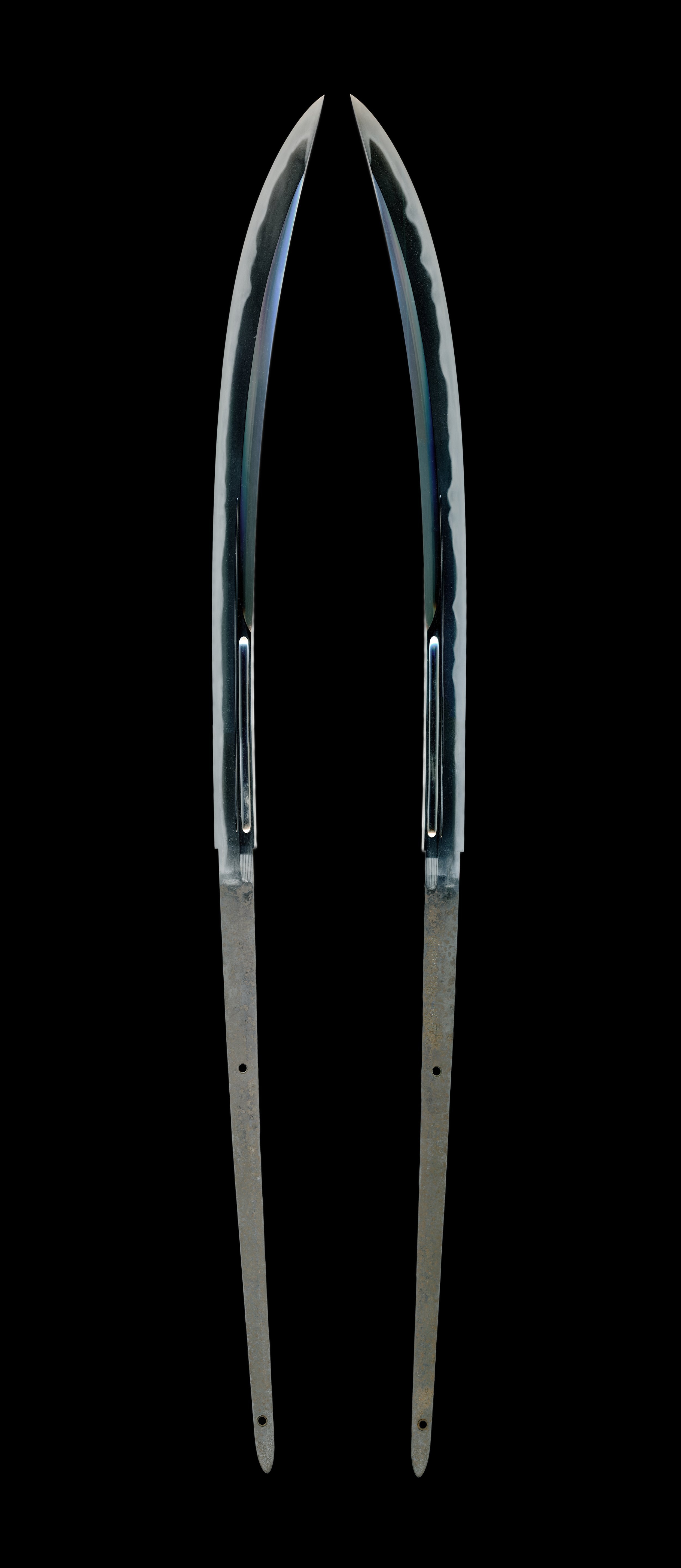
Beside the bold pole stands a quiet one: the temper low and even, a shallow notare or suguha-cho mixing ko-gunome, the nioiguchi deep and bright, the superbly forged ji carrying the piece. The texts mark these explicitly as the calm side of the Shizu kiwame, and the rare suguha-cho works, one signed tachi among them, show how far the register reaches.

Hamon 刃文
Bōshi 帽子
Scholarship

His origin is stated throughout: first a smith of the Yamato Tegai school named 包氏, he studied under Masamune and moved to Shizu in Mino, changing the writing of his name to 兼氏; the texts add that he thereby created the foundation of the Mino smiths.

No dated work of his exists; the texts fix his period indirectly, from the Kanno 1 (1350) date on his pupil Kanetsugu, placing his activity from the end of Kamakura into early Nanbokucho.

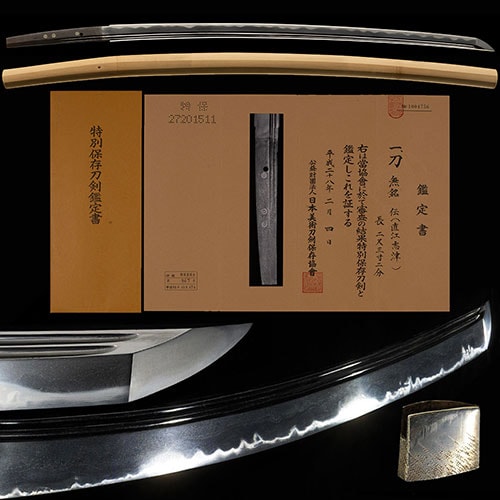
Signed works are exceedingly rare, the texts saying so in nearly identical words across decades; most of his work survives as o-suriage mumei, and a signed tachi is prized as material evidence for his ubu form.

The generations are an open question the texts handle through the mei: at least two Kaneuji are thought to exist in Nanbokucho, and Honma's view, recorded in the Jubi volume, is that the large boldly cut mei belong to the first generation and the small mei to the second and after, while noting the question deserves further study.

The first generation mei itself is described: angular and large is its characteristic, cut in fine chisel on the omote of the nakago toward the mune; old kinzogan attributions by Hon'ami hands and by Kanzan and Choshiki carry the kiwame on the mumei blades.

Honors

享保名物帳Kyōhō Meibutsu Chō (Catalog of Celebrated Blades)

Catalog 6 · burned 1 (7 total)

The Hon'ami family's catalog of celebrated blades (名物) presented to shogun Tokugawa Yoshimune in Kyōhō 4 (1719). Records ~274 blades of Heian–Nanbokuchō manufacture (168 extant + ~80 burned + ~26 later additions), grouped by smith with valuations and provenance. This honor tags smiths whose work is recorded in the catalog; the detail field carries per-smith counts where the published tally is exact, or 所載 + named blades where only inclusion is verified.

正宗十哲Masamune Juttetsu (Ten Brilliant Students of Masamune)

One of the Ten — closest of all to the master's style

The Ten Brilliant Students of Masamune — an Edo-period construct first attested in the Tōken Shōsan (刀剣正纂, 1862), which itself already disclaims the grouping as later conjecture. Several members cannot have been actual students on chronology (Kanemitsu, Chōgi, Kinjū, Naotsuna), and Norishige is now considered a fellow student under Shintōgo Kunimitsu — yet NBTHK setsumei invoke the roster constantly, and it remains core collector vocabulary. Roster variants exist (Sadamune in place of Naotsuna; Kongōbyōe Moritaka swapped in for Rai Kunitsugu or Naotsuna); this honor tags the standard ten.

Designations

Kokuhō—
Jūyō Bunkazai6
Jūyō Bijutsuhin9
Gyobutsu—
Tokubetsu Jūyō19
Jūyō Tōken122

Elite Standing

0.60 across 156 designated works

Top 4% among smiths

Provenance

46 documented provenances across certified works by Kaneuji

Provenance Standing

19 works held in elite collections across 46 documented provenances

Top 3% among smiths

Raw score: 3.33 / 10

Blade Forms

Distribution across 156 ranked works

Signatures

Signature types across 156 ranked works

Currently Available

Lineage

TeacherMasamune
Kaneuji
Students (6)
  1. 1.Nagamori長守1 for sale41designated
  2. 2.Kanetomo兼友11designated
  3. 3.Kaneuji兼氏3designated
  4. 4.Kanenobu兼信2designated
  5. 5.Kanetsugu兼次4designated
  6. 6.Kaneuji包氏2designated