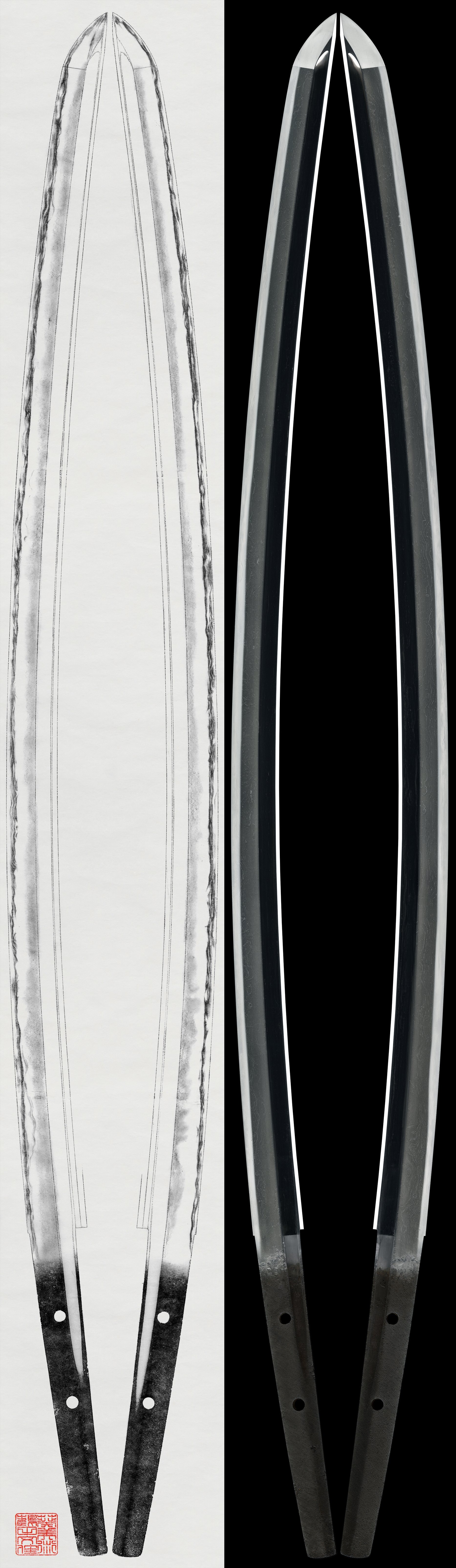
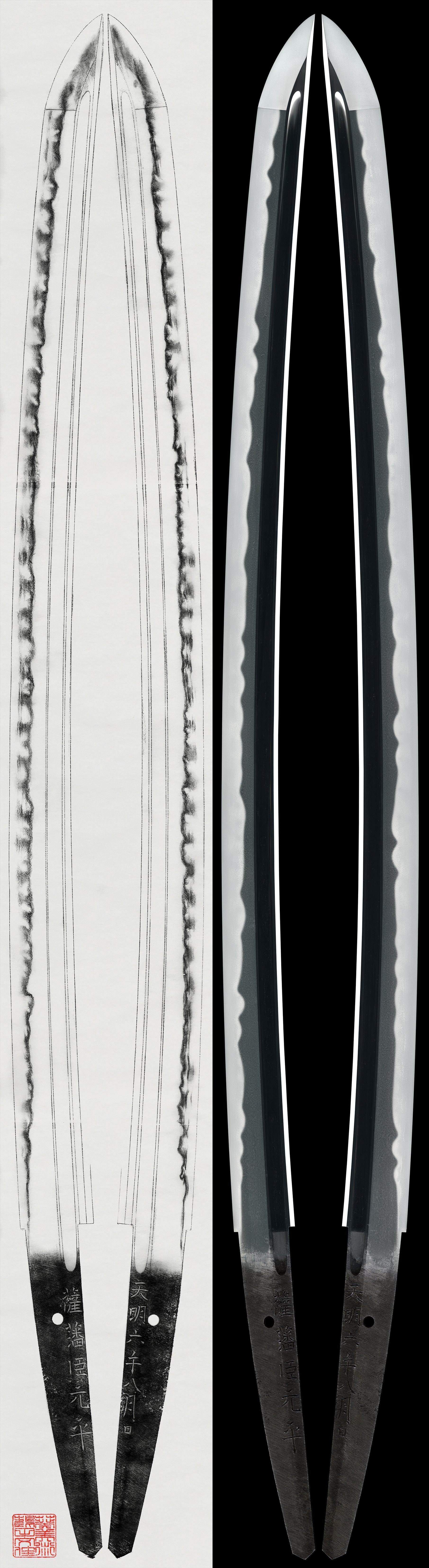
Sadayoshi worked in Takaichi District of Yamato Province, where the Hosho school flourished from the close of the period into the . The published sources, known from extant works to have placed the school at Takaichi, rank him with Sadamune as the two most celebrated hands of the line, recording that both styled themselves Hosho Goro (保昌五郎と称した). The smiths of the school all share the character as a common element of their names, Sadatsugu, Sadamune, Sadayoshi, Sadakiyo, Sadaoki and Sadamitsu among them, and among them Sadayoshi is the hand who most often inscribes his place of residence and a working date, so that his locale and period are clearly fixed. Of his signed swords on official record one is a of Karyaku 3 (1328), inscribed as a resident of Takaichi with the title Saemon-no-jo, and the long signatures recur with the era names Bunpo, Genko and Karyaku, anchoring his activity to the very end of . Fujishiro grades him Sai-jo , the highest of the rankings.
The forging is decisive and it is where his hand is read. Across the Hosho work the becomes an all-over , the straight grain running cleanly from to point, and on Sadayoshi it runs to a flowing tendency, the steel well refined and dense, with thick and fine and entering frequently. A stands along the grain. The published sources name the Hosho recognition exactly: the entangles with the very grain and frays repeatedly, and from around the upward the tempered width broadens while the turns suddenly stronger. Over the flowing he tempers a , often a carrying a shallow and small , and the edge breaks into recurrent , with , and along the . and run through it, the bright and clear, deep in and laden with . The pure full over a fraying , with and concentrated along the upper edge, is the Hosho tell, and it is most plainly shown here. The other Yamato schools forge a -leaning rather than this total straight grain.
The answers the temper. It runs essentially straight and ends , with vigorous toward the point, at times taking on a flame-like form, at times turning back in a small with coarse and in the return. The form is most often large, a point the published sources note as his habit, so that his rare small-built are recorded as exceptions to it. He works in and , and his blades include the Yamato forms less common elsewhere, a and a , the latter carrying carved on both faces. The tang is the school's signed point: filed in , the cross-hatched cypress-fence pattern, and cut off blunt at the tip, a named feature of recognition. On one Honma remarked that the dark tone of the steel is itself a point of the school, the published sources recording that among Yamato work this darkish iron color is a thing to be appreciated.
His work resolves into one coherent Hosho manner read in two registers, keyed to the form and to the state of the signature. The signed register is the , and that carry his long signatures recording location and date, several inscribed 'Yamato Takaichi-gun' or 'Washu Takaichi' with the titles Saemon-no-jo or Kingo, and the -filed, bluntly-cut tang intact beneath them. The unsigned register is the later given gold-inlaid attribution. Two such blades are on record, and on both the published sources affirm that the and display a typical and particularly outstanding Hosho excellence that fully supports the inlaid reading. One was inlaid by the house and records that the blade, owned by Mori Motoyasu, was shortened by the family. The other carries the gold attribution of Koichi, who counts as the ninth head of the main line from Kotoku.
Within Hosho the workmanship is uniform enough that the smiths are told apart chiefly by their signatures, and it is precisely here that Sadayoshi is the most knowable of the line, the one who records his residence and his date where the others leave only a two-character name. His place against the wider Yamato schools is drawn the way, by his own grounded traits rather than by contrast. The Hosho is, the published sources state and restate, the most distinctly individual of the five Yamato schools: where , , Shikkake and Senjuin work a -leaning , Hosho commits to the pure, total , and Sadayoshi's flowing total grain, his fraying with its and , and his tang carry the school's character at its plainest. The school carried this total- manner forward into the period.
Sadayoshi's designated record stands at one National Treasure and two Important Cultural Properties, with a and blades beneath them, five works in the and tiers and three more designated Bijutsuhin before the war. He is Sai-jo in Fujishiro's grading. The provenance recorded against his blades runs through the houses: a long-signed comes down through the Hosokawa family, the dated Karyaku 3 was held in Tokyo by Yamauchi Toyokage, the by Date Kiyoo of Hokkaido, and the -carved , of which the published sources note that signed Yamato are comparatively few, by Tokugawa Yoshihiro. The preserve, in their gold inlay, the names of Mori Motoyasu and the and appraisers. A Sadayoshi is among the scarcer things a collector may encounter. The National Treasure and Important Cultural Properties are patrimony, held and never traded; of the rest, the , and Bijutsuhin pieces are few in number and largely held rather than offered, so that a signed Hosho Sadayoshi reaching open hands is a rare event, a landmark when it comes, and not to be expected often.