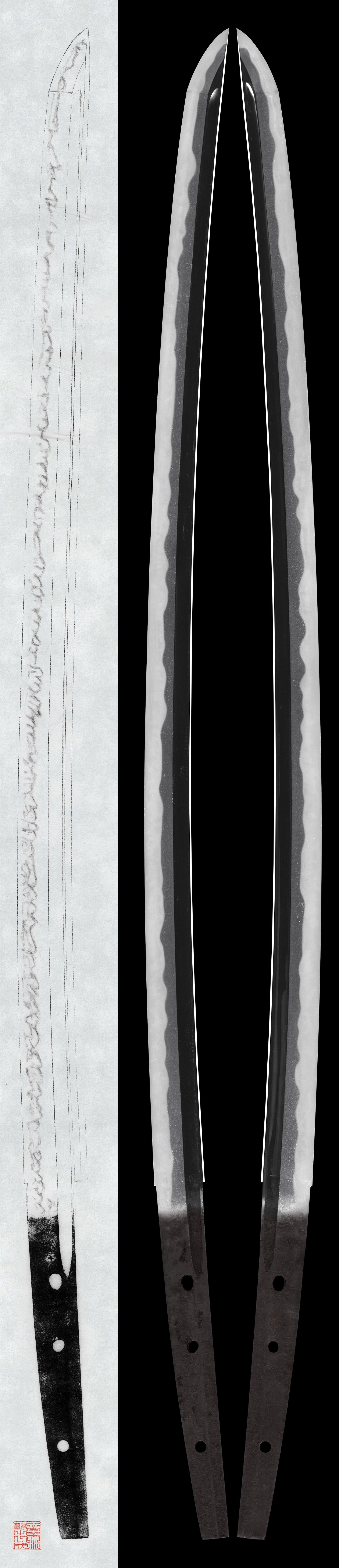
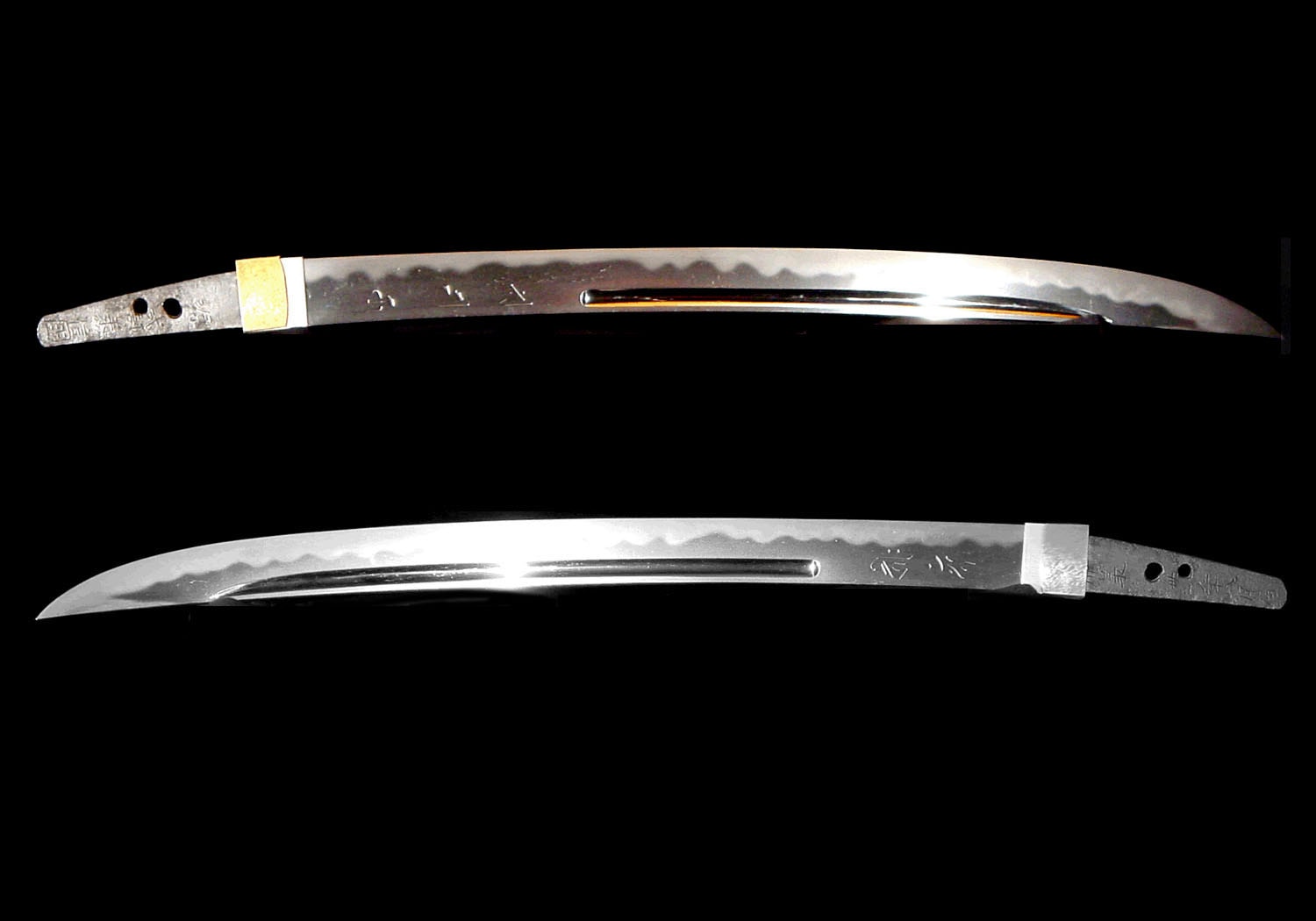
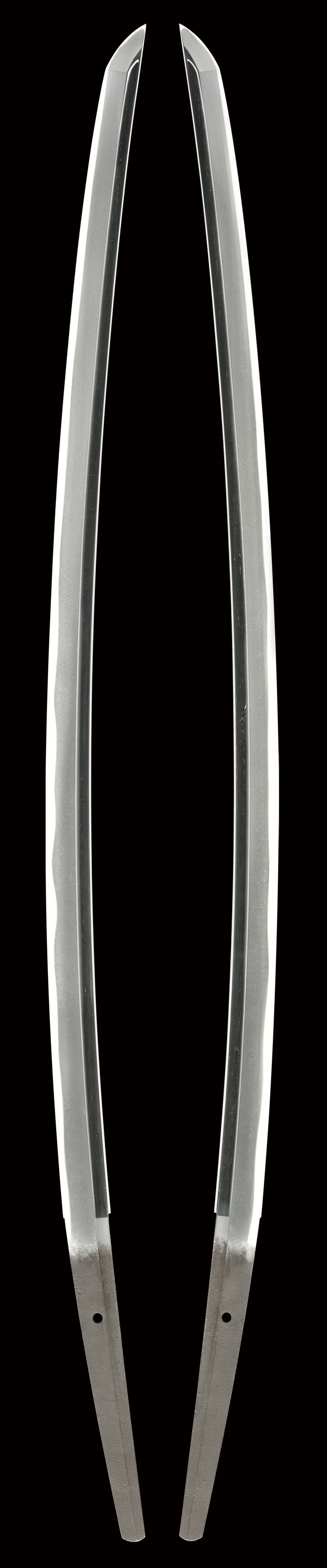
A of Hoei 7 (1710) signed "made of , an emulation of Fudo Kuniyuki" marks the working life of Shigekane, the smith whom the published sources rank highest in technical skill within his school. He was the son of Yoshikane, born in Enpo 1 (1673), known by the common name Harada Sukeroku and also Sukezaemon, and he worked at Fukuoka as a retained smith of the Kuroda house. His line was the branch of the Kyoto school, which had moved west and flourished as Kuroda kakae-ko from the Keicho era down to the beginning of Meiji; the published record names its representative makers Yoshisada, Yoshimasa, Yoshitsugu, Yoshikane and Shigekane, and of that company writes that "Shigekane in particular ranked high in technical skill within the group". In Kyoho 6 (1721), when he was forty-nine, he was summoned by the eighth shogun Yoshimune to and set to forge at the Hama Palace beside Mondo-no-sho Masakiyo of Satsuma and Ippei Yasuyo; his skill recognized, he was granted the single hollyhock crest to cut into the , and on returning home he renamed himself Masakane, dying in Kyoho 13 (1728) at the age of fifty-six.
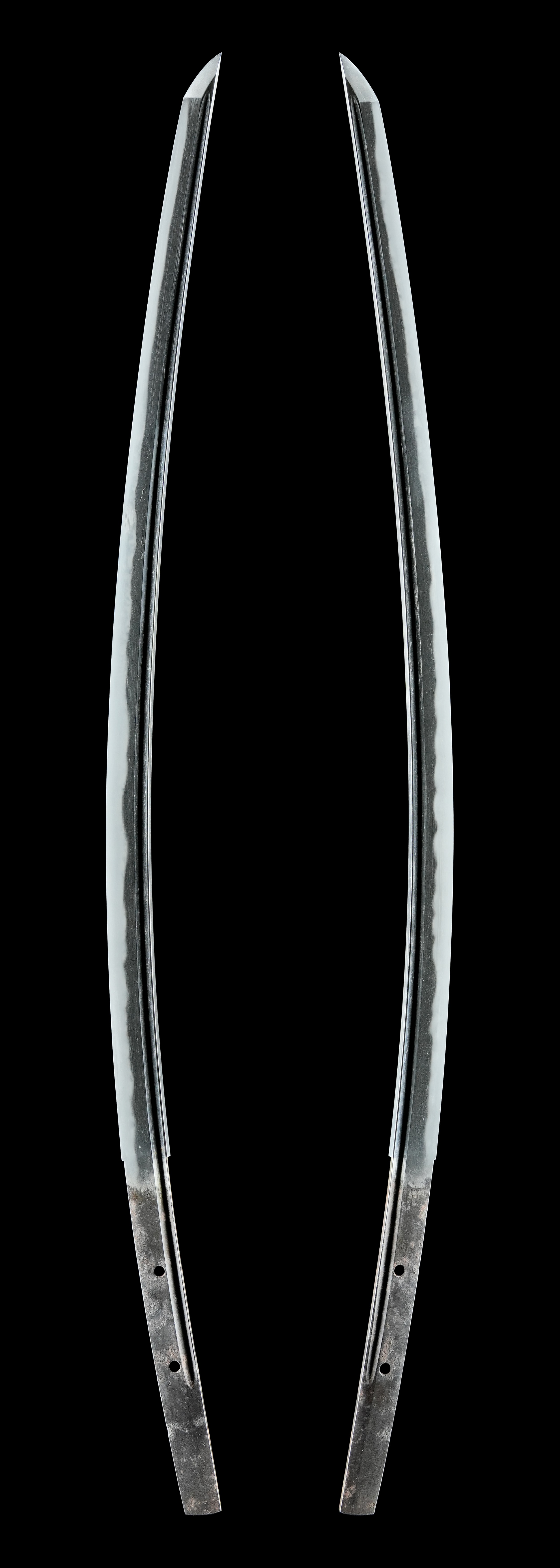
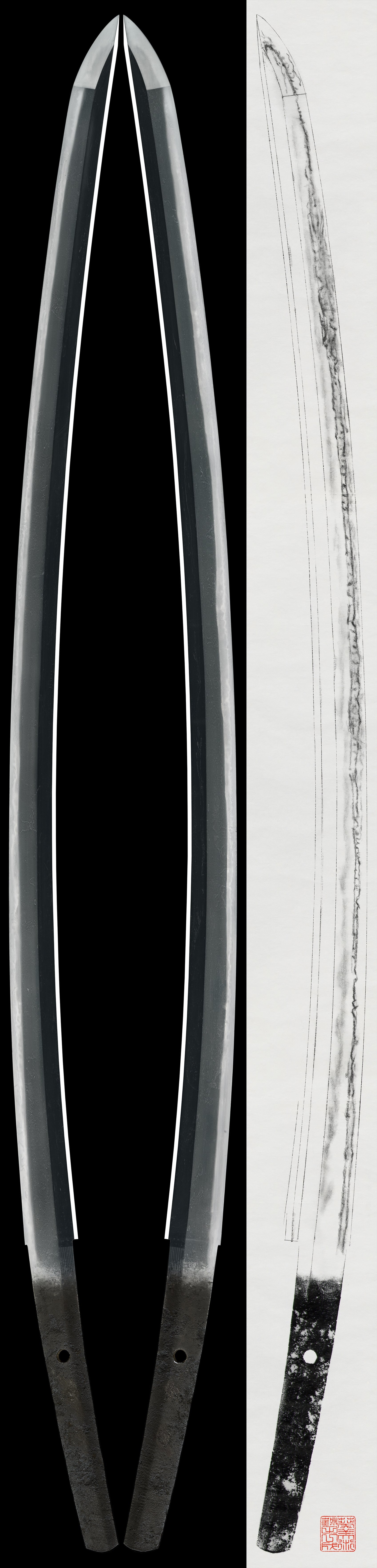
His representative hand is a flamboyant carried over a well-worked . On the of the thirty-first session the flows strongly into and mixes , adheres, enters, and a faint stands; over it the is wide, a into which and are interwoven, and entering well to a brilliant effect, with , fine and . So showy a temper, the published sources observe, can at a glance suggest a high-grade work of the Ishido lineage; but they draw the line at once. Against Ishido his and are the more conspicuous, while within the the is pronounced and the and stand out, and it is exactly there, the text concludes, that "the characteristics of Shigekane also appear". The runs into , tending on the toward an flavor, with .
The is what carries that distinction. It is an , at times flowing markedly into and mixing , the thick and the plain, and it is on this steel that the faint rises, the trace of old and Yamashiro the Ishido smiths did not keep so clearly. Where the temper grows quieter the becomes a dense , as on the Hoei 7 . Through the the activity is constant rather than gathered into set patterns: and enter, runs, appear, and on the Hama Palace the is bright and clear. The are a part of the picture, the Taki-Fudo and cut in relief within the grooves of the two blades, deeply chiselled and dense, an iconography fitted to the Fudo Kuniyuki he was copying.
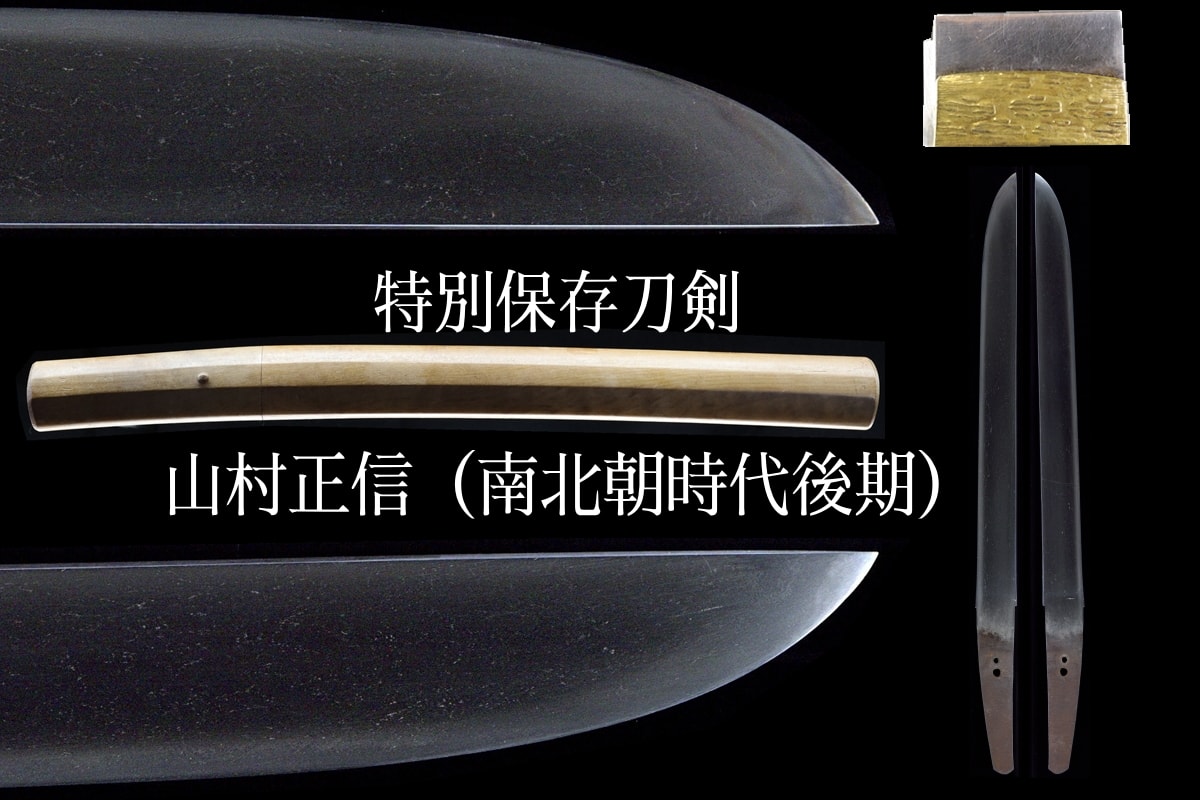
Within one prime period his work divides into two registers the texts present together. The first is the flamboyant just described, the showy side of his range. The second is a quieter manner tied to his fame as a copyist of : a or mixing a pointed tendency and -like elements, entering, the deep or brightly clear. The published sources record that he was adept at -mono and that there are blades bearing added inscriptions such as "Fudo Kuniyuki " and "Masamune " (「不動国行写」・「正宗写」などと添銘したものがあり、写し物も得意としている). The Hoei 7 is the named example: its -and- temper is called rare for him, a deliberate reach toward the Fudo Kuniyuki, and the text judges the attempt a success of fine workmanship. His designated blades are all signed, three of them carrying the long signature Chikushu-ju Minamoto Shigekane boldly cut on an , one adding the date and circumstances of manufacture in three lines.
The project is what most clearly sets him apart, because it is documented as well as visible. The of the thirty-first session bears no added inscription, yet the published sources transmit it as a copy of the Nikko and find that intention fully legible in its flamboyant tempering. The Hama Palace goes further: it is "a copy of the celebrated Fudo Kuniyuki", and it corresponds closely in both dimensions and carvings to the recorded under that name in the Kotoku Toezu, while the inscription cut into its tang fixes that it was forged at the Hama Palace on that occasion. His own bright, clear and , his conspicuous and his pronounced are what separate these copies from the Ishido work their outline resembles, and they place him securely as the leading hand of the line rather than a borrower of another school's manner.
Fujishiro grades him Jo , and four designated works stand on the official record, all of them and all signed. The provenance is led by the Hama Palace of the fifty-ninth session, called "a particularly painstaking work made in response to a shogunal command" and transmitted, in the words of the published record, as "a blade handed down within the Great Tokugawa house"; it survives both as a sword and as a document of the Kyoho forging at . The others passed through Tokyo and Fukuoka collectors of recorded whereabouts. His record carries no higher cultural-property designation, so the question of patrimony locked beyond the market does not arise; what a collector may realistically encounter is a blade of this small, even body of work, signed and often dated, coming to light only from time to time and a notable occasion when one does. For its rarity and for the historical episode it preserves, the shogunal-command is among the more telling things a student of could meet, and the four together give an exact measure of the technical level the published sources credit to the head of the school.