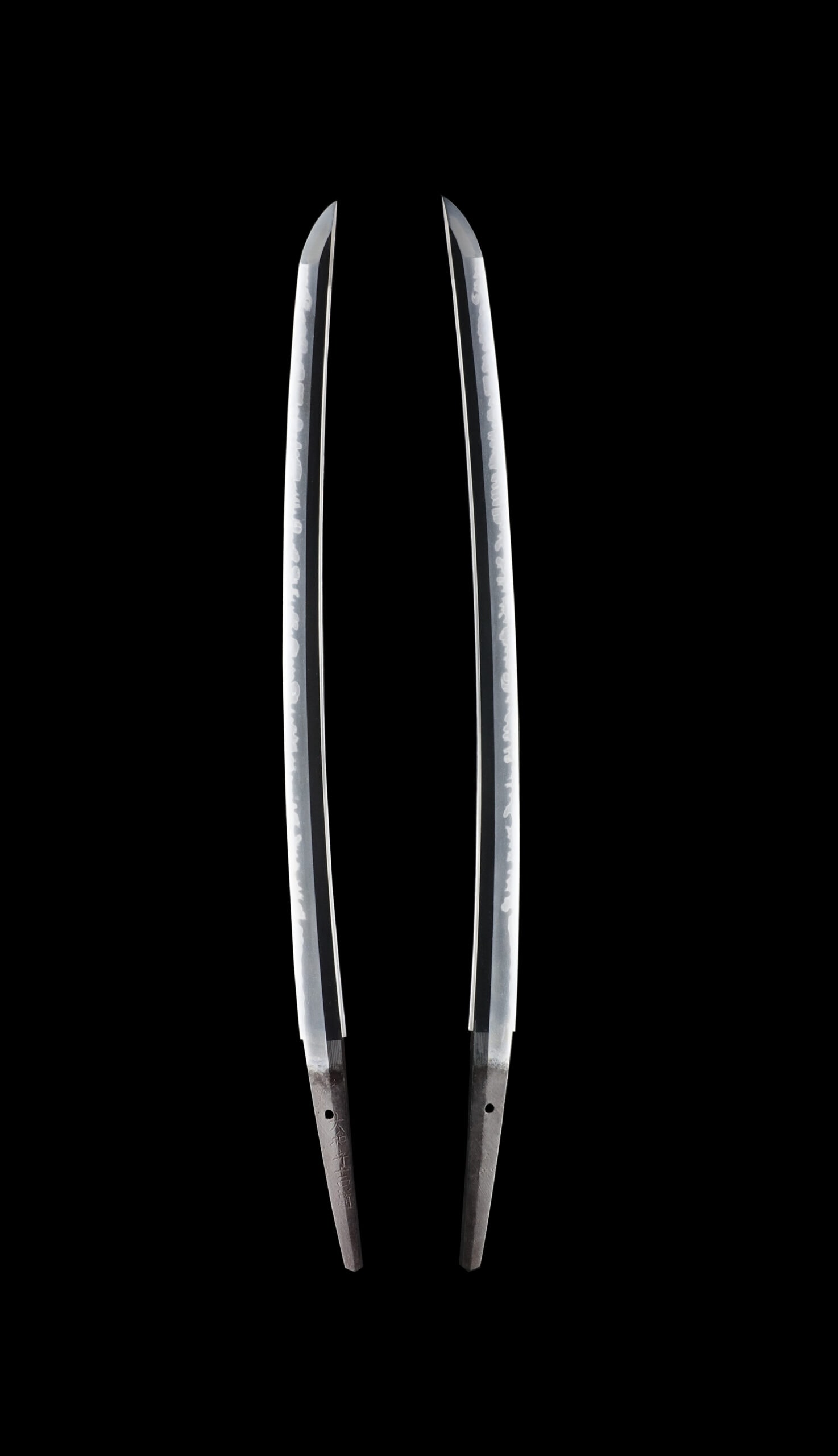
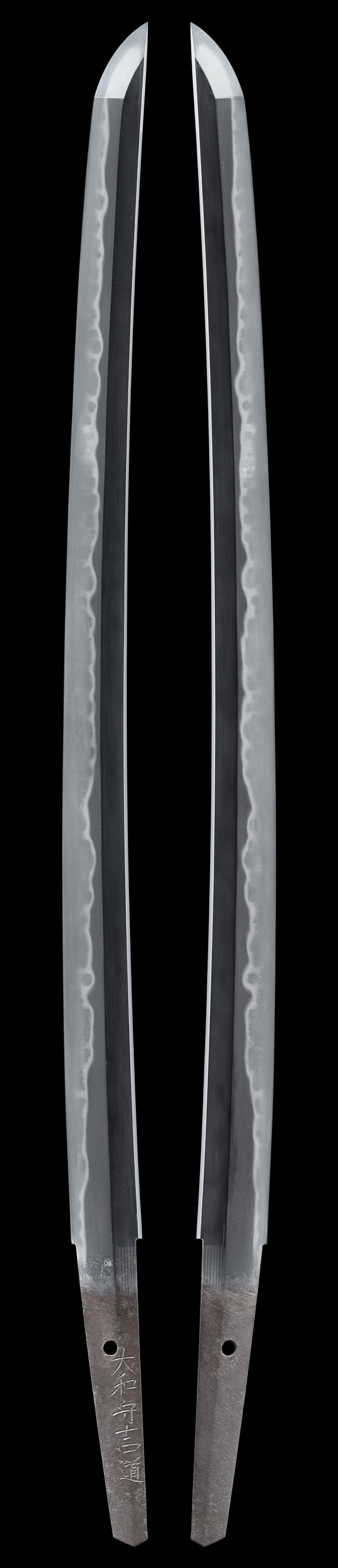
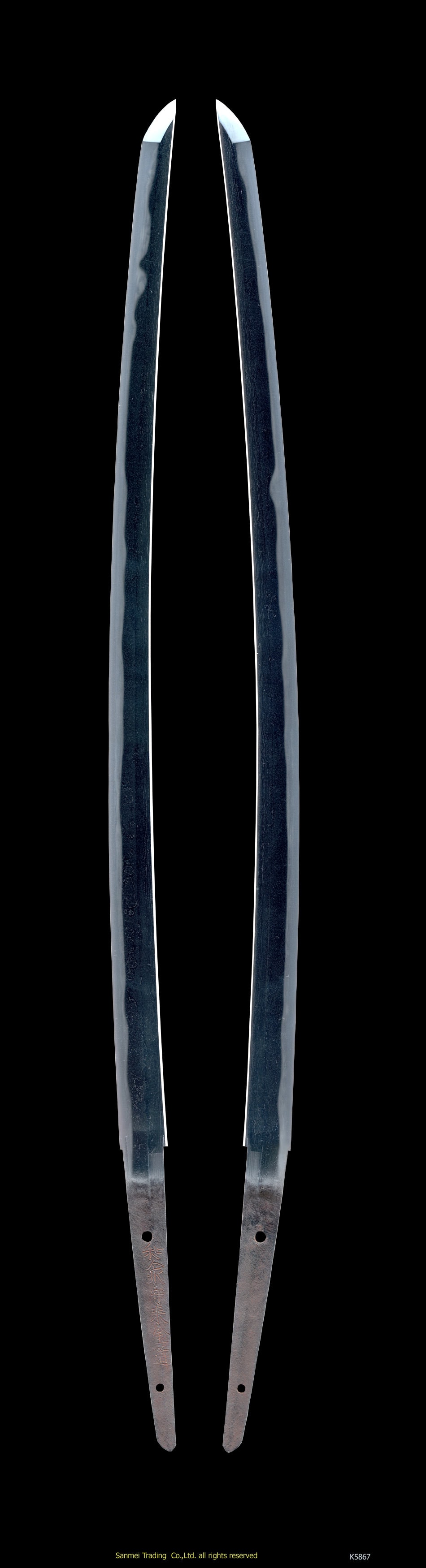
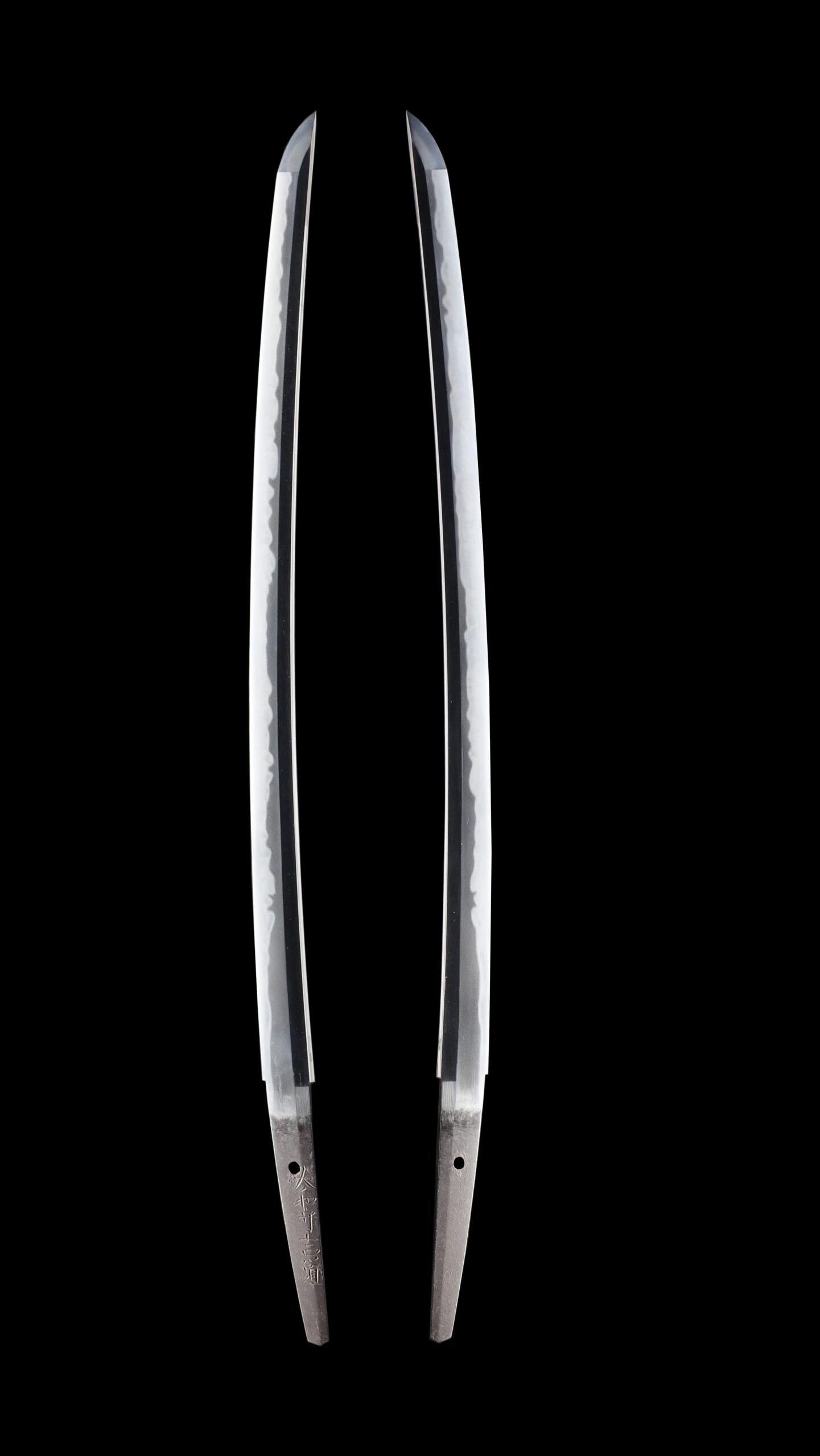
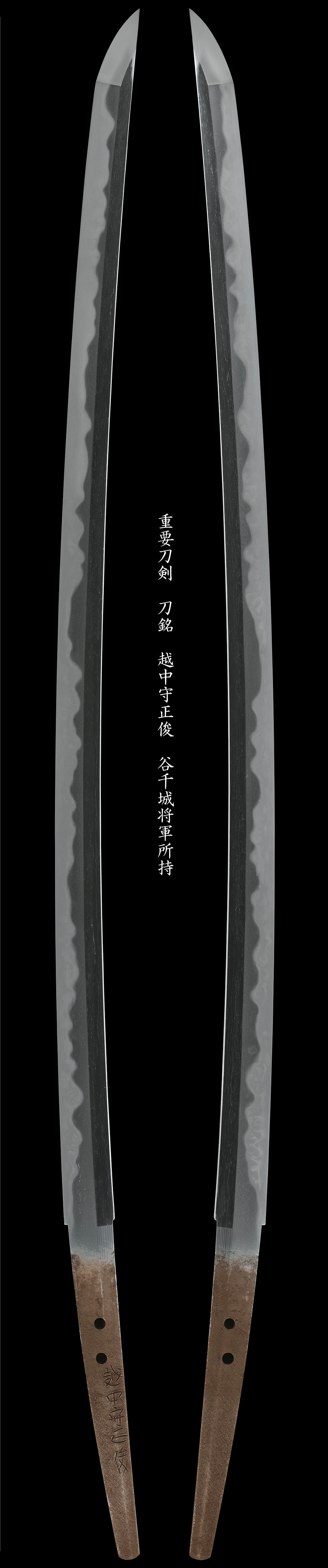
Iga no Kami Kinmichi was the eldest of the four sons of Kanemichi of -Seki, and with his father and his three younger brothers, Izumi no Kami () Kinmichi, Tanba no Kami Yoshimichi and no Kami Masatoshi, he came up to Kyoto and settled at Nishinotoin Ebisugawa, where the published sources record that he 'greatly raised the name of the school'. He stands as the founding hand of the , or , line of Kyoto , head of the so-called Kyo go-kaji, the five Kyoto smiths, and the Jubi commentary on his shortened names him a master smith of Japan, one who 'was active as a Nihon kaji sosho'. From the second generation the house held a hereditary right to recommend smiths to the court for their titles, and added that by-line to its signatures. The name continued under the appellation to the end of the period, but the published record holds the first generation the most outstanding of the line.
His work is read across his court title, and that division is the spine of his . Before he received the Iga no Kami rank, around the Tensho years, the published sources call his manner essentially that of late : 'his workmanship at this stage is the very thing of ', a somewhat whitish forging carrying pointed , or else - and , the tending to tighten with small , and the so-called not yet formed. Several signed blades of this phase stay close to the home style of the four brothers, a - akin to that of Kanesada and Ujifusa, a small mixed with that recalls the ; the judges read him as the brother who carried the inheritance most faithfully.
After he received his title his manner is renewed, and here lies the body of his recognized record. The published sources describe how 'his range was renewed into a manner', the mode in which he most excelled. Over an mixed with and a strong flowing toward the , the grain standing, fine adheres thickly and enter well. The temper is a large built on a small , mixing , angular elements and pointed teeth; the is strong and at times coarse, gathering unevenly; vigorous runs through it, long enter, and and small cross the edge, the tending to sink. It is a hand of and activity grafted onto a root, and the swordbooks note he was accomplished across the , Seki, Yamato and traditions alike.
The is the constant beneath both phases. An that flows into toward the , the grain standing, with thick fine and frequent , carries the -Seki inheritance through into the Kyoto work; on the finest blades a rises from just above the . Over it the late temper is restless rather than calm, the clustering unevenly and breaking down in places, the often forming striping with the . The is the clearest single tell: a or run-in, the tip pointed with vigorous , the that is explicitly absent from the early phase and manifest in the late. Around the middle of his -mode blades the strong gathers until the temper takes on a basket-weave aspect, the budding of , and it is this seed that would define the school under his successors.
What sets him apart is exactly what the judges name. He is held apart from his native past by the strength of the , the and , and the emergent and that the early work lacks; and the manner that is his prime was a specialty he shared with his youngest brother, no Kami Masatoshi, some of his blades reading as if copied from . His signatures come as a three-character Kinmichi-, a five-character , and a Fujiwara-prefixed seven-character form, with dated examples rare, so the manner of the signature joins the workmanship in placing a blade within his line. He is the root from which the school grew into one of the great houses of Kyoto .
For the collector he is a foundational name. Fujishiro grades the first generation Jo-jo . He has no National Treasures and no Important Cultural Properties; his record runs instead through the prewar Bijutsuhin and the modern tiers, with four blades raised to and eighteen to , the published sources calling his finest the masterpiece and 'the finest example of Kanemichi', a blade brimming with commanding spirit and sound in both and . Provenance on record is sparse but real: one was among the cherished swords of Tani Tateki, and the Bijutsuhin blade passed through the Satake family. Roughly two dozen of his blades stand in the and tiers, of which only a small number trade, so a signed first-generation Iga no Kami Kinmichi comes to light only from time to time, and with patience one may be encountered: a document of how the school began.