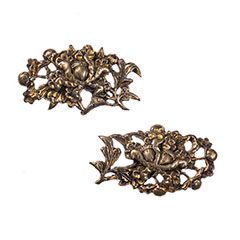
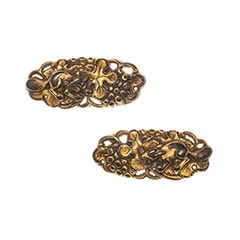
This is a pair of Ezo style menuki featuring a peony design. Made from shibuichi with katachibori carving and gold plating, these fittings are attributed to the Ezo group of sword fittings makers active from the Nanbokucho to early Muromachi period. They are accompanied by a Tokubetsu Hozon Tosogu certificate from the NBTHK.
Ezo · Muromachi

Ezo School
Muromachi
Tokuho (NBTHK)
Kinko · Ezo
3 pieces on the market now
The Ezo tradition designates a collective body of sword-fitting metalworkers active from the Nanbokucho period through the early Muromachi period, producing a distinctive class of mountings commonly known as Ezo-kanamono. "[[c:1]] What unifies the group is not a documented lineage of masters but a recognizable material vocabulary and a shared archaic character that the designation sessions have identified with remarkable consistency across nearly four decades of appraisal. The technical hallmarks of Ezo work center on the use of yamagane or oborogin as the ground metal, "ranging from those with a whitish cast to those tending toward black,"[[c:3]] over which gilding is applied to the entire surface. " Scale is a defining feature: Ezo menuki are consistently described as large or exceptionally large, with "a bold, imposing presence"[[c:4]] suited to tachi and other full-length mountings.
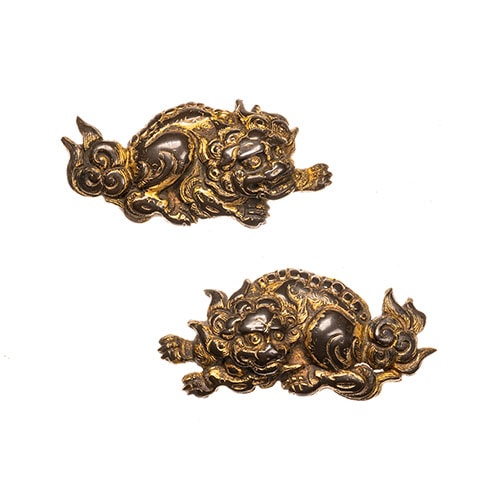
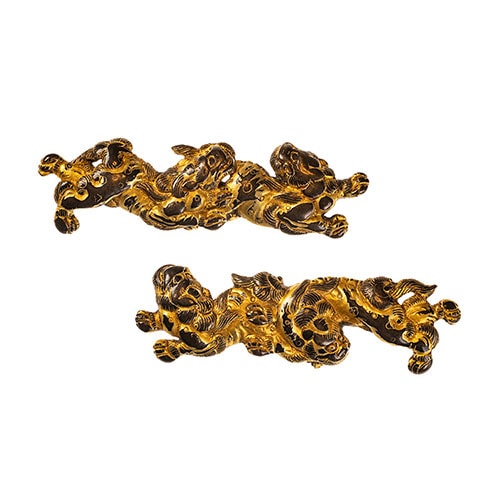
In the finest examples, vigorous chisel handling produces figures of considerable force — paired lions, baku, peonies — rendered "in a bold and powerful manner" through confident, incisive cuts. "[[c:5]] Gilding techniques include kin-tokin, usukin-dashi, and keshi-watakin, and the works are occasionally finished with iroe accents. The most distinctive quality of Ezo-kanamono, and the one the NBTHK returns to in virtually every appraisal, is the transformation wrought by age upon the gilded surface. As the gold wears through use and time, it enters the condition called suri-hagashi — a state of rubbed and abraded wear in which the dark ground metal emerges through the thinning gilt. Learn more →
| Smith | Era | Designated |
|---|---|---|
| Ono Goshi小野剛資 | Nanbokucho | 1 |
A Hozon-certified fitting of notably superior craftsmanship and condition, often with signature or workmanship of high reference value.
The NBTHK (Nihon Bijutsu Tōken Hozon Kyōkai, the Society for the Preservation of Japanese Art Swords) is a public-interest incorporated foundation founded in 1948 and supervised by Japan’s Agency for Cultural Affairs (Bunkachō); it is based at the Japanese Sword Museum in Tokyo. Its expert panels physically examine each submitted work (shinsa) and issue a certificate (kanteishō) ranking it by artistic and historical merit. NBTHK papers are the most widely recognized standard of authentication for Japanese swords and fittings.
NBTHK official siteReturns/exchanges/cancellations not accepted after shipment except for significant defects; if defective, return/exchange possible within 3 days of arrival (return shipping paid by customer).
This is a pair of Ezo style menuki featuring a peony design. Made from shibuichi with katachibori carving and gold plating, these fittings are attributed to the Ezo group of sword fittings makers active from the Nanbokucho to early Muromachi period. They are accompanied by a Tokubetsu Hozon Tosogu certificate from the NBTHK.
Ezo · Muromachi

Ezo School
Muromachi
Tokuho (NBTHK)
Kinko · Ezo
3 pieces on the market now
The Ezo tradition designates a collective body of sword-fitting metalworkers active from the Nanbokucho period through the early Muromachi period, producing a distinctive class of mountings commonly known as Ezo-kanamono. "[[c:1]] What unifies the group is not a documented lineage of masters but a recognizable material vocabulary and a shared archaic character that the designation sessions have identified with remarkable consistency across nearly four decades of appraisal. The technical hallmarks of Ezo work center on the use of yamagane or oborogin as the ground metal, "ranging from those with a whitish cast to those tending toward black,"[[c:3]] over which gilding is applied to the entire surface. " Scale is a defining feature: Ezo menuki are consistently described as large or exceptionally large, with "a bold, imposing presence"[[c:4]] suited to tachi and other full-length mountings.
In the finest examples, vigorous chisel handling produces figures of considerable force — paired lions, baku, peonies — rendered "in a bold and powerful manner" through confident, incisive cuts. "[[c:5]] Gilding techniques include kin-tokin, usukin-dashi, and keshi-watakin, and the works are occasionally finished with iroe accents. The most distinctive quality of Ezo-kanamono, and the one the NBTHK returns to in virtually every appraisal, is the transformation wrought by age upon the gilded surface. As the gold wears through use and time, it enters the condition called suri-hagashi — a state of rubbed and abraded wear in which the dark ground metal emerges through the thinning gilt. Learn more →
| Smith | Era | Designated |
|---|---|---|
| Ono Goshi小野剛資 | Nanbokucho | 1 |
A Hozon-certified fitting of notably superior craftsmanship and condition, often with signature or workmanship of high reference value.
The NBTHK (Nihon Bijutsu Tōken Hozon Kyōkai, the Society for the Preservation of Japanese Art Swords) is a public-interest incorporated foundation founded in 1948 and supervised by Japan’s Agency for Cultural Affairs (Bunkachō); it is based at the Japanese Sword Museum in Tokyo. Its expert panels physically examine each submitted work (shinsa) and issue a certificate (kanteishō) ranking it by artistic and historical merit. NBTHK papers are the most widely recognized standard of authentication for Japanese swords and fittings.
NBTHK official siteReturns/exchanges/cancellations not accepted after shipment except for significant defects; if defective, return/exchange possible within 3 days of arrival (return shipping paid by customer).