NihontoWatch Mon

NihontoWatch

Market
Encyclopedia
Kantei
NihontoWatch Mon

NihontoWatch

Market
Encyclopedia
Kantei

Description

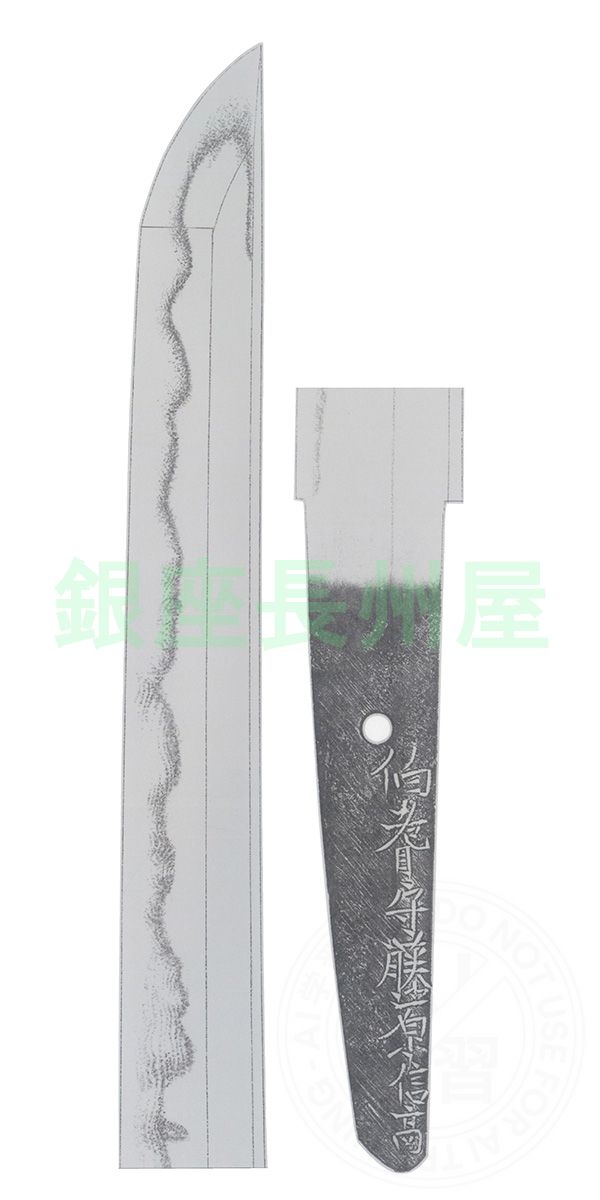
The third generation Hoki no Kami Nobutaka was the legitimate son of the second generation Kanyujindo, and his common name was Kawamura Sannojo. He received the title of Hoki no Kami in Kanbun 5. Among the various generations of Nobutaka, he left the most works. In response to the family traditions of the Owari Tokugawa clan which encouraged martial arts, a robust tsukurikomi was preferred. In that region, he was highly prized alongside Ujifusa and Masatsune, and they are praised as the Owari Sansaku (Three Masters of Owari). Since works by the third generation Nobutaka exist with the soemei "Heishi Toshikane Shoji no nari" (Owned by Toshikane of the Taira clan), one can glimpse an interaction with Yagyu Renyasai Toshikane, who served the second Owari Tokugawa lord Mitsutomo and held a fief of 800 koku. It is imagined that he received guidance on swordsmanship regarding the sugata and tsukurikomi. The titled wakizashi has an extremely wide mihaba and thick kasane, a sturdy tsukurikomi unique to Owari Shinto. The jitetsu of ko-itame mixed with itame is beautifully tightened and clear, with fine ji-nie appearing over the entire surface, and undulating chikei make the hadame stand out, expressing a tough character here as well. The hamon, consisting of continuous large and small gunome in a toran-midare style forming large mountain shapes, is accompanied by active ashi. It is gorgeously decorated with piercing gunome in places and tobiyaki. The boshi on the omote is ko-maru kaeri with faint hakikake, and on the ura, a sphere is tempered at the tip with a midare-kaeri. The yakiba, primarily ko-nie mixed with nioi, is remarkably bright; nie flows along the habuchi creating delicate hotsure, and in the middle of the toshin, kinsen flows across the ko-ashi. The nakago has a good feel in the hand, with the mei carved in powerful strokes.

NihontoWatch MonNihontoWatch
MarketEncyclopediaKantei
Swords›Nobutaka›Tokubetsu Hozon Wakizashi by Hoki no kami Fujiwara no Nobutaka (3rd generation)
wakizashiTokubetsu Hozon
Nobutaka

Tokubetsu Hozon Wakizashi by Hoki no kami Fujiwara no Nobutaka (3rd generation)

Shinto · nagasa 54.8cm

¥800,000
Visit seller website →
Nobutaka — 1 of 10
Nobutaka — 2 of 10
Nobutaka — 3 of 10
Nobutaka — 4 of 10
Nobutaka — 5 of 10
Nobutaka — 6 of 10
Nobutaka — 7 of 10
Nobutaka — 8 of 10
Nobutaka — 9 of 10
Nobutaka — 10 of 10
1 / 10
1 / 10
Nobutaka — 1 of 10Nobutaka — 2 of 10Nobutaka — 3 of 10Nobutaka — 4 of 10Nobutaka — 5 of 10Nobutaka — 6 of 10Nobutaka — 7 of 10Nobutaka — 8 of 10Nobutaka — 9 of 10Nobutaka — 10 of 10
Measurements & details
Smith
Nobutaka
Type
Wakizashi
Period
Around 1624–1644(Kanei)
Measurements
Nagasa 54.8cm
Description

The third generation Hoki no Kami Nobutaka was the legitimate son of the second generation Kanyujindo, and his common name was Kawamura Sannojo. He received the title of Hoki no Kami in Kanbun 5. Among the various generations of Nobutaka, he left the most works. In response to the family traditions of the Owari Tokugawa clan which encouraged martial arts, a robust tsukurikomi was preferred. In that region, he was highly prized alongside Ujifusa and Masatsune, and they are praised as the Owari Sansaku (Three Masters of Owari). Since works by the third generation Nobutaka exist with the soemei "Heishi Toshikane Shoji no nari" (Owned by Toshikane of the Taira clan), one can glimpse an interaction with Yagyu Renyasai Toshikane, who served the second Owari Tokugawa lord Mitsutomo and held a fief of 800 koku. It is imagined that he received guidance on swordsmanship regarding the sugata and tsukurikomi. The titled wakizashi has an extremely wide mihaba and thick kasane, a sturdy tsukurikomi unique to Owari Shinto. The jitetsu of ko-itame mixed with itame is beautifully tightened and clear, with fine ji-nie appearing over the entire surface, and undulating chikei make the hadame stand out, expressing a tough character here as well. The hamon, consisting of continuous large and small gunome in a toran-midare style forming large mountain shapes, is accompanied by active ashi. It is gorgeously decorated with piercing gunome in places and tobiyaki. The boshi on the omote is ko-maru kaeri with faint hakikake, and on the ura, a sphere is tempered at the tip with a midare-kaeri. The yakiba, primarily ko-nie mixed with nioi, is remarkably bright; nie flows along the habuchi creating delicate hotsure, and in the middle of the toshin, kinsen flows across the ko-ashi. The nakago has a good feel in the hand, with the mei carved in powerful strokes.

About the maker

Nobutaka

信高

Tosa · around 1624-1644

1 piece on the market now

›
1 work by Nobutaka on the market→
Nobutaka — full profile

Historical context

For two and a half centuries of peace the sword was the warrior’s legal badge rather than his weapon. Each great city developed its own manner, Edo’s tested strength against Ōsaka’s polished brilliance, until demand thinned in the era’s last decades.

The Edo period (1615 to 1868) →

NBTHK Certificate
Tokubetsu Hozon Tōken特別保存刀剣
Sword Especially Worthy of Preservation
›

A Hozon-certified blade judged to show notably superior workmanship and a better state of preservation. The bar is higher: re-tempered blades and most unsigned Muromachi/Edo works are excluded.

About the NBTHK›

The NBTHK (Nihon Bijutsu Tōken Hozon Kyōkai, the Society for the Preservation of Japanese Art Swords) is a public-interest incorporated foundation founded in 1948 and supervised by Japan’s Agency for Cultural Affairs (Bunkachō); it is based at the Japanese Sword Museum in Tokyo. Its expert panels physically examine each submitted work (shinsa) and issue a certificate (kanteishō) ranking it by artistic and historical merit. NBTHK papers are the most widely recognized standard of authentication for Japanese swords and fittings.

NBTHK official site→

Seller
C
Choshuya
🇯🇵Ships from Japan
›
✓Verified dealerwww.choshuya.co.jp
Settles in JPY
✓Ships worldwide✓English support
Return policy

If, due to our fault, the item differs significantly from its proper condition, the item may be returned. Cooling-off is within one week of the item's arrival.

View all of Choshuya’s listings→View this item on the dealer’s site→

Swords

  • Katana
  • Wakizashi
  • Tantō
  • Tachi
  • Naginata
  • Yari

Fittings

  • Tsuba
  • Fuchi-Kashira
  • Kozuka
  • Menuki

Armor

  • Kabuto
  • Samurai Armor

By Certification

  • Tokujū
  • Jūyō
  • Tokuho
  • Hozon

Resources

  • Dealer Directory
  • Artist Directory
  • The Daily Kantei
  • Glossary
  • Browse All
Nihontowatch© 2026
TermsPrivacyCookiesAbout

Description

The third generation Hoki no Kami Nobutaka was the legitimate son of the second generation Kanyujindo, and his common name was Kawamura Sannojo. He received the title of Hoki no Kami in Kanbun 5. Among the various generations of Nobutaka, he left the most works. In response to the family traditions of the Owari Tokugawa clan which encouraged martial arts, a robust tsukurikomi was preferred. In that region, he was highly prized alongside Ujifusa and Masatsune, and they are praised as the Owari Sansaku (Three Masters of Owari). Since works by the third generation Nobutaka exist with the soemei "Heishi Toshikane Shoji no nari" (Owned by Toshikane of the Taira clan), one can glimpse an interaction with Yagyu Renyasai Toshikane, who served the second Owari Tokugawa lord Mitsutomo and held a fief of 800 koku. It is imagined that he received guidance on swordsmanship regarding the sugata and tsukurikomi. The titled wakizashi has an extremely wide mihaba and thick kasane, a sturdy tsukurikomi unique to Owari Shinto. The jitetsu of ko-itame mixed with itame is beautifully tightened and clear, with fine ji-nie appearing over the entire surface, and undulating chikei make the hadame stand out, expressing a tough character here as well. The hamon, consisting of continuous large and small gunome in a toran-midare style forming large mountain shapes, is accompanied by active ashi. It is gorgeously decorated with piercing gunome in places and tobiyaki. The boshi on the omote is ko-maru kaeri with faint hakikake, and on the ura, a sphere is tempered at the tip with a midare-kaeri. The yakiba, primarily ko-nie mixed with nioi, is remarkably bright; nie flows along the habuchi creating delicate hotsure, and in the middle of the toshin, kinsen flows across the ko-ashi. The nakago has a good feel in the hand, with the mei carved in powerful strokes.

NihontoWatch MonNihontoWatch
MarketEncyclopediaKantei
Swords›Nobutaka›Tokubetsu Hozon Wakizashi by Hoki no kami Fujiwara no Nobutaka (3rd generation)
wakizashiTokubetsu Hozon
Nobutaka

Tokubetsu Hozon Wakizashi by Hoki no kami Fujiwara no Nobutaka (3rd generation)

Shinto · nagasa 54.8cm

¥800,000
Visit seller website →
Nobutaka — 1 of 10
Nobutaka — 2 of 10
Nobutaka — 3 of 10
Nobutaka — 4 of 10
Nobutaka — 5 of 10
Nobutaka — 6 of 10
Nobutaka — 7 of 10
Nobutaka — 8 of 10
Nobutaka — 9 of 10
Nobutaka — 10 of 10
1 / 10
1 / 10
Nobutaka — 1 of 10Nobutaka — 2 of 10Nobutaka — 3 of 10Nobutaka — 4 of 10Nobutaka — 5 of 10Nobutaka — 6 of 10Nobutaka — 7 of 10Nobutaka — 8 of 10Nobutaka — 9 of 10Nobutaka — 10 of 10
Measurements & details
Smith
Nobutaka
Type
Wakizashi
Period
Around 1624–1644(Kanei)
Measurements
Nagasa 54.8cm
Description

The third generation Hoki no Kami Nobutaka was the legitimate son of the second generation Kanyujindo, and his common name was Kawamura Sannojo. He received the title of Hoki no Kami in Kanbun 5. Among the various generations of Nobutaka, he left the most works. In response to the family traditions of the Owari Tokugawa clan which encouraged martial arts, a robust tsukurikomi was preferred. In that region, he was highly prized alongside Ujifusa and Masatsune, and they are praised as the Owari Sansaku (Three Masters of Owari). Since works by the third generation Nobutaka exist with the soemei "Heishi Toshikane Shoji no nari" (Owned by Toshikane of the Taira clan), one can glimpse an interaction with Yagyu Renyasai Toshikane, who served the second Owari Tokugawa lord Mitsutomo and held a fief of 800 koku. It is imagined that he received guidance on swordsmanship regarding the sugata and tsukurikomi. The titled wakizashi has an extremely wide mihaba and thick kasane, a sturdy tsukurikomi unique to Owari Shinto. The jitetsu of ko-itame mixed with itame is beautifully tightened and clear, with fine ji-nie appearing over the entire surface, and undulating chikei make the hadame stand out, expressing a tough character here as well. The hamon, consisting of continuous large and small gunome in a toran-midare style forming large mountain shapes, is accompanied by active ashi. It is gorgeously decorated with piercing gunome in places and tobiyaki. The boshi on the omote is ko-maru kaeri with faint hakikake, and on the ura, a sphere is tempered at the tip with a midare-kaeri. The yakiba, primarily ko-nie mixed with nioi, is remarkably bright; nie flows along the habuchi creating delicate hotsure, and in the middle of the toshin, kinsen flows across the ko-ashi. The nakago has a good feel in the hand, with the mei carved in powerful strokes.

About the maker

Nobutaka

信高

Tosa · around 1624-1644

1 piece on the market now

›
1 work by Nobutaka on the market→
Nobutaka — full profile

Historical context

For two and a half centuries of peace the sword was the warrior’s legal badge rather than his weapon. Each great city developed its own manner, Edo’s tested strength against Ōsaka’s polished brilliance, until demand thinned in the era’s last decades.

The Edo period (1615 to 1868) →

NBTHK Certificate
Tokubetsu Hozon Tōken特別保存刀剣
Sword Especially Worthy of Preservation
›

A Hozon-certified blade judged to show notably superior workmanship and a better state of preservation. The bar is higher: re-tempered blades and most unsigned Muromachi/Edo works are excluded.

About the NBTHK›

The NBTHK (Nihon Bijutsu Tōken Hozon Kyōkai, the Society for the Preservation of Japanese Art Swords) is a public-interest incorporated foundation founded in 1948 and supervised by Japan’s Agency for Cultural Affairs (Bunkachō); it is based at the Japanese Sword Museum in Tokyo. Its expert panels physically examine each submitted work (shinsa) and issue a certificate (kanteishō) ranking it by artistic and historical merit. NBTHK papers are the most widely recognized standard of authentication for Japanese swords and fittings.

NBTHK official site→

Seller
C
Choshuya
🇯🇵Ships from Japan
›
✓Verified dealerwww.choshuya.co.jp
Settles in JPY
✓Ships worldwide✓English support
Return policy

If, due to our fault, the item differs significantly from its proper condition, the item may be returned. Cooling-off is within one week of the item's arrival.

View all of Choshuya’s listings→View this item on the dealer’s site→

Swords

  • Katana
  • Wakizashi
  • Tantō
  • Tachi
  • Naginata
  • Yari

Fittings

  • Tsuba
  • Fuchi-Kashira
  • Kozuka
  • Menuki

Armor

  • Kabuto
  • Samurai Armor

By Certification

  • Tokujū
  • Jūyō
  • Tokuho
  • Hozon

Resources

  • Dealer Directory
  • Artist Directory
  • The Daily Kantei
  • Glossary
  • Browse All
Nihontowatch© 2026
TermsPrivacyCookiesAbout
NihontoWatch Mon

NihontoWatch

Market
Encyclopedia
Kantei
NihontoWatch Mon

NihontoWatch

Market
Encyclopedia
Kantei