NihontoWatch Mon

NihontoWatch

Market
Encyclopedia
Kantei
NihontoWatch Mon

NihontoWatch

Market
Encyclopedia
Kantei

Description

This is a Katana made by Sadahiro, an active swordsmith in Owari during the mid-Edo period (Kyoho era). The blade features a shinogi-zukuri, iori-mune, with a slightly high shinogi relative to the body width. The jigane shows a prominent itame grain on the omote side and a tightly forged ko-itame on the ura side. The hamon is nie-rich, starting with suguha and transitioning into gunome-choji with interspersed notare, creating a modified Kanefusa-midare pattern with sunagashi in the peaks. The boshi returns in a straight, round, and quick manner, with a slightly yaki-sage finish. This is a recommended sword for those seeking a local Owari blade.

NihontoWatch MonNihontoWatch
MarketEncyclopediaKantei
Swords›Sadahiro›Katana: Bisyu jyunin Sadahiro saku
katanaTokubetsu Hozon
Sadahiro

Katana: Bisyu jyunin Sadahiro saku

mei · Genroku (1688-1704) · nagasa 75cm · sori 1.8cm

SOLD
Sadahiro — 1 of 3
Sadahiro — 2 of 3
Sadahiro — 3 of 3
1 / 3
1 / 3
Sadahiro — 1 of 3Sadahiro — 2 of 3Sadahiro — 3 of 3
Measurements & details
Smith
Sadahiro
Type
Katana
Period
Around 1716–1736(Kyoho)
Province
Owari
Signature
Signed
Measurements
Nagasa 75cmSori 1.8cmMotohaba 3.06cmSakihaba 2.05cmKasane 0.7cm
Description

This is a Katana made by Sadahiro, an active swordsmith in Owari during the mid-Edo period (Kyoho era). The blade features a shinogi-zukuri, iori-mune, with a slightly high shinogi relative to the body width. The jigane shows a prominent itame grain on the omote side and a tightly forged ko-itame on the ura side. The hamon is nie-rich, starting with suguha and transitioning into gunome-choji with interspersed notare, creating a modified Kanefusa-midare pattern with sunagashi in the peaks. The boshi returns in a straight, round, and quick manner, with a slightly yaki-sage finish. This is a recommended sword for those seeking a local Owari blade.

About the maker

Sadahiro

定廣

Owari · around 1716-1736

1 piece on the market now

›
1 work by Sadahiro on the market→
Sadahiro — full profile

Historical context

Under the Tokugawa peace the daishō became a regulated uniform, and demand gathered in the castle towns, above all Edo itself. The craft split two ways: brilliant display work for connoisseurs, and tested blades whose cutting results were sometimes inlaid in gold.

The Edo period (1615 to 1868) →

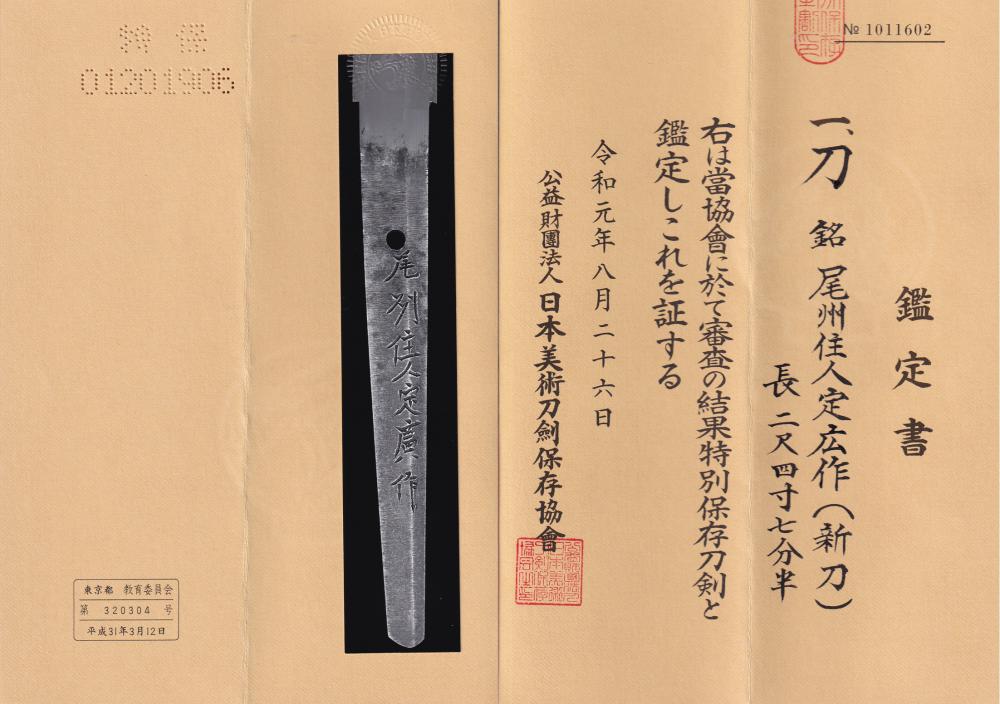
NBTHK Certificate
Tokubetsu Hozon Tōken特別保存刀剣
Sword Especially Worthy of Preservation
›

A Hozon-certified blade judged to show notably superior workmanship and a better state of preservation. The bar is higher: re-tempered blades and most unsigned Muromachi/Edo works are excluded.

About the NBTHK›

The NBTHK (Nihon Bijutsu Tōken Hozon Kyōkai, the Society for the Preservation of Japanese Art Swords) is a public-interest incorporated foundation founded in 1948 and supervised by Japan’s Agency for Cultural Affairs (Bunkachō); it is based at the Japanese Sword Museum in Tokyo. Its expert panels physically examine each submitted work (shinsa) and issue a certificate (kanteishō) ranking it by artistic and historical merit. NBTHK papers are the most widely recognized standard of authentication for Japanese swords and fittings.

NBTHK official site→

Seller
S
Shoubudou
🇯🇵Ships from Japan
›
✓Verified dealershoubudou.co.jp
✓Ships worldwide✓English supportWire transferPayPalCredit card
Return policy

Please contact us by phone within 3 days of the item's arrival and ship it back the next day. The postage and security service fees are the customer's responsibility.

View all of Shoubudou’s listings→View this item on the dealer’s site→

More works by Sadahiro

View all →
Yushindou
Katana - by Sadahiro - Bisyu jyunin Sadahiro sakuKatana - by Sadahiro - Bisyu jyunin Sadahiro saku

Katana

BySadahiro
¥500,000

Swords

  • Katana
  • Wakizashi
  • Tantō
  • Tachi
  • Naginata
  • Yari

Fittings

  • Tsuba
  • Fuchi-Kashira
  • Kozuka
  • Menuki

Armor

  • Kabuto
  • Samurai Armor

By Certification

  • Tokujū
  • Jūyō
  • Tokuho
  • Hozon

Resources

  • Dealer Directory
  • Artist Directory
  • The Daily Kantei
  • Glossary
  • Browse All
Nihontowatch© 2026
TermsPrivacyCookiesAbout

Description

This is a Katana made by Sadahiro, an active swordsmith in Owari during the mid-Edo period (Kyoho era). The blade features a shinogi-zukuri, iori-mune, with a slightly high shinogi relative to the body width. The jigane shows a prominent itame grain on the omote side and a tightly forged ko-itame on the ura side. The hamon is nie-rich, starting with suguha and transitioning into gunome-choji with interspersed notare, creating a modified Kanefusa-midare pattern with sunagashi in the peaks. The boshi returns in a straight, round, and quick manner, with a slightly yaki-sage finish. This is a recommended sword for those seeking a local Owari blade.

NihontoWatch MonNihontoWatch
MarketEncyclopediaKantei
Swords›Sadahiro›Katana: Bisyu jyunin Sadahiro saku
katanaTokubetsu Hozon
Sadahiro

Katana: Bisyu jyunin Sadahiro saku

mei · Genroku (1688-1704) · nagasa 75cm · sori 1.8cm

SOLD
Sadahiro — 1 of 3
Sadahiro — 2 of 3
Sadahiro — 3 of 3
1 / 3
1 / 3
Sadahiro — 1 of 3Sadahiro — 2 of 3Sadahiro — 3 of 3
Measurements & details
Smith
Sadahiro
Type
Katana
Period
Around 1716–1736(Kyoho)
Province
Owari
Signature
Signed
Measurements
Nagasa 75cmSori 1.8cmMotohaba 3.06cmSakihaba 2.05cmKasane 0.7cm
Description

This is a Katana made by Sadahiro, an active swordsmith in Owari during the mid-Edo period (Kyoho era). The blade features a shinogi-zukuri, iori-mune, with a slightly high shinogi relative to the body width. The jigane shows a prominent itame grain on the omote side and a tightly forged ko-itame on the ura side. The hamon is nie-rich, starting with suguha and transitioning into gunome-choji with interspersed notare, creating a modified Kanefusa-midare pattern with sunagashi in the peaks. The boshi returns in a straight, round, and quick manner, with a slightly yaki-sage finish. This is a recommended sword for those seeking a local Owari blade.

About the maker

Sadahiro

定廣

Owari · around 1716-1736

1 piece on the market now

›
1 work by Sadahiro on the market→
Sadahiro — full profile

Historical context

Under the Tokugawa peace the daishō became a regulated uniform, and demand gathered in the castle towns, above all Edo itself. The craft split two ways: brilliant display work for connoisseurs, and tested blades whose cutting results were sometimes inlaid in gold.

The Edo period (1615 to 1868) →

NBTHK Certificate
Tokubetsu Hozon Tōken特別保存刀剣
Sword Especially Worthy of Preservation
›

A Hozon-certified blade judged to show notably superior workmanship and a better state of preservation. The bar is higher: re-tempered blades and most unsigned Muromachi/Edo works are excluded.

About the NBTHK›

The NBTHK (Nihon Bijutsu Tōken Hozon Kyōkai, the Society for the Preservation of Japanese Art Swords) is a public-interest incorporated foundation founded in 1948 and supervised by Japan’s Agency for Cultural Affairs (Bunkachō); it is based at the Japanese Sword Museum in Tokyo. Its expert panels physically examine each submitted work (shinsa) and issue a certificate (kanteishō) ranking it by artistic and historical merit. NBTHK papers are the most widely recognized standard of authentication for Japanese swords and fittings.

NBTHK official site→
Seller
S
Shoubudou
🇯🇵Ships from Japan
›
✓Verified dealershoubudou.co.jp
✓Ships worldwide✓English supportWire transferPayPalCredit card
Return policy

Please contact us by phone within 3 days of the item's arrival and ship it back the next day. The postage and security service fees are the customer's responsibility.

View all of Shoubudou’s listings→View this item on the dealer’s site→

More works by Sadahiro

View all →
Yushindou
Katana - by Sadahiro - Bisyu jyunin Sadahiro sakuKatana - by Sadahiro - Bisyu jyunin Sadahiro saku

Katana

BySadahiro
¥500,000

Swords

  • Katana
  • Wakizashi
  • Tantō
  • Tachi
  • Naginata
  • Yari

Fittings

  • Tsuba
  • Fuchi-Kashira
  • Kozuka
  • Menuki

Armor

  • Kabuto
  • Samurai Armor

By Certification

  • Tokujū
  • Jūyō
  • Tokuho
  • Hozon

Resources

  • Dealer Directory
  • Artist Directory
  • The Daily Kantei
  • Glossary
  • Browse All
Nihontowatch© 2026
TermsPrivacyCookiesAbout
NihontoWatch Mon

NihontoWatch

Market
Encyclopedia
Kantei
NihontoWatch Mon

NihontoWatch

Market
Encyclopedia
Kantei
