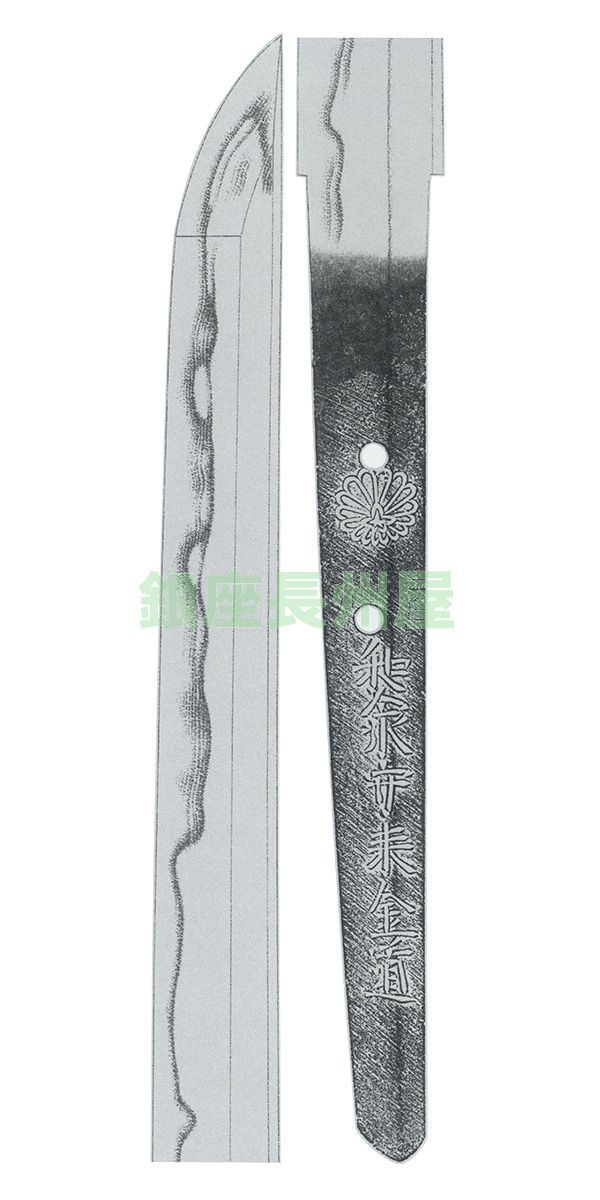
This katana is attributed to the 3rd generation Izumi no Kami Rai Kinmichi, active around the Kanbun era (1661-1672). It features a refined construction with a slightly extended chu-kissaki and a tight ko-itame hada resembling a cut pear. The hamon is a shallow notare mixed with togari-ba and hako-ba, displaying vibrant nie and kinsuji.
 NihontoWatchBETA
mei · Shinto · nagasa 69.5cm · sori 1.06cm








A blade of top-grade workmanship and condition, formally judged to rank with a nationally recognized Important Art Object (Jūyō Bijutsuhin). Awarded only at the NBTHK’s competitive annual examination.
Of Japan’s roughly 2.5 million registered swords, only 12,358 (about 1 in 202) have ever attained Jūyō.
The NBTHK (Nihon Bijutsu Tōken Hozon Kyōkai, the Society for the Preservation of Japanese Art Swords) is a public-interest incorporated foundation founded in 1948 and supervised by Japan’s Agency for Cultural Affairs (Bunkachō); it is based at the Japanese Sword Museum in Tokyo. Its expert panels physically examine each submitted work (shinsa) and issue a certificate (kanteishō) ranking it by artistic and historical merit. NBTHK papers are the most widely recognized standard of authentication for Japanese swords and fittings.
NBTHK official siteIf, due to our fault, the item differs significantly from its proper condition, the item may be returned. Cooling-off is within one week of the item's arrival.
This katana is attributed to the 3rd generation Izumi no Kami Rai Kinmichi, active around the Kanbun era (1661-1672). It features a refined construction with a slightly extended chu-kissaki and a tight ko-itame hada resembling a cut pear. The hamon is a shallow notare mixed with togari-ba and hako-ba, displaying vibrant nie and kinsuji.
NihontoWatchBETAmei · Shinto · nagasa 69.5cm · sori 1.06cm
A blade of top-grade workmanship and condition, formally judged to rank with a nationally recognized Important Art Object (Jūyō Bijutsuhin). Awarded only at the NBTHK’s competitive annual examination.
Of Japan’s roughly 2.5 million registered swords, only 12,358 (about 1 in 202) have ever attained Jūyō.
The NBTHK (Nihon Bijutsu Tōken Hozon Kyōkai, the Society for the Preservation of Japanese Art Swords) is a public-interest incorporated foundation founded in 1948 and supervised by Japan’s Agency for Cultural Affairs (Bunkachō); it is based at the Japanese Sword Museum in Tokyo. Its expert panels physically examine each submitted work (shinsa) and issue a certificate (kanteishō) ranking it by artistic and historical merit. NBTHK papers are the most widely recognized standard of authentication for Japanese swords and fittings.
NBTHK official siteIf, due to our fault, the item differs significantly from its proper condition, the item may be returned. Cooling-off is within one week of the item's arrival.