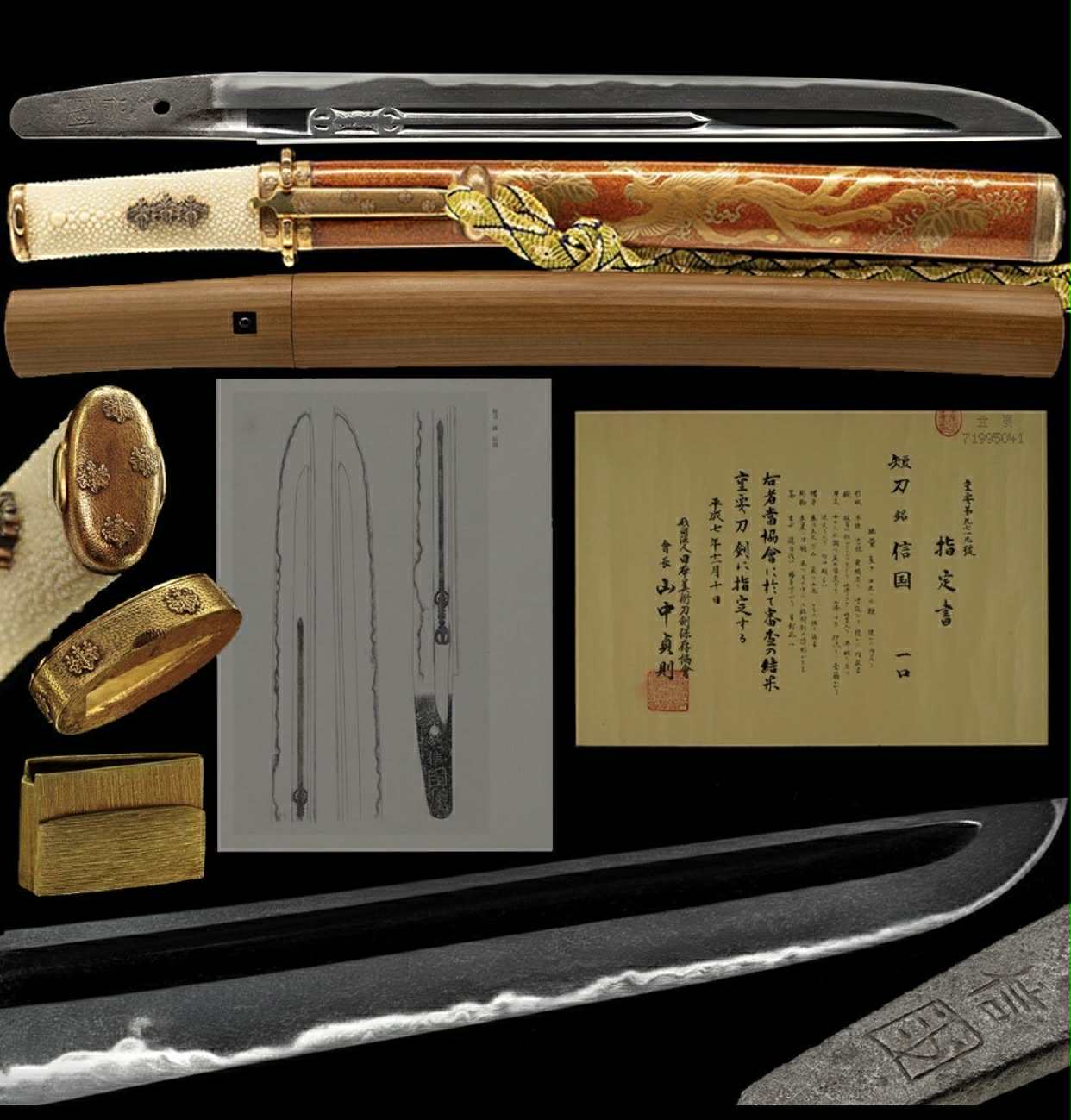
Juyo Kyo Nobukuni tanto
SOLD
Tracked across 76 dealers worldwide · price history · sold archive
Specifications
29.3 cm
2.5 cm
About the maker
Nobukuni信國
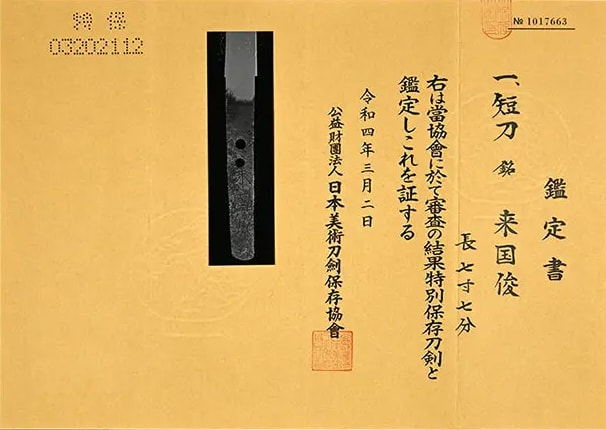
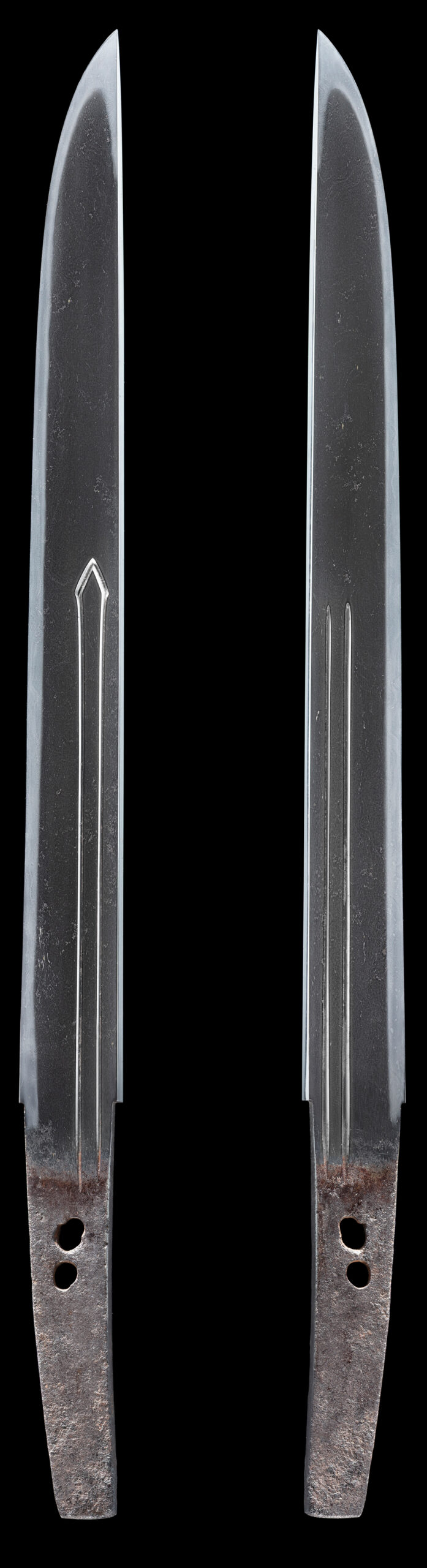
Shodai Nobukuni (初代信国) represents a distinguished lineage among the Kyoto smiths, flourishing from the Nanbokucho period through the Muromachi era. From old times he has been said to have been a disciple of Soshu Sadamune, and his period was traditionally transmitted as the Kenmu era (1334-1338). However, as the NBTHK consistently observes, "among extant works there are no dated examples from Kenmu or nearby years, nor are there works that can convincingly be appraised as reaching that far back in time." Because the style of the earliest surviving Nobukuni blades--those dated Enbun and Joji--"connects directly with Sadamune," the prevailing view today recognizes the Enbun-Joji smith as the first generation. According to transmitted documents, he is recorded as the son or grandson of Ryokyunobu, a son of Ryokai, placing him within the Rai school heritage of Yamashiro Province. Nobukuni's forging characteristically shows *itame-hada* mixed with *mokume* and flowing *nagare-hada*, with the grain tending toward *masame* near the edge--a feature that accords with his Rai lineage. Fine *ji-nie* adheres thickly, *chikei* enters well, and vivid *nie-utsuri* stands out in his best works, producing a *jigane* that is "bright and clear." His *hamon* displays two principal modes: a dignified *suguha* "that strictly preserves the tradition of Kyo-mono," and a *ko-notare* mixed with *gunome* in which the *nioi* is deep, *nie* forms thickly, and vigorous activities such as *kinsuji*, *sunagashi*, *hotsure*, and *yubashiri* emerge. The *nioiguchi* is repeatedly described as "bright and clear" (*saeru*). His *boshi* is typically *ko-maru* with a slightly pointed tendency, often showing *hakikake*. The NBTHK notes that both working modes--the ornate *midareba* and the quieter notare--represent an inheritance from Sadamune, "who produced both modes," and that Nobukuni "successfully inherited his teacher's tradition and was highly accomplished." The setsumei further emphasize Nobukuni's mastery of *toshin horimono* (blade carvings). His signed tantoblade at Tokubetsu Juyo "leaves nothing lacking in the expression of his characteristic features," with carvings that are "superb and in fine harmony with the blade." Carved motifs include *kurikara*, *bonji*, *suken*, *gomabashi*, and *rendai*; the *kasanebori* (superimposed carving) technique is singled out as "a specialty for which this group is particularly noted." Signed works by the shodai are few, conferring heightened documentary value on each authenticated example. The Enbun 3 (1358) dated tanto designated Juyo-Bijutsuhin is "especially valuable as a documentary reference example," while a tachi formerly bestowed by the shogunal house upon the Owari house in Koka 2 (1845) and a wakizashi known by the *go* "Arao Nobukuni"--transmitted in the Geishu Asano family--attest to the enduring regard in which this Nanbokucho master has been held. Later generations bearing the Nobukuni name, including the Oei-period Saemon no Jo and Shikibu no Jo, continued both the *suguha* and *gunome*-based idioms, yet it is the shodai's direct connection to Sadamune and mastery of the *Soshu-den* that defines the lineage's highest achievement.