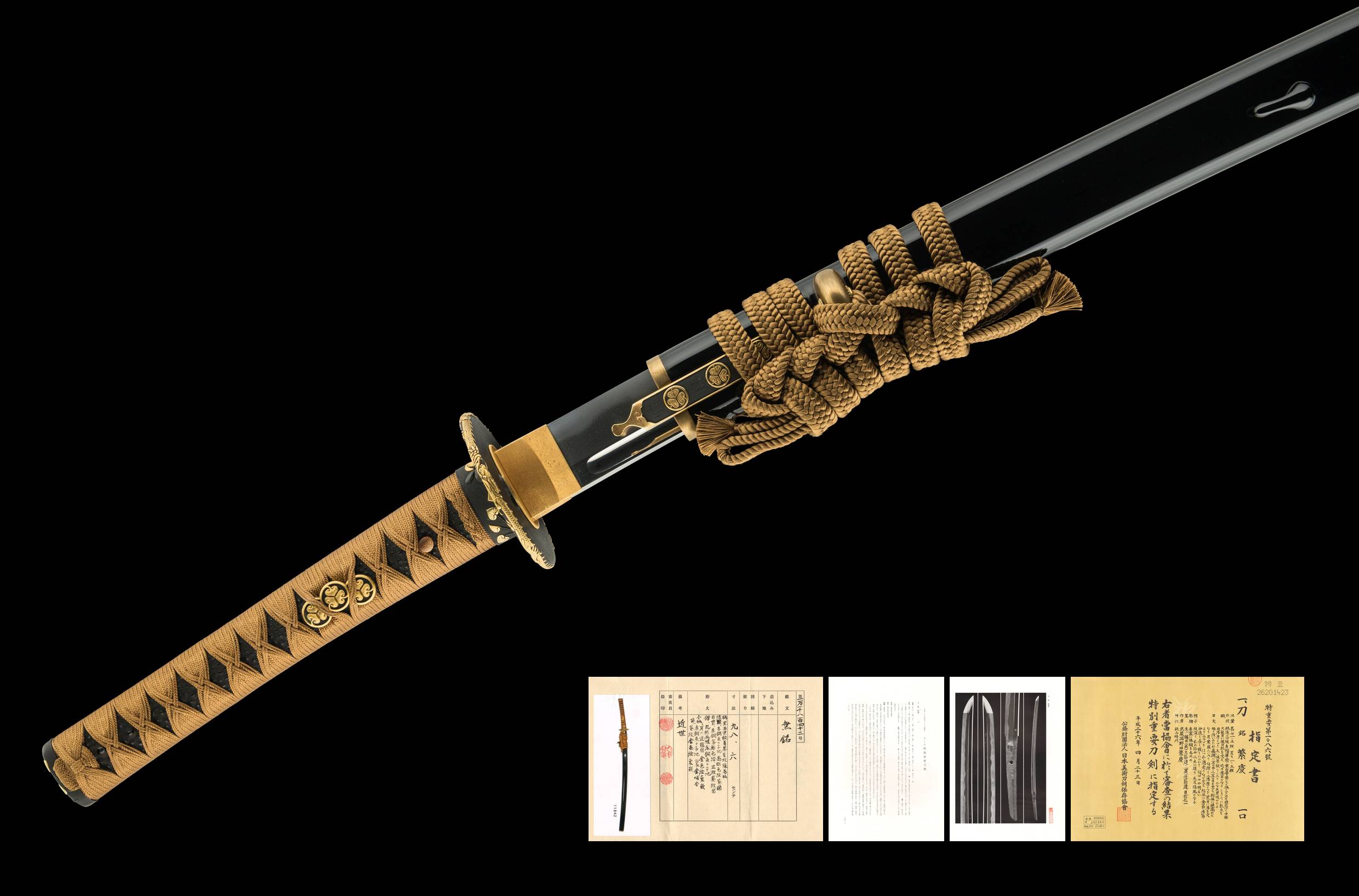
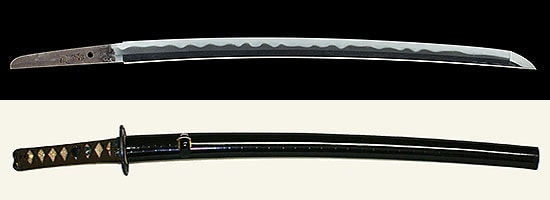
Hankei (繁慶), the Tokugawa gunsmith who became a swordsmith in Edo, left not a single dated blade, a lack the published sources say makes his study resist precision. Born in Mikawa and called Noda Zenshiro Kiyotaka (野田善四郎清堯), he was a gunsmith retained by the Tokugawa house; after Ieyasu's death in Genna 2 (1616) he went to Edo and turned swordsmith. The NBTHK places him beside the first Yasutsugu, calls him "a pioneer of Edo sword-making"[[c:1]], and counts him "one of the early shinto smiths who modeled themselves on the Soshu tradition and succeeded." No teacher is recorded; the texts venture only that he may first have studied under the first Yasutsugu, or, in another theory, Tsunahiro. In place of dates his chronology hangs on two anchors: a matchlock of Keicho 17 (1612) signed with his gunsmith pre-name Kiyotaka (清堯), kept at the Izumo shrine that holds his dedication katana, and the document of Kan'ei 10 (1633) for a sword he presented to Kongobu-ji on Koyasan.
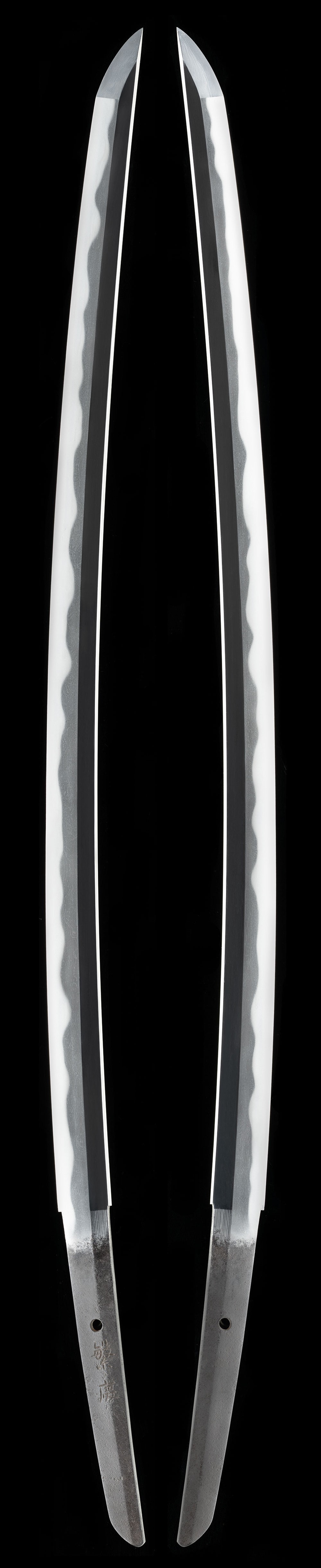
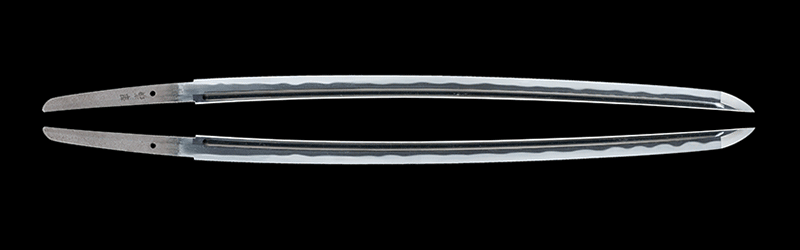
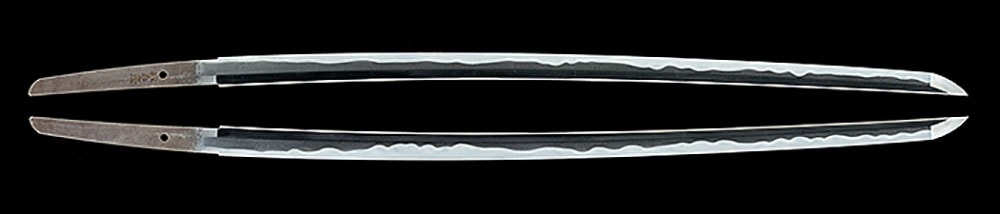
The published sources repeat one sentence across his record: his ideal is said to have been Soshu Masamune, but in the work itself it is rather Norishige. The work shows a jigane with a name of its own: the forging is itame mixed with o-itame, mokume and flowing hada, standing strongly; ji-nie lies thick, at times coarse; black, thick chikei enter ceaselessly until the surface becomes what the texts call hijiki-hada (ひじき肌), and the steel color tends blackish. One Juyo paper explains the image outright, "hijiki is a kind of seaweed"; other notes call it Hankei-hada or matsukawa-hada. The texts trace it to the gun forge: "the mixed-steel forging was his forte, known in the world as hijiki-hada or matsukawa-hada," hard and soft steels mixed as he had mixed them for guns. And the word belongs to him: across the designation literature it appears only in his own papers and, borrowed, in those of his pupil Hanmasa.
Over a shallow notare mixed with gunome and ko-gunome the nioi runs deep and the nie lies thick and strong, rough nie clumping in patches. Hotsure and yubashiri mix at the edge; sunagashi sweeps the whole length, and kinsuji and niesuji run long and frequent. Above all the nioiguchi sinks, in the formula repeated across more than twenty of his papers, "until the border of ji and ha is no longer distinct"[[c:2]]. In this he presses past his model: his hada stands more strongly than Norishige's, his nie runs rougher and his habuchi sinks deeper, where the Etchu master keeps a brighter, clearer ha. The construction states the debt openly: the standard Hankei katana is shinogi-zukuri with a mitsu-mune whose upper surfaces fall steeply, read blade after blade as a deliberate echo of Norishige in which his intent shows. The build is wide or standard with little taper, the kasane thick, the sori shallow, and despite his Keicho years the chu-kissaki often does not extend; the boshi is swept with hakikake, frequently into flame shapes.
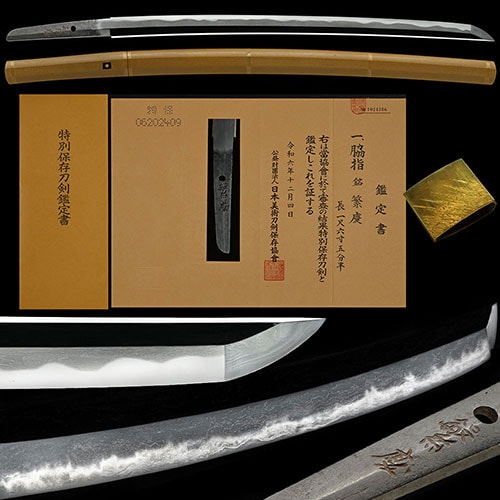
The texts mark registers rather than periods. A few swords signed with his first sword name, the gunsmith Kiyotaka, survive; certain calm Hankei blades, the forging tightened, the ha a gentle notare or suguha tone, the nioiguchi bright and clear against his usual sunken one, are read as "passing into the style of his early works signed Kiyotaka"[[c:3]]. The quiet register finishes, in the sources' words, "in an altogether calm, settled manner," with dignity and an antique air; the flamboyant register lets large gunome erupt "large, showy and complex," in works the texts call full of spirit and force. The flat-built pieces are rarities of form: hira-zukuri wakizashi and tanto are scarce, only three hira-zukuri wakizashi seen, and the texts divide the shapes into three types, the wide and sunnobi, the stubby kitchen-knife form (庖丁風), and the slender elongated one. A single bag-socket naginata survives, tempered in a suguha uncharacteristically calm for him, and a Tokubetsu Juyo wakizashi with a kurikara dragon in openwork within pierced hi is the only such carving in his work.
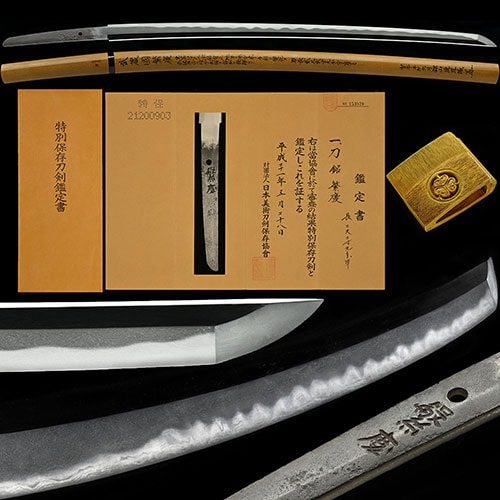
The signature is a study of its own. Where ordinary smiths cut their mei, his is carved out in relief with a thick chisel, a bold two-character 繁慶 set on a nakago the texts judge "his own invention, the mei cut with a carving chisel and special to him": the tip yagen-shaped, the filing o-sujikai on the omote and reversed on the ura, the machi cut deep. Homma records the tradition that the deep machi and the carved mei were "a precaution against the blade being shortened and rendered unsigned in later ages." The mei also carries his chronology: the 又 form is held to be the signature of his prime and the ル又 form of his late years, blades signed above the mekugi-ana are rare. His surname is recorded both ways, Noda and Ono; the dedication katana at Hinomisaki Shrine in Izumo bears the shrine mei[[c:4]] over the signature Ono Hankei (小野繁慶); the sources describe him as a smith of strong faith who presented swords and guns of his own making to shrines and temples across the provinces. One Juyo Bijutsuhin katana carries a maxim he himself cut into the nakago[[c:5]], on the peril of arms without sincerity. Downstream, established scholarship counts Izumi no Kami Kaneshige and Hanmasa among those who carried his manner; Hanmasa's designation papers borrow the very word hijiki-hada. The measure of the upstream debt is a Tokubetsu Juyo tanto judged to press "into the realm of Norishige he aspired to," though the texts also mark where the imitation stops: his tanto take a shallow sori and do not reproduce Norishige's peculiar bamboo-shoot curve (筍反り).
He is Sai-jo saku in Fujishiro's grading, and his record is signed through: of fifty-one designated works on record, fifty are signed and none unsigned. Three blades are Important Cultural Properties and six are Juyo Bijutsuhin; beneath them stand forty-one blades in the Tokubetsu Juyo and Juyo tiers. Nine works carry recorded provenance: the Arima house, which held the Tokubetsu Juyo katana the texts single out as the finest of his work, the Shimazu house, the Saijo Matsudaira house and the Imperial Family, while the Hinomisaki dedication katana remains at its shrine. One Juyo bears the record of a three-body cutting test by Yamano Kaemon before Nagai Shinano no Kami, another the gold-inlaid owner inscription of the Maebashi elder Miyabe Moseki. The Important Cultural Properties and the shrine dedications are patrimony, preserved where they stand; what a collector may realistically encounter is the Tokubetsu Juyo and Juyo tier, and even there a Hankei comes to market only from time to time. When one does, it carries the man whole: hijiki-hada, sunken habuchi, carved mei on the invented nakago.