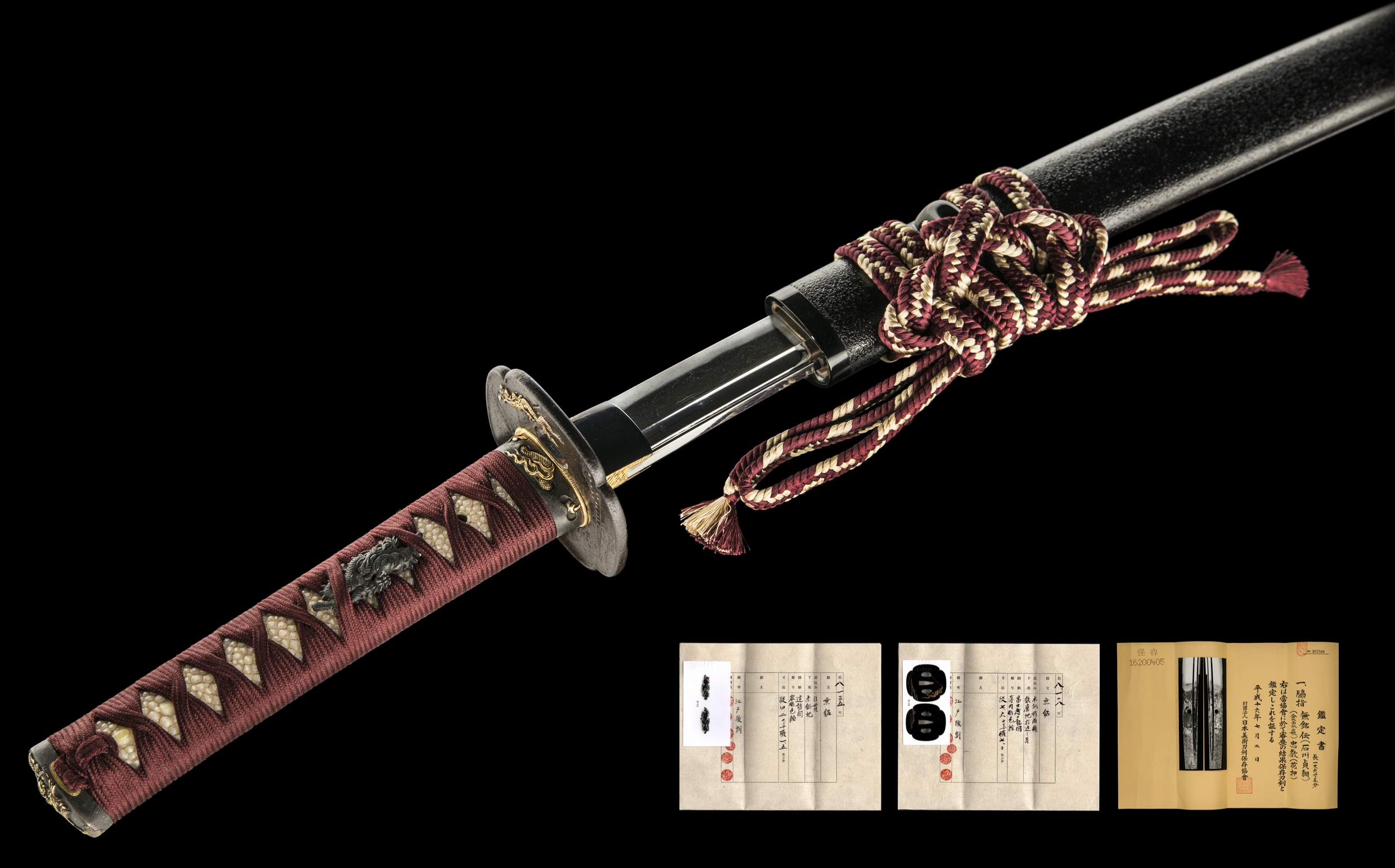
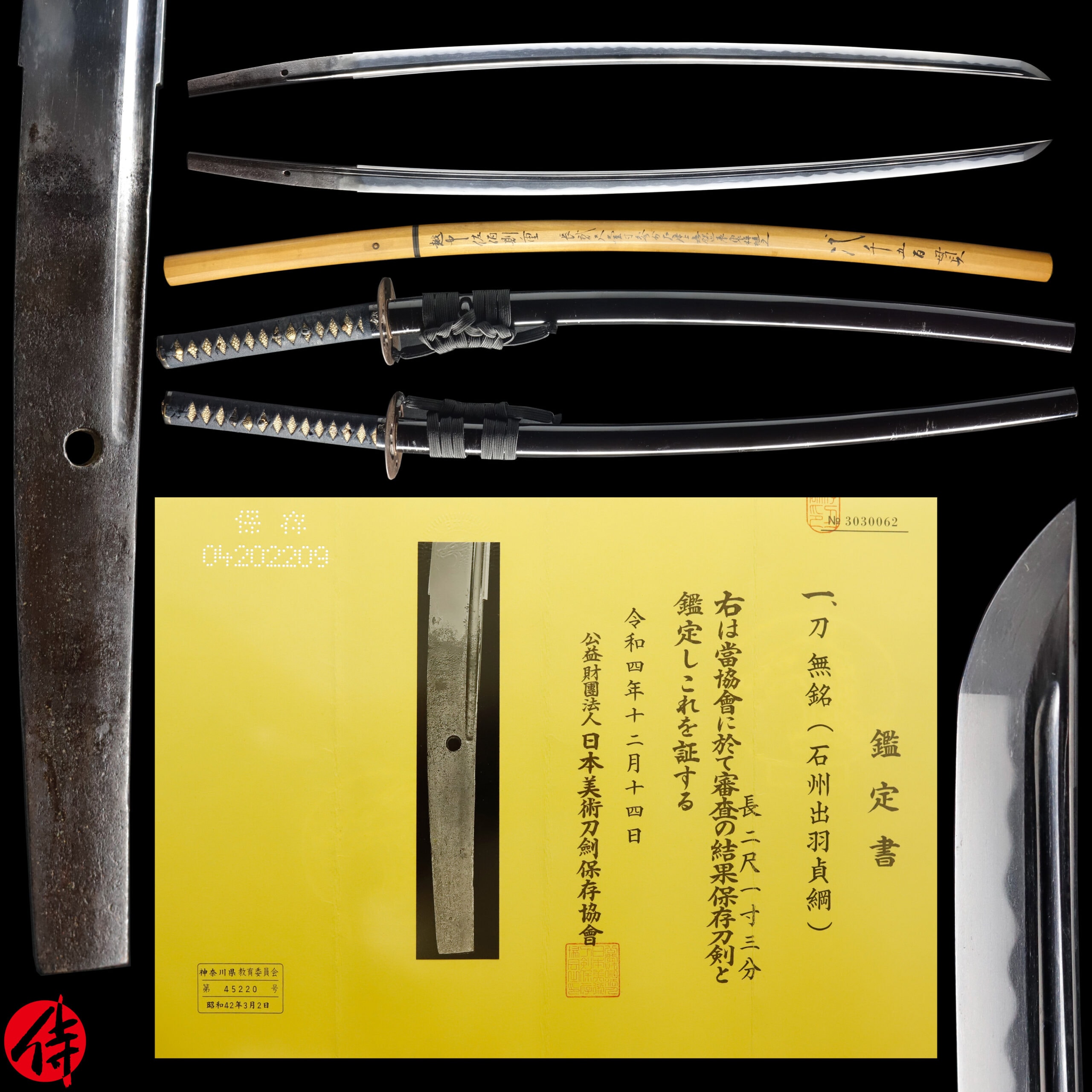
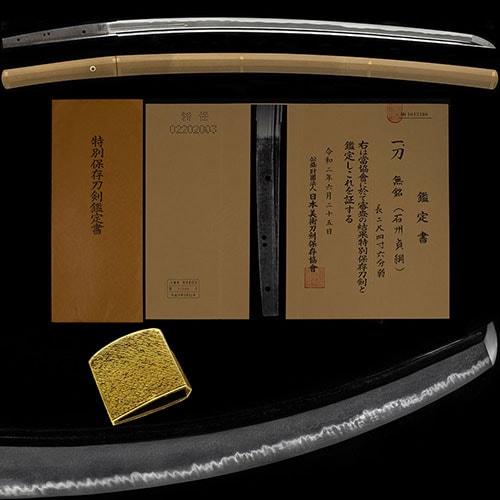
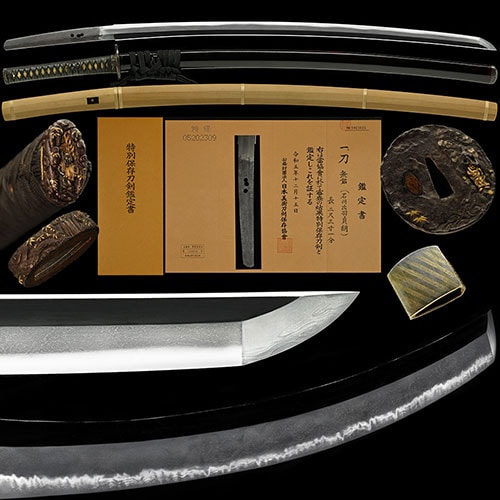
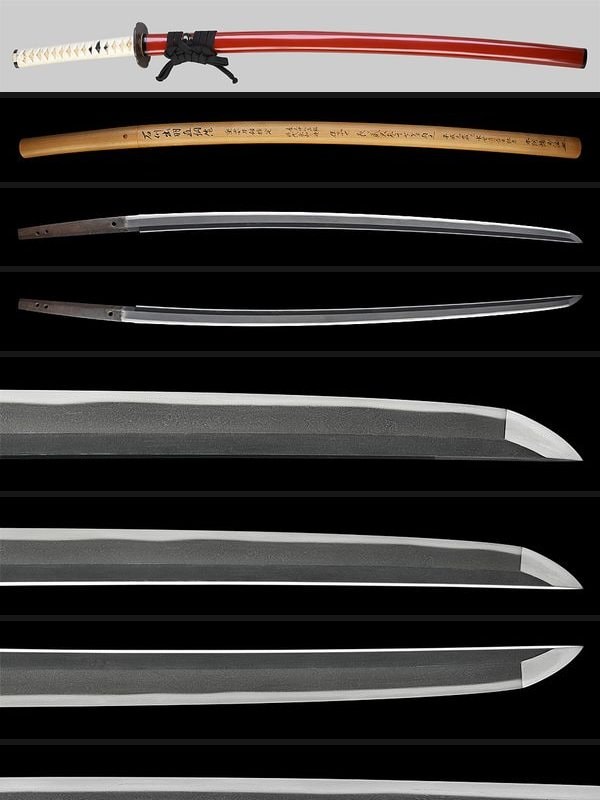
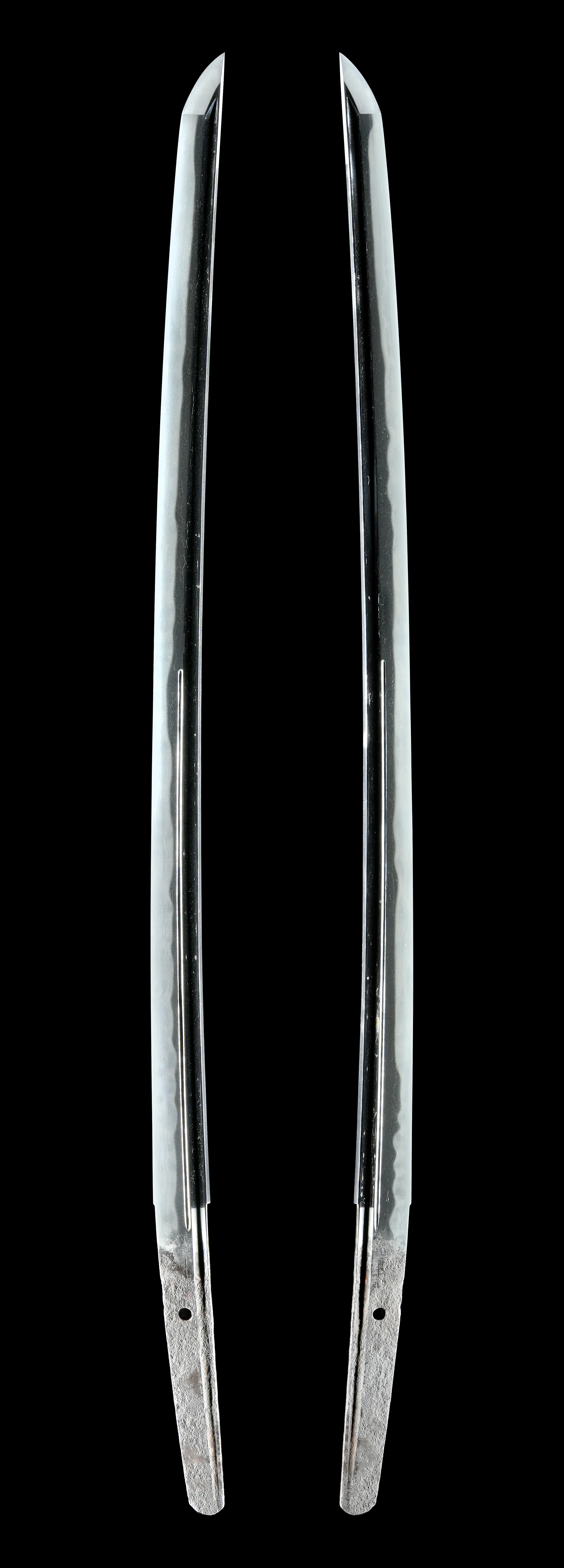
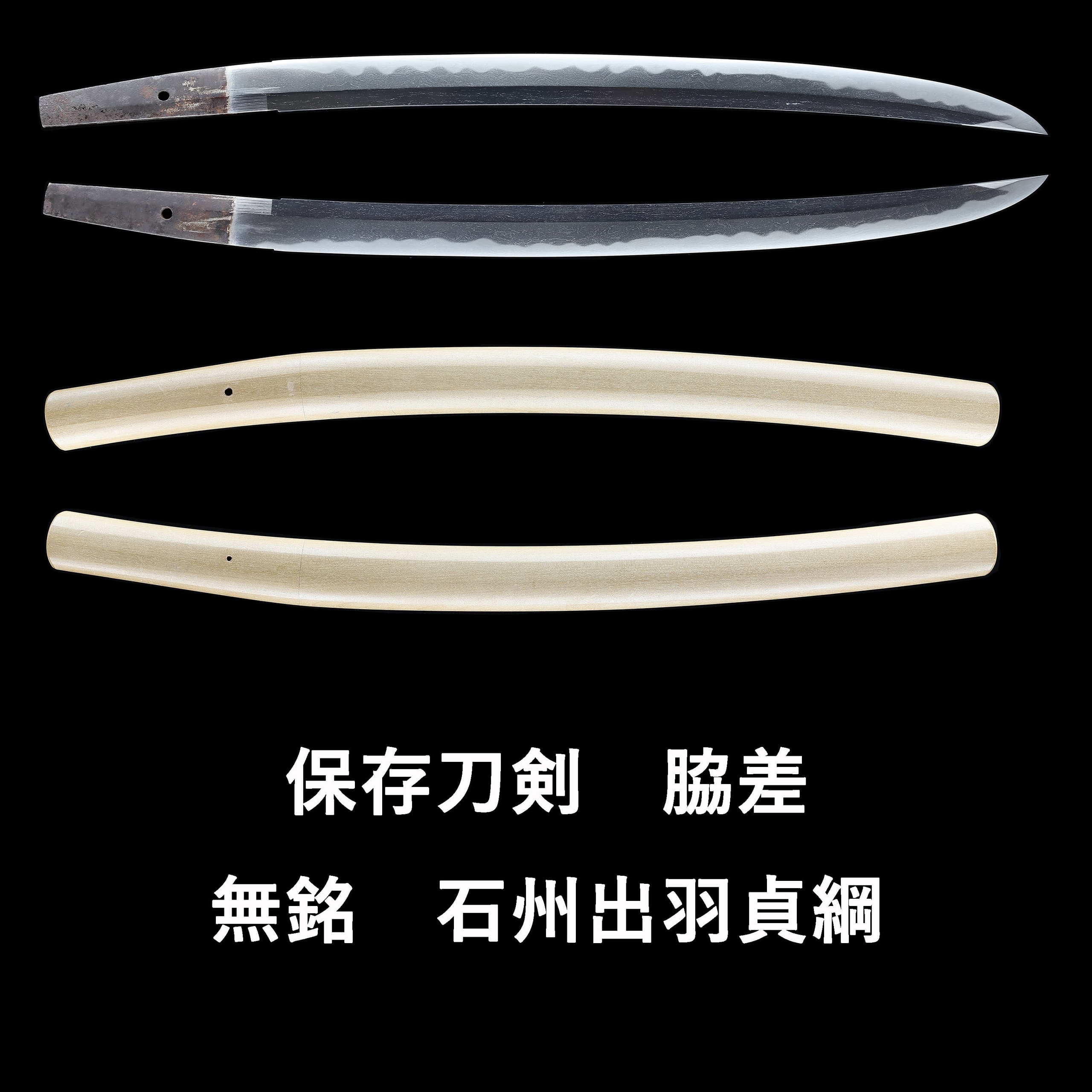
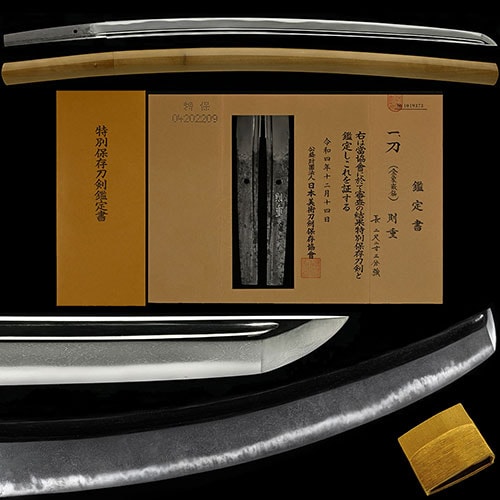
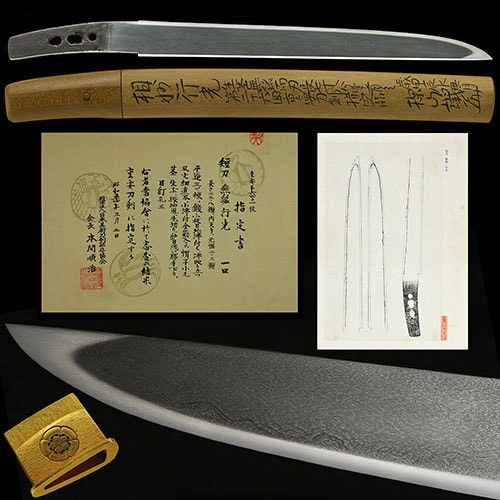
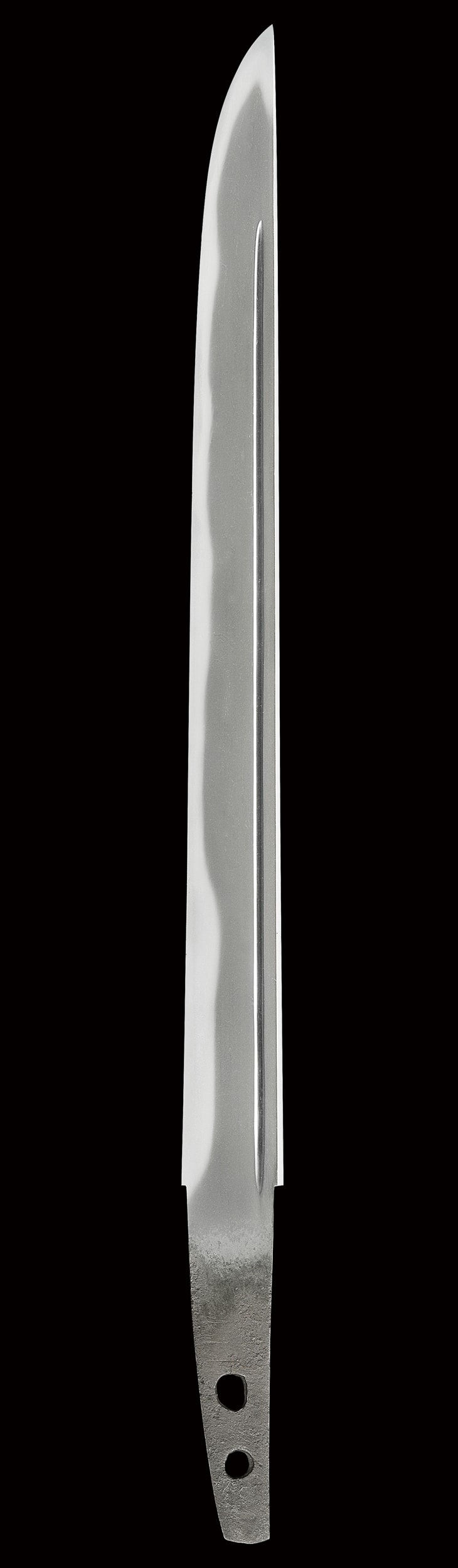
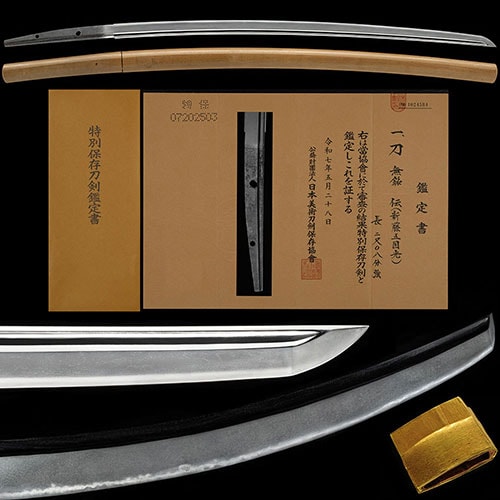
A signed tantō in the fiftieth Jūyō session carries a large six-character inscription, Sekishū Dewa Sadatsuna, cut across the second mekugi-ana, and it is this rare full signature that anchors the smith. Sadatsuna worked at Izuha in Iwami Province in the late Nanbokuchō period, and the published sources transmit him as a son of the first-generation Naotsuna, the Sekishū master counted among the pupils of Masamune who carried the Sōshū tradition into the provinces of the San'in coast. The reference works record the name across three or even four generations descending into the Muromachi period, the first placed about the Shōhei era, the later hands in Meitoku, Ōei and Kōshō. Because signed pieces survive almost only from after the entry into Muromachi, and examples dated to the Nanbokuchō are scarcely encountered, his earliest work is read on the evidence of the ji and ha rather than from an inscription, which is why so much of his designated body is mumei tachi and katana appraised to his hand.
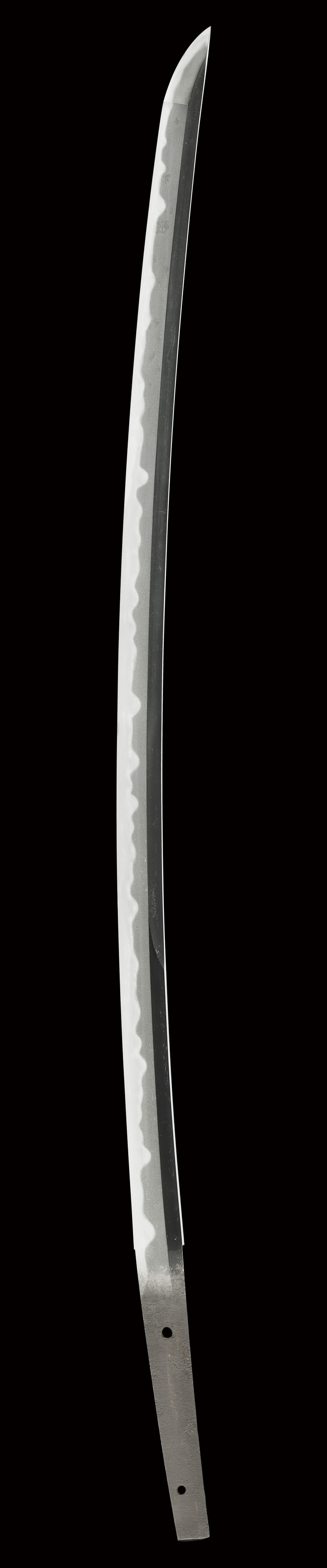
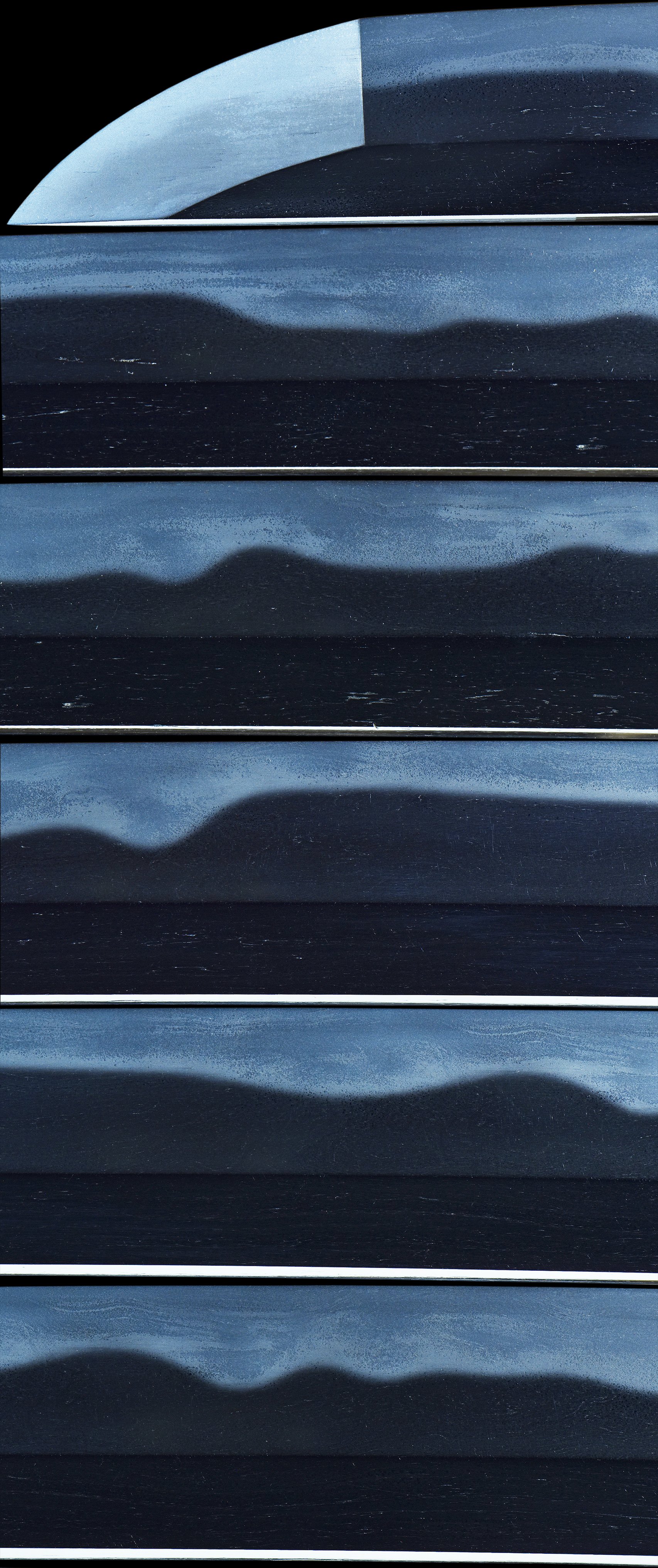
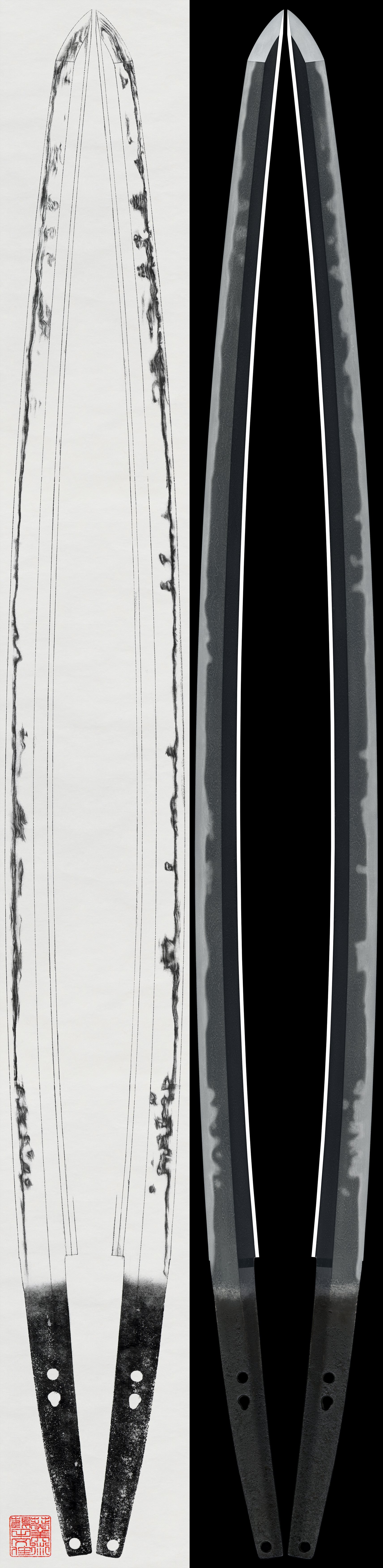
The recurring verdict across his blades is that Sadatsuna resembles Naotsuna while tempering a gunome smaller in scale. His hamon is fundamentally a gunome-midare, present on every one of his designated blades, that runs in linked sequences across the ha, mixed with togariba and angular kaku-gunome, and at times a round-headed gunome and a slight chōji-gokoro. Ashi enter, the nioi runs deep, and the nie adheres strongly, coarsening here and there into rough crystals. Through this temper kinsuji and sunagashi work vigorously, with yubashiri drifting in places, so that the activity within the ha is conspicuous rather than quiet. The single clearest tell sits in the bōshi, which brushes into hakikake on most of his blades, sometimes burning out in a yakitsume manner, sometimes turning back in ko-maru with a pointed tendency and a long kaeri. It is in the point that the Sōshū inheritance shows most plainly, the swept nie carrying the temper past the yokote.
The jigane is a standing itame mixed with mokume and a flowing nagare-hada, the grain opening rather than closing, so that the published sources reach for the word zanguri to describe its loose, granular surface. Over it ji-nie adheres well and often dust-fine, chikei enter, and the steel takes on a kana-iro tone darkened toward black, a provincial Iwami jigane that distinguishes the school from the tighter, brighter ji of the Sagami masters it imitates. On the tantō a jifu-like mottling gathers toward the lower half, and the ji-nie thickens to a fine dense cover. The whitish shirake cast that marks much wakimono work appears on one early tachi but is not his rule; more typical is the dark, active ji against which the kinsuji and sunagashi of the ha stand out.
The published sources draw his work into two registers. They state plainly that he is seen both in a gunome-based manner and in a ko-notare-based manner, and that in either case the nie adheres well and the sunagashi is applied vigorously. The gunome manner is the principal one, the linked midare with its angular and pointed elements and its strong, sometimes coarse nie. The ko-notare manner runs a shallow notare or small notare into the gunome, the nioiguchi tending to sink toward a subdued shizumi, the kinsuji and sunagashi drawn out long, and it is carried above all by his hira-zukuri tantō, broad and slightly sun-nobi with thick kasane and very shallow sori. Form follows the late date: the suriage katana run to standing itame in a blackish steel, while the one slender, deep-curved, ko-kissaki tachi with its two-character signature keeps a classical Kamakura silhouette that the published commentary calls archaic in feeling even as the nie-laden temper marks it as Naotsuna's circle.
What places him is the line itself. The published sources name his manner as that of the Sekishū Naotsuna group expressing the Sōshū-den, and an appraisal to Sadatsuna as a follower within Naotsuna's circle is one they say can be accepted for exactly these reasons. Of the first designated tachi they write that strong nie, frequent sunagashi and intermixed yubashiri mean 「相州伝が認められ, 直綱に通じるものがある」[[c:1]], that the Sōshū tradition is recognized and there are points in common with Naotsuna. The smith-level characterization repeated almost verbatim across his blades is 「直綱に似て, 互の目調のものと小のたれ調のものを見る」[[c:2]], that he resembles Naotsuna and is seen in gunome and ko-notare manners alike. He is the school's hand at one remove from its founder, faithful to the Sōshū idiom but working it smaller, darker and more provincial than the Sagami originals, and standing above the Nagahama smiths, Shōmatsu, Shōsada and Rinshō, who are counted as his subsequent line.
Sadatsuna is rated Jō-saku in the Fujishiro ranking, and eight of his blades hold the rank of Jūyō-Tōken, with no National Treasure or Important Cultural Property among them; his record is that of a sound provincial master, not a great name. A signed tantō of his is called by the published sources 「貞綱の見どころがよくあらわれている」[[c:3]], a piece in which Sadatsuna's points of interest are well brought out, and a fine and forceful example among his works. One of his katana descends with an origami written by Hon'ami Kōjō and dated Enpō 7, the year 1679, which attributes it to Sadatsuna and which the modern commentary affirms on the strength of the blackish itame and the linked gunome of well-adhering ko-nie. Provenance is otherwise thin, with no daimyō houses or museums recorded among his blades, so the honest account is of a body held quietly in private hands. For a collector his work is among the more attainable of the Sōshū-influenced provincial masters: most of his designated blades sit in the Jūyō tier rather than locked away as patrimony, and a signed example, fixing the name with certainty, is the rarer and more desirable encounter, coming to light only from time to time and with patience.