Edo was the sword’s age of connoisseurship: the Hon’ami appraisers, the shogunal register of famous blades of 1719, and a thriving literature turned the sword into an object of study even as it ceased to be drawn in war.
 NihontoWatchNihontoWatch
This is a wakizashi by Kisyu Yasuhiro, a prominent smith from Kii province during the Edo period. The blade features a well-forged koitame hada and a vibrant gunome hamon. It comes with both a shirasaya and a koshirae, and is accompanied by NBTHK Tokubetsu Hozon papers.
NihontoWatchOffered by World Seiyudo

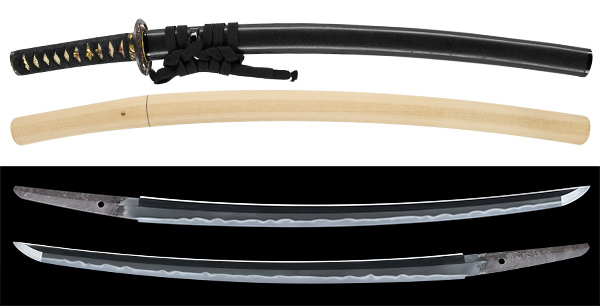

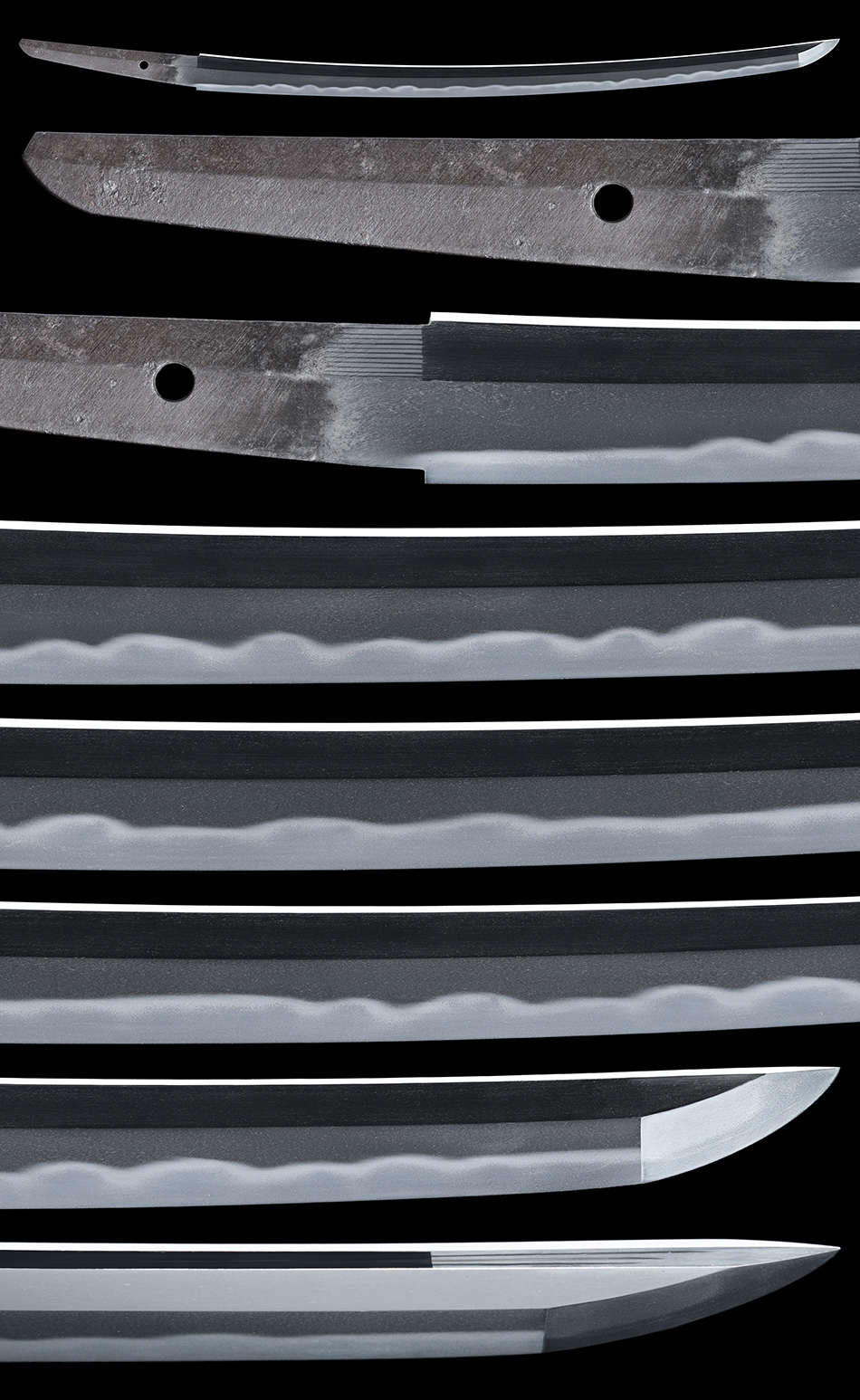
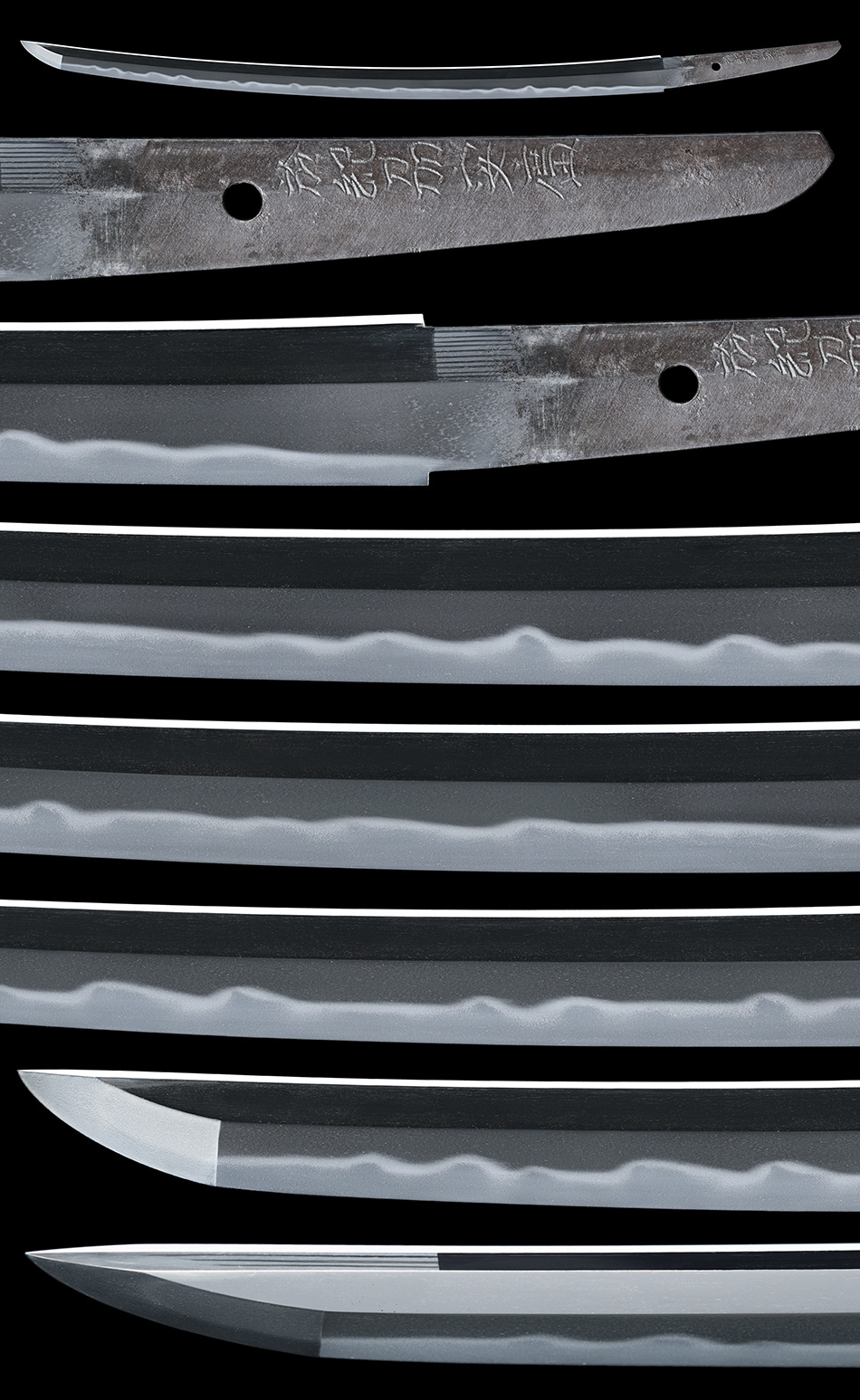
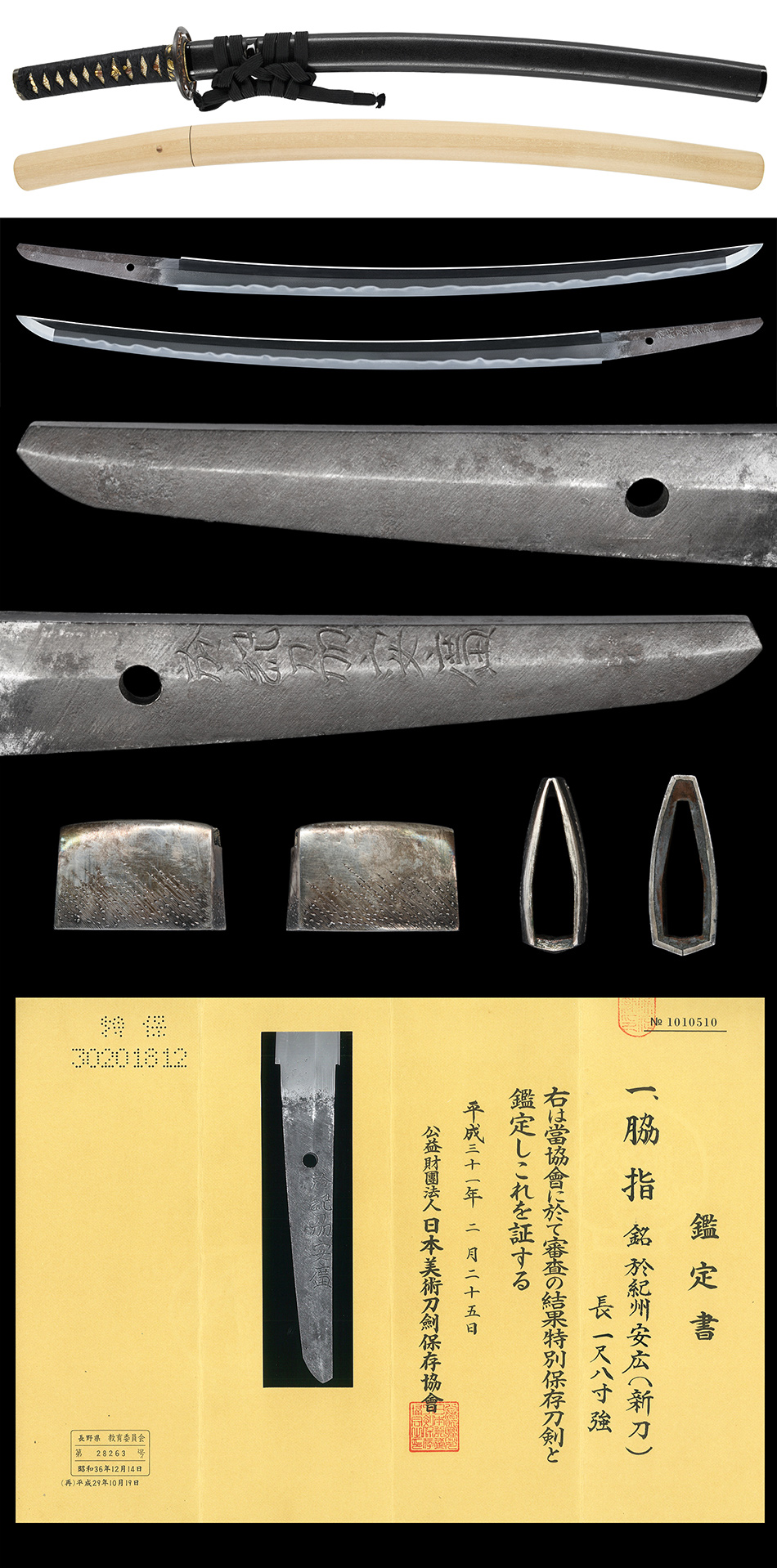
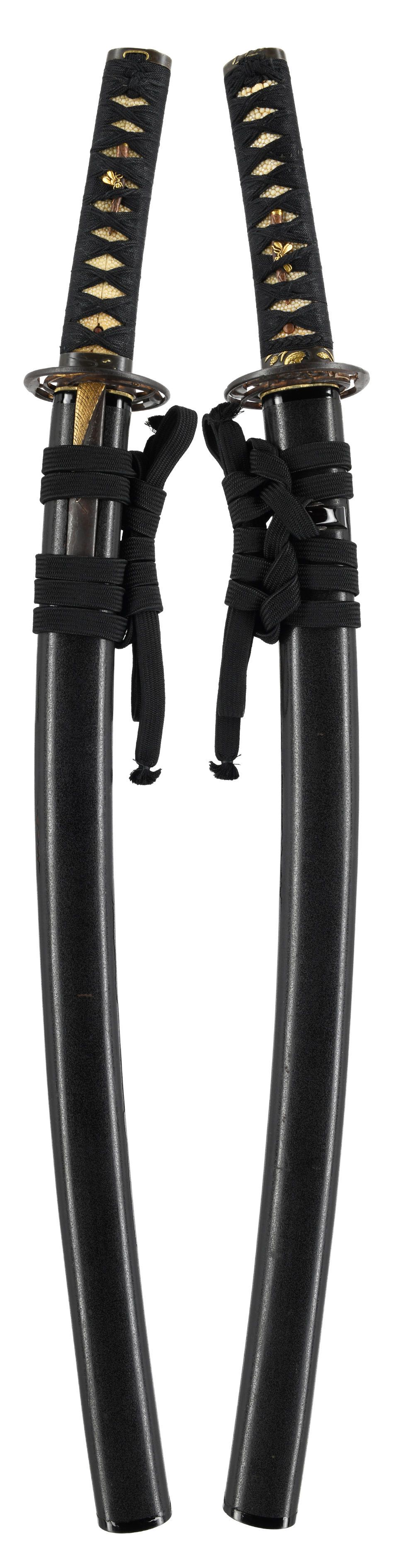
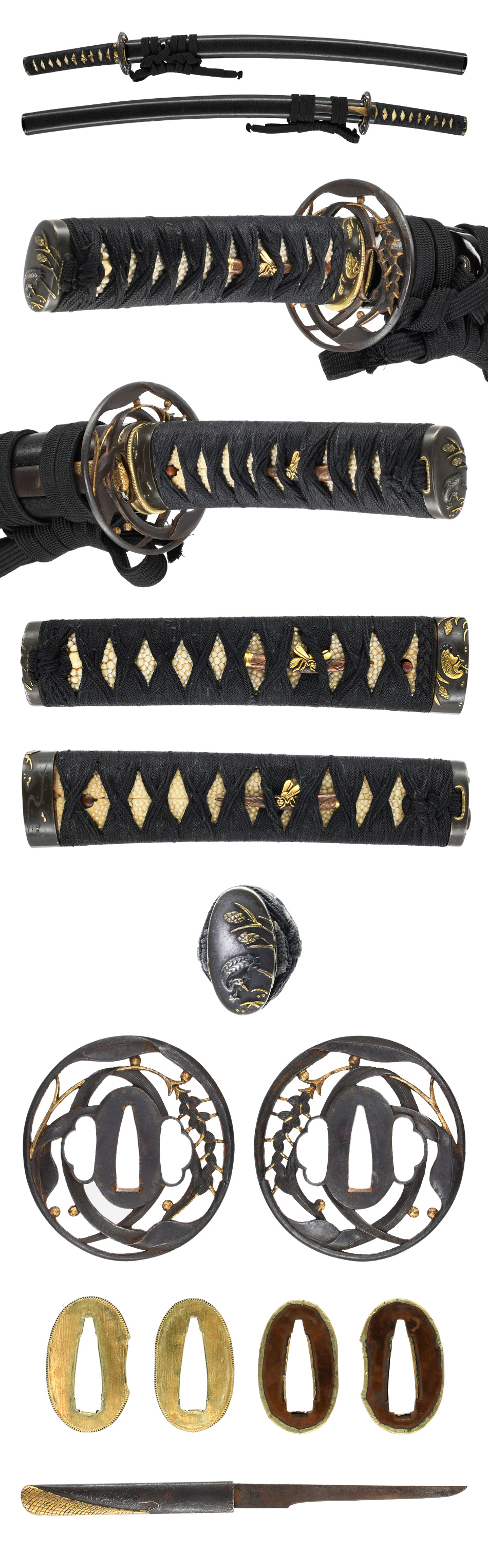
Kishu Ishido / founder of Osaka Ishido (Shinto) · Kii · around 1661-1673
Tōken Taikan top 60%
1 piece on the market now
Bicchu no Kami Tachibana Yasuhiro, whose personal name was Tomita Gorozaemon, is named by the published sources as a representative master of the Kishu Ishido group and the founder of the Osaka Ishido line, active around the Kanbun era of the early Edo period. The Ishido smiths were the Shinto generation that set out to revive the Bizen manner of the old Ichimonji, and Yasuhiro carried that revival as a house specialty: the published commentary describes his style as a Bizen tradition that may be called his hereditary art, a forging over which utsuri rises and on which choji-midare is the temper he particularly excelled in[[c:1]]. His name itself records the revival as historical project rather than imitation, for the school sought to recover the bright, utsuri-bearing Bizen steel that most Shinto smiths of his century could no longer produce. He worked first in Kishu under the Kii daimyo and later moved to Osaka, where his manner became the seed of a second Ishido line, so that his blades stand at the head of two branches of the same Bizen revival.
The feature that marks his work first is the choji-midare in the revived Bizen manner, set over a forging in which midare-utsuri stands clearly. On the pre-title wakizashi the tightly forged ko-itame carries dust-fine ji-nie and a midare-utsuri, and over it he takes the yakihaba markedly wide and tempers a choji-midare that mixes juka-choji, ko-choji, gunome and ko-gunome, with ashi and yo entering abundantly to produce a florid effect, the whole turned nioi-gachi. The published sources name the school's two Bizen models directly, calling Yasuhiro and the Ishido group masters of the Ichimonji-copy choji-midare and the Sue-Bizen-copy gunome with an opened lower contour, both worked in nioi-deki[[c:2]]. Running through his temper is an overall saka-gokoro, a reverse slant in the choji and the ashi that the commentary treats as one of his own tells, most marked in his early pieces.
The jigane on which this temper sits is a ko-itame, well packed, on the titled katana mixed with a flowing tendency and at times a masame-leaning grain along the ha, with fine ji-nie and a faint midare-utsuri rising over it. The utsuri is the conspicuous mark of the Ishido revival, the bright Bizen reflection that the published sources take for the foundation of his work and that separates him at sight from the great run of Shinto smiths. The boshi runs straight to a ko-maru with slight hakikake and a long or deep return, and on the early wakizashi he carves a koshi-bi on the omote against gomabashi on the ura, both finished in maru-dome. The result on his best work is a high, bright nioiguchi with a tightening tendency, the hamon broad and full of incident rather than reduced to small repeating patterns.
His hand divides cleanly by the moment in his career, read off the signature. Before he received his court title he signed such forms as Oite Kishu Yasuhiro and Kii no Kuni Yasuhiro, at times prefixing Toichi as in Kii no Kuni Toichi Yasuhiro; after receiving the title Bicchu no Kami he cut a long six- or seven-character signature, sometimes dividing the inscription across the two faces, and carved a chrysanthemum crest on the reverse, the mark of his titled work. The published commentary reads the wide, florid pre-title wakizashi as a youthful, vigorous piece, where the strength of the yakiba is felt more than usual and the blade is filled with spirit[[c:3]], and notes that no other wakizashi of such stout and magnificent build had been encountered[[c:4]]. Apart from his choji-midare house style stands a kawari-deki centered on large gunome with deep nioi and well-adhering nie; the commentary ties this departure to his earlier name, written Yasuhiro with a different character, recording that in that period he left collaborations with Yamato no Kami Yasusada[[c:5]], so that features reminiscent of Yasusada can be recognized in the boshi, and judging that such a work is therefore not unnatural for him[[c:6]].
What sets him apart within the Shinto field is drawn from his own grounded traits rather than from the comparand. His bright midare-utsuri and his choji-midare in the recovered Bizen manner are features most of his Shinto contemporaries could not make, and his recurrent saka-gokoro and the chrysanthemum crest of his titled period mark his blades as his. The published sources judge his titled katana the full, unreserved display of Bicchu no Kami Yasuhiro's strengths and an outstanding work among his production[[c:7]], noting greater height variation in the edge than in his customary pieces. He stands at the junction of two Ishido branches, the representative of the Kishu group and the founder of the Osaka line, and into both he carried the same midare-utsuri jigane and the same Bizen-revival choji.
Yasuhiro's signed katana and wakizashi survive in modest numbers, three of them on record at the Juyo level and all of them signed, with no work raised to National Treasure or Important Cultural Property rank, so that none is permanently held out of private hands. His designation factor and his standing in the reference gradings place him among the upper Ishido hands rather than the very first names of the Shinto period, which is the honest measure of a fine school smith rather than a national master. Provenance is recorded for one of his blades: the broad, robust pre-title wakizashi the published sources call beyond anything they had seen was transmitted in the Shimazu house of Satsuma during the domain era. A signed Yasuhiro sits almost wholly within the Juyo tier, held more often than traded, and a securely signed example, dividing between his florid pre-title manner and the chrysanthemum-marked work of his titled years, comes to the serious collector only from time to time, a representative piece of the Ishido Bizen revival when it does.
Where Yasuhiro stands among comparable artisans: across all of nihontō, and within tradition, era, and period. The tiers (Foremost · Leading · Major · Notable) weigh official designations from the NBTHK and Japan's Agency for Cultural Affairs, together with historical honors of lasting repute such as the Sansaku and Meibutsu-chō.
Select a lens to see how it's measured.
Shinto · Omi
40 pieces on the market now
The Ishido school (石堂) traces its root to Omi Province, where smiths surnamed Hioki and bearing names such as Ishido worked before the line dispersed across the country in the early Edo period. From that Omi stem grew four principal branches: the Fukuoka Ishido of Chikuzen, the Edo Ishido carried east by makers who had first gone up from Omi to Kyoto, the Osaka Ishido seeded by smiths who settled in the merchant city, and the Kishu Ishido working under the Kii daimyo. What bound these scattered workshops was a single, deliberate program: the recovery of the choji-midare of the old Ichimonji and Ko-Bizen, complete with the utsuri that the medieval Bizen masters had carried in their steel. The school's very name records this revival as a historical project rather than an imitation, for its smiths set out to recover the bright, reflection-bearing Bizen jigane that most shinto makers of the seventeenth century could no longer produce. Korekazu, Tsunemitsu, Moritsugu, and Tameyasu stand among the names by which the branches are known, alongside Bicchu no Kami Yasuhiro, who bridged the Kishu and Osaka lines, and Tatara Nagayuki of Osaka. The shared vocabulary of the school begins with the temper. Over a tightly forged itame, often a well-packed ko-itame mixing mokume and a little nagare-hada, the Ishido smiths cut a choji-midare crowded with double-flower juka-choji, fukuro-choji, large and small choji, gunome, and pointed elements, so the line shows pronounced height as it crests and falls. Ashi and yo enter in profusion, the work turning nioi-dominant with attached ko-nie, sunagashi running through and kinsuji appearing here and there. Beneath sits the surer half of the recognition: a well-forged itame carrying ji-nie in minute particles, across which stands a midare-utsuri.
Utsuri on a new-sword blade is rare and deliberate, and its recovery was the school's whole purpose, so a flamboyant choji standing over a clear irregular reflection is the first thing that separates an Ishido blade from any other shinto choji. The published sources name the school's two Bizen models directly: the Ichimonji-copy choji-midare and the Sue-Bizen-copy gunome with an opened lower contour, both worked in nioi-deki. Within these constants the branches diverge. Tsunemitsu of the Edo group holds his bright, height-varied juka-choji over a vividly standing reflection across every blade on record; Yasuhiro of the Kishu and Osaka lines tells himself by a saka-gokoro, a reverse slant in the choji and ashi most marked in his early work, and by the chrysanthemum crest of his titled years; Nagayuki of Osaka, reckoned the leading Bizen-den hand among the shinto makers, divides cleanly between his Ichimonji choji and a gunome modeled on Yosazaemon no Jo Sukesada, the boshi entering midare-komi, pointed at the tip, and turning back deeply. To kantei an Ishido blade is to read revived Bizen choji on a shinto ground: the flamboyant clove temper above, the midare-utsuri standing below, but a jigane whose nie and forging belong unmistakably to the new-sword period rather than to any true koto reflection. The recurring verdict the judges return to is that the best work recalls the old Ichimonji of classical times, brought vividly to mind by Tsunemitsu's Edo pieces in particular. Among the school's members the first-rank names carry the recognition: Korekazu and his fellows of the Fukuoka and Edo branches, Tsunemitsu by his standing utsuri and juka-choji, Yasuhiro at the junction of two branches, and Nagayuki at the head of the Bizen-den shinto hands. Provenance attaches to a portion of the school's record; Yasuhiro's broad pre-title wakizashi was transmitted in the Shimazu house of Satsuma, and one of his katana is recorded in Honma's inventory of the Imperial collection, while much of the wider Ishido output sits in the Juyo tier, more often kept than traded. A securely signed Ishido blade, showing the bright clove over a standing reflection, remains the document of how a shinto school brought the old Ichimonji choji back to life. Learn more →
| Smith | Era | Designated |
|---|---|---|
| Tsunemitsu常光 | 1648-1661 | 7 |
| Yasuhiro安廣 | 1661-1673 | 3 |
| Nagatsugu長次 | 1681-1684 | 0 |
| Nagayoshi永吉 | 1688-1704 | 0 |
| Nagatsugu長次 | 1345-1350 | 0 |
The Edo period (1615 to 1868)
Edo was the sword’s age of connoisseurship: the Hon’ami appraisers, the shogunal register of famous blades of 1719, and a thriving literature turned the sword into an object of study even as it ceased to be drawn in war.
A Hozon-certified blade judged to show notably superior workmanship and a better state of preservation. The bar is higher: re-tempered blades and most unsigned Muromachi/Edo works are excluded.
The NBTHK (Nihon Bijutsu Tōken Hozon Kyōkai, the Society for the Preservation of Japanese Art Swords) is a public-interest incorporated foundation founded in 1948 and supervised by Japan’s Agency for Cultural Affairs (Bunkachō); it is based at the Japanese Sword Museum in Tokyo. Its expert panels physically examine each submitted work (shinsa) and issue a certificate (kanteishō) ranking it by artistic and historical merit. NBTHK papers are the most widely recognized standard of authentication for Japanese swords and fittings.
NBTHK official siteNo cooling-off period or returns; refund only if the purchased sword is proven fake, capped at purchase price (excludes commission sales, accessories, auction items).