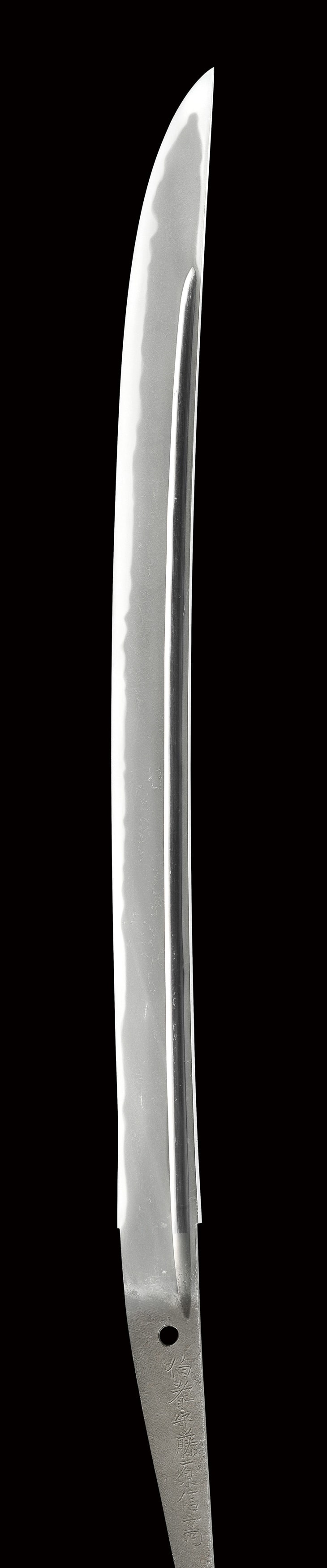
薙刀 生ぶ茎無銘 伯耆守信高
売却済
世界81社の刀剣商を横断追跡 · 価格履歴 · 売却アーカイブ
仕様
61.8 cm
3.39 cm
3.18 cm
4 cm
作者について
Sanami Nobutaka信高
The first-generation Hoki no Kami Fujiwara Nobutaka was born in Eiroku 6 (1563) at Kami-Aruchi in Mino Province. Traditionally said to descend from the San'ami Kanekuni lineage, he received the court title of Hoki no Kami in Tensho 9 (1581) at the age of nineteen. He subsequently moved to Kiyosu in Owari Province and, in Keicho 15 (1610), accompanied Tokugawa Yoshinao to Nagoya, where he became one of the founding figures of the Owari shinto tradition. In Kan'ei 10 (1633) he retired under the Buddhist name Keiyu, dying three years later at seventy-six. His personal name was Kawamura Saemon, and the majority of his extant works are *shinogi-zukuri* katana and wakizashi, with *hira-zukuri* tanto and polearms comparatively few. Nobutaka's forge work reveals the Mino tradition of his origin: *itame-hada* mixed with *nagare-hada*, tending toward *hada-dachi*, with thick *ji-nie* and *chikei*. His tempering ranges from tightly controlled *notare* with clear *nioiguchi* to bold, spirited compositions in which *gunome-midare*, *tobiyaki*, and *yubashiri* span into the *shinogi-ji*, developing into *hitatsura*-like all-over hardening. The *nie* is deep and sometimes coarsely formed, yielding *nie-kuzure* at the *yakigashira* and *hotsure* along the *habuchi*, punctuated by frequent *kinsuji* and *sunagashi*. His *boshi* tends to be deeply tempered with long *kaeri*, at times assuming an *ichimai*-like boldness. Among the designated pieces, the Tensho 9 katana is celebrated as an *utsushi* after the renowned Inabae, executed with natural assurance immediately upon receiving his court title. His imposing *o-kissaki* katana display the wide-bodied proportions characteristic of the Momoyama period, while even his yari of extraordinary length show no breakdown in execution, demonstrating technical mastery across blade forms.