NihontoWatch MonNihontoWatchBETA
MarketEncyclopedia
NihontoWatch Mon

NihontoWatchBETA

Market
Encyclopedia
Overview·Kantei·Designations·Provenance·Blade Forms·Signatures·Lineage·School
OverviewKanteiDesignationsProvenanceBlade FormsSignaturesLineageSchool
  1. Schools
  2. Osafune
  3. Ōei-Bizen
  4. Yasumitsu

Oei-Bizen Yasumitsu

康光

Tokujū
Vol. 4, No. 35 · Tachi

Oei-Bizen Yasumitsu

康光

55 ranked works

ProvinceBizenEraOei (1394–1428)PeriodMuromachiSchoolOsafune>Oei-BizenTraditionBizen-denGeneration1stTeacherShigeyoshiFujishiroJo-jo sakuToko Taikan850(top 11%)TypeSwordsmithCodeYAS847
4Jūyō Bunkazai
1Jūyō Bijutsuhin
3Gyobutsu
4Tokubetsu Jūyō43Jūyō Tōken

Overview

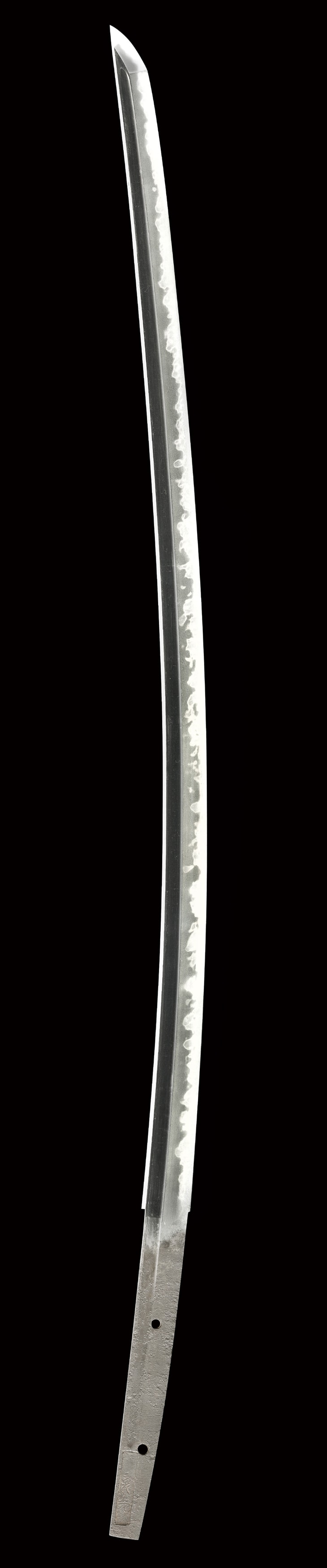
Yasumitsu of worked in Province in the early period, around the Ōei era (1394–1428), the years in which a flourishing group of smiths revived after the slump of . The published sources call that group Ōei-, and they place Yasumitsu, with Morimitsu, at its head: "Yasumitsu, together with Morimitsu, stands as the twin pillars among the smiths of the early period collectively termed Ōei-." Beside the two leading hands they name Iesuke, Tsuneie and Sanemitsu as lesser masters of the circle. The school's ideal, the sources say, was a return to the period, an aim visible in its revival of the shape and of the that had fallen out of use under . He carries on the line of Nagamitsu and Kagemitsu, and his dated work runs densely through the Ōei years, the long signature Bishū Yasumitsu cut toward the with the date on the reverse.

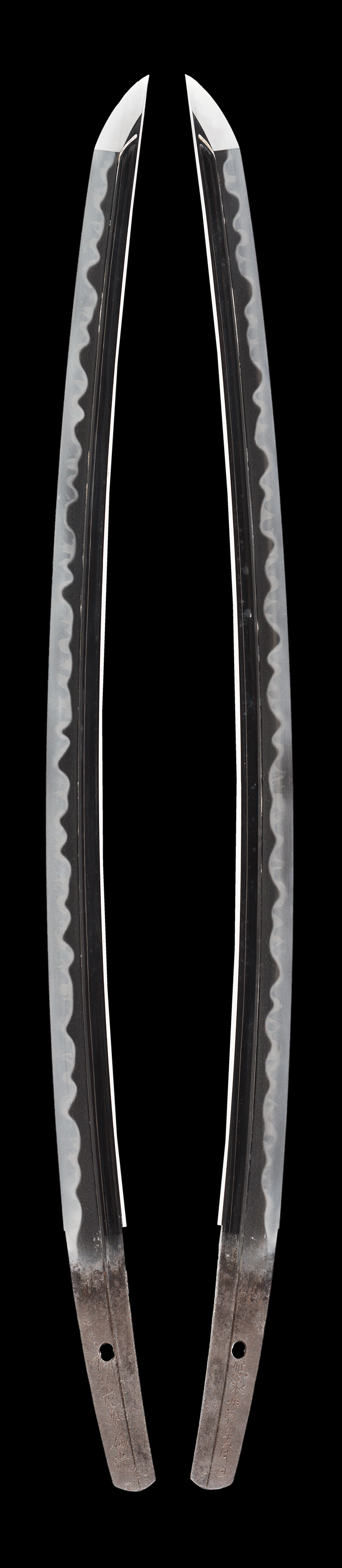
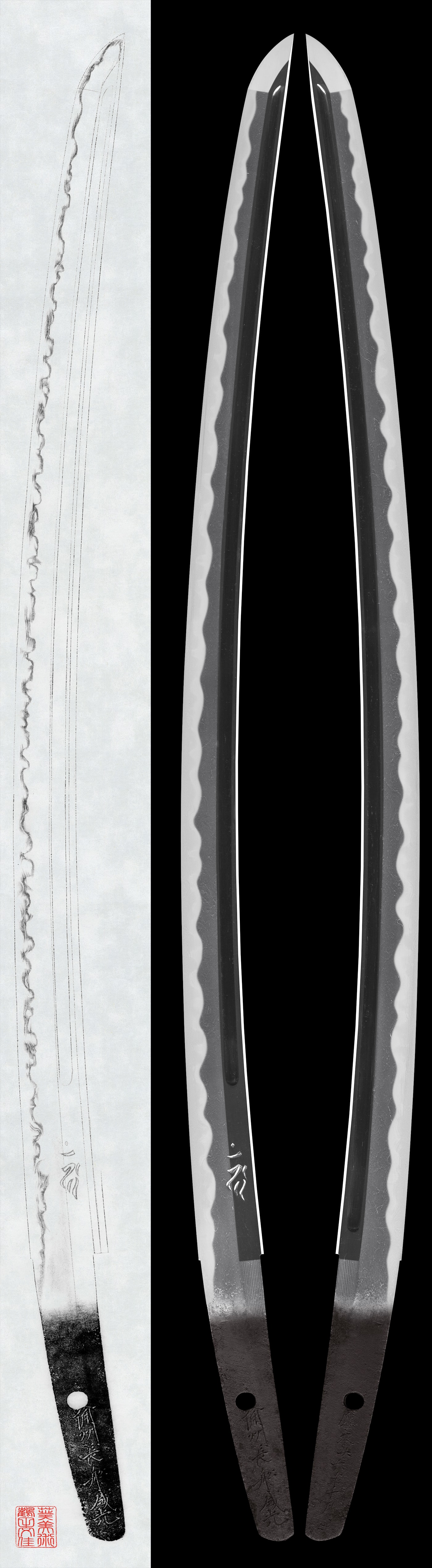
His prime and most characteristic hand is a flamboyant one. Over an mixed with , the grain standing, the temper rises into a large-pattern built on whose base opens wide at the waist, the form the published sources treat as the school's own. and enter abundantly; the line is -based with , slight and fine playing through, scattering at times, the bright and clear. The enters and turns back to a pointed, tongue-like tip, with brushed through it. This turnback is his signature feature and the school's: the sources single out "a whose tip becomes pointed, the characteristic form generally called the rōsoku-no- (candle-wick)." It is the trait by which Ōei- separates itself from the revival its and otherwise evoke.

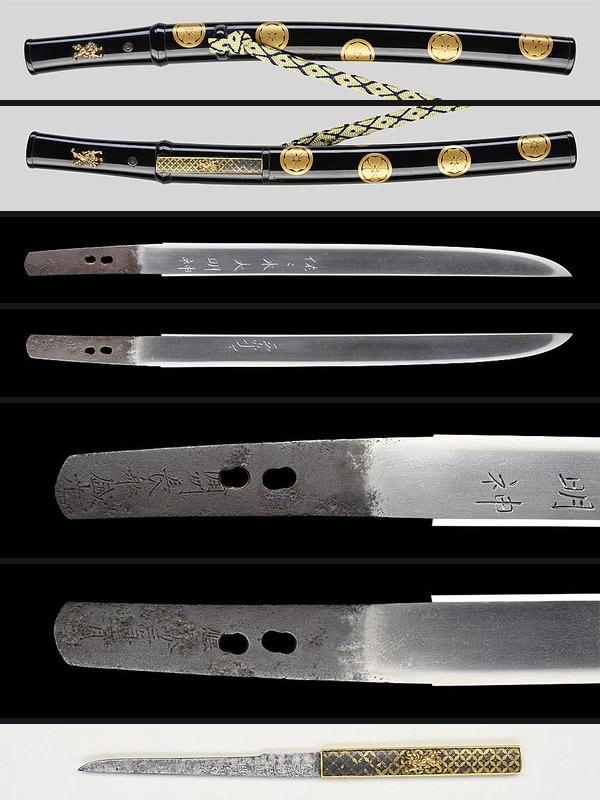
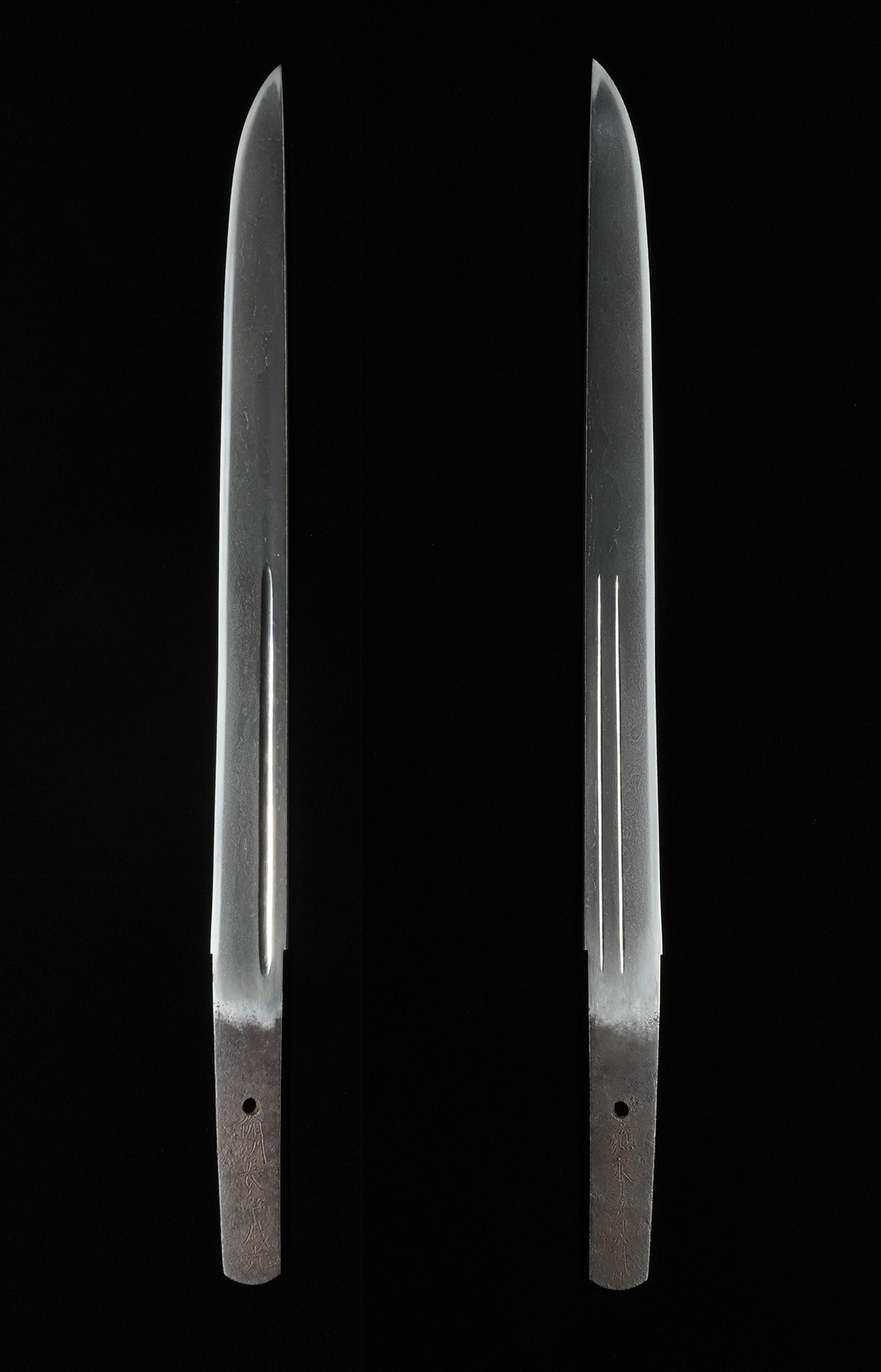
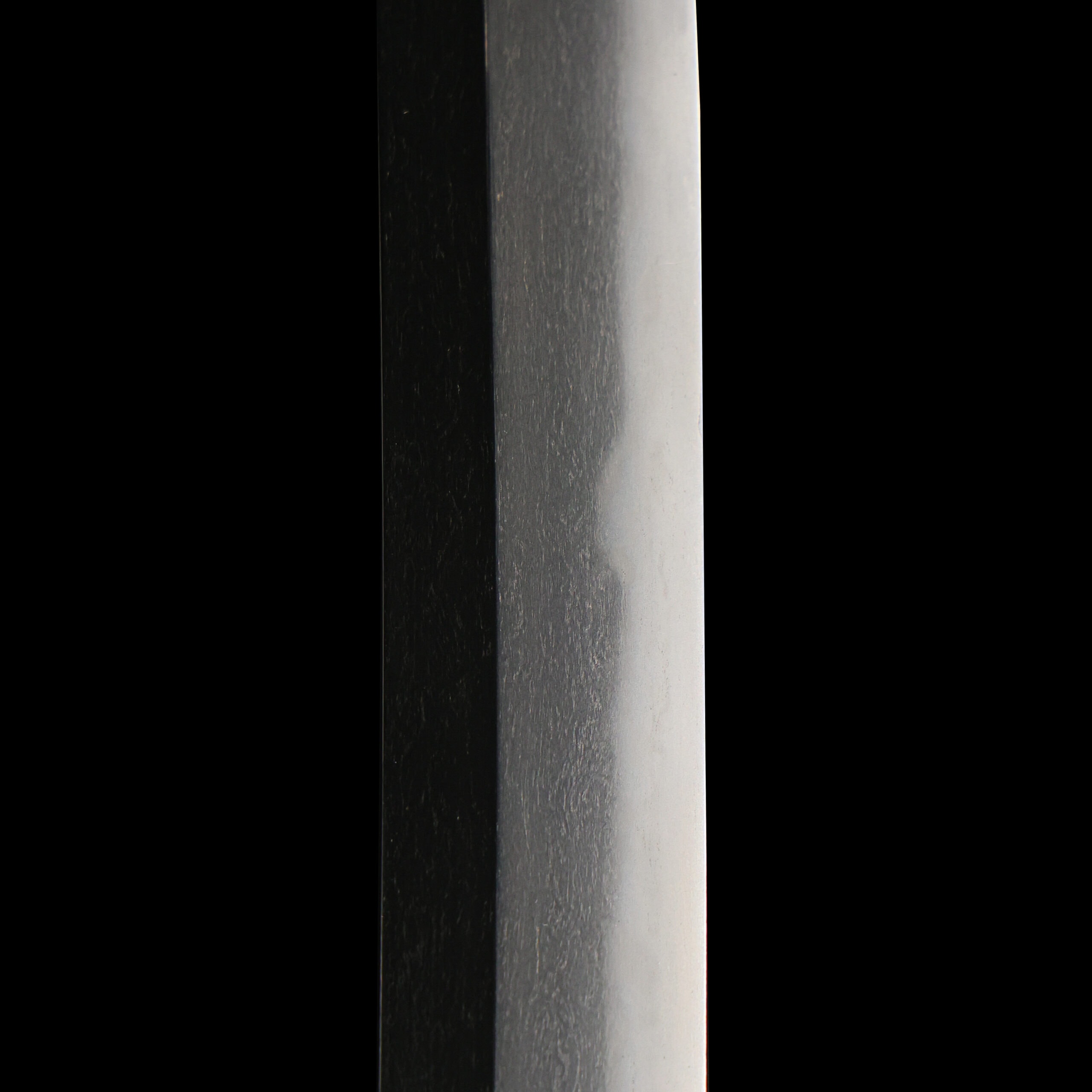
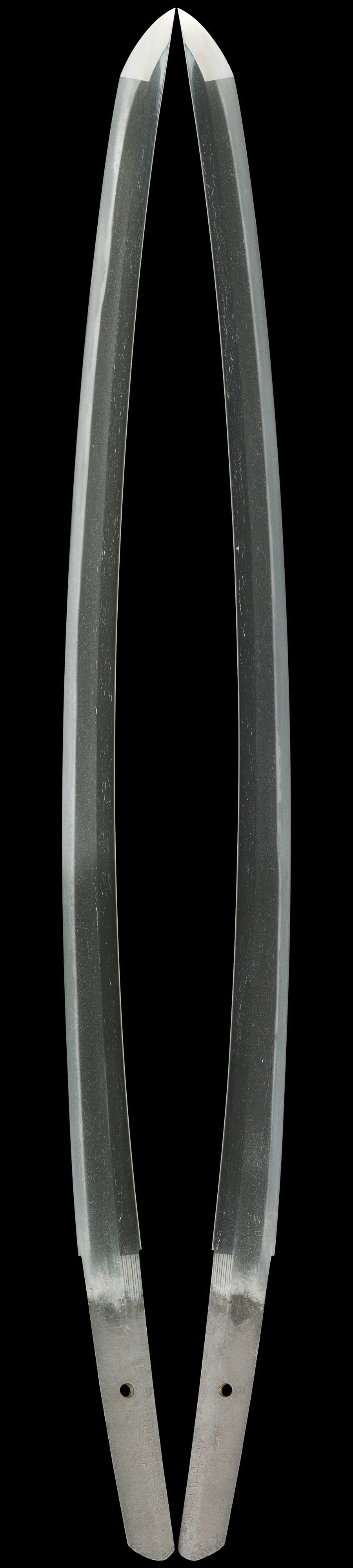
The is the throughout his work and is itself a point: a standing thickly mixed with , sometimes flowing, fine adhering like dust and -like dark lines entering, what the sources render as - no . Across it stands a reflection, and the sources distinguish two kinds: a straight or , and a that they read as the more archaic, recalling late- . Of one the published commentary remarks that its is "not the often seen in this period, but instead shows ." It is the standing, -bearing , not the smoother , that the judges use to fix the attribution. A , often with a paired , is finished round above the , a school tell, and the may carry , a sankozuka-, or carved deity names.

Alongside the flamboyant the sources mark a second, calm hand. It is a chū- or , the tight, bright and clear, faintly broken with and and frayed along the edge with and , the running straight to a . The judges note this hand is comparatively common in him, and more his than his fellow master's: "the , it would seem, is found rather more in Yasumitsu than in Morimitsu." His signing follows the registers that scholarship uses to sort the generations. The corpus is overwhelmingly and long-signed with an Ōei date; two-character are comparatively rare and tend to carry no date. Dated work survives from Ōei, Shōchō, Eikyō and Kakitsu, and the common reading takes the pieces dated after Shōchō as a second hand. The reference works place the Yasumitsu who styled himself Uemon-no-jō as the first generation, active in the Ōei years, count five generations of the name down to the end of , and assign a Sakyō-no- working in the Eikyō and Bunan eras, the so-called Eikyō-, to the next, whose temper is smaller in pattern and judged a touch inferior; the strict division between the generations the sources leave open for further study.

Within the Ōei- pair the two masters share the school manner, and the working distinction a collector draws between them is a fine one the sources state in their own words. Of a whose teeth point at the head the commentary observes that this is "a generally found rather more in Yasumitsu than in Morimitsu," and the is said of the calm . His can deceive: at a glance it recalls late- , and where the sinks and enter it can evoke , the sources writing of one such blade that "it has tempered a of tight , so as to suggest , yet this kind of workmanship is seen from time to time in Yasumitsu." The attribution settles back on him by the standing - and the Ōei . The religious carving he cuts at the , , the sankozuka-, names such as , is not his invention but an inheritance: "this is the carving tradition seen in work since Nagamitsu and Kagemitsu, and it is carried on down to ."

Fujishiro grades him Jō-jō , and his work carries weight in the designation record: four of his blades are Important Cultural Properties and four are , with forty-three beneath them, forty-seven in the and tiers together. He is Jō-jō and almost entirely signed, fifty-five signed pieces against none unsigned in the official record, and he left accomplished work in every form: , , , , and even a rare -signed great spear, the published sources noting that signed Ōei- spears are extremely scarce. His blades carry a distinguished provenance, twelve recording a history through the Yamauchi lords of Tosa, the Nabeshima, Maeda, Tōdō, Naitō and Akimoto houses, the Imperial Family, and the rōnin Horibe Yasubei (Taketsune) of the Akō affair. The Important Cultural Properties are held as patrimony and do not trade. Of recorded whereabouts his blades sit largely in shrines and museums, among them Atsuta Jingū, Jingū, Nikkō Tōshōgū, the Yūtoku, Hayashibara and sword museums, and the British Museum. A Yasumitsu in the or tier is not wholly beyond reach, for the corpus is large for so prized a name, but the finest survive in held collections and one comes to open hands only from time to time, a landmark of early- when it does.

Kantei

One Oei-Bizen manner in Yasumitsu's own cast (a standing itame-mokume jigane carrying utsuri, worked in two hands), read in three registers. First the two hands the published sources name: a flamboyant koshibiraki-gunome and choji midare, his typical and prime work; and a calm chu/hoso-suguha that at a glance recalls Kamakura Osafune or Aoe. Second a signature register: long signatures (BishU Osafune Yasumitsu) carrying an Oei date, against bare two-character mei. Third a temporal/generation split that the published sources themselves draw: the dated Oei pieces are the shodai (Uemon-no-jo), while blades dated after Shocho (the Eikyo and Kakitsu nengo) are taken as a second generation (Sakyo-no-suke), the so-called Eikyo-Bizen, whose work is smaller in pattern and judged a touch inferior. The 康光 name continued five generations to the end of Muromachi; the NBTHK lumps the early line under this code while dating individual blades, and the corpus is overwhelmingly the Oei shodai.

Yasumitsu is, with Morimitsu, one of the twin pillars of Oei-, the workshop that revived at in the Oei era (1394-1428) after the decline; the published sources repeatedly pair the two names and call them the school's leading hands. His ideal was a return to : a and a -bearing that recall the and old at a glance. What is his own, and the school's, is a standing mixed thickly with , a -bearing , a or , and above all a - (a whose base opens at the waist) mixed with into a flamboyant . The turns back pointed, the tongue-like tip the published sources call a 'candle-wick' (ROsoku-no-), a defining Oei- feature. He works in two hands: the flamboyant - and a calm that can be mistaken for . He is almost entirely signed and dated, the long signature 'BishU Yasumitsu' with an Oei nengo recurring across the corpus.

Diagnostic discriminators

the prime Oei-Bizen tell and the heart of Yasumitsu's flamboyant hand: a gunome whose base opens wide at the waist, mixed with choji into a large-patterned midare, in 48% of his setsumei where the bare gunome root (shared school boilerplate) sits at 85%; the published sources name it the first feature separating the Oei-Bizen individuality from the Kamakura revival the sugata and choji evoke

a pointed boshi appears in 63% of his setsumei; the published sources repeatedly single out the tongue-like pointed turnback, naming it the 'candle-wick' (rosoku-no-shin), as a great and defining Oei-Bizen feature, where the round ko-maru of his suguha hand is the alternative (40%)

the Oei-Bizen jigane is a standing itame thickly mixed with mokume (itame 98%, mokume 48%, hadatachi 60%), carrying chikei and a reflection; a midare-utsuri stands on 31% and a bo-utsuri/sugu-utsuri on 44%, the published sources contrasting the two and noting the midare-utsuri as the more archaic, recalling late-Kamakura Osafune. The standing mokume-bearing itame is what the judges use to separate Oei-Bizen from the smoother Kamakura revival it evokes

the collector's working distinction within Oei-Bizen: the two masters share the school manner, but the published sources state in so many words that a midare whose teeth point at the head, and the calm suguha, are generally more Yasumitsu than Morimitsu; the suguha hand in particular they call 'rather Yasumitsu than Morimitsu'. (Morimitsu is not yet profiled; captured here only as the sources state the contrast.)

Observation by phase

The flamboyant hand: koshibiraki-gunome and choji midare, the candle-wick boshi

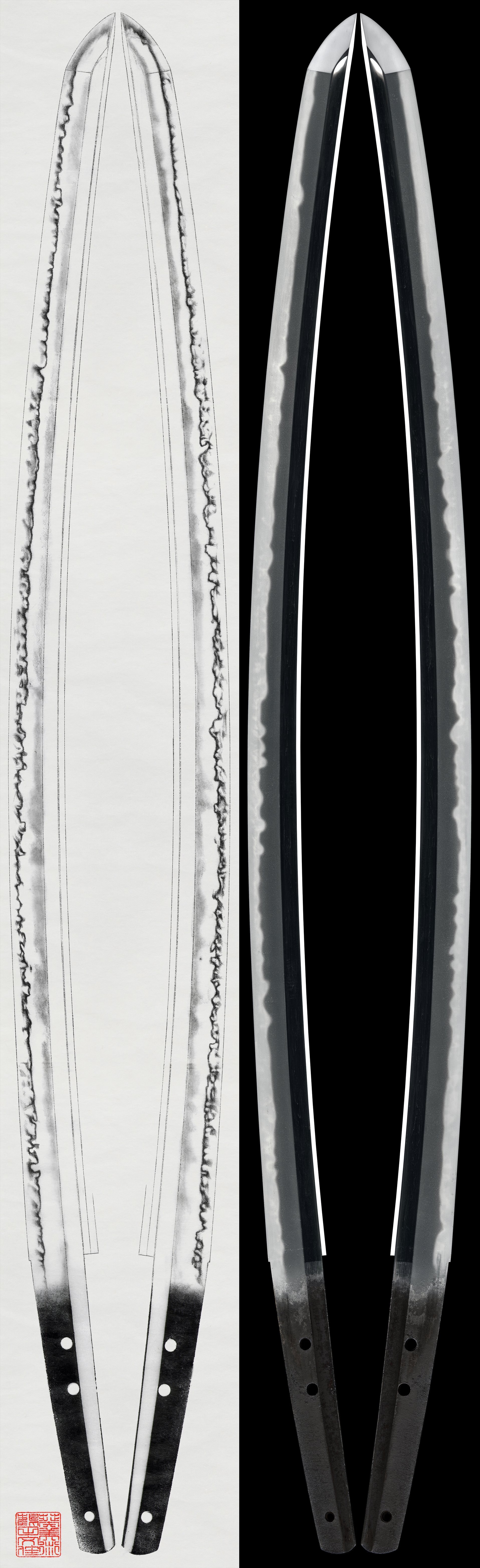
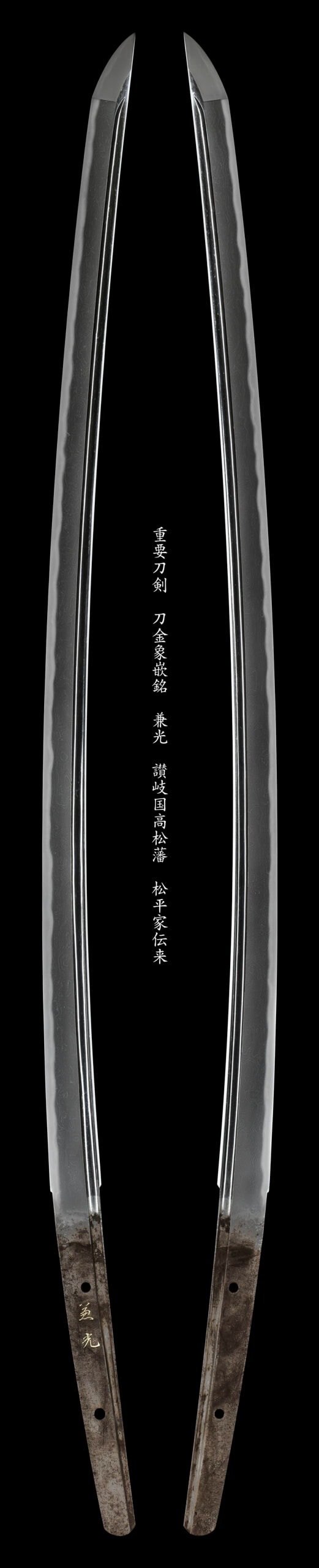
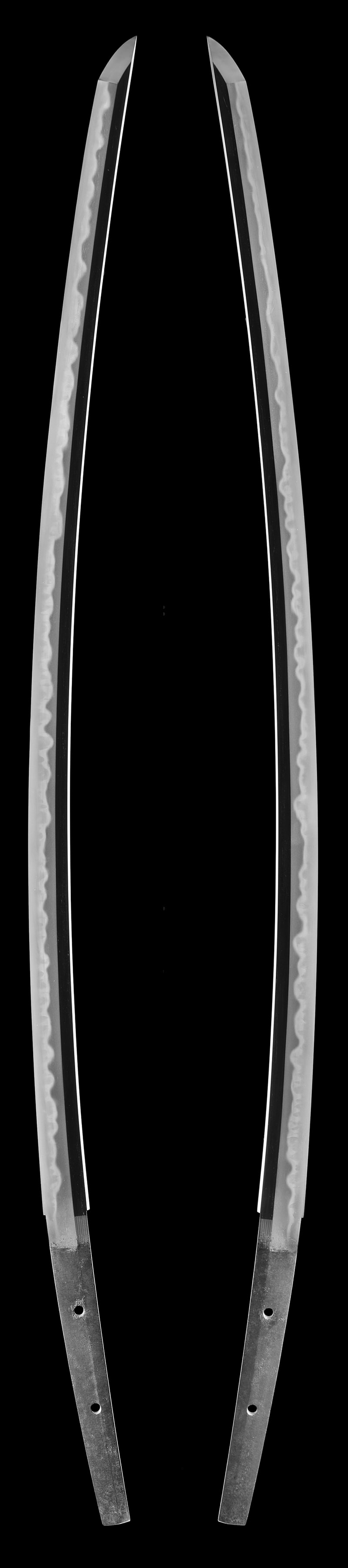
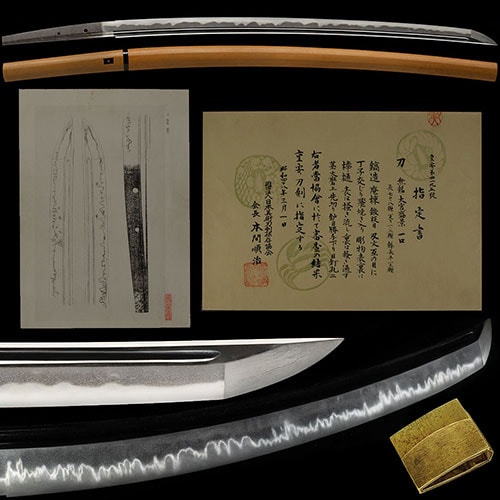
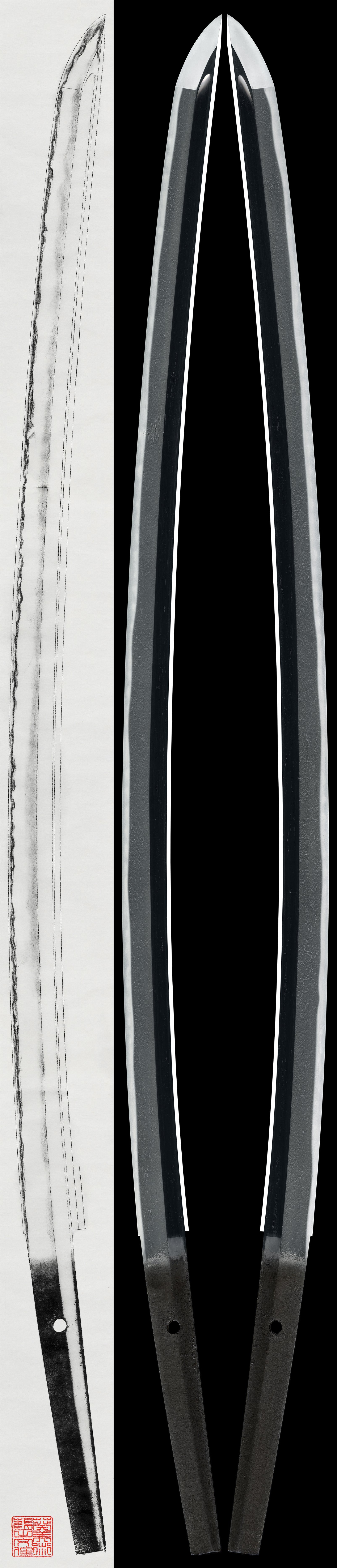
His typical and prime work. Over a standing mixed with and some , the carrying dust-fine , fine and a - or , Yasumitsu tempers a - (the spreading at its waist) mixed with into a flamboyant, large-patterned . and run in abundantly, the line is -based with , fine and play through, sometimes scatter, and the is bright. The often runs a touch (slanting) toward the base. The turns and points, the tongue-shaped tip the published sources liken to a candle-wick, frequently brushed with . A , often with , is finished round () above the , a school tell, and the may carry and a sankozuka-.

Jigane 地鉄
Hamon 刃文
Bōshi 帽子

The calm hand: a chu/hoso-suguha recalling Kamakura Osafune

the suguha hand, comparatively common in Yasumitsu and (the published sources note) more his than Morimitsu's; on it the jigane is the same standing itame-mokume with bo-utsuri or a faint sugu-utsuri, but the line is a chu- or hoso-suguha with a tight, bright nioiguchi, faintly broken with ko-gunome and saka-ashi, that at first glance recalls late-Kamakura Osafune or even Aoe

Alongside the flamboyant the published sources mark a calm as Yasumitsu's second hand, and note it is comparatively common in him and rather more his than Morimitsu's. The is the standing and , showing, with a or a faint standing along the . The line is a chu- or , the tight and bright and clear, faintly broken with and , the edge sometimes frayed with or . The runs to a . Several such blades the judges say recall late- at a glance, or evoke in a sunken- with ; the attribution settles on Yasumitsu by the standing - and the Oei .

Jigane 地鉄
Hamon 刃文
Bōshi 帽子

Signature register: the long Bishu-Osafune mei with an Oei date vs the bare two-character mei

the long signature 'Bishu Osafune Yasumitsu' (or six-character variants) with an Oei nengo on the ura, against the bare two-character 康光 mei; the published sources note two-character pieces are comparatively scarce and, oddly, the two-character blades tend to carry no date, while the long-signed ones are dated

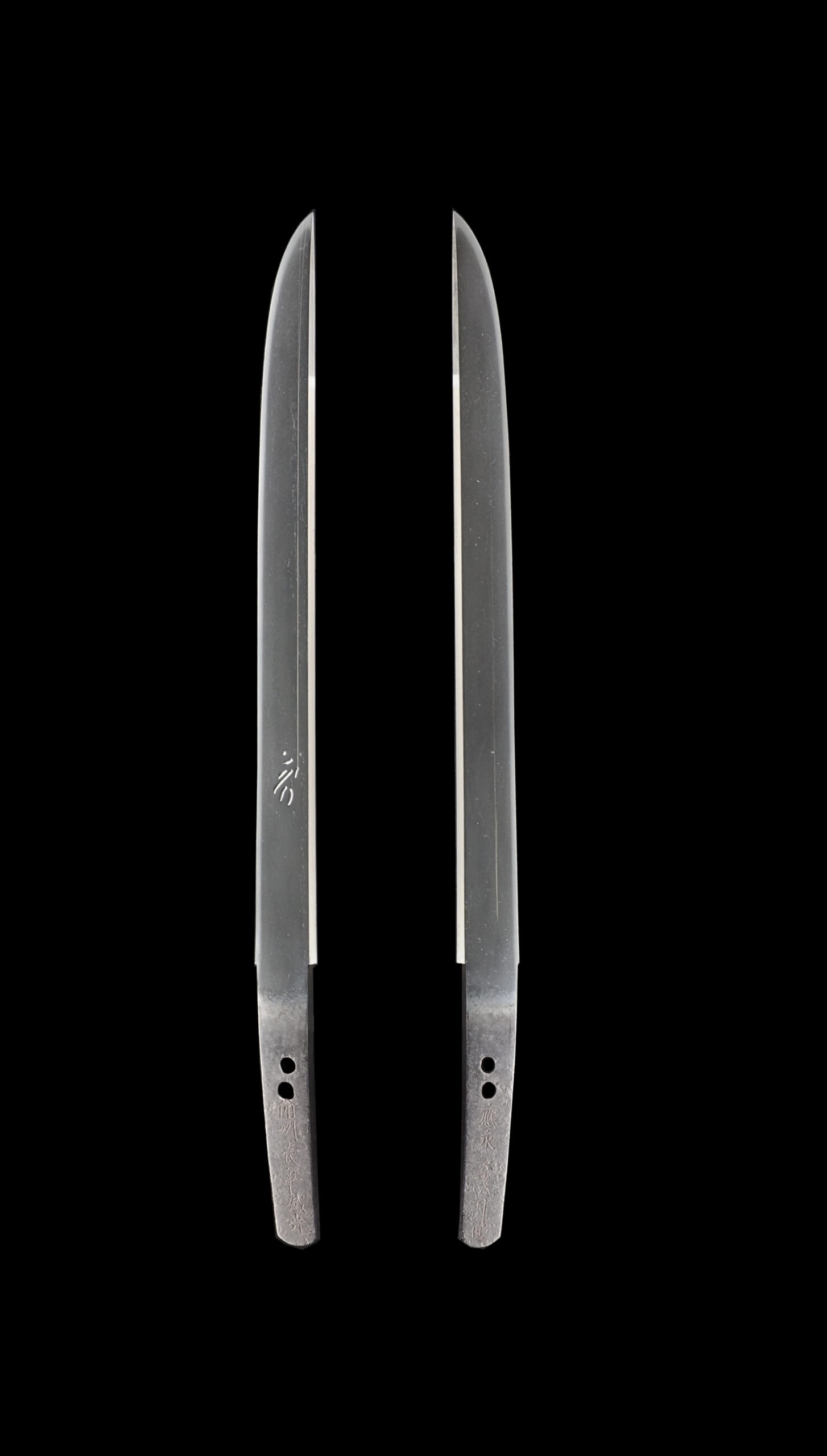
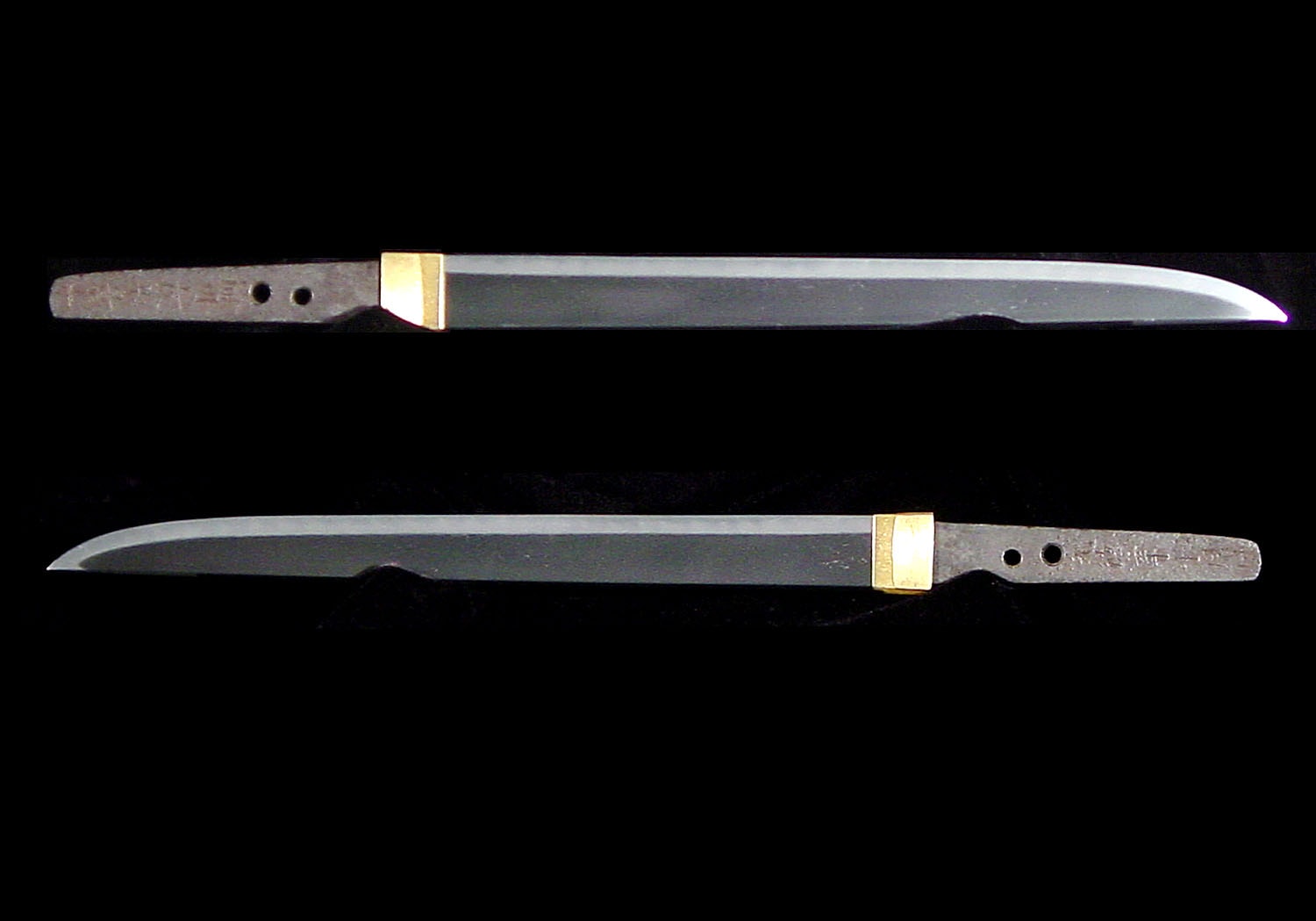
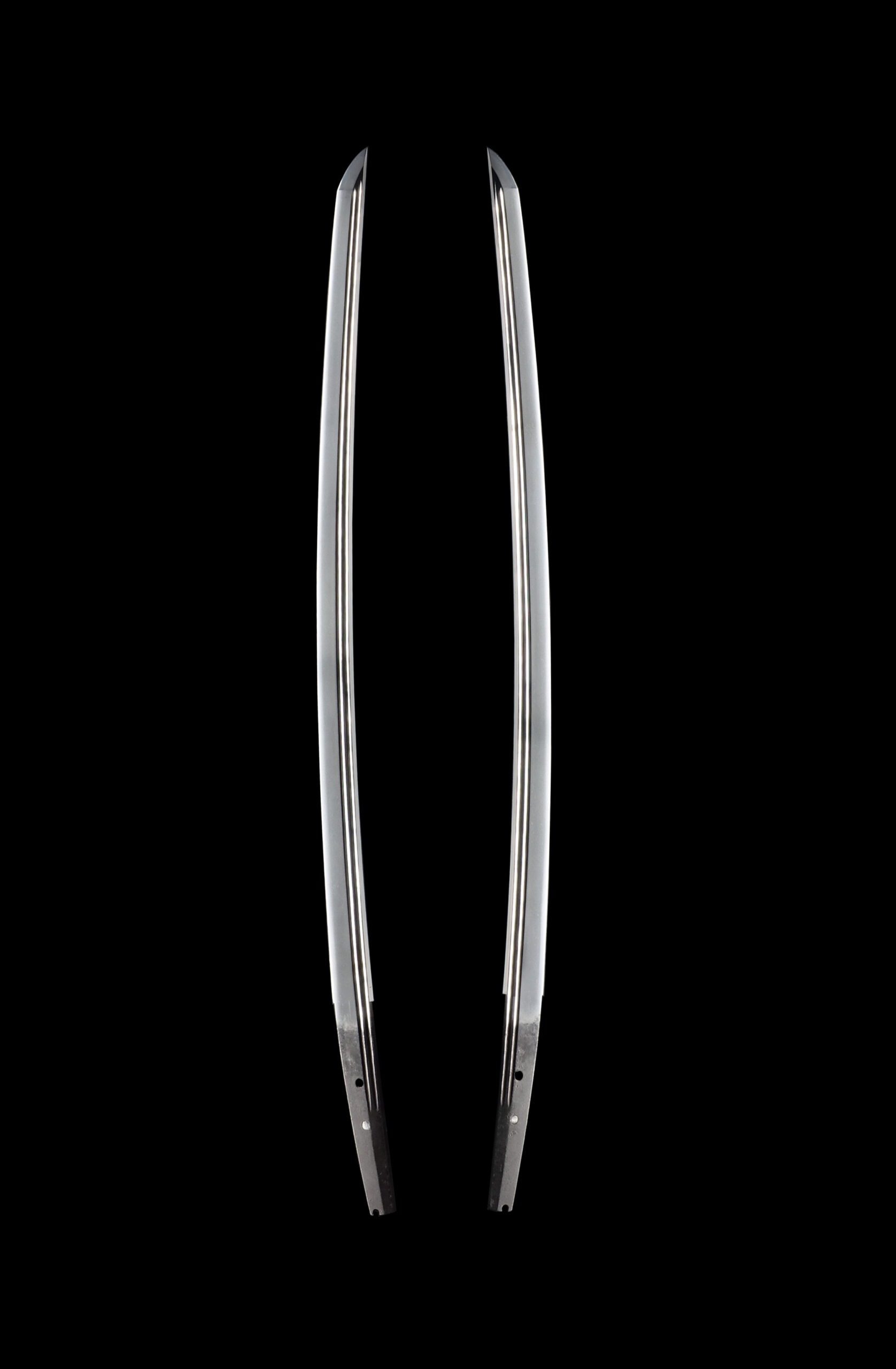
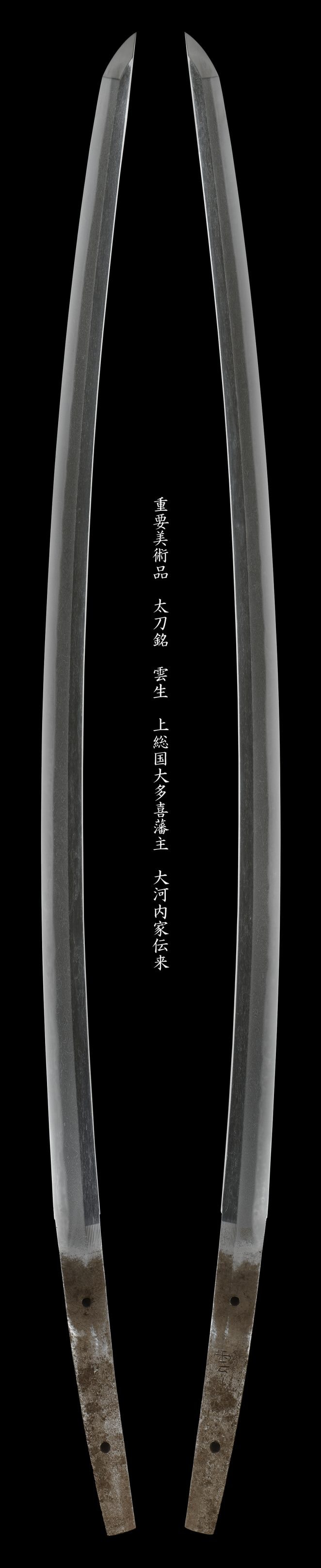
Yasumitsu is overwhelmingly signed: the corpus is almost all tang with a long signature, Bishu Yasumitsu, cut toward the side with an Oei nengo on the ; the dated examples run densely from Oei 10 through Oei 33. Bare two-character are comparatively scarce and, the judges remark, tend to carry no date, where the long-signed blades are dated. The are , long, with a high and a touch of -zori; the and are , broad and for their length with a shallow and thick , the typical Oei体配. He left good work in , , and alike, and even a rare -signed great spear (o-).

Sugata 姿
Scholarship

Yasumitsu carries Oei, Shocho, Eikyo and Kakitsu dates; following the common reading the pieces dated after Shocho are taken as a second generation, whose work is judged a touch inferior to the Oei first generation.

The published sources count the 康光 name to five generations to the end of Muromachi, making the first Uemon-no-jo and a second Sakyo-no-suke active in the Eikyo era, the so-called Eikyo-Bizen, the strict division between generations still left for future study.

Designations

Kokuhō—
Jūyō Bunkazai4
Jūyō Bijutsuhin1
Gyobutsu3
Tokubetsu Jūyō4
Jūyō Tōken43

Elite Standing

0.36 across 55 designated works

Top 7% among smiths

Provenance

14 documented provenances across certified works by Yasumitsu

Provenance Standing

9 works held in elite collections across 14 documented provenances

Top 6% among smiths

Raw score: 2.92 / 10

Blade Forms

Distribution across 55 ranked works

Signatures

Signature types across 55 ranked works

Currently Available

Lineage

TeacherShigeyoshi
Yasumitsu
Students (11)
  1. 1.Morimitsu盛光6 for sale61designated
  2. 2.Yasuaki靖要1 for sale
  3. 3.Yasutake靖武3 for sale
  4. 4.Yasushige靖繁
  5. 5.Yasunobu靖延
  6. 6.Yasutake靖武
  7. 7.Yasumitsu康光
  8. 8.Yasumitsu康光1 for sale2designated
  9. 9.Yasumitsu康光
  10. 10.Yasunaga康永1designated
  11. 11.Yasumoto安元1designated

Oei-Bizen School

Other artisans of the Oei-Bizen school

  1. 1.Morimitsu盛光6 for sale61designated
  2. 2.Sanemitsu實光4designated
  3. 3.Yasumitsu康光1 for sale2designated
  4. 4.Tsuneie經家2designated
  5. 5.Yasunaga康永1designated
  6. 6.Tsuneie經家6designated
  7. 7.Yasunaga安永1designated