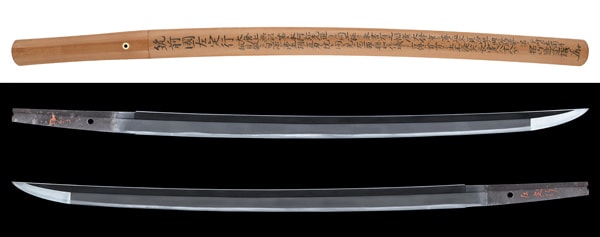
Akikuni is the Nagato continuation of the line. The published sources place him among the later disciples of Yasuyoshi, taken on after Yasuyoshi carried the name out of and into Chochu, and the reference works on signatures add that he was the son of Chochu Yasuyoshi. The works caution that the name is not quite a single man: they list six smiths who bore it, beginning with a smith of the Bunwa era in the line of Yasuyoshi and including the Oei-period hand described as the son of Chochu Yasuyoshi, so that Chochu Akikuni is best read as a name handed down through the Nagato workshop. Among his extant dated works the earliest are of the Oei era, with later examples reaching into the Bunan years, which sets him in the early period carrying a provincial, late reading of the manner the line had taken up.
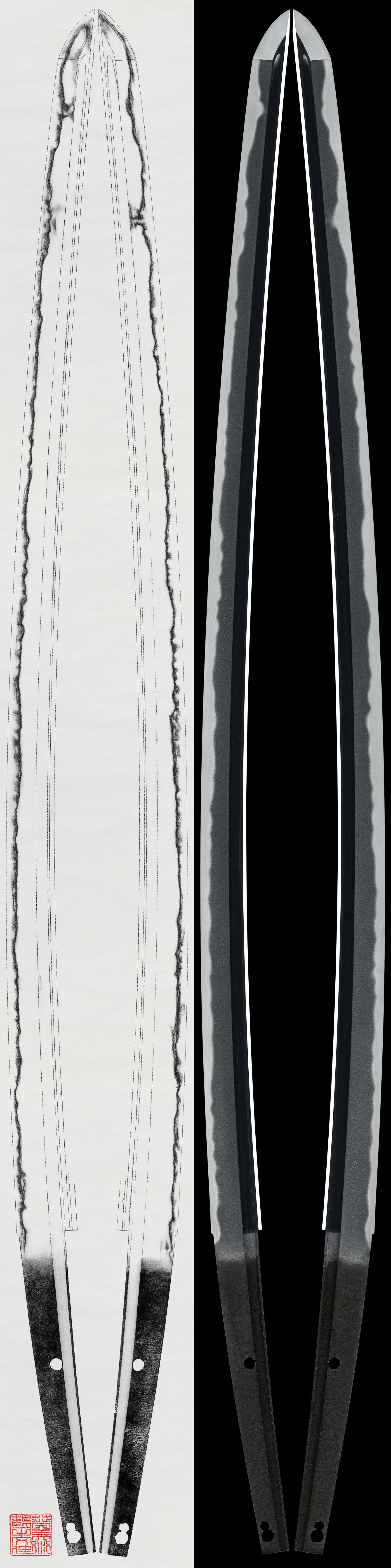
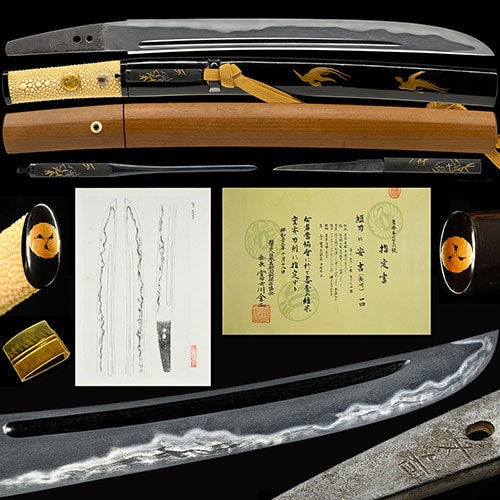
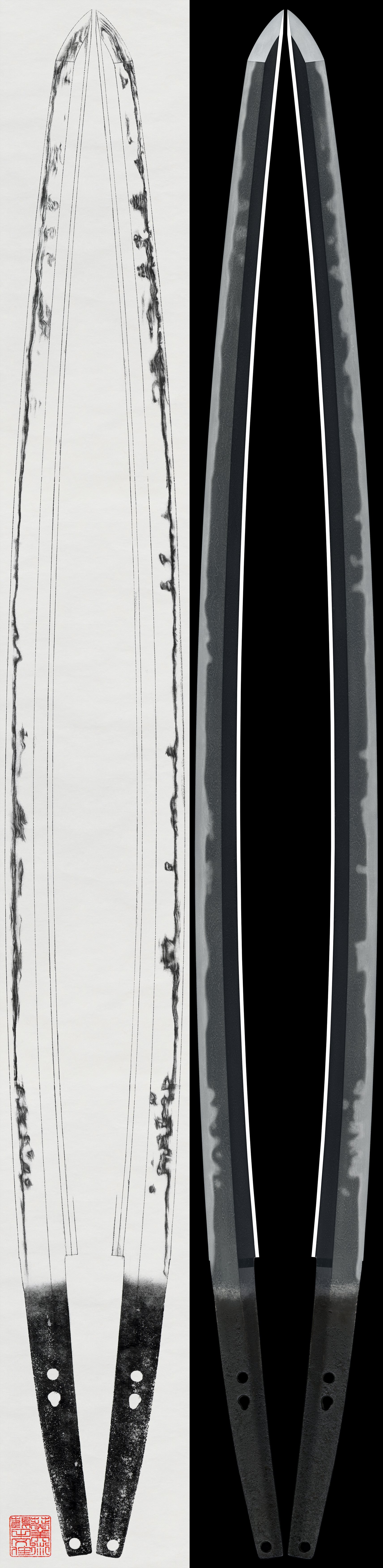
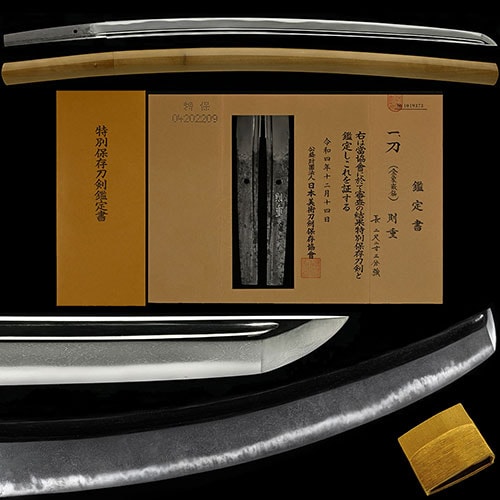
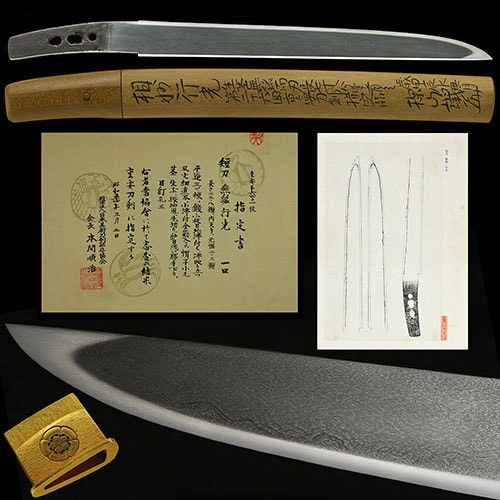
The published sources state his temper in a single sentence of connoisseurship, that his work includes both blades in and blades in which develops strongly and a linked is formed. The latter is the manner they call representative. On his dated Oei 31 the runs linked, with entering and the adhering, and on the signed the temper carries small , a deep , with and drawn through. The manner appears in its fuller form on his broadest , a base bearing a slight with and , and entering, the uneven in places with slight and small , and present, the tending to sink. The answers the temper face by face: straight into a with a long return finely swept in on the piece, turning back with a pointed tendency on the , and on the Oei 31 -kuzure on one face with a straight on the other.
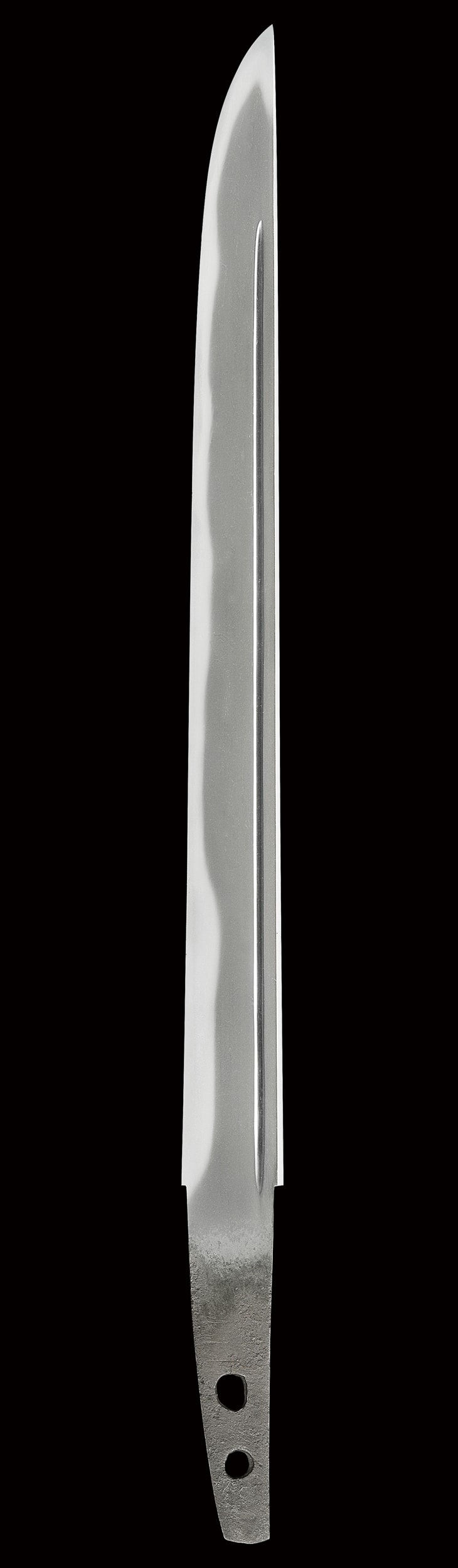
The is , often standing, mixed with and , with thick and fine -like lines of steel. On his broadest a faint stands and the steel carries a slightly blackish cast, the marks of a peripheral late- forge rather than the bright . are carved on both faces, at times with companion grooves running partway up the blade. Of that broadest the published sources write that there is a rustic character to the workmanship which, with the large , conveys a vigorous, commanding spirit, and they note that large-scale blades of this kind are scarce within his oeuvre, its imposing form resembling that of an by the smith certified before the war as an Important Art Object.
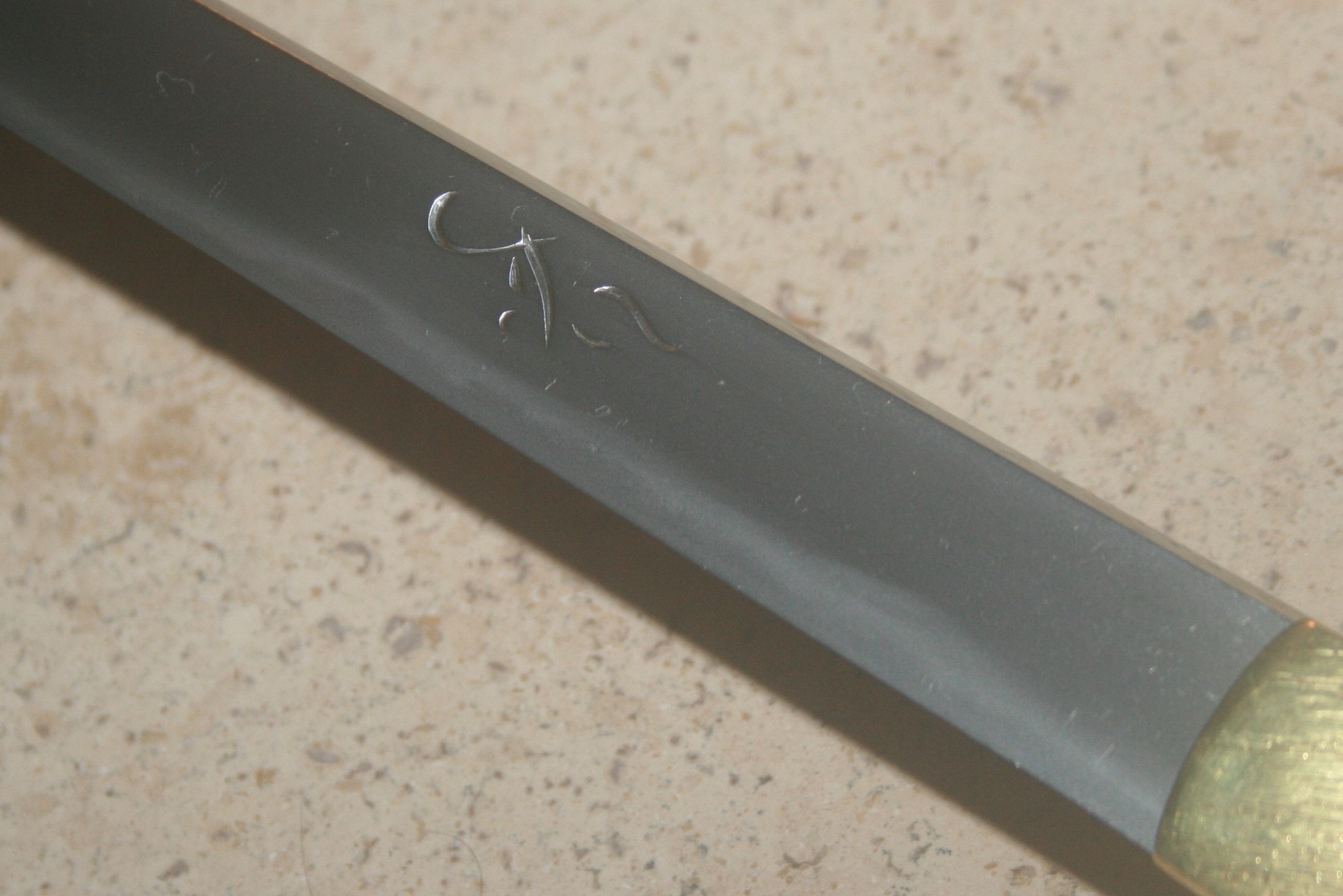
The signature itself is part of the . Signed works are comparatively few, the standard cut in five characters as Chochu-ju Akikuni, and among the Oei-dated examples some add the title Saemon no Jo (左衛門尉) while others state the place of residence as Chochu Setozaki junin. One carries the folded over on a shortened tang, an (折返銘), the groove carried through into the folded portion. Because the reference works gather several Akikuni under the one name, a date and a place-name in the inscription do as much to anchor a piece as the manner of the temper. His of Oei 31 is valued by the published sources for exactly this reason, the representative example of his connected in which his characteristic features are readily seen, both and well executed, the Oei date itself prized as documentary material.
The lineage to Yasuyoshi is the axis on which his attributions turn, and the published sources argue it from both sides. On a shaped like a shortened they concede that the workmanship does not connect directly to Yasuyoshi's own style, yet accept the handed-down attribution all the . On the signed they read the positive case, finding in both the and the a current of workmanship descending from Yasuyoshi. Taken together the two readings place Akikuni at the provincial far end of the tradition, carrying the manner into Nagato and into the early period with a coarser, more -driven character than the source.
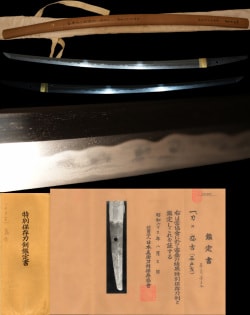
Akikuni is a smith of the standing the collector meets through his designated blades rather than his name. Fujishiro grades him Jo , and his record on the books is four works at the level, none raised to the higher designations, a profile that fits a fine provincial hand of the descent. Provenance, where it survives, is fitting to that reading: his work descended in the great houses of his own province, the Ouchi of Suo and Nagato and the Mori who succeeded them, a transmission that reads like the local history of the blade. Recorded ownership beyond that is thin, as it usually is for a smith of this rank, and no museum holding can be claimed from the record. A signed and dated Akikuni is not a blade that comes often to market, and when one does it is met as the work of a well-documented branch smith of the line, a vigorous early- piece carrying the descent into Nagato, valuable to the student of the school for the directness with which it shows a country forge working in the old tradition.