NihontoWatch MonNihontoWatchBETA
MarketEncyclopedia
NihontoWatch Mon

NihontoWatchBETA

Market
Encyclopedia
Overview·Kantei·Designations·Provenance·Work Types·Signatures·Lineage·School
OverviewKanteiDesignationsProvenanceWork TypesSignaturesLineageSchool
  1. Schools
  2. Yokoya
  3. Soyo

Yokoya Soyo

宗與

Tokujū
Vol. 6, No. 67 · Mitokoromono

Yokoya Soyo

宗與

14 ranked works

ProvinceEdoEraGenroku-An'ei (1701–1779)SchoolYokoyaTraditionMachiboriGeneration2nd (宗興 Sōko, adopted son of Sōmin)TeacherSominSpecialtiestsuba, kozuka, menuki, fuchi-kashira, kogaiTypeTosogu MakerCodeYOK002
1Tokubetsu Jūyō13Jūyō Tōken

Overview

Yokoya Soyo was born in in Genroku 13 (1700), the second son of Yokoya Soju and younger brother of Eisei. Invited to become the adopted son of the celebrated Yokoya Somin, he succeeded to the family headship in Kyoho 18 (1733) at the age of thirty-four, following Somin's death, thereby preserving the distinguished Yokoya house name. In later years he took the art name Shokei. He should be distinguished from the first-generation Soyo (sometimes called "Sofu Soyo" or "Ko-Soyo"), who had studied under Goto Injo Mitsutomi, served as an official bakufu carver during the 'ei era, and founded the Yokoya lineage in . The second-generation Soyo stands as the direct artistic heir of Somin and an outstanding presence among the many metalworkers who emerged in what came to be called .

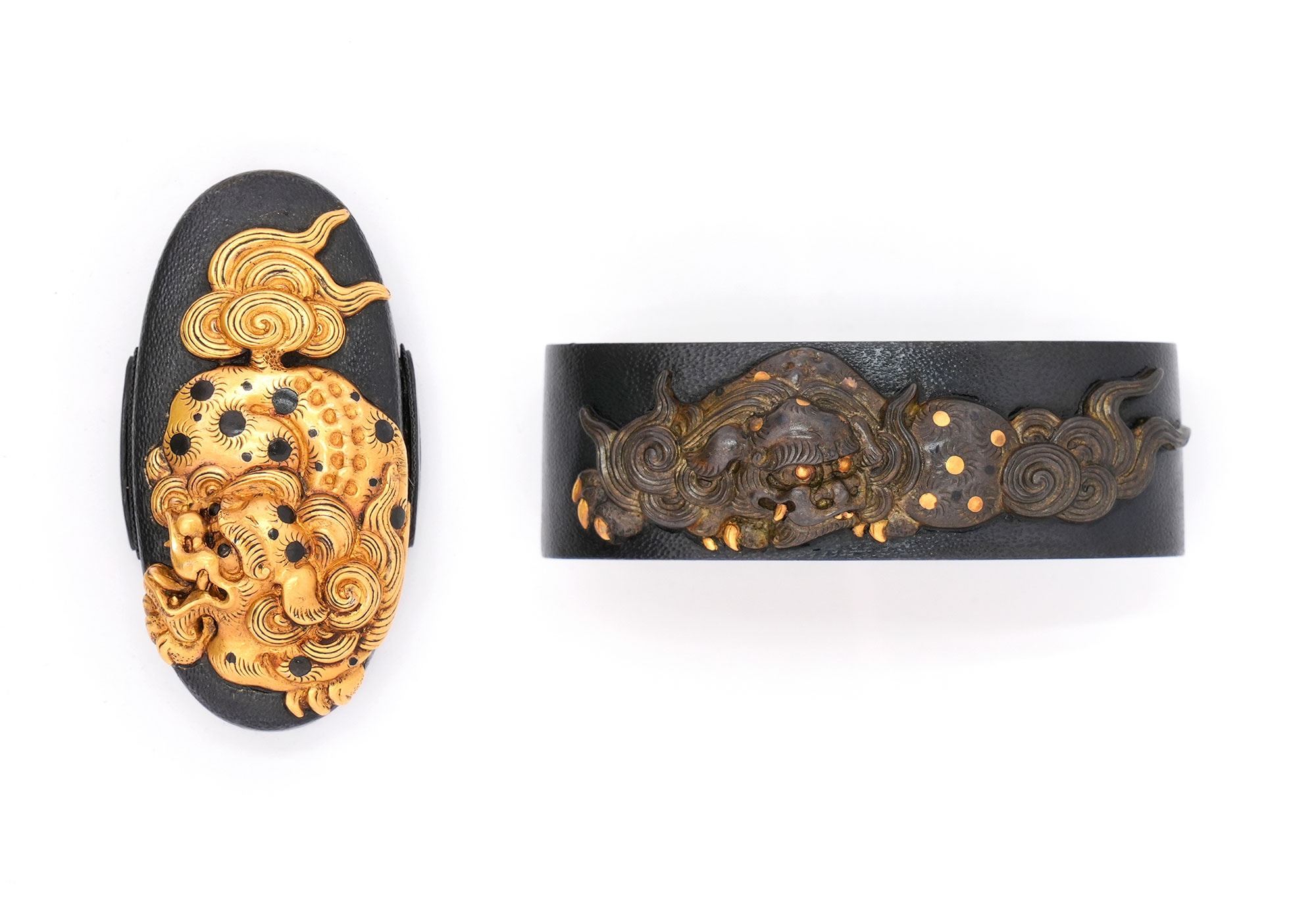
Soyo's oeuvre divides broadly into two modes. Many of his works are executed on polished grounds using — the single-edge "engraver's brush" carving that was a favored specialty inherited from Somin — in which he "demonstrates an excellent technique inherited from his master and adoptive father." By deftly alternating chisels of varying widths, he achieves compositions that combine bold, powerful with delicate linework. A smaller but no less distinguished body of work employs grounds with , inlay, and , producing "superb results that possess both the capability and the dignity expected of Somin's successor." His lions — the celebrated "Yokoya shishi" originating with Somin — are rendered with imposing presence and richly modeled high relief, while his horses display a naturalistic, sketch-from-nature quality. His signature is characteristically cut in vigorous script with .

The repeatedly affirm Soyo's place as a master who "clearly surpassed the rest" among metalworkers while faithfully continuing his teacher's manner. His works are described as "extremely rare," lending special value to surviving examples; fully coordinated matching sets (mitsudogu) are rarer still and regarded as representative masterpieces. Whether working in the restrained monochrome palette of polished or introducing touches of color through kinhira- rim accents and gold , his pieces consistently display "a high level of skill inherited from Somin" alongside an individuality all his own — a capacity, as the observes, for adding "the innovative freshness of " to the traditional Yokoya atelier vocabulary.

Kantei

3 descriptive axes: material (the grounds and metals) x technique (the carving and inlay hand) x themes (the subjects he carved). His axes are largely those of the Yokoya house Somin founded; the profile isolates the two narrow features the setsumei use to separate Soyo's own hand from the house and from Somin.

Yokoya Soyo is the metalwork artist who succeeded Yokoya Somin, the founder of (town carving), as head of the Yokoya line. The record him consistently: the second son of Yokoya Soju, born in 1700 in , with an elder brother named Hidekiyo (Eisei); invited to become the adopted son of Somin, he succeeded the family headship in 1733 at the age of thirty-four after Somin's death, kept the prestige of the Yokoya name, and in old age took the go Shokei. He is judged by how faithfully he continued his master-father's manner, and the stress that continuity: with iro-e and, above all, the katakiri-bori single-edged line that Somin created. His own characteristic work-domain is the polished ground worked in katakiri-bori; pieces on the ground in high relief with inlay and iro-e are the minority but show his power and refinement as Somin's heir. He signs the one name in three orthographic variants, 宗与 / 宗興 / 宗與, in clean with a .

Diagnostic discriminators

the setsumei repeatedly state that Soyo's work-domain is mostly katakiri-bori on a shibuichi polished ground, while the shakudo nanako high-relief pieces are the minority; this ground choice is the closest thing the corpus offers to a Soyo-vs-Somin separator, since Somin's accepted work is on the shakudo nanako ground

the biography records that in old age he took the go Shokei; it is his own personal name, absent from Somin's corpus, and helps place a piece late in his career

Material

Two grounds divide his work. His characteristic domain is the polished ground (-migaki); the other, in the minority, is the inherited Yokoya ground with inlay and iro-e, often a plain-backed bo-. polished ground, plain copper and solid gold also appear.

Technique

His hand is the Yokoya hand. He is especially skilled in katakiri-bori, the single-edged painterly line that Somin created, using broad and narrow chisels together and pairing the bold cut with fine . The minority high-relief pieces add inlay and iro-e on the ground. -bearing signatures throughout.

Themes

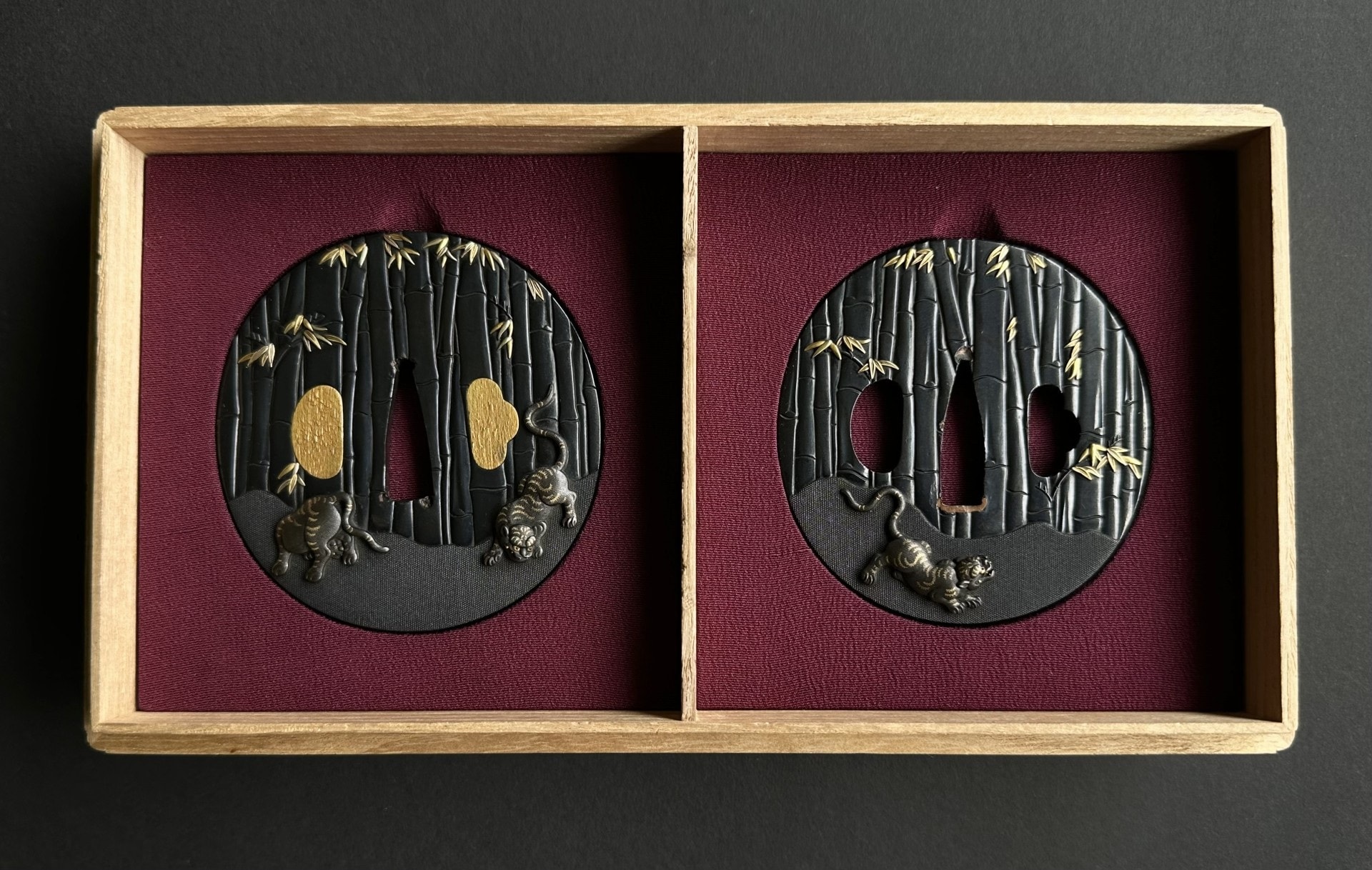
His subjects are the Yokoya repertoire he inherited: the eponymous Yokoya lion with peony, tigers, and the bold standing-horse seen front and back, together with auspicious figures such as Fukurokuju and the qilin. The single out his horse subjects as faithfully continuing Somin's, and his naturalist drawing power as Somin's legacy.

The inherited Yokoya repertoire (lion, peony, tiger)

The Yokoya lion (), peony and peony-eating lion, and tigers, which the describe as beginning with Somin and being a forte of the school; Soyo carries them on into his own work.

Horses and auspicious figures

The bold standing-horse viewed front and back and the eight-fine-horses subject, carved with naturalist drawing power the call Somin's legacy, and auspicious figures such as Fukurokuju and the qilin.

Full iconography

Signature chronology

Recorded signatures

Documentary note

Soyo has few features that separate his own hand from Somin's. The judge him almost entirely by how faithfully he continued his master-father: they say he well continued the master's manner, was especially skilled in the katakiri-bori Somin created, and that one horse rendering faithfully continues Somin's horse subject, his drawing power being Somin's legacy. The Yokoya idiom on which both are described (katakiri-bori, the lion, the high-relief with iro-e) is therefore a shared foundation, not a Soyo discriminator. Two records carry a non-stylistic attribution signal: one futatokoromono is accompanied by Soyo's own self-issued (jishin-orikami), said to date the set to 1763 with the finished in the tenth month and the in the twelfth (single source, 17-347); and one , signed by Soyo, was later fitted with a new rim by Natsuo at a patron's request, recorded in the rim inscription (single source, 52-148) and so a co-signer's mark, not co-making.

Scholarship

His horse subjects are traditionally judged to continue Somin's faithfully, his naturalist drawing power being Somin's legacy.

Designations

Kokuhō—
Jūyō Bunkazai—
Jūyō Bijutsuhin—
Gyobutsu—
Tokubetsu Jūyō1
Jūyō Tōken13

Elite Standing

0.06 across 14 designated works

Top 20% among makers

Provenance

1 documented provenance across certified works by Soyo

Provenance Standing

0 works held in elite collections across 1 documented provenances

Top 70% among makers

Raw score: 1.94 / 10

Work Types

Distribution across 14 ranked works

Other
857%
Kozuka
429%
Tsuba
214%

Signatures

Signature types across 14 ranked works

Currently Available

Lineage

TeacherSomin
Soyo

Yokoya School

Other artisans of the Yokoya school

  1. 1.Somin宗珉1 for sale48designated
  2. 2.Masa雅3designated
  3. 3.Soju宗壽1 for sale3designated
  4. 4.Katsura Eiju桂永寿1 for sale2designated
  5. 5.Tomoyoshi友喜1 for sale2designated
  6. 6.Nobusada宣貞1designated
  7. 7.Naoteru直照1designated
  8. 8.Soyo宗与1designated
  9. 9.Terukiyo英精1designated
  10. 10.Kiryusai Somin起龍斎宗珉3 for sale1designated
  11. 11.Genchin元珍3 for sale1designated
  12. 12.Eiko英光1designated

Soyo

Soyo(宗與) was a maker of Japanese sword fittings (tōsōgu) of the Yokoya school in Edo province, active during the Genroku-An'ei (1701-1779) period.

The work follows the Machibori tradition.

Designated works by Soyo include 1 Tokubetsu Jūyō, 13 Jūyō.