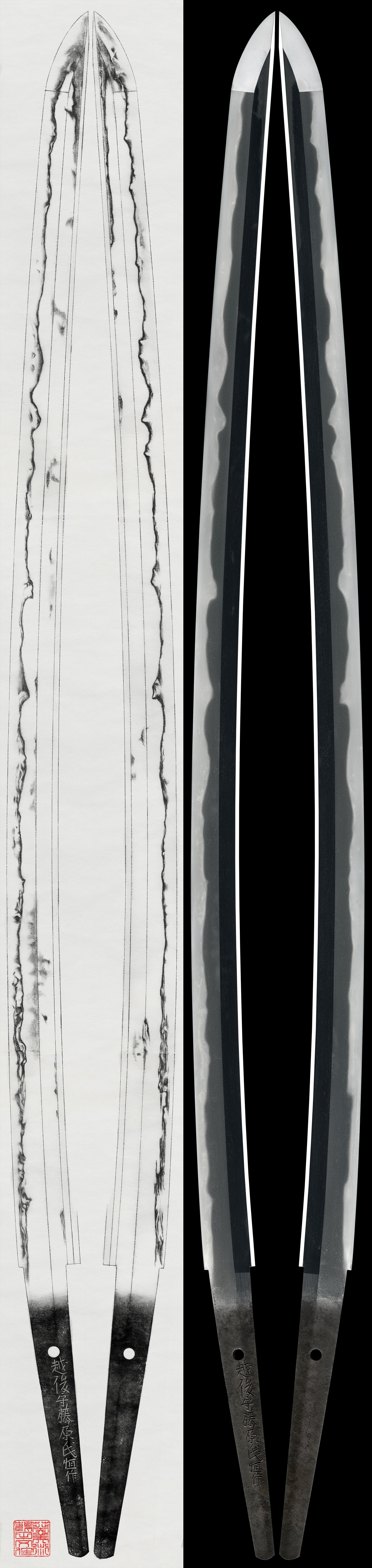
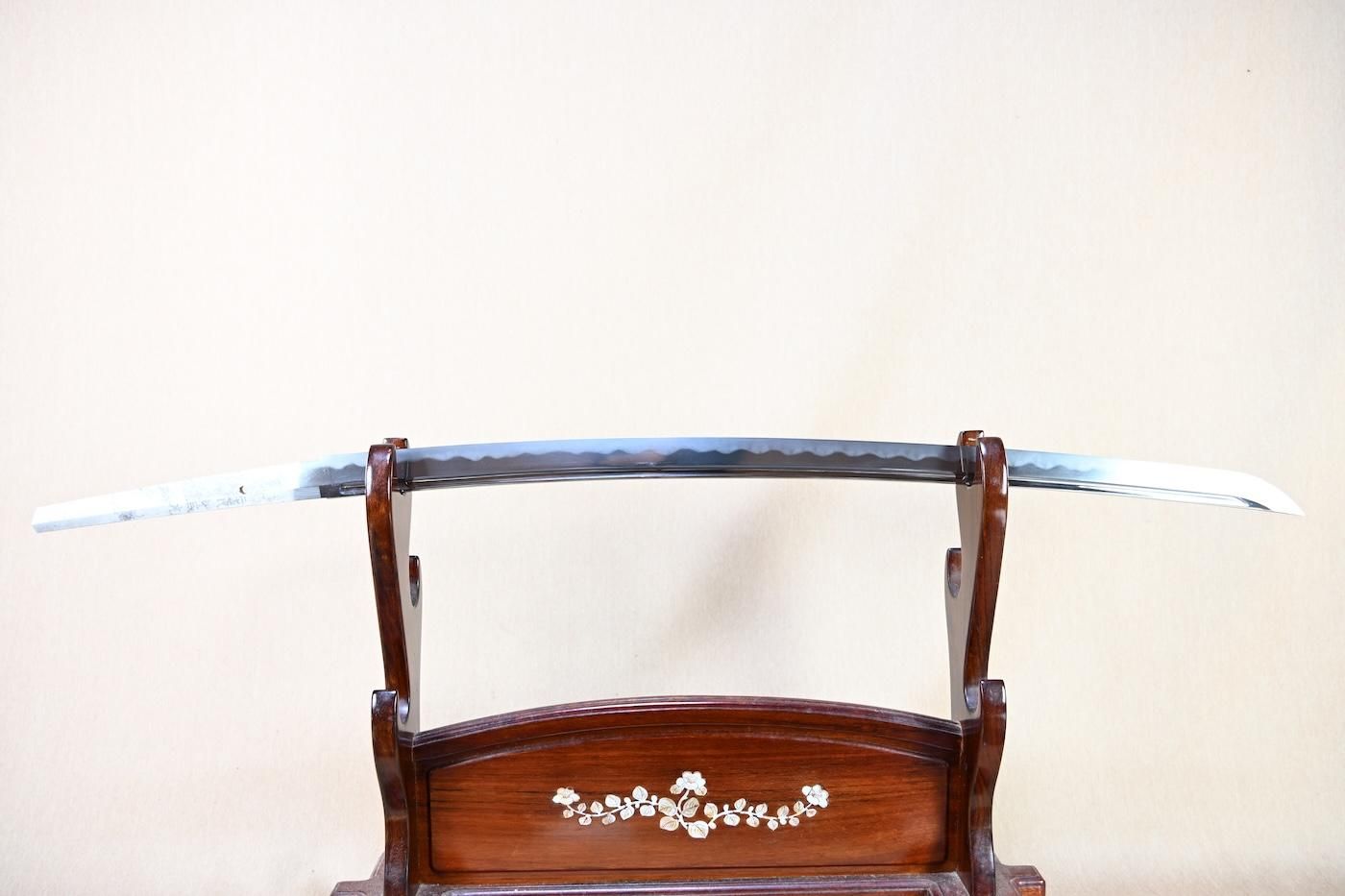
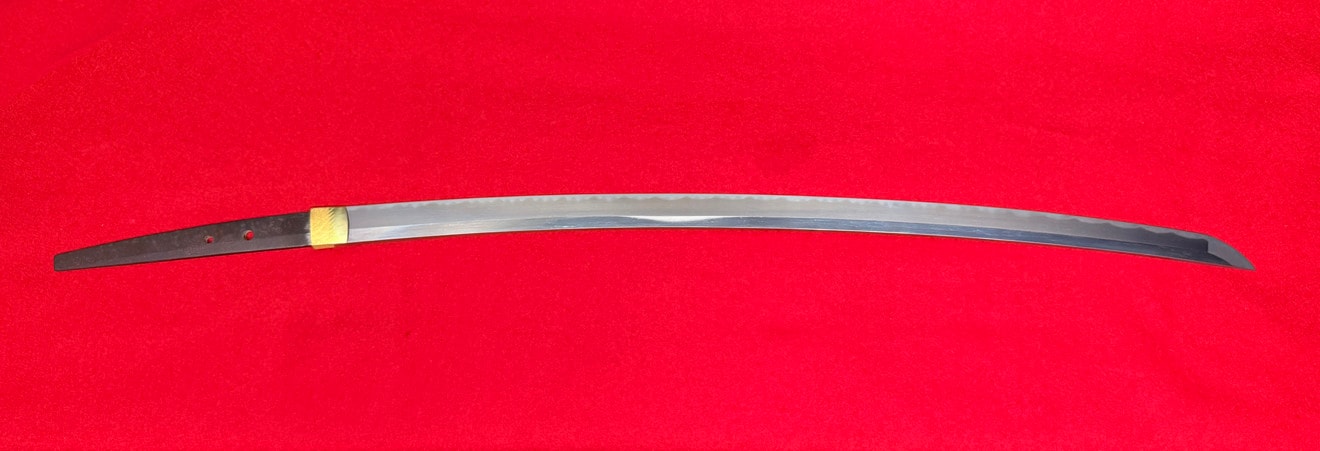
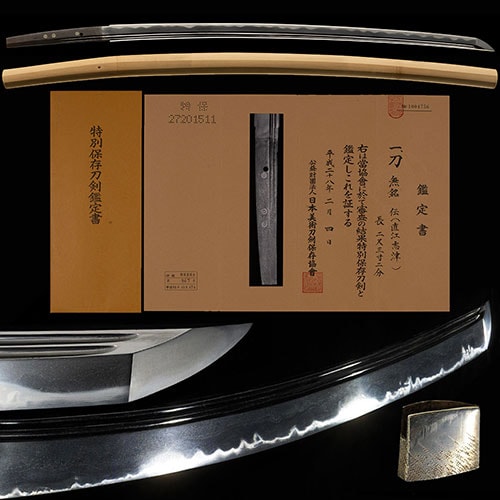
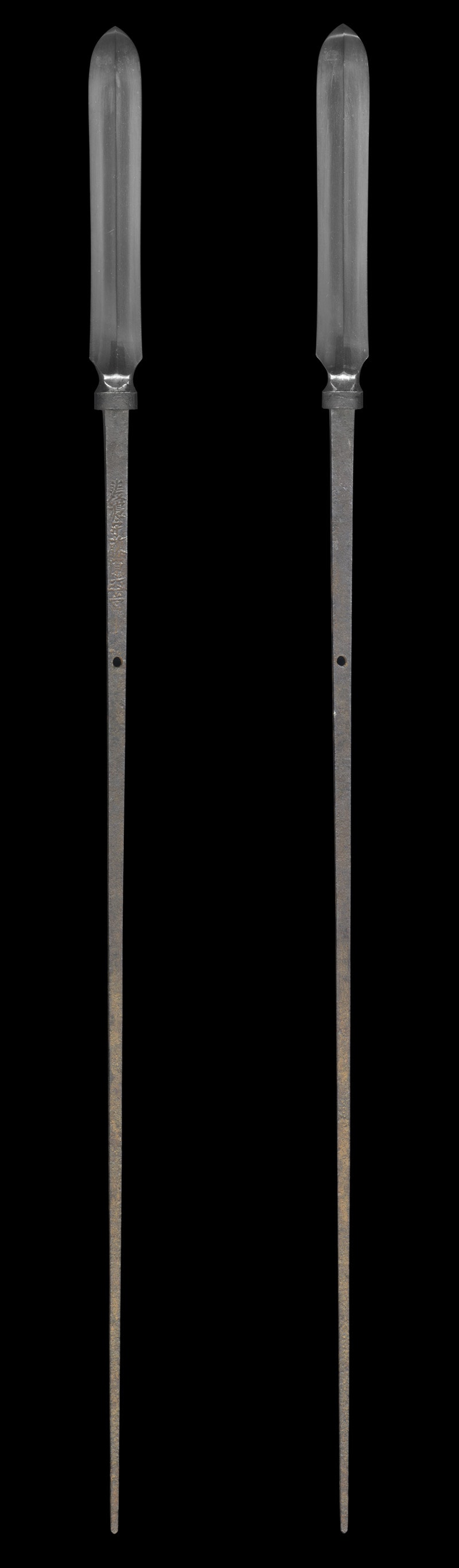
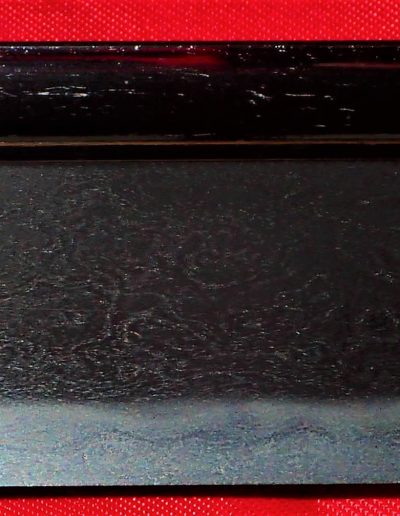
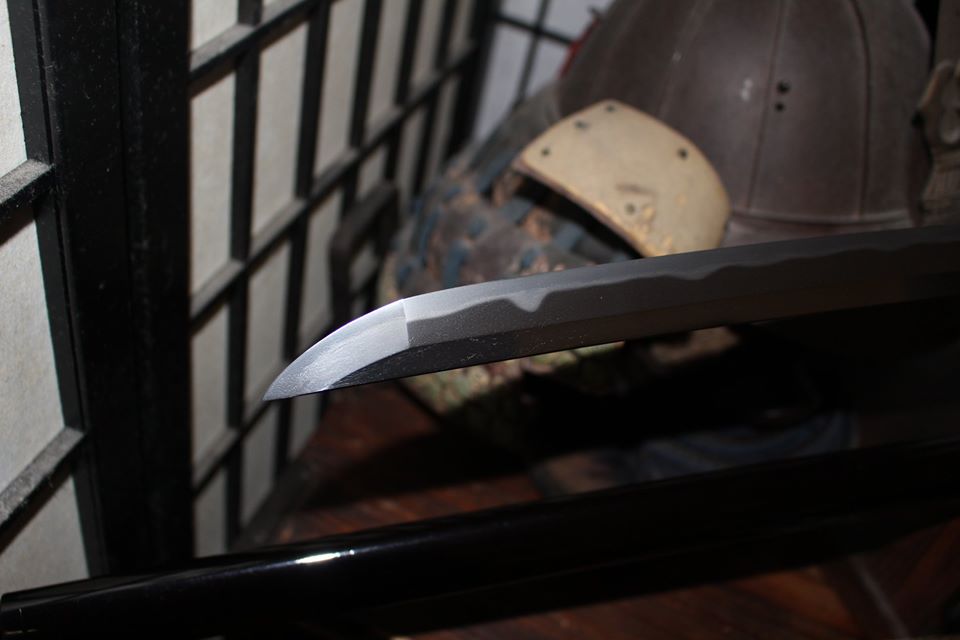
Kanesada is the second-generation Izumi no Kami Kanesada of Seki in , the smith universally called "" because he cut the character (定) with the element inside the u-crown formed as 之. The published sources place his working life across the Meio years into Daiei, in the closing decades of the Muromachi period, and rank him with Kanemoto as a representative Mino smith of his age. He was, as the published commentary notes, a rare case in the kotO era of a smith granted the court title Izumi no Kami, and he often cut the Fujiwara surname as well. The first generation having signed plainly, it was this hand that carried the name to its height, and the swordbooks call him simply "an excellent master"1. The change from a standard-script sada to the 之 form that earned him his nickname is placed by the published sources around the eleventh month of Meio 8 and before the eighth month of Meio 9; the third-generation "Hikisada" is kept distinct from him.
His recognized strength is the lively Mino hand. The shape is the late-Muromachikatana, wide in body with sakizori and at times an o-kissaki, dignified and imposing, the hiraniku full as on a blade meant to cut. Over an itame that runs a little in places and is overall well forged, the jigane carries ji-nie and a whitish shirake-utsuri. The temper is a busy mixture, gunome with choji and pointed togariba elements, nioi-dominant with ko-nie, slight ashi and yo, sunagashi running through, and very slight tobiyaki. The boshi runs as a midare-komi with hakikake, tending to a pointed turnback. Of his finest piece in this manner the published commentary writes that the ji and ha are both clear and that it shows "the true strength of Nosada, the finest example among this smith's works"2.
The jigane is the constant of his hand. Itame, sometimes tightening into ko-itame mixed with mokume, with ji-nie and a whitish cast, appears on nearly every blade; where the grain runs it leans toward masame, and the utsuri it carries is the pale shirake of Mino steel rather than the bright midare-utsuri of Bizen. That whitish jigane is itself the discriminator the judges return to, the feature that separates his work from the brighter Bizenutsuri. Over it the nioiguchi is laid tight and clear, the activity carried in ashi, sunagashi and ko-nie; one shortened katana widens toward the middle into a more flamboyant midare with tobiyaki, while the body of the temper stays a busy gunome.
His work divides into two registers, and the published sources draw the line themselves. Beside the lively Mino temper stands a deliberate Yamashiro imitation, a slender suguha over a closely packed ko-itame, which the commentary says was made with Rai Kunitoshi and the Yamashiro masters as the explicit target. Of this register the judges write that as a Kyo-mono utsushi among all the Kanesada, "none surpasses this example"3. The tell that the hand is still his is named in the same breath: even at this level of workmanship there is fushi within the edge, a faint gunome mingling in the otherwise quiet suguha, the shape leaning to sakizori, the itame turning whitish where Yamashiro steel would not. He worked the full range, katana, tanto and the rare naginata, and a small number of blades carry a chrysanthemum crest and the inscription that they were made at Yamada in Ise, the so-called Yamada-uchi pieces treasured for that mark.
What sets him apart within the Seki group is exactly what the judges name. Several Muromachi smiths cut the Kanesada name and a number held the Izumi no Kami title, so the published sources treat the generational divisions as not yet settled, and grant that at least four distinguishable hands cut the 之 form. Among them his signature style is "the most extolled, and in fact the most skillful"4, the maker whose dated Eisho works the commentary singles out as the finest of the group. His bright, busy Mino temper over a whitish itame, and his slender Rai-styled suguha with its hidden gunome, are the grounded marks that hold him apart from the plainer Seki output around him; the published record calls his oeuvre "broad in scope and high in artistic value"5.
For the collector he is a great late-kotO name, well represented but never common. Fujishiro grades him Jo-jo saku. He has no National Treasures and no Important Cultural Properties on this record; his standing is carried instead by one Tokubetsu Juyo and a long line of Juyo blades, with a Juyo Bijutsuhin tachi among them, and his blades pass through the highest daimyO provenance. The Tokubetsu Juyokatana was the personal sash-sword of Miura Shogen, chief retainer of the Kii Tokugawa house; one tachi was forged for Takeda Sakyo no Daibu Nobutora, father of Shingen; a chrysanthemum-crested katana points to an imperial connection, and his blades are recorded with the Shimazu, Satake, Kyogoku, Yamauchi and Akimoto houses and in the Sano Art Museum. With only a single piece in the Tokubetsu Juyo tier and the rest at Juyo and below, a signed Nosada comes to market from time to time rather than rarely, more findable than the great Kamakura names, yet a fine dated Eisho example with sound provenance remains a landmark when it appears, a sword by the smith the swordbooks call an excellent master.
Kantei
two registers of one Nosada hand: his honryo, the lively Mino temper of mixed gunome, choji and togariba over an itame with shirake-utsuri, set against the deliberate Yamashiro imitation, a slender suguha over a tight ko-itame aimed at Rai Kunitoshi and judged the finest Kyo-mono utsushi among the Kanesada
Kanesada is the second-generation Izumi no Kami Kanesada of Seki in Mino, active from the Meio years into Daiei in the late Muromachi period, and with Kanemoto the representative Mino smith of his age. He is universally called "Nosada" because he cut the character sada (定) with the element inside the u-crown formed as 之; the published sources note he first cut sada in standard script and shifted to the 之 form around Meio 8 to 9, and they distinguish him from the third-generation "Hikisada." Almost alone among kotO-period smiths he was granted the court title Izumi no Kami, often signing with the Fujiwara surname, and the swordbooks call him "an excellent master." His own work runs in two registers. The first, his honryo, is the lively Mino hand: over an itame that runs a little and tightens with ji-nie and a whitish shirake-utsuri, he tempers a busy mixture of gunome, choji and pointed togariba, nioi-dominant with ko-nie and sunagashi, the boshi a midare-komi with hakikake tending to a point. The second is a deliberate Yamashiro imitation, a tight ko-itame under a slender suguha aimed at Rai Kunitoshi, prized as the finest Kyo-mono utsushi among all the Kanesada, where a faint gunome or fushi within the otherwise quiet edge is the tell that the hand is still his.
Diagnostic discriminators
白け映りshirake-utsuri4
尖り刃togariba3
unique vs his own Yamashiro-imitation suguha register
京物Kyo-mono1
unique vs other Kanesada namesakes (Kyo-mono utsushi)
Observation by phase
His honryo, the lively Mino temper (Nosada's true strength)
His recognized strength is the lively Mino hand. The shape is the late-Muromachikatana, wide in body with sakizori and at times an o-kissaki, dignified and imposing, with the thick hiraniku of a cutting blade. Over an itame that runs a little in places and is overall well forged, ji-nie appears and a whitish utsuri stands. The temper is a busy mixture of gunome, choji and pointed togariba elements, slight ashi with some yo, nioi-dominant with ko-nie, sunagashi running, and very slight tobiyaki occurring. The boshi is a midare-komi with hakikake tending to a pointed turnback. On this manner the published sources call the ji and ha both clear, the true strength of Nosada, and the finest example among the smith's works. The Tokubetsu Juyokatana cut for Miura Shogen of the Kii Tokugawa house is the exemplar; the Juyo Bijutsuhin tachi made for Takeda Nobutora, father of Shingen, carries the same standard manner.
The Yamashiro imitation, slender suguha (Kyo-mono utsushi)
His other register is the deliberate Yamashiro imitation. Over a closely packed ko-itame, sometimes mixed with mokume, with ji-nie and a whitish cast, he tempers a slender suguha or a chu-suguha mixed with ko-gunome, the nioiguchi tight and clear with ko-nie and small ashi, the boshi running straight to a ko-maru. The published sources read these as made with Rai Kunitoshi and the Yamashiro masters as the explicit target, and call this the finest Kyo-mono utsushi among all the Kanesada, with none to surpass it. The tell that the hand is still Nosada's is that the shape leans to sakizori, the itame turns whitish where Yamashiro steel would not, and within the otherwise calm edge a faint gunome or fushi mingles.
Sugata 姿
先反り1
Jigane 地鉄
小板目ko-itame2白け映りshirake-utsuri2地沸ji-nie2
Hamon 刃文
直刃suguha2互の目gunome1匂口締まるshimatta nioiguchi2足ashi2
Bōshi 帽子
小丸ko-maru2
Scholarship
The published sources record that several Seki smiths cut the name Kanesada in the Muromachi period and that a number held the title Izumi no Kami, so detailed identification of the generations remains a task for the future; even among the 之-form "Nosada" works at least four distinguishable hands exist, of which this smith's signature style is the most extolled and the most skillful.1
On his Yamashiro imitations the published sources judge them the finest Kyo-mono utsushi among the Kanesada, with none to surpass them, while naming the one point of discrimination: even at this level of workmanship, a faint gunome or fushi mingles within the edge, betraying the Mino hand.1
Dated Works
Years he was demonstrably active, proven by signed-and-dated blades
Active period
1510–1515Editorial estimate: 1492–1515
5 of 33 designated works carry a date
15001520
1510
永正七年Juyo session 22, item 80
永正七年Juyo session 37, item 53
1513
永正十年Juyo session 56, item 19
1515
永正十二年Juyo session 35, item 51
永正十二年Juyo session 5, item 11
Historical importance
Where Kanesada stands among comparable artisans: across all of nihontō, and within tradition, era, and period. The tiers (Foremost · Leading · Major · Notable) weigh official designations from the NBTHK and Japan's Agency for Cultural Affairs, together with historical honors of lasting repute such as the Sansaku and Meibutsu-chō.
随一
Foremost
屈指
Leading
MinoSue-kotō / Momoyama
有数
Major
All nihontōKotō
著名
Notable
Select a lens to see how it's measured.
Designations
Kokuhō—
Jūyō Bunkazai—
Jūyō Bijutsuhin1
Gyobutsu2
Tokubetsu Jūyō1
Jūyō Tōken33
Elite Standing
0.15 across 37 designated works
Top 14% among smiths
Provenance
14 documented provenances across certified works by Kanesada
▸Imperial2
▸Shogunal1
▸Premier Daimyō1
▸Major Daimyō2
▸Other Daimyō3
Zaibatsu—
▸Institutions1
▸Named Collectors4
Provenance Standing
6 works held in elite collections across 14 documented provenances