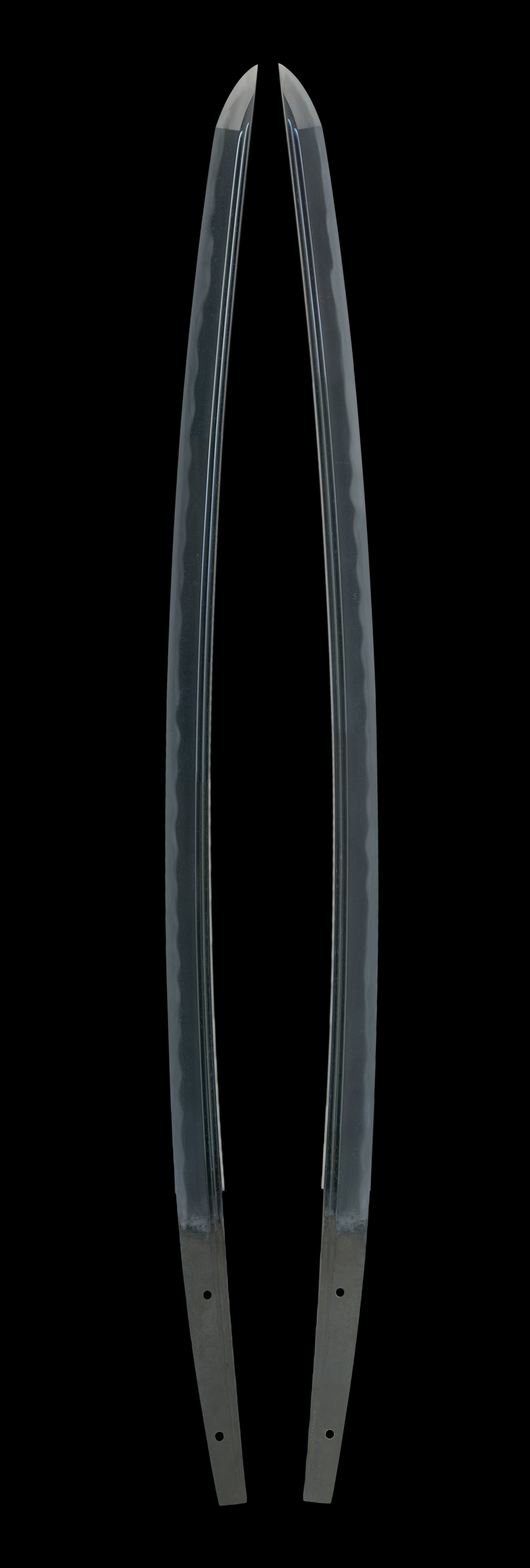
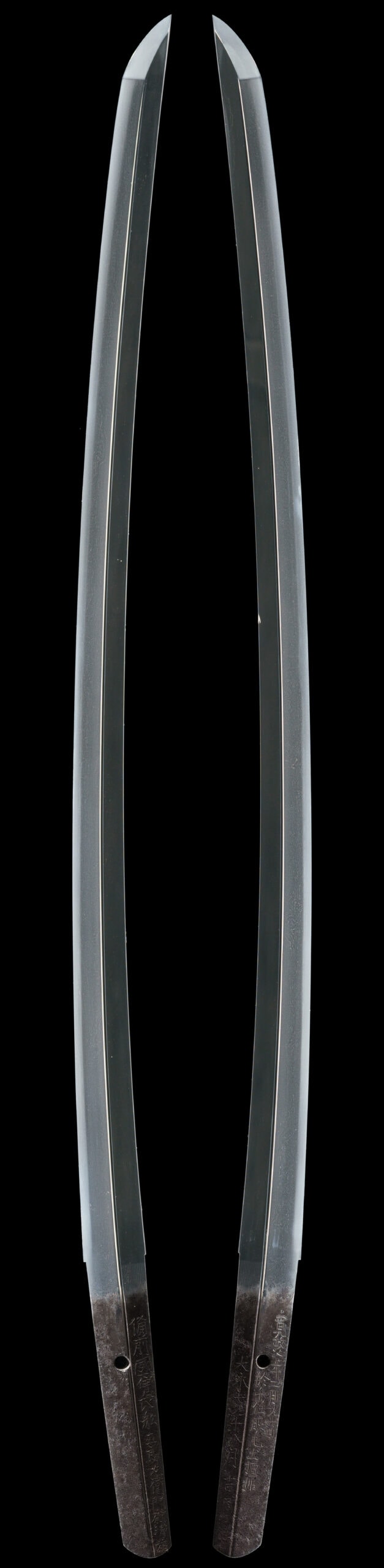
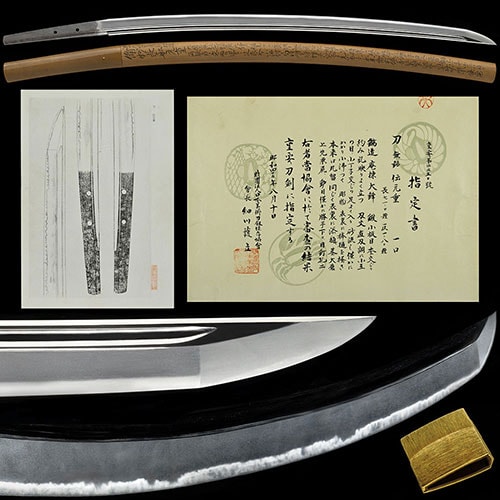
Two bearing dates in the Karyaku era, one inscribed in the first month of Karyaku 3 (1328) and the other in the tenth, fix almost everything that is known of Shigesuke. He was a swordsmith of the Wake group, a small line working at Wake-shō in Province a short way from in the closing years of the period. The published sources name him together with Shigenori as the Wake smiths, dating the pair by these few surviving signed pieces, and record the local tradition that "Wake is said to have been the former homeland of the smiths", with the cautious addition that the line may have drawn on the lineage, though the matter is not clear. His is a peripheral hand, set against the great workshops a few miles to the west, and read very much in their light.
His recognized manner is the signed , slender and small in scale, one carrying a -tinged curvature and another a feeling despite its compact size, running to a . Over a tightly packed with and a standing he tempers not the clove-flower of mainstream but a restrained , into which he sets small and small , with entering and intermingled. The tends tight, with and . This quieter, -based line, carried over the rich , is the spine of his hand and the feature that separates the Wake group from the flamboyant temper of the decades.
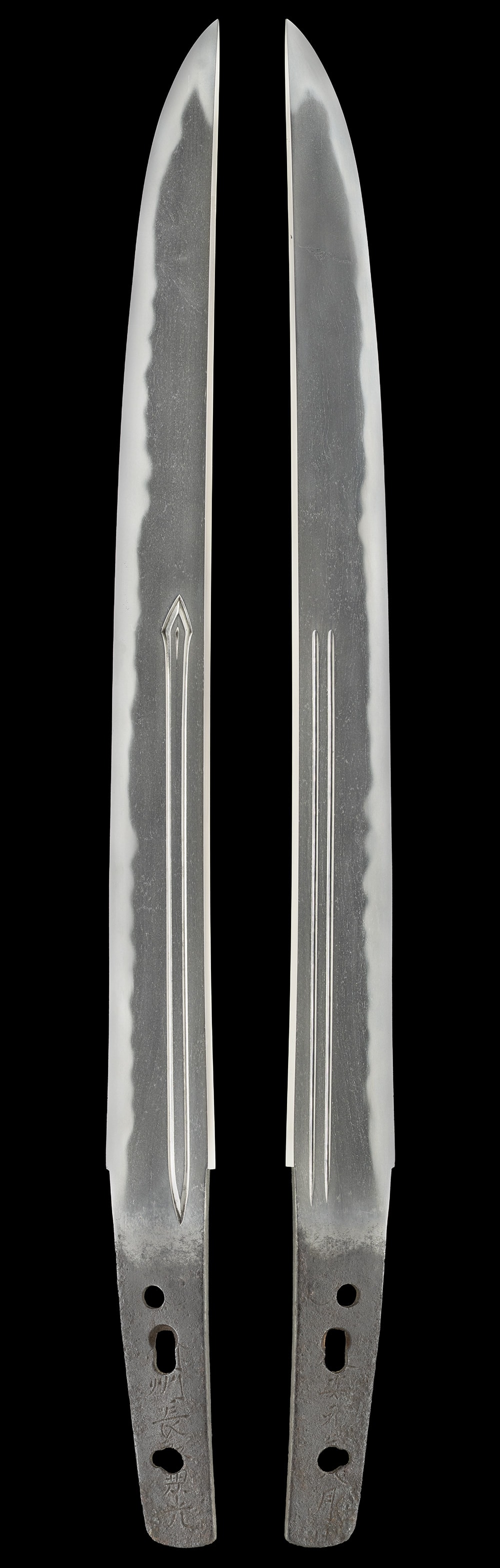
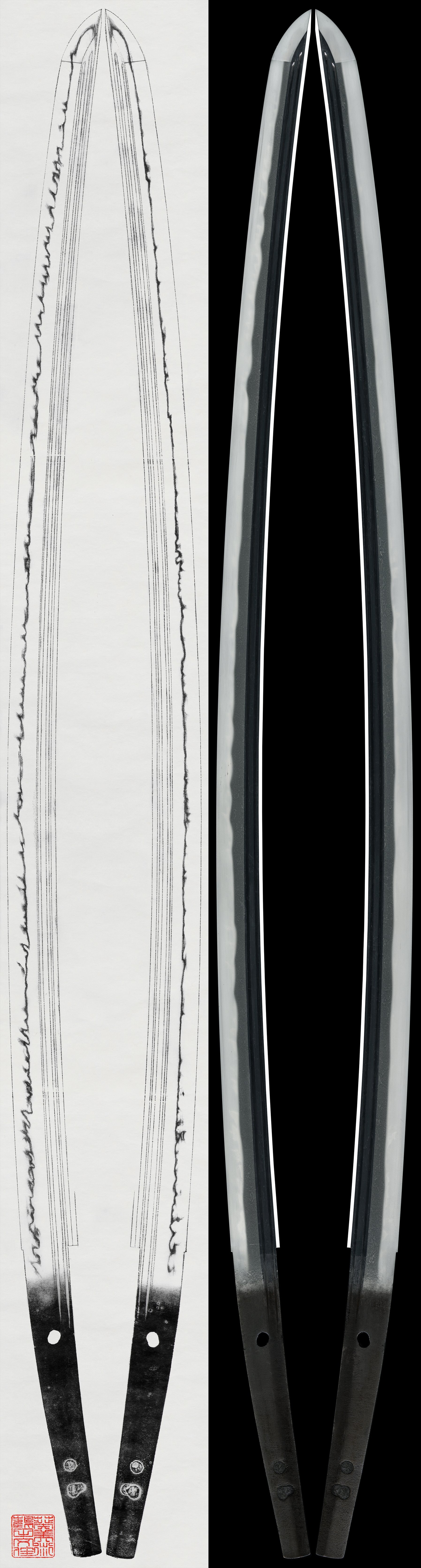
The is the constant across his work. A standing rises on nearly every blade, signed and alike, over an that in the tightens to a fine and in the shortened stands a little, mixed with and . On the most fully described pieces the steel carries in fine particles, entering, and a slightly mottled -like complexion, the old the Wake line keeps from its supposed root. Over that the runs a shallow and turns back in , sometimes finishing in or with a touch of ; on the a is frequently carved through.
Within this one hand the published sources draw two further registers. A , its five-character signature cut away after "Bishū Wake-jū" and judged Shigesuke from a dated reverse of Karyaku 1, is forged in a flowing with conspicuous o- and tempered in a with reverse-slanting elements and a -style ; the commentary calls it a piece that "tempers a -like blade reminiscent of Kagemitsu", good in workmanship and valuable as source material for the study of the Wake smiths even with the signature truncated. The larger part of his record, the , is attributed to him as the typical Wake hand, affirmed from era, school and the standard set by the surviving signed rather than from any personal flourish.
What sets him apart from his neighbours is exactly what the judges keep returning to. The Jūyō Bijutsuhin commentary, examining one of the dated , finds that "in comparison with the activity of the near-contemporary Kagemitsu, there is variation", and of the other that its workmanship is in no way inferior to, and may even surpass, the standard work of that master. The modern judges read the the way, calling their , with and shallow close to contemporary work, the affinity that justifies the attribution. He stands, then, as a quiet satellite of the school, his name preserved because a hand of this date, distinct from the clove-flower mainstream, is worth keeping straight.
For the collector he is a rare peripheral name rather than a great one, and the record is honest about it. There are no National Treasures and no Important Cultural Properties on it; his standing rests instead on a single , nine blades, and two prewar Jūyō Bijutsuhin, twelve designated works on record in all. The published commentary calls the signed "an outstanding achievement among his works", of particularly fine preservation, and one of the "an excellent piece attributed to Shigesuke, with no breakdown in either or ". His blades sit in collections grounded in their own provenance: the finest signed was bestowed by the shōgun Tokugawa Tsunayoshi on Mizuno Katsunaga in 1701 and long held by the Mizuno house, lords of Yūki Domain in Shimōsa; the Mitsui family owned one of the dated Jūyō Bijutsuhin , and the Tsukamoto Museum of Art holds the other. With so few signed works in existence and most of the attributions long held, a Shigesuke comes to market only rarely, and a signed example is among the scarcer documents a collector could hope to encounter, a record of how the old Wake line worked in the shadow of .