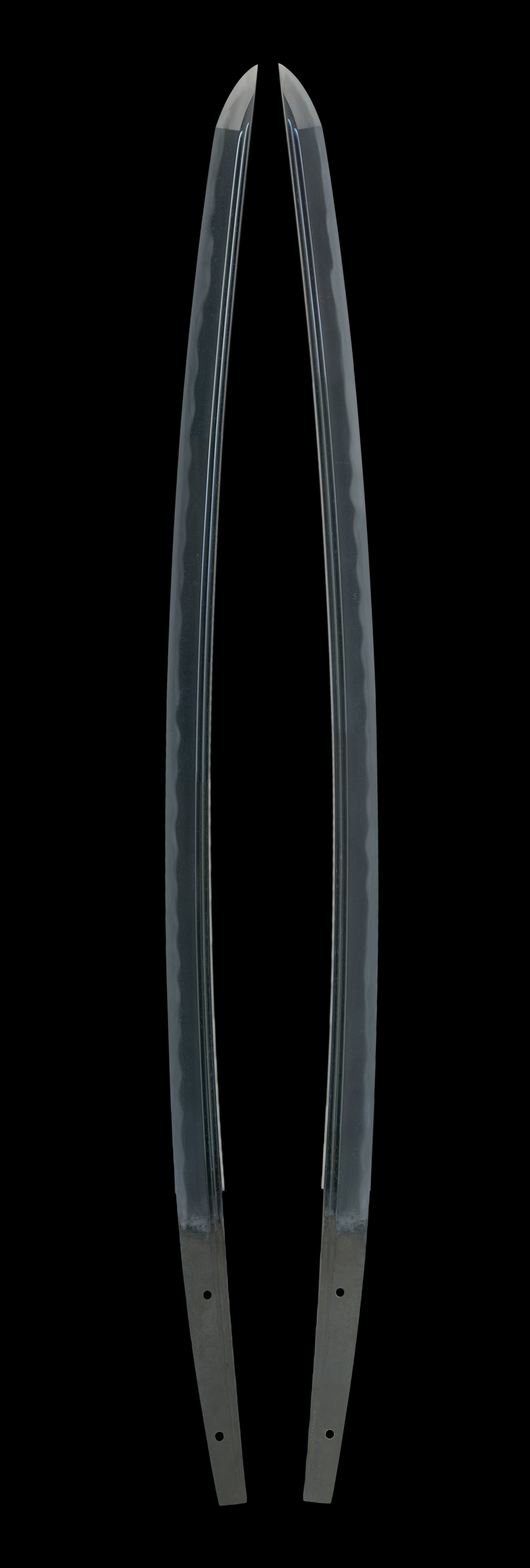
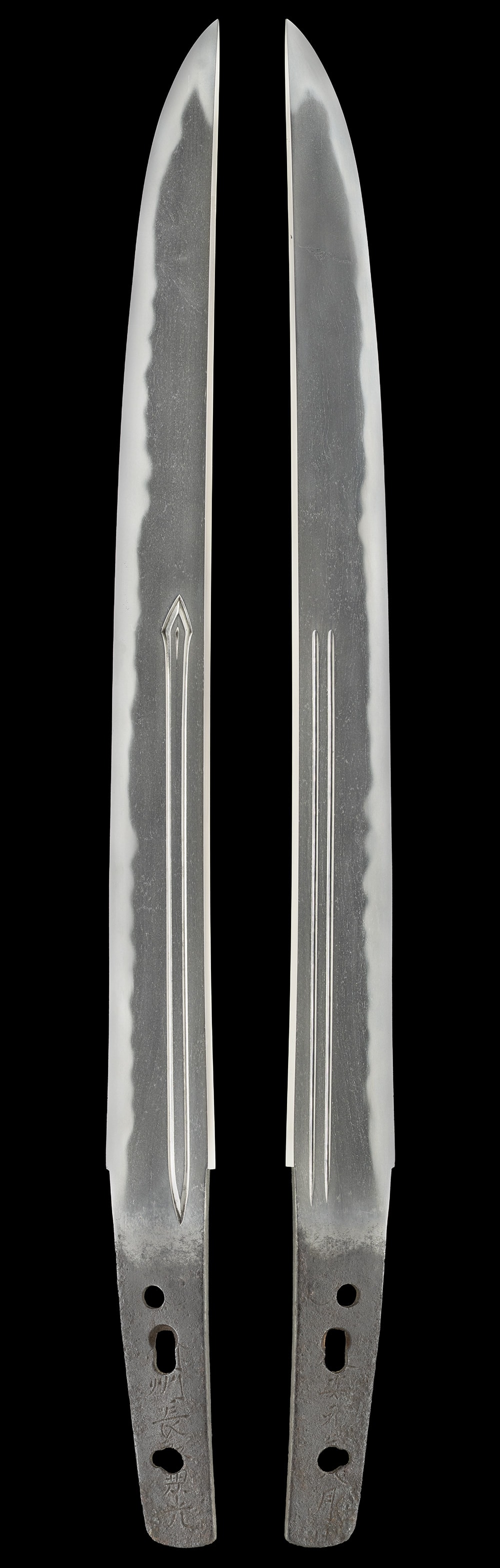
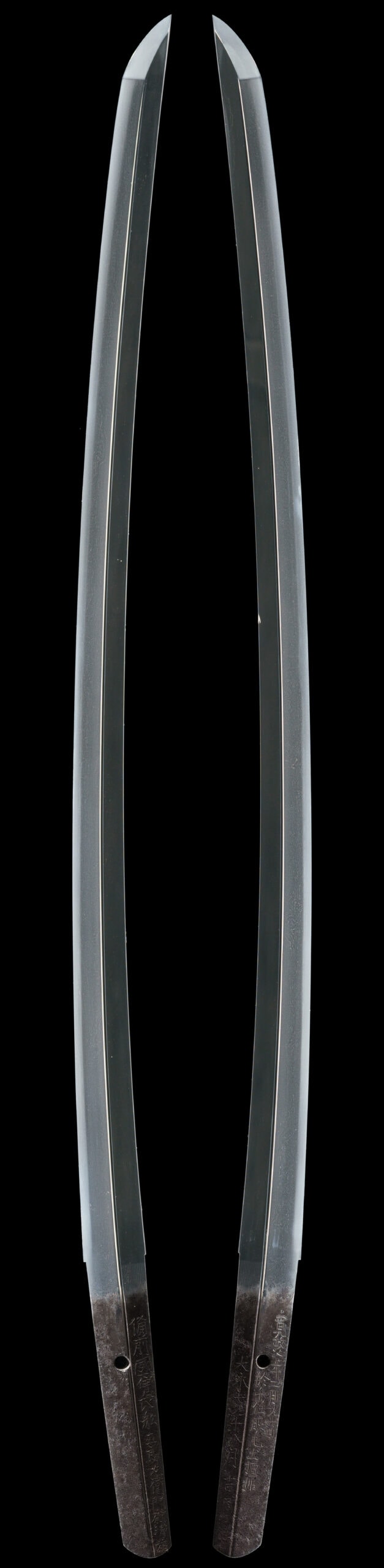
Shigenori was a swordsmith of the late period who lived at Wake Manor, Wake-shō, in province, his activity fixed by dated works of Shōchū 3, also read as Genkō 4 (1324), and Karyaku 3 (1328). The published sources record him beside a second Wake smith, Shigesuke, the two known together from this handful of dated pieces, and they cite Wake as one of the proposed homelands of the old smiths. One view holds that Shigenori too descended from the line, though the published record holds the matter not clearly settled. Four of his blades have passed the : three signed and one greatly shortened attributed to Wake Shigenori. They are enough to read one steady hand, a smith whose work stands so close to the main line of his own day that the published sources liken his best to that of Sanenaga and Kagemitsu, yet whose and carry a quieter, slightly rustic character that marks him as a man of Wake rather than of proper.
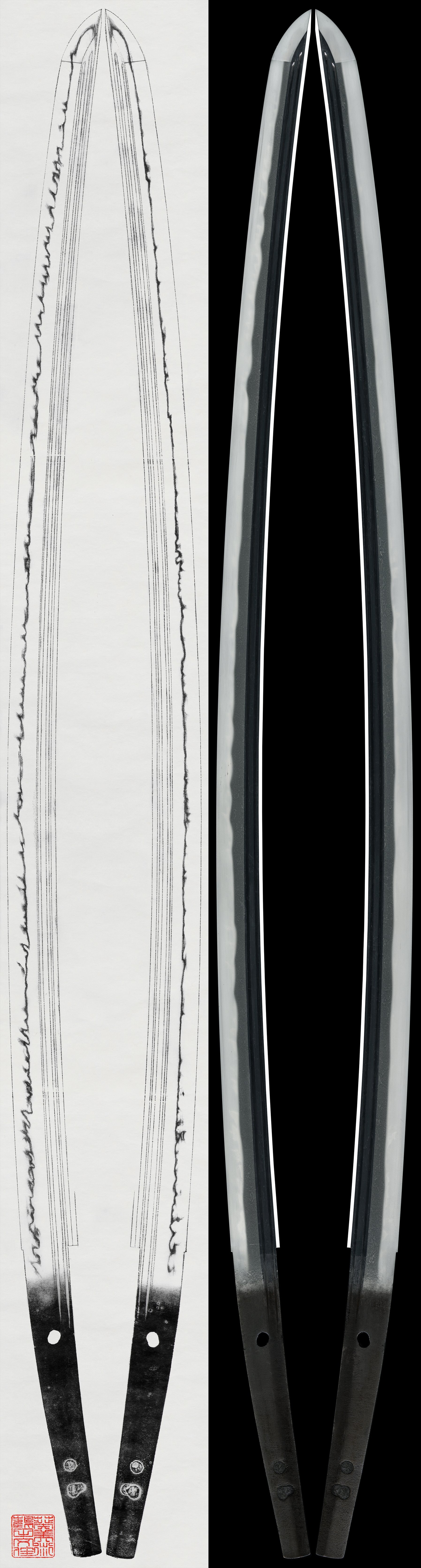
The temper is the heart of his recognition. Over a calm base of narrow , , he mixes only small forms: , and , never the tall clove- of the main line. enter the line well, with on the , and the temper runs -dominant, , with added. The is tight, , and at moments takes on an , a soft, moist tone, and is bright on the latest of his blades; and appear, the set near the base on his earliest . The published sources name precisely this controlled, somewhat huddled , mixed with , as the place where the distinctive character of the Wake group shows, the temper that closely resembles late- work but stops short of its full flowering.
The carries the other half of the reading. He forges a to that takes in and stands faintly open, , gathering , with entering and patches of , ō-hada and clear . Across this a rises distinctly, the speckled reflection of old steel and the feature that seats him beside the main line. On the the forging is overall fine yet slightly standing, and along the a minute breaks into , giving the and a small rustic vigor, yashu; it is exactly here that the published sources find the attribution to Wake affirmed, writing that on this point 「ここに和気の極めが首肯される」. The answers the calm of the temper, running shallowly or and turning back in .
The four blades draw a single manner rather than a sequence of phases. The shape is the late- throughout: , mostly slender, with and and a small to medium point, every example shortened, or , as such early almost always are. The signed pieces carry their inscriptions toward the : a two-character , simply Shigenori, on the 24th- and 56th-session , and on the 31st a somewhat fine-chiseled long signature, Bishū Wake-jū Shigenori, partly corroded by age. The 56th-session , slender and signed, the published sources prize less for its scale than for its testimony, calling signed work by Wake Shigenori exceptionally rare and the blade therefore extremely valuable material for understanding this smith and his group. The of the 59th session is the counter-case, a strong, long blade of standard width whose Wake attribution rests not on a signature but on the connoisseur's reading of that rustic .
What distinguishes Shigenori is therefore a matter of degree against a close model. His and in set him squarely among the late- smiths, and the published sources twice describe his work as close to the smiths of the time, reading the 31st-session as workmanship 「真長・景光さながらの出来」, much like Sanenaga and Kagemitsu, and judging it 「重則の上々作と称してよく」, fit to be called an especially fine work by Shigenori, adding that the corroded inscription is no real concern. Yet the sources are careful to hold him apart: the subdued, slightly huddled , the persistent , and the rustic vigor of the are where the Wake hand reveals itself, the marks of a -descended satellite working alongside, and in the manner of, the orthodox line without quite belonging to it.
Four blades on record, all at the level and none designated above it, are the whole of Shigenori's preserved corpus, and signed examples are rarer still: of the four, three bear his name and one is a attribution. The published sources record no provenance and name no holding institution for these pieces, and signed Wake Shigenori is by their own account exceptionally rare, so the survival of even three signed is itself the point of interest. A blade by this smith is not a thing the collector encounters often; when one appears it is at the tier, valued less as a famous name than as evidence of a small, half-documented group whose hand the published record can still recover. For the student of late , that scarcity is the attraction: each surviving Shigenori is a primary witness to the Wake workshop, and the of the 59th session, where 「刃縁には一際光の強い刃沸がきらめき」, the glittering with particularly intense , is the finest demonstration of what that recovered hand could do.