Naotsuna worked in Iwami, the western province the swordbooks call Sekishu, during the period, signing his blades with the residence Sekishu-ju or Sekishu Dewa-ju. The old tradition counts him among the Masamune-jittetsu, the ten noted disciples of Masamune, and the published sources have transmitted that account from the period onward. They do not accept it on its face. Of the first generation they write that he 'is counted among the so-called Masamune Jittetsu, yet seen in terms of chronology a direct connection seems somewhat forced, and the question must await further careful study', for no extant work bears a date earlier than the Eiwa era. What can be fixed is the manner: this is the tradition carried west to Iwami, and the published sources read its current as running together with and .
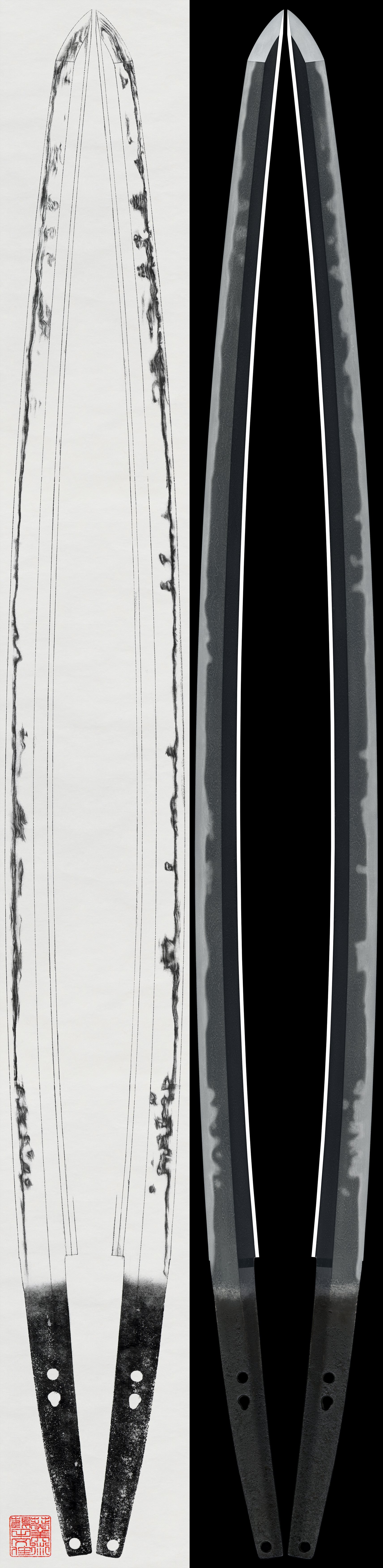
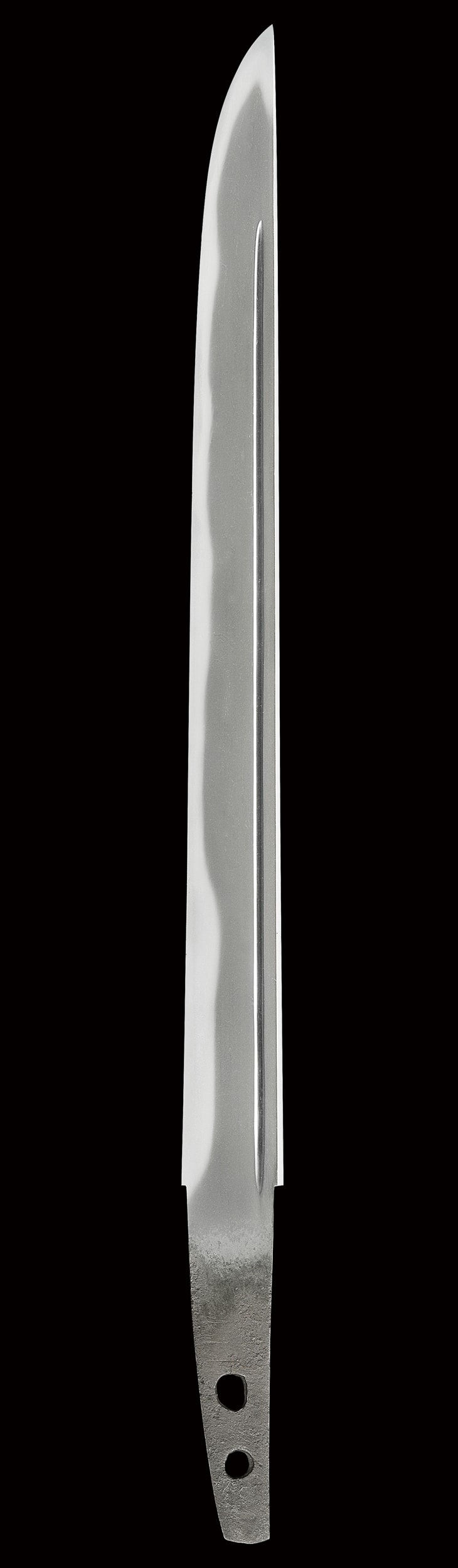
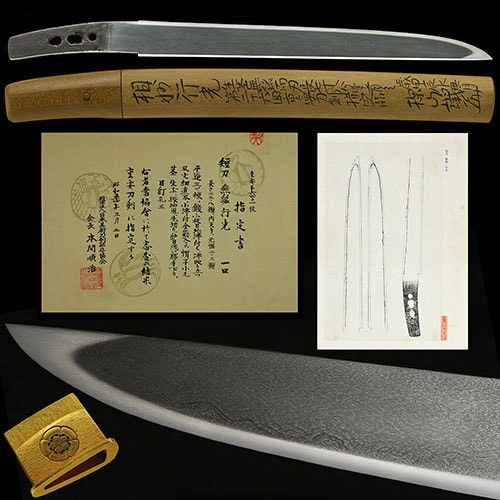
His hand is read from workmanship rather than from signature, because signed Naotsuna are scarce. The published record notes plainly that 'signed works by Naotsuna are comparatively few', and most of what survives is and , so the few signed carry a weight beyond their number. The tell the judges name is a temper of squared-off, lined-up , the angular teeth running in step with one another, mixed with small , small and pointed . Over a well-'d he lays vigorous and frequent , with and entering often. The published commentary draws the whole picture together on one shortened blade: the of flowing with and , worked with 'a distinctive linked and , with and , is the characteristic point of interest of Sekishu Naotsuna'. That sentence is the heart of his .
The is the constant beneath the temper. It is an that flows and stands, mixed with , the open rather than packed, with adhering and entering well, and a steel tone that runs darkish, at times with a slight whitish cast. Over that the activity belongs wholly to : gathers thickly, and drift into the upper half, and on some blades a -like line doubles the while the tends to sink. The answers the below, running in irregular and swept with , pointed on one face and small-round on the other, often closing in a -like sweep. Most of the carry a cut through both sides, now and then with a beside it.
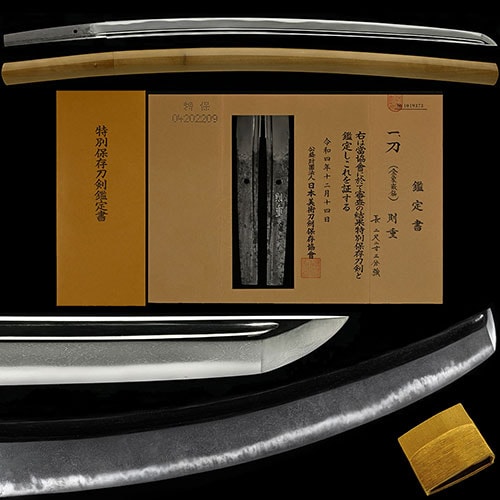
The record divides cleanly into two registers of the one hand. The first is the small body of signed , several of them judged the work of the first generation and prized for being signed at all. The keystone is the inscribed Naotsuna in two large characters, which the published sources call 'appraised as the work of the first generation and, being signed, exceedingly valuable', and whose -based temper with pointed elements they liken to and . The second register, far the larger, is the attributed to Sekishu Naotsuna from the workmanship alone. A second , a shortened bearing a long , shows the angular lined up across the blade with that characteristic activity. Across these the signatures themselves differ from blade to blade, which is one reason the swordbooks have never fixed which pieces are first generation and which second, placing the generations variously at Kenmu, Eiwa and Oei.
Within the tradition his work is set beside Kaneuji and , the published sources holding that his temper 'shares an underlying current with and of the -'. What separates him is not borrowed but his own: the lined-up angular and the abundant and over a dark, flowing are the features by which an unsigned blade is judged his, where a hand would show a more refined and a smith a bright packed with . He stands as the figure who took the manner out to Iwami and gave it a recognizable provincial accent, the linked his signature where the cut signature is missing.
For the collector he is a smith met almost entirely through attribution. Fujishiro grades him Jo-jo . He has no National Treasures and no Important Cultural Properties; his record runs instead through two pieces at the rank, some sixty-nine at the , and three prewar Bijutsuhin recording signed and a , several from named houses. His blades are held in institutions and long-standing collections grounded in their own provenance, among them the Tokugawa Art Museum and the Tokyo Museum, with documented owners reaching back to the Tokugawa and Uesugi families, the Takatsukasa house, Ikeda Toshitaka and Tachibana Tadazane. Most designated blades, in private hands as in public, are held rather than traded, and a signed Naotsuna is rarer still than the count of designations suggests, since so little of his work is signed. An carrying his linked comes to a private collector from time to time and with patience; an , signed judged the first generation is among the scarcer things one could hope to encounter, and a quiet document of how the tradition travelled to the far west.