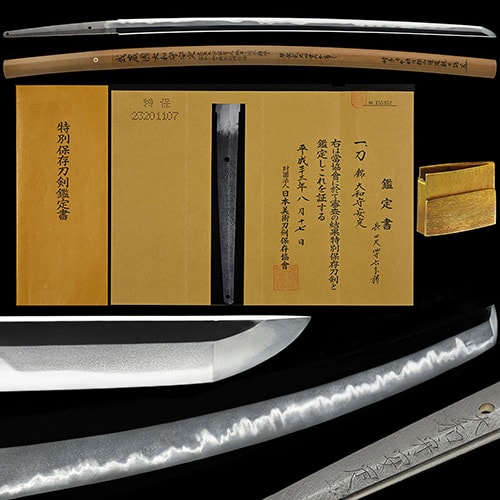
Tatara Nagayuki is said to have been originally from Kishu. He styled himself Shirobei and became a disciple of Kawachi no Kami Yasunaga, who had moved from Kishu to Osaka. He is consistently described as a craftsman whose technique surpassed even that of his teacher. Dated works are exceedingly rare, but a small number bearing dates from the Tenna and Jokyo eras allow us to infer, broadly, that he was active in the late seventeenth century. He is regarded as the foremost - smith among the makers, having thoroughly studied the tradition.
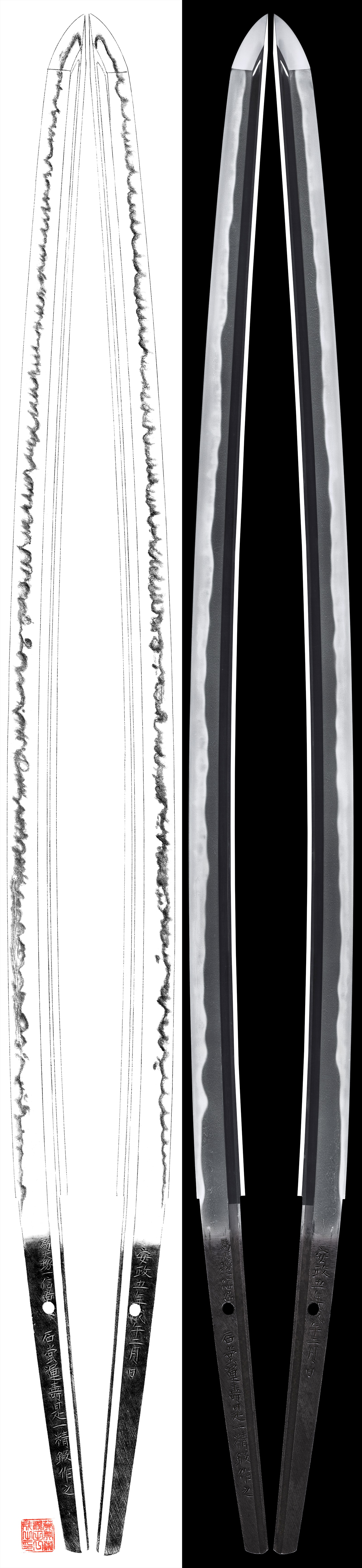
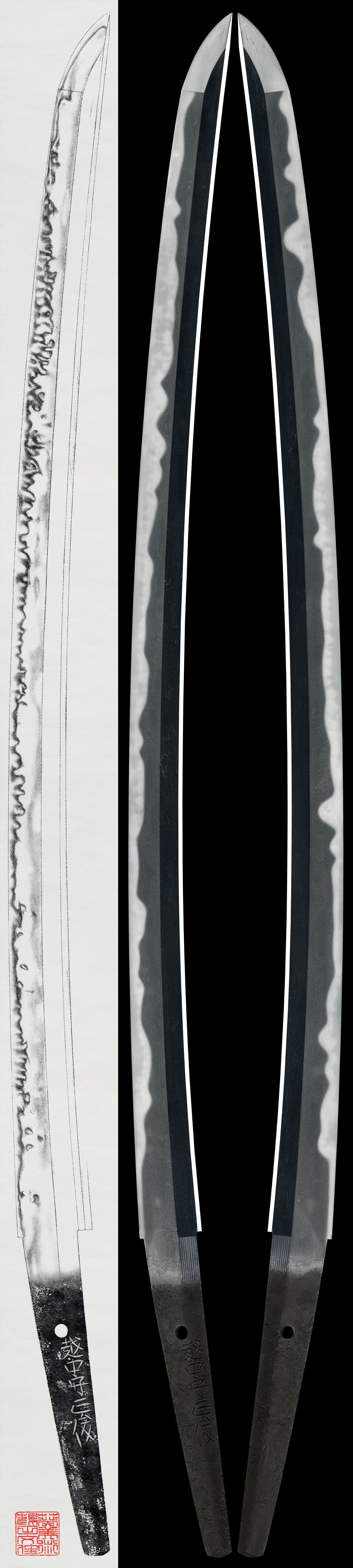
His manner of work divides into two distinct types. One is a flamboyant style in which large are mixed with and pointed elements, with abundant and -- a deliberate aim at in what may be called the Ishido lineage's traditional specialty. The in this mode tends toward tightness and brightness. The other type takes as its principal theme with an opened "waist," mixed with compound-style () elements, and appears to model the manner of , particularly the work of Yosazaemon no Jo Sukesada. The across both modes shows mixed with , tending toward standing grain, with fine and distinctly standing . The characteristically enters in , becomes pointed at the tip, and turns back deeply -- a habitual trait consistently seen throughout his work.
Nagayuki's blades frequently display notably wide with ample , producing grand and powerful forms that possess great impact. The occasional supplementary inscription "forged using Chigusa iron" offers a glimpse into iron distribution in the period and marks works of special commission. A matched by this smith is extremely rare, and the cursive-script signature appearing on one example is without parallel among his known works, rendering such pieces exceptionally valuable as documentary material.