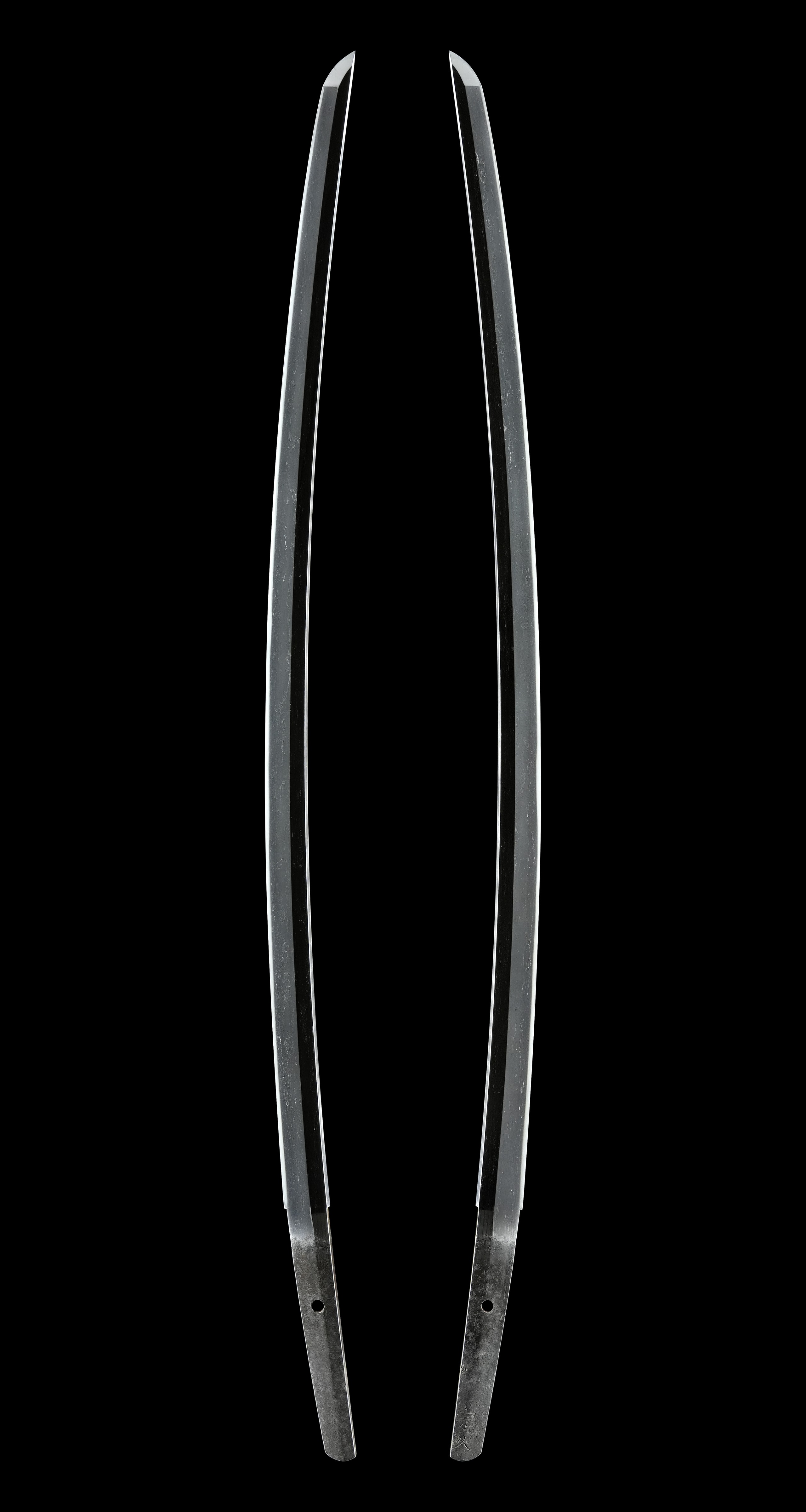
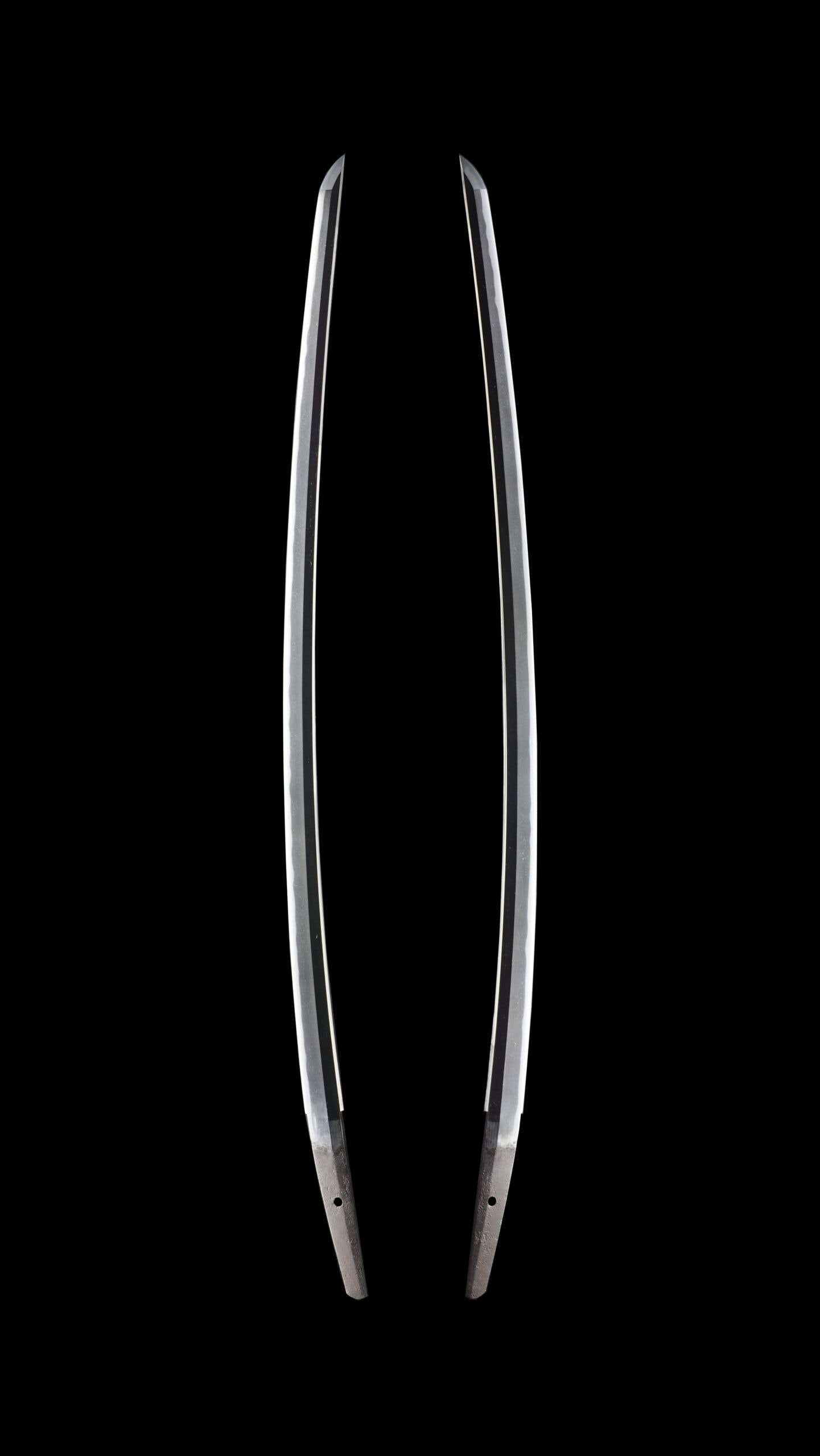
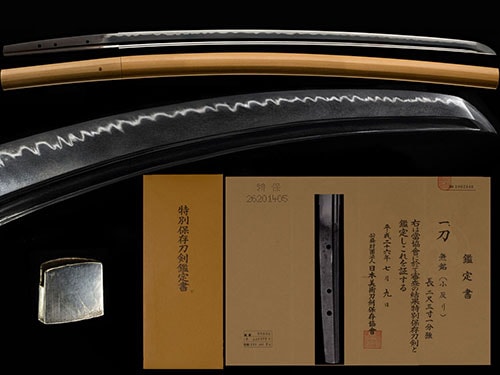
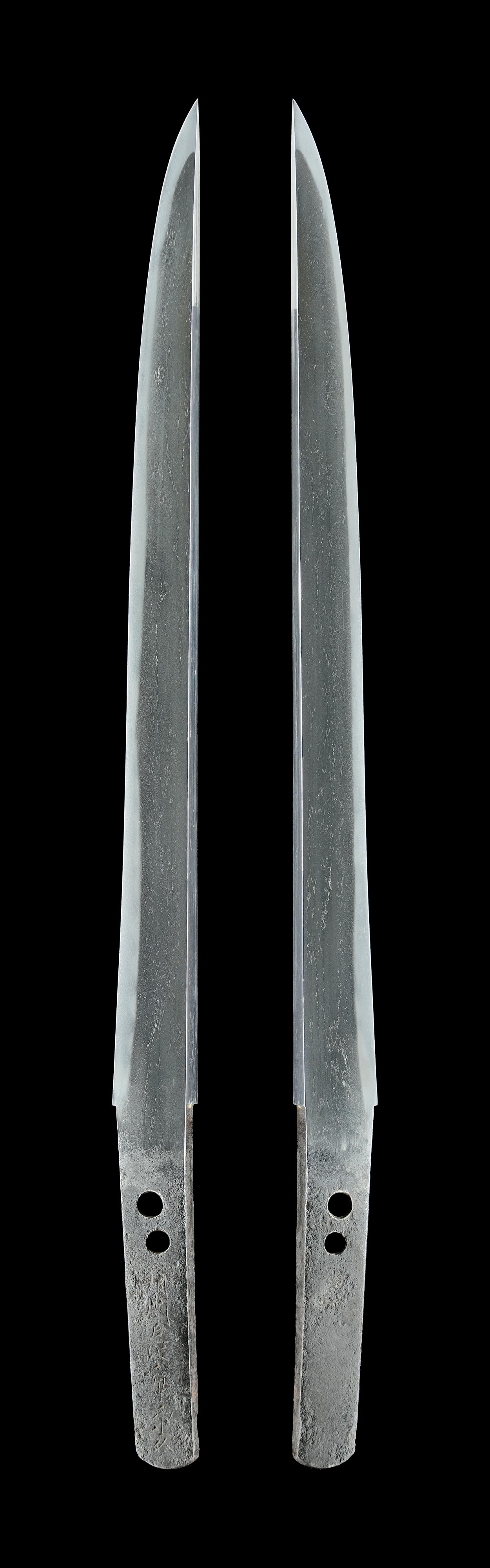
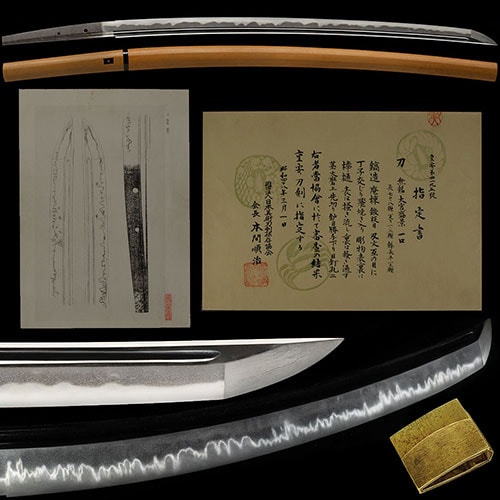
Motomasa is recorded in sword reference compendia as a swordsmith of the school, active during the late period. The first generation is dated to the Joji era (1362-1368), with a second generation placed around the Shitoku era (1384-1387). His predecessor is said to have been the younger brother of Ko-Motoshige, and from his name it is readily understood that he was a smith close to Motomitsu within the Kanemitsu line. Whether the earliest Motomasa was truly the younger brother of Ko-Motoshige requires further research; however, his lineage places him firmly among the smiths of the late through periods.
Motomasa's forging characteristically shows mixed with and , with an overall tendency toward . Fine covers the surface, dark steel appears in a -like manner, and faint emerges. His is typically based in mixed with a wide range of forms — , , open-waisted , angular and pointed elements — producing an overall small-pattern with , together with and . The small scale of chisel-work in his signatures further emphasizes the defining traits of the style. The open-waisted manner seen in his tempering is noted as suggesting a portent of the transition toward Oei-. One rare in narrow demonstrates his range beyond the characteristic idiom.
Signed examples by Motomasa are rare, and his works are valued as documentary material for understanding the scope of his craftsmanship. Across the extant body of work, both and are praised as — sound and well-preserved — with ample and especially bright in the hardened edge. His blades possess high documentary value not only for their quality of workmanship but also for the date inscriptions they preserve from the era, providing critical reference material for the study of late production.