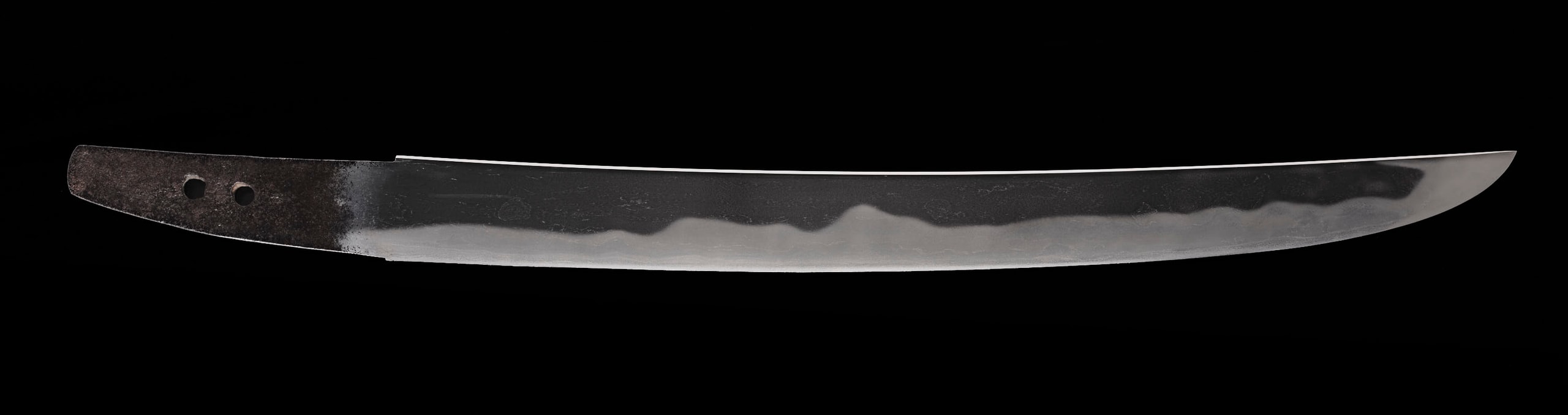
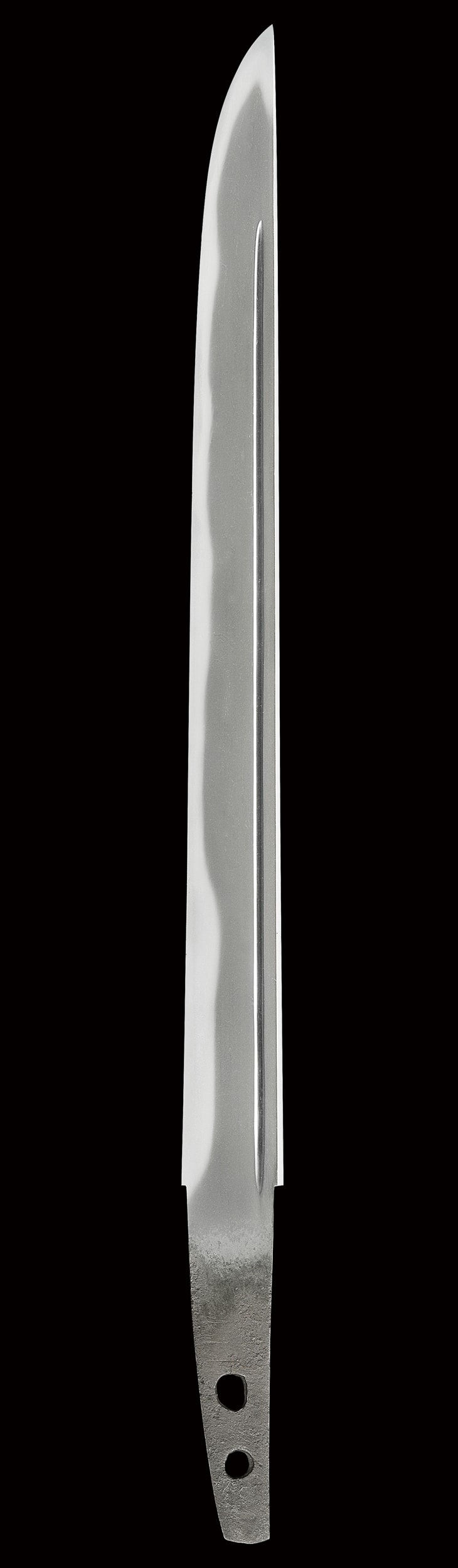
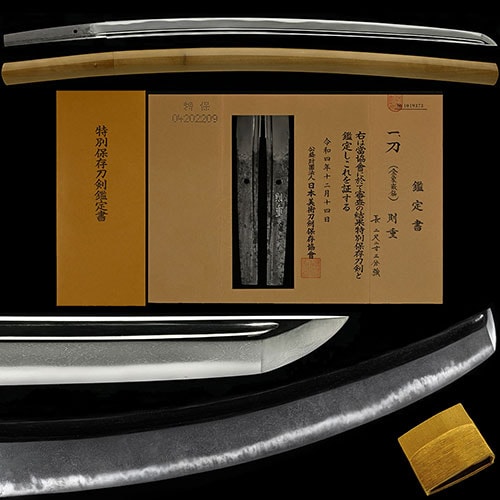
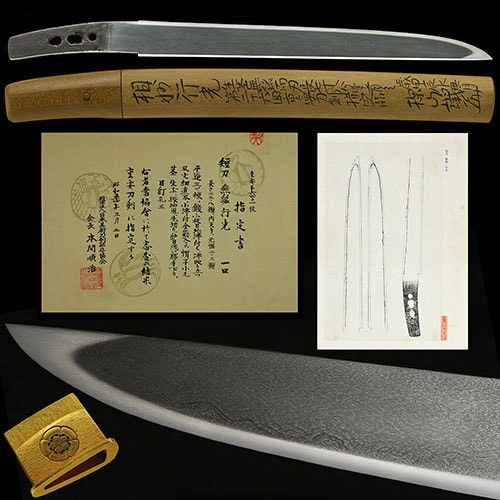
Hasebe Kuninobu worked in Kyoto in the period, his dated blades running Enbun and Joji, and with the school head Kunishige he is named in text after text as one of the two principal representatives of the Hasebe group. The school is the tradition carried into Yamashiro: contemporaneous with the smiths Hiromitsu and Akihiro, known for flamboyant , the Hasebe smiths produced equally brilliant full-temper work, their residence traditionally given as Gojo Bomon Inokuma, though no surviving blade is signed "resident of Yamashiro." The Kosei records Kuninobu as the son of the first-generation Kunishige and the younger brother of the second, while several published commentaries, finding his dated work confined to Enbun and Joji, read him simply as Kunishige's contemporary; the brother and pupil accounts are both chronologically sound. Recent scholarship holds the school's home province to be Yamato, the route the published sources set down as "home province Yamato, brought to full development in , and at last settled in the capital."
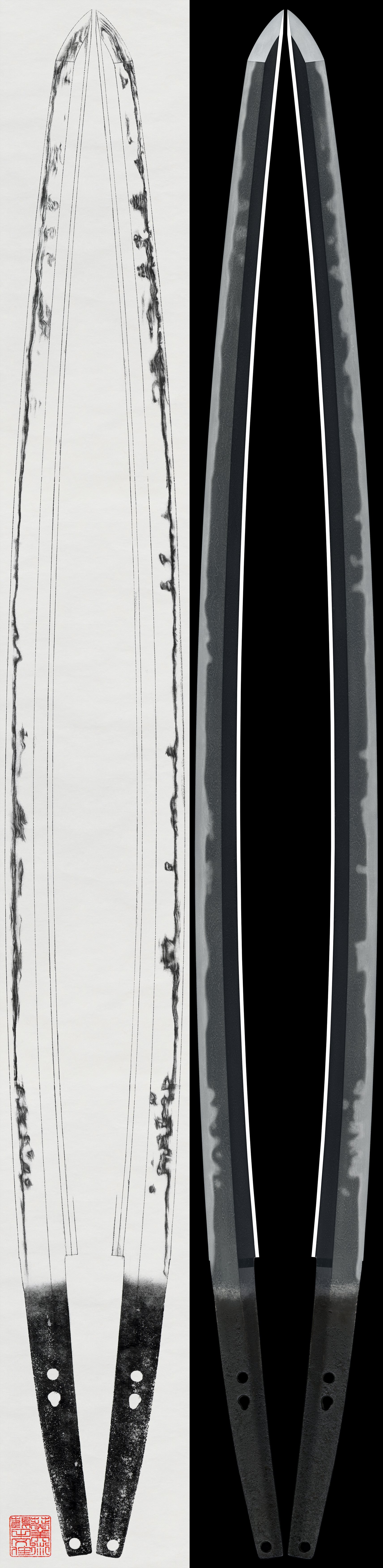
What the published record gives as Kuninobu's own, within a manner he shares almost wholly with the founder, is a single point in the temper. Whereas is built on and , Hasebe work takes and , and the commentaries return, blade after blade, to one clause: "in Kuninobu's case in particular the turns angular, or takes on an arrow-nock () character." His squares off and runs to a forked-arrow shape more readily than the founder's, the angular teeth linked by a low . The carvings are a second mark of his hand: , , a sanko , and on the wide faces of his blades, one commentary stating outright that "this kind of carving is, within the group, almost limited to Kuninobu." The third tell is the , large and round, its return burned long down the until it joins the , the chief separation named from the pointed, thrusting of the pair.
The forging is , the grain standing, mixed with and flowing into and toward both edge and back; lies thick and enter freely. Over this the temper is carrying , the deep, thick, and frequent, and worked across the and until the whole rises to . The flowing near the and is the feature the published sources call rare in and count among the school's surest hallmarks, the Yamato substrate showing through the manner, beside the period's extremely thin . The typical form is the or with , wide in and , the imposing build of the height, of which the Atsuta Kuninobu at Atsuta Jingu is named the standard.
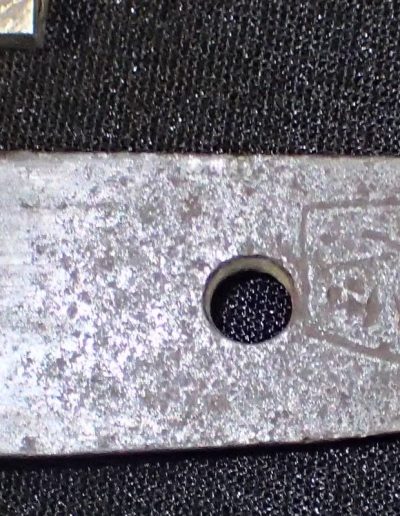
Beside this mainstream the published sources note two extremes of scale, "extremely large pieces of more than a , and conversely small ones in the six- or seven- range," and a quieter register they treat as exceptional for him. In several smaller the temper is a low mixed with rather than full , the still thick and still running; in one the departs from his usual standing grain into a tightly forged, clear that recurs on one of his rare . -length work is scarce. A few signed survive, slender with high and a small , tightly forged in , several tempered in a with rather than , a manner set apart from Kunishige, signed Hasebe being scarcely ever seen. To these are joined his shortened blades: judged Kuninobu by build, and a whose original signature is preserved on the cut-down tang, once a very long shortened in the manner of the smiths Kanemitsu and Morikage. One , differing in both signature and workmanship from the usual Enbun-dated pieces, leads the published record to suppose more than one generation of the name.
His work is read by the points that set the school apart from and Kuninobu apart from the founder. Against Hiromitsu and Akihiro the separation is substrate and : the Hasebe rises over a -bearing the pair lack, and turns back large and round rather than pointed. Against Kunishige, whose workmanship the commentaries call so close a difference is hard to find, the separation is the angular, arrow-nocked , the richer carving, and the longer-burning return, the marks named when settling an unsigned blade. One older commentary frames the limit of his hand plainly, allowing that "his technique cannot reach so far as the Heshikiri Hasebe," yet adding that he excelled in the dark, moist temper, working exceedingly close to Kunishige. Within Yamashiro the Hasebe stand with the school as the representative smiths of the province; the school further includes Kunihira, Munenobu and Shigenobu.
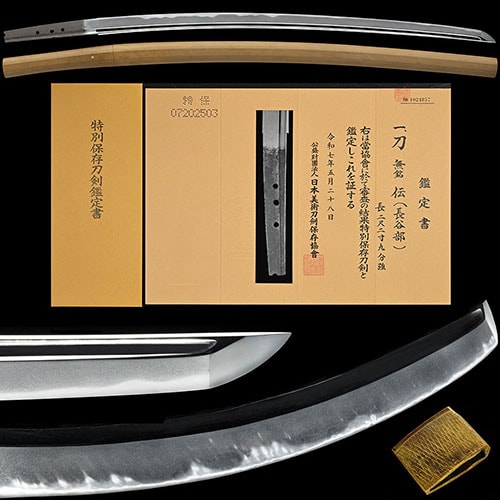
Kuninobu is Jo-jo in Fujishiro's grading, and his record carries weight: three Important Cultural Properties and three , with thirty-three beneath them, thirty-six in the and tiers. Of his roughly forty-one designated works on record, almost all are signed, an open hand unlike the largely masters. The signed nicknamed Karakashi descended in the Uesugi house, counted among the thirty-five swords selected by Uesugi Kagekatsu, with a late- mounting. A was presented to the fourteenth shogun Tokugawa Iemochi by the Owari Tokugawa house at Nagoya castle in Keio 1, recorded in its ; another was dedicated at Shizutani Shrine for the Ikeda lord Terumasa; and one , published in the Tsuchiya , "is transmitted as a treasured blade of Katsu Kaishu." His carry of Genroku 5 and Enpo 8. The Important Cultural Properties, including the Atsuta , are heritage held by shrine and museum and do not trade; recorded holders include Atsuta Jingu, the Kyoto National Museum, Itsukushima Jinja and the Sano Art Museum. The signed and in the and tiers are what a private collector may realistically encounter, and even these reach the market only rarely, a secure Hasebe Kuninobu a landmark when one appears.