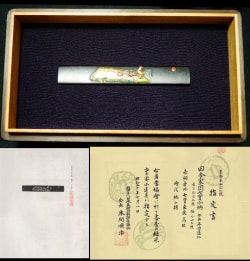
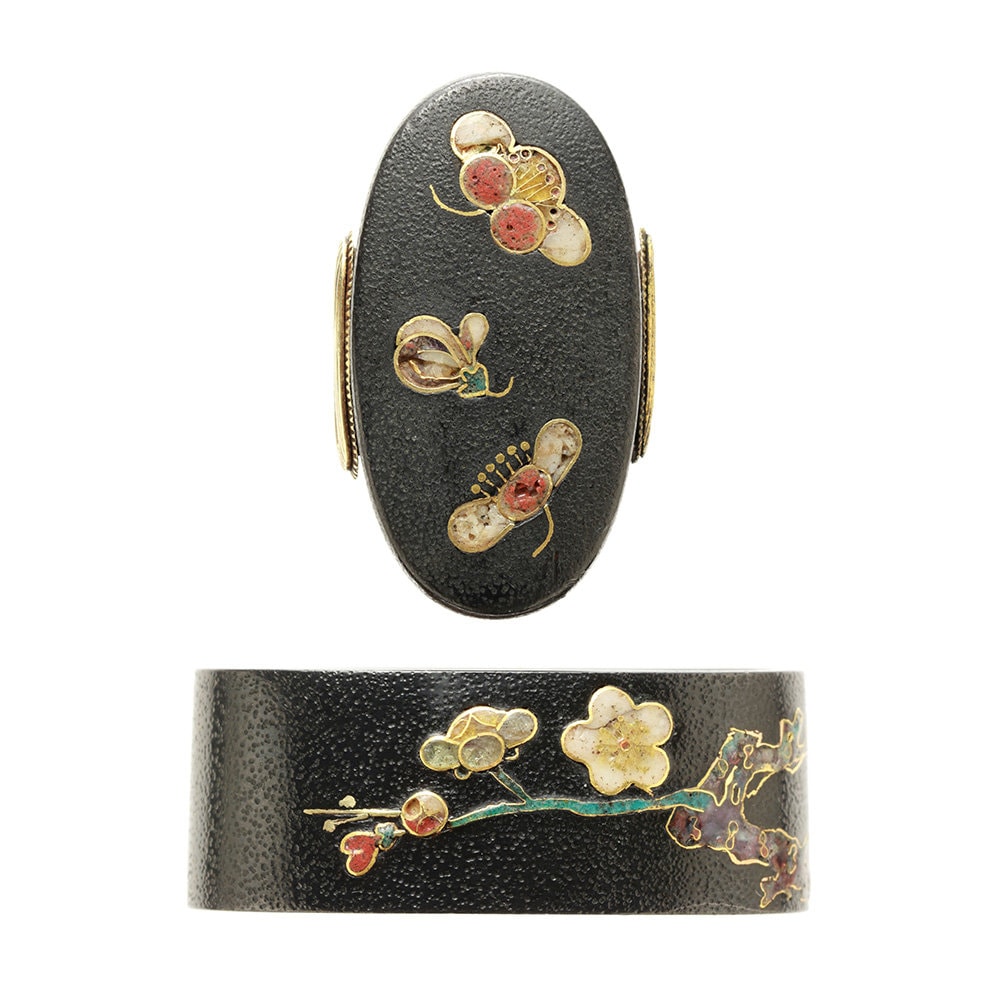
Hirata Harunari was the eighth-generation master of the Hirata school, a lineage founded by Hirata Donin (also recorded as Hirata Michihito), who was celebrated for expressing the sumptuous beauty of -period art in sword fittings through the medium of shippo (cloisonne enamel). As hereditary specialists in service to the shogunate, the Hirata house transmitted its enameling techniques across successive generations. Harunari stands out as an especially accomplished artisan within that lineage: unlike other heads of the family, he did not confine himself to the hereditary shippo alone but also practiced chokin (metal carving), and for that reason left behind works employing a wide variety of methods. Following Harunari, the Hirata family continued to make full use of its inherited cloisonne expertise, undertaking the production of decorations and orders for the Meiji government.
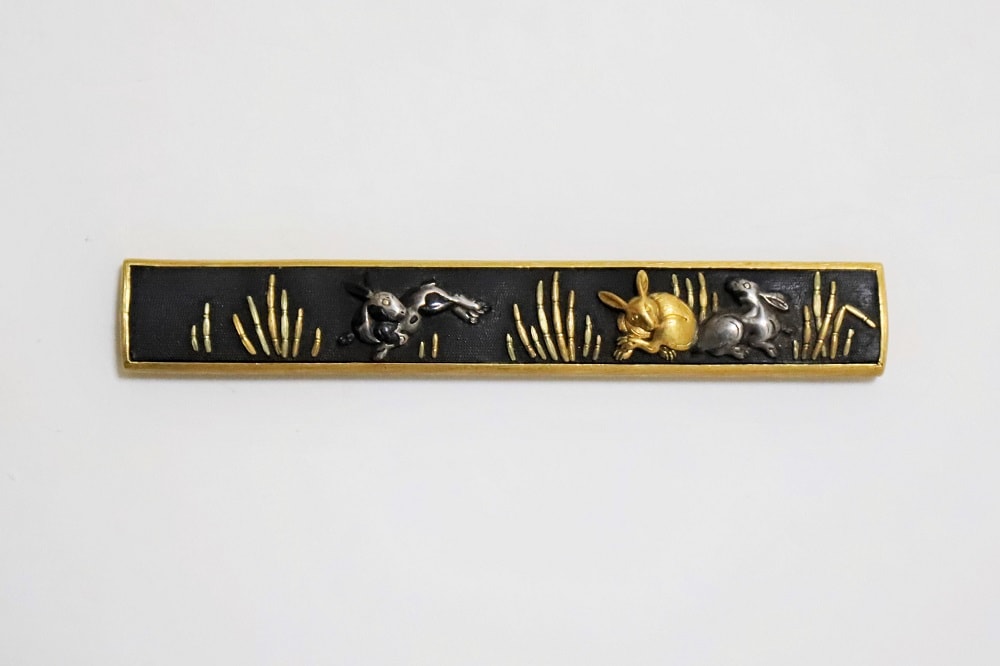
Harunari's shippo work employs predominantly gold cloisonne, yielding an elegant effect; many of his pieces are, in every respect, exceptionally beautiful. His gold-wire cloisonne inlays (kinsen shippo ) are arranged with remarkable effect, producing enamel tonalities that are highly transparent and clear -- a quality that distinguishes late-period Hirata work from the earlier manner, in which doro shippo was heaped up in thicker relief. In works combining cloisonne with carving, his is executed through precise and accurate chisel handling, and a range of colored metals -- gold, silver, , and -- is employed so that even the finest details are rendered with exactitude. Among his oeuvre there are also works that do not employ shippo at all, yet are executed with finely controlled workmanship -- neat, delicate, and painstakingly thorough.
The has consistently recognized Harunari as a maker whose output gathers together the very essence of shippo inlay while simultaneously demonstrating crisp, masterful carving skill. His pieces are described as exceptionally dignified in tone, and his best works stand as excellent demonstrations of the high technical level attained by this maker. That Harunari was thoroughly conversant with multiple techniques -- uniting the Hirata tradition of cloisonne with extremely meticulous metal-carving work -- places him in a singular position within the late -period tosogu world, an artisan whose versatility elevated the hereditary art of his house to its fullest expression.