The oldest extant dated work of the name is of Bunki 1 (1501), signed Uemon-no-jo Muramasa; from that anchor the published sources set the scheme of the name. Muramasa, the writes, was the representative swordsmith of Province in the late period, resident at Kuwana, and the accepted reading recurs across the designation records: "the common view takes Bunki as the first generation, Tenbun as the second and Tensho as the third, and among them the one held to be the second is the most skilled, his works survive in the greatest number, and his signature characters are moreover fluent and skillful". Treated here is that second master, the Tenbun-era Muramasa, forty-one designated works on record; of one the judges write that "the Muramasa most widely known to the world as the finest of the line is this second generation". The old tale that he studied under Masamune the sources reject as an unfounded tradition (不当); one text adds that no firm division of the generations is settled, and the older commentary counts Eisho together with Tenbun in the second master's span.
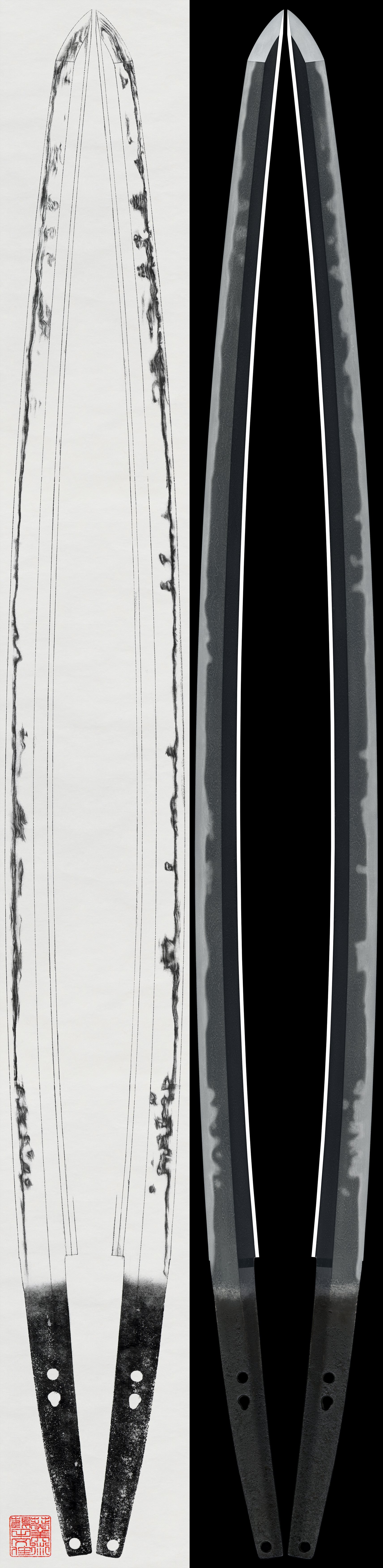
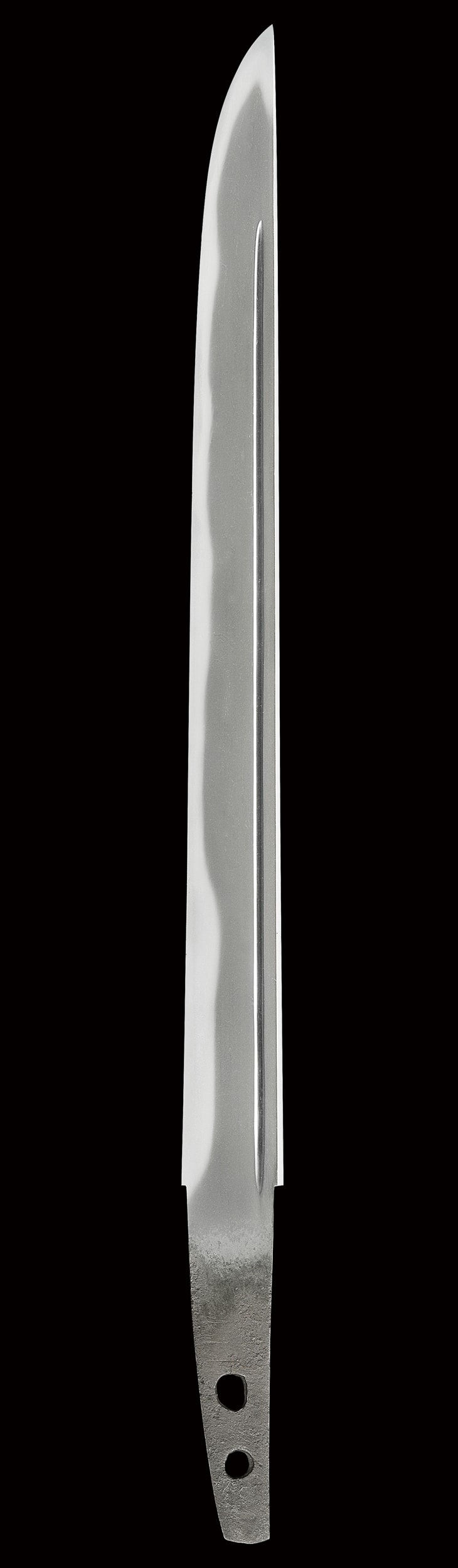
First among his marks the sources place the matched temper. "The point at which the of the and the align conspicuously is the characteristic of Muramasa", one note states, "and the box-shaped , and the point that the valleys of the come close to the cutting edge, are likewise things to see in this smith". His standard is a of and mixed with box-shaped elements, compound () , pointed and figures; the heads of the split, and the valleys press down toward the edge. The tightens, the patchy, in mura, at times with a subdued cast; runs frequently. The is or with , often swept with and pointed in feeling, the return deep.
The forms that carry it are above all the and with , wide in and extended in length, the shallow; a smaller compact group has uchi-zori, and his are short, strongly -zori . The is mixed with flowing and -inclined grain, standing somewhat, with , and often shows the whitish cast the descriptions repeatedly note, at times a faint . Beneath it sits the : , narrowing through its lower half into the fish-belly form the texts call , which "becomes especially pronounced from the second generation", and bearing the large two-character cut with a thick chisel (太鏨), whose fluent, forceful strokes are themselves a mark of the second master; rare pieces carry the long signature Seishu Kuwana ju Muramasa . Forty of the forty-one designated works are signed. The single blade is the styled Ageha (揚羽), read as a signature rubbed away long ago, with a tradition that it came to Kotoku as his sashiryo; one keeps its faint two characters as a soko-mei, the gold inlay a title inscription of Okubo Tadahiro, not an attribution; and one bears a later-added gold reading Mukoku (夢告).
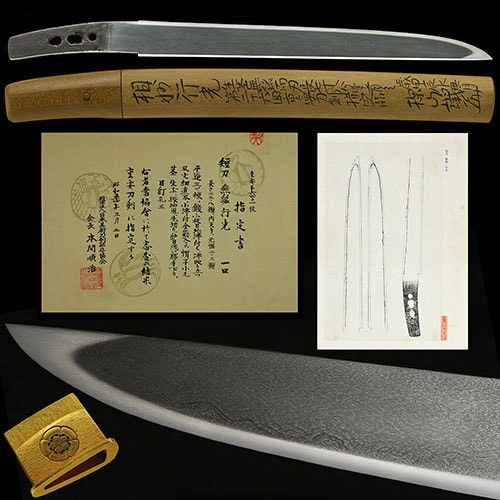
Beside this flamboyant rule the corpus records a quiet register, in medium or narrow , of which the judges write that "this is the kind that aimed at works of the school and the like, and it succeeds; now and then this occurs in his work"; on it appears as large and box-shaped figures at the base under a -toned upper half, the two deliberately differing. A smaller register leans toward , and temper along the back thickening until the blade reads as in manner, called rare in his work by one text, a manner seen from time to time by another. There is also a corpus of spears, su-, omi-no- and the rare katakama-jumonji form, seven of the forty-one; the sources conclude that "he excelled also in the making of spears"; of one large-bodied example they write that it "should assuredly be called a celebrated spear". A made jointly with Toshitsugu and Toshihiro also survives, Toshitsugu held an Odawara smith of about Kyoroku, prized by the judges for its documentary value.
The record is unusually explicit about the company in which he is judged. "At first sight it can be confused with works of the Kanesada sort", the notes say, elsewhere naming Kaneshiba; they find a likeness to the Shimada smiths, and of Heianjo Nagayoshi in Kyoto the judgment sharpens to "extremely close", some relationship between the two being presumed. What parts him from all of these, in the judges' own listing, is the matched and , the box-shaped figures, the valleys pressing to the edge, the tight with its patchy , and the under the thick-chisel . Within the school, Masashige and Masazane work in the manner, and the decides once more: the is cut angular on Muramasa where Masashige rounds it with full flesh. remains an occasional flourish over the one matched , never the rule of his work.
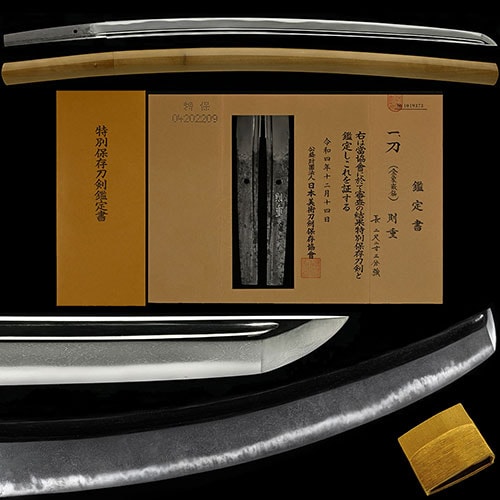
Muramasa is rated Jo-jo in Fujishiro's grading; the second generation's designated record is forty-one works, all ; the register holds no National Treasures and no Important Cultural Properties, so nothing of his is permanently sealed away. History thinned the signatures on its own. From the period onward, the sources record, "legends circulated that the blades brought calamity upon the Tokugawa house, or that they would curse their owners, and for this reason many were rendered unsigned", so that signed in particular are comparatively rare today. On the fate of the name the texts divide, some stating that after Tensho "the name lapsed, having met, it may be, the disfavor of the Tokugawa shogunal house", others that "the signature continued in succession into the era". No museum or shrine holding is recorded against his blades and no roll attaches to them; on the record they have moved among private hands. A second-generation Muramasa, and signed with the thick-chisel two characters over the , comes to market only rarely, and the legend that effaced so many signatures has only added to the call for those that remain.