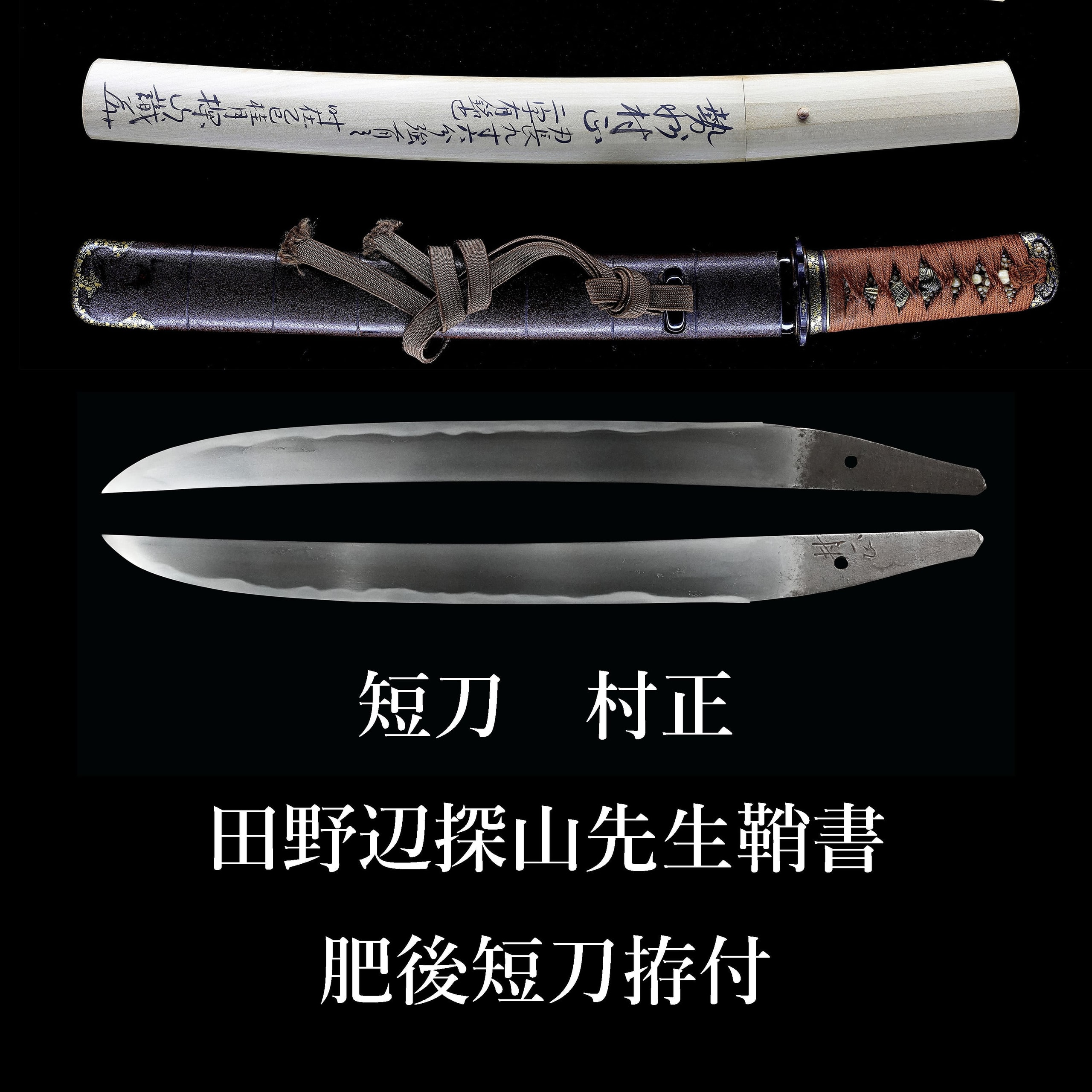
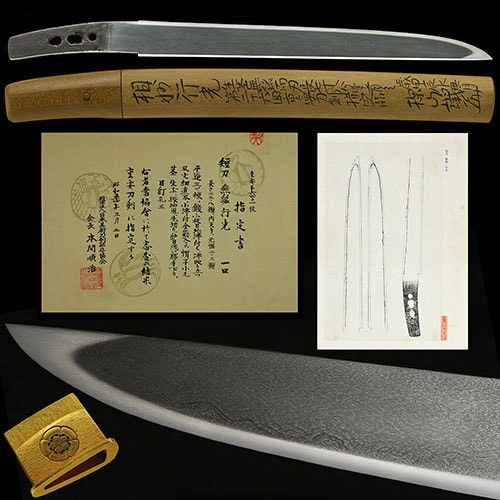
Masashige worked in Kuwana, in Province, where the published sources record him together with Masazane as a disciple of the first-generation Muramasa, the founder of the Sengo line: "Masashige, together with Masazane, was a disciple of the first-generation Muramasa." The school reckoning runs from a first generation active around Eisho, the name reaching three generations, and Masashige is filed by tradition within that frame as a pupil of the . He leaves no dated blade, so his place is read from style and the manner of signing, and the published commentary takes those works that fall in the Eisho to Tenbun span as the earliest. His standard work is the late- and , wide in and slightly elongated; the few are with a high -zori. He is Jo-jo in Fujishiro's grading, and unlike the great masters whose names survive mostly on attributions, every one of his designated blades carries his signature.
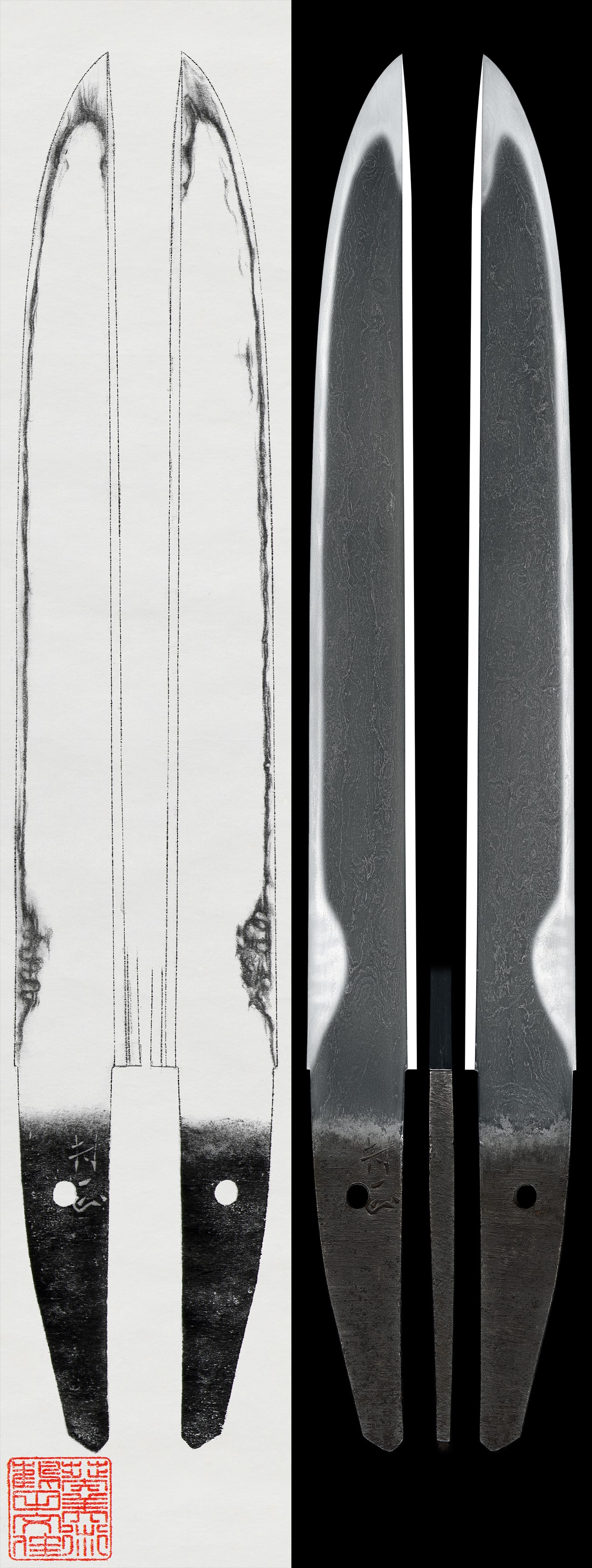
His hand is the Sengo manner turned more open and more strongly in . The forging is mixed with and a flowing tendency, and it stands: the published commentary returns, blade after blade, to the observation that as a whole many of his works show a more conspicuously standing grain () than Muramasa's, and that compared with the master his and are the stronger in . The temper takes a base into which , large and bold , box-shaped and arrow-nock teeth are mixed, the patterns on and tending to align; and enter, the attaches thickly, and runs frequently. Over a base the bold is markedly his, and it is the bones of his more flamboyant . The runs to a , often swept with and pointed on one face. He is set apart from his master not by a single trick but by the proportion of these features: the worked larger, the carried further, the grain allowed to stand.
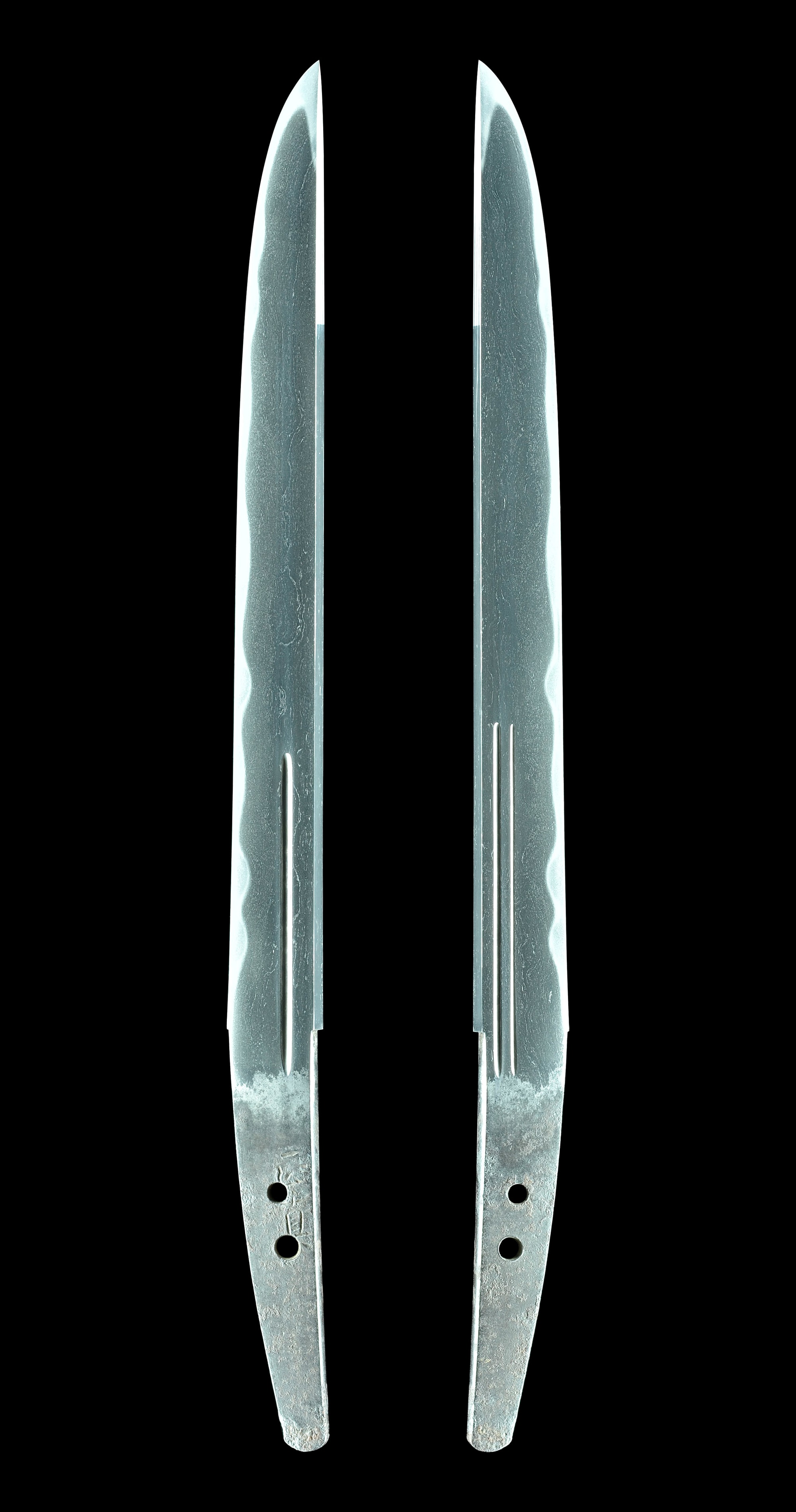
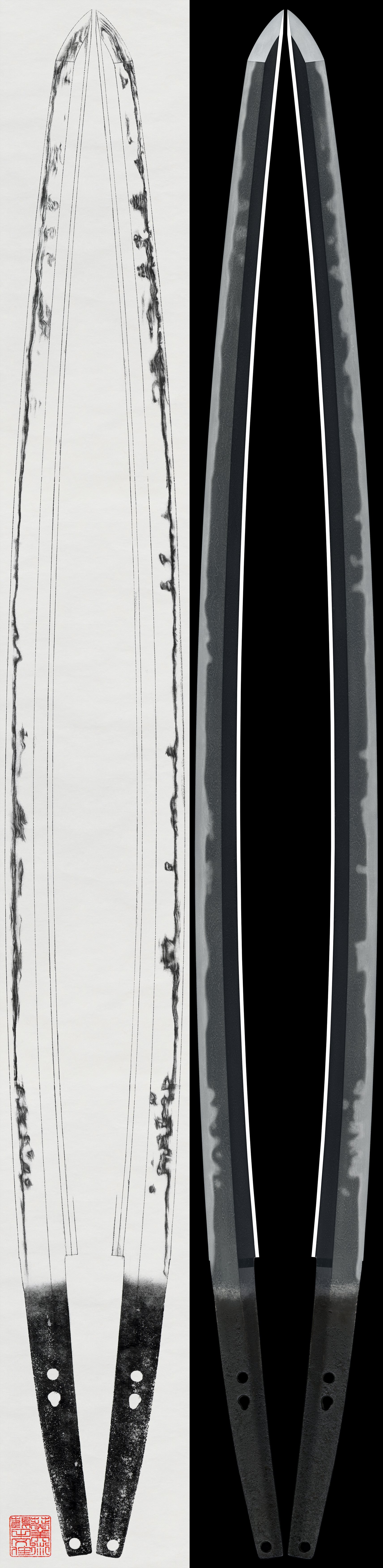
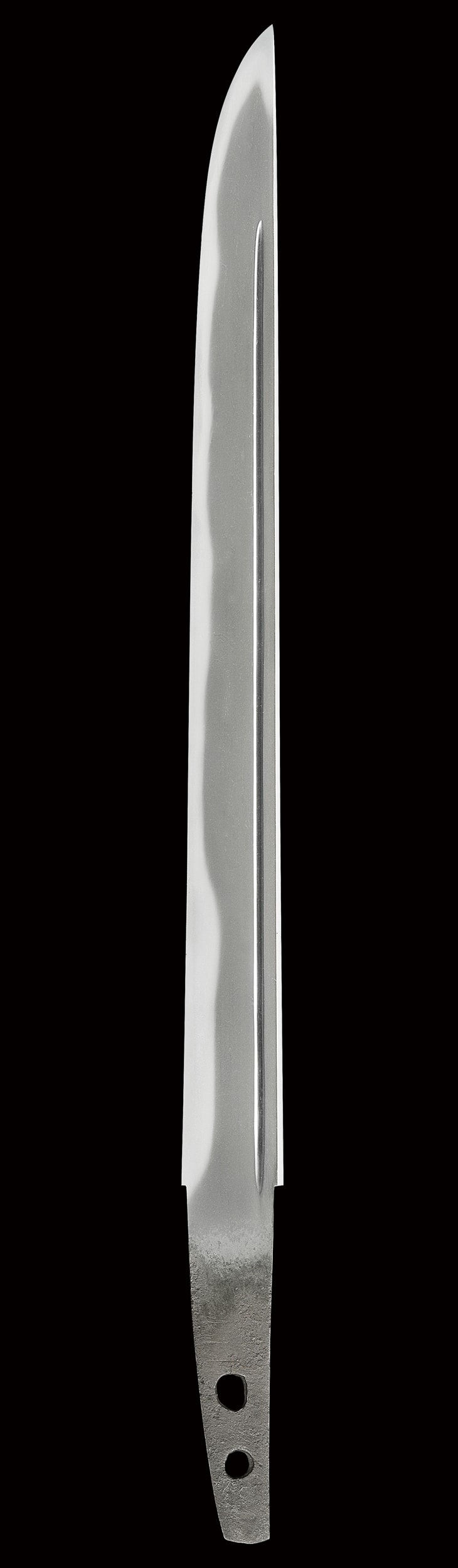
The is where the school is read. Over a standing , often mixed with and flowing grain, the gathers thickly and enters, so that the surface reads as the more active of the two Sengo hands. The published commentary is consistent that his is the more openly standing grain, writing of the line that "compared with Muramasa his and are the stronger in ." The temper is a over a shallow undulating base, bright and clear at its best, with deep and well-adhering ; thread through it and sweeps heavily, at times the breaking up out of the . The is the most variable element, frequently tempered deep into an -like return, , the point constricting and turning back in a rounded form, swept long down the . Carving is occasional: one carries a grass-script on the and with and a lotus pedestal on the .
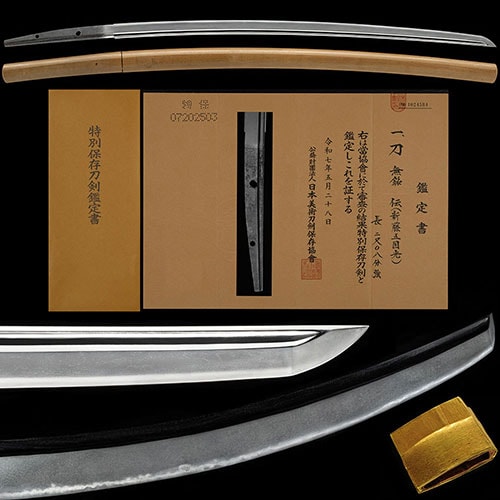
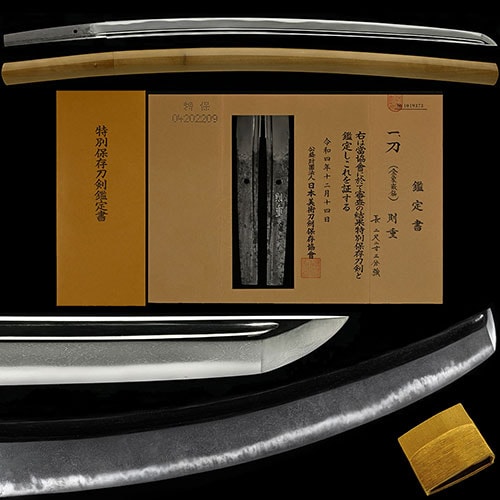
Within one Sengo manner the published descriptions read his work in two registers. The first is his standard, orderly hand, the and in and , which the commentary calls his typical workmanship; of one such , brought to a calm character in small, even without roughness or crumbling , it writes that it "reveals a creative domain closely akin to that of his master Muramasa." The second is the wild register that the judges plainly prize: and angular squared-off teeth enter the , the thicken and break up, runs heavily, and with - build toward a -like effect, the burning deep and thrusting up. Of one such the commentary writes that it is finished "as a bold piece rich in rustic spirit," and of another, "open-hearted in feeling and filled with commanding vigor." A that fully exploits this manner is said to "fully demonstrate this smith's true strengths." The is a thick-chisel two-character signature, sometimes a three-character Masashige-, cut on the toward the ; one reads its signature Masashige.
His distinction from Muramasa is the spine of the school's , and the published commentary names it precisely. He shares with the master the distinctive , the fish-belly swelling of the , so that on form alone the two run close; the earliest of his signed , the commentary observes, is the oldest in date among the works of the name and "at first glance appears to be a masterwork by Muramasa." The point that parts them is the . Where Muramasa's is cut angular, Masashige's rounds out fleshily, and the judges name this the principal point of appreciation, returning to one phrase across his designations: "whereas Muramasa's is angular, the distinctly rounded, fleshy is the point of interest." To the end the stands more openly and the carry further than the master's. He works alongside Masazane in the mould, the two named together as the famous pupils of the ; within that mould the rounded , the standing grain and the stronger are his.
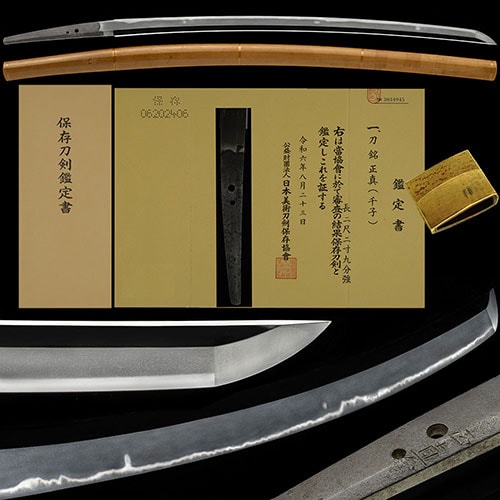
Masashige is among the more attainable of the celebrated names, and his record is honest about why. Twelve of his blades hold the rank, every one of them signed and , and none has risen to the higher designated tiers; his Toko Taikan valuation sits in the middle of the field. None of the designated blades carries a recorded provenance, so the school's reputation rather than a chain of famous owners is what is preserved in them. The corpus is geographically scattered, the recorded holders private collectors across Japan and one in the United States, and the swords themselves the usual Sengo and , the blade of late . Of the twelve, two sit in the tradeable tier of recorded whereabouts; a signed, Sengo Masashige is therefore not beyond a serious collector's reach, coming to market from time to time and standing as a faithful witness to the school of Muramasa, its rounded and its standing, -laden steel telling the pupil from the master.