NihontoWatch MonNihontoWatchBETA
MarketEncyclopedia
NihontoWatch Mon

NihontoWatchBETA

Market
Encyclopedia
Overview·Kantei·Designations·Provenance·Work Types·Signatures·Lineage·School
OverviewKanteiDesignationsProvenanceWork TypesSignaturesLineageSchool
  1. Schools
  2. Yokoya
  3. Omori
  4. Horie Okinari

Omori Horie Okinari

堀江興成

Jūyō
Vol. 36, No. 235 · Kozuka

Omori Horie Okinari

堀江興成

7 ranked works

Eraact. Meiwa–Tenmei (c. 1770s-80s)SchoolYokoya>OmoriTraditionMachiboriTypeTosogu MakerCodeMUR010
7Jūyō Tōken

Overview

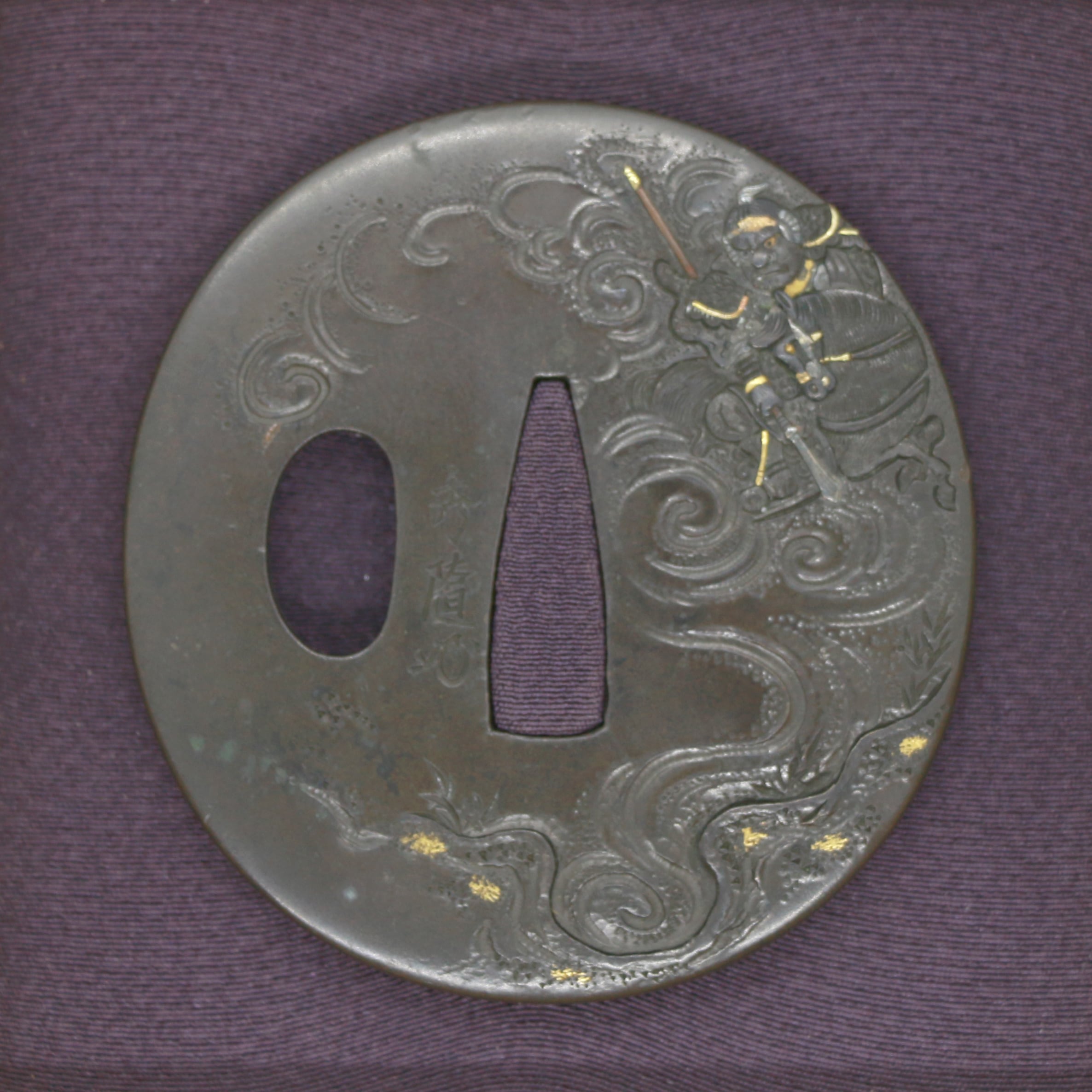
Horie Kosei first studied under Hamano Masayuki, using the name Masusui. In Meiwa 6 (1769), while still in his twenties, he encountered the death of his teacher Masayuki, after which he newly entered the school of Omori Eishu. He was granted permission to use one character from his master's name and changed his art name to Eishun. He also became affiliated as a disciple of Ozaki Naomasa, a craftsman of Goto lineage, absorbing the methods of the mainline house-carving tradition. After establishing himself independently he adopted the name Kosei. Later he served as a kakae-ko -- an officially retained craftsman -- of the Hachisuka house of Awa Province, and trained many pupils and successors within his circle.

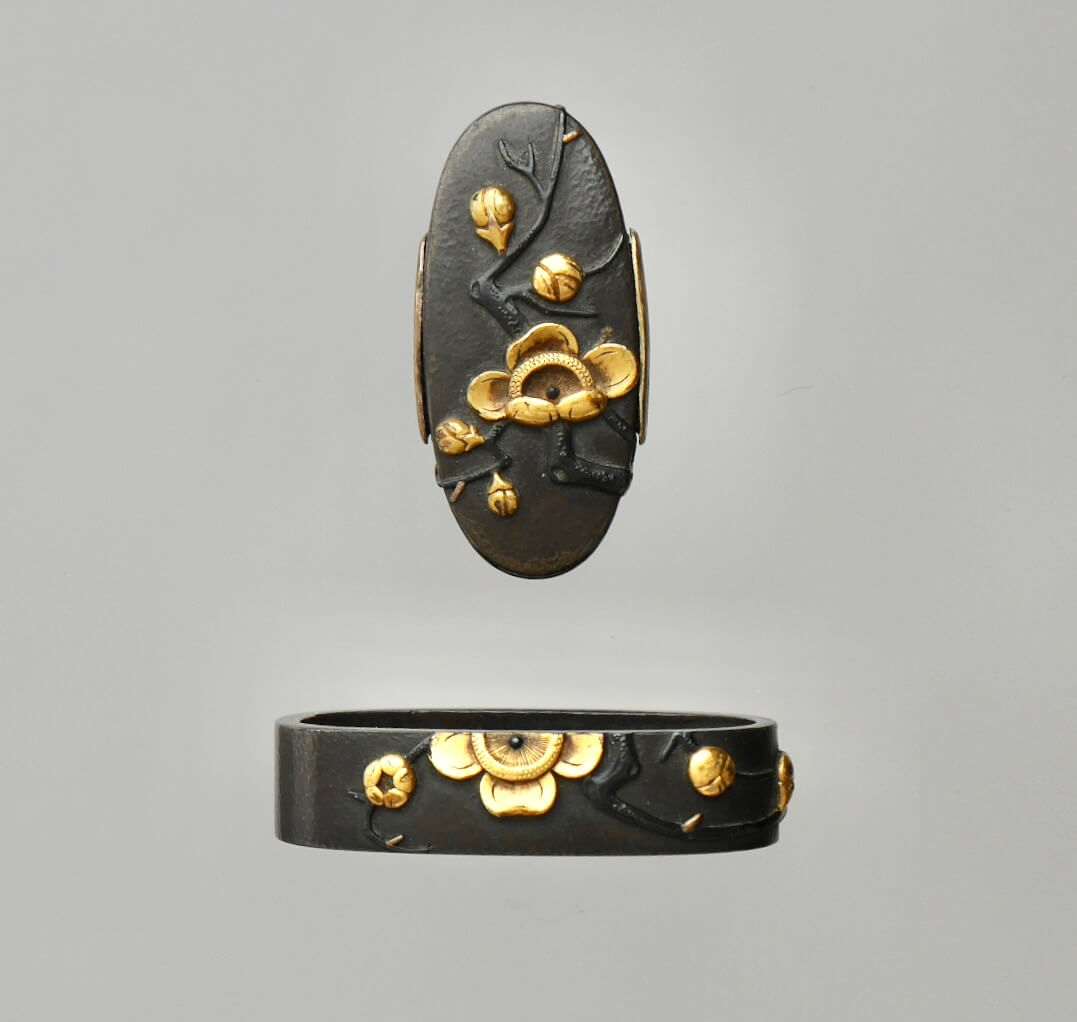
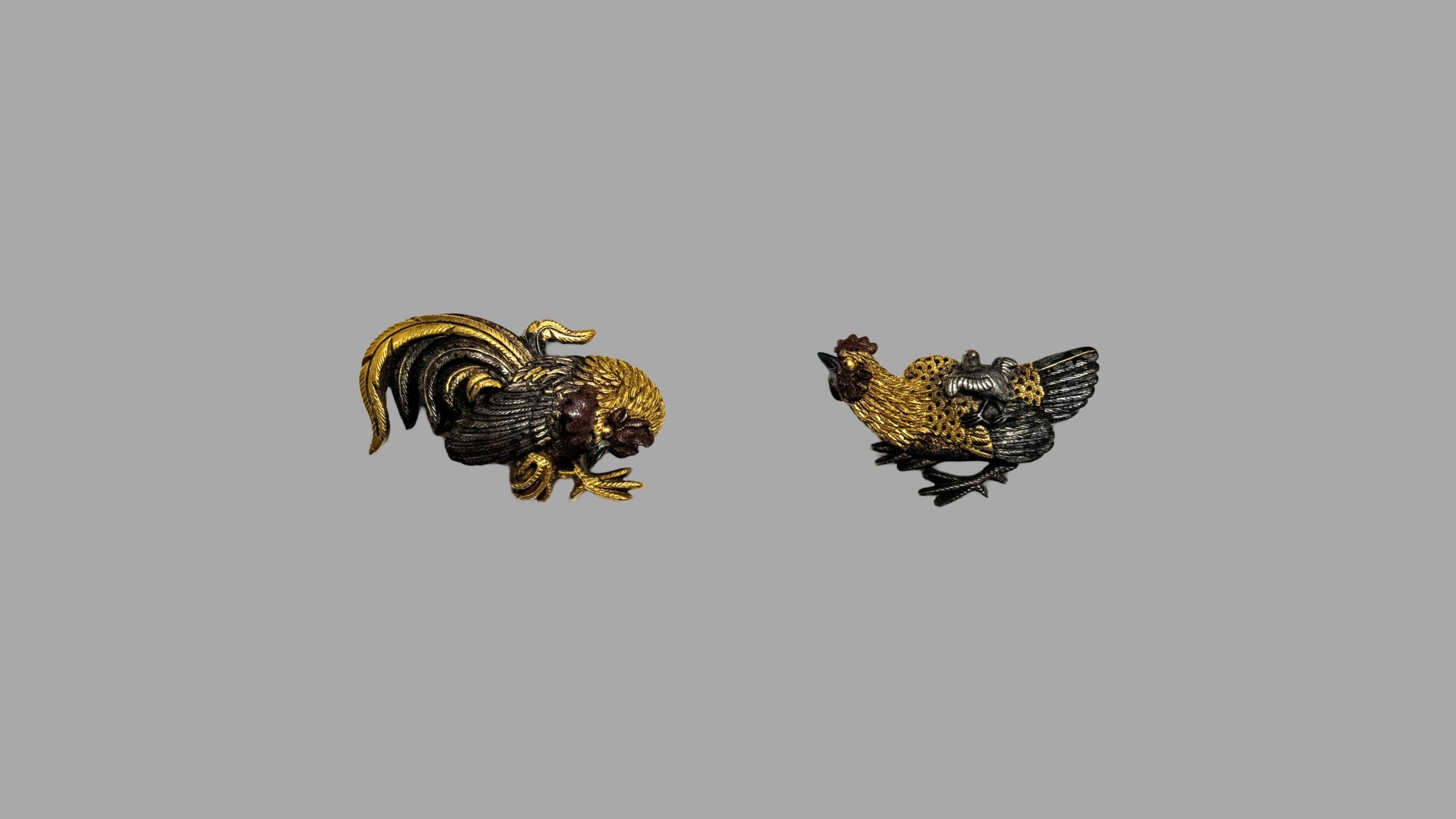
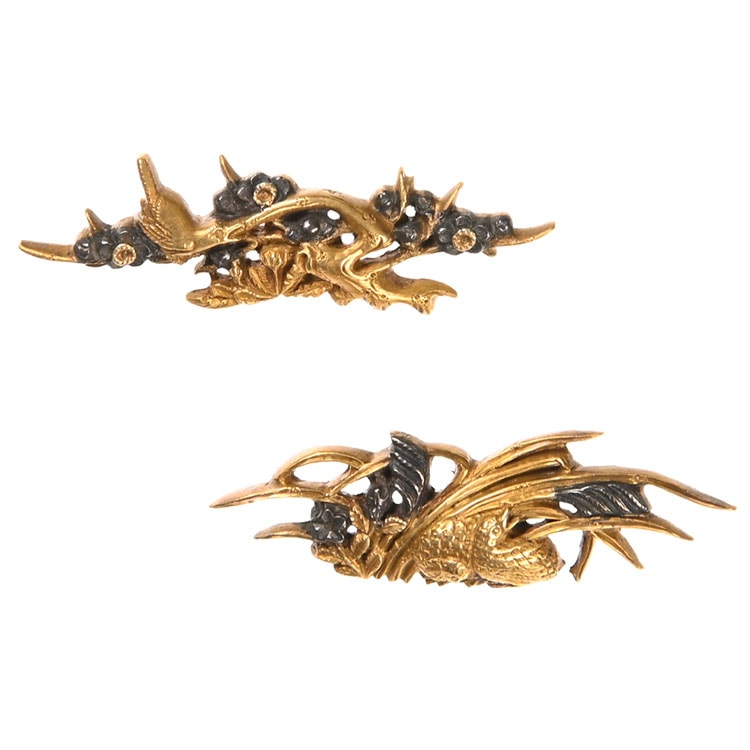
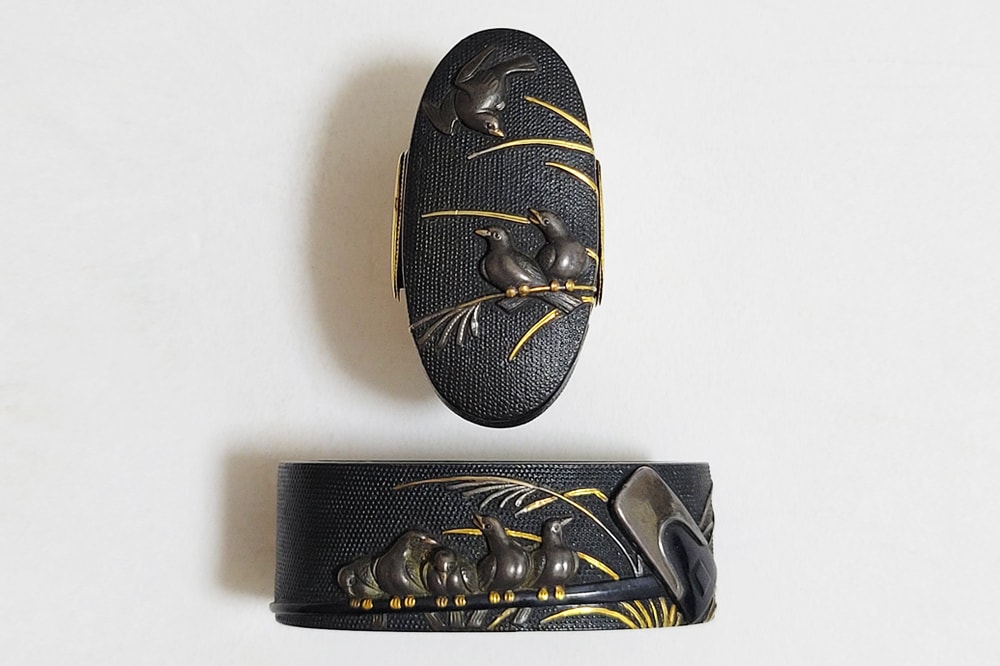
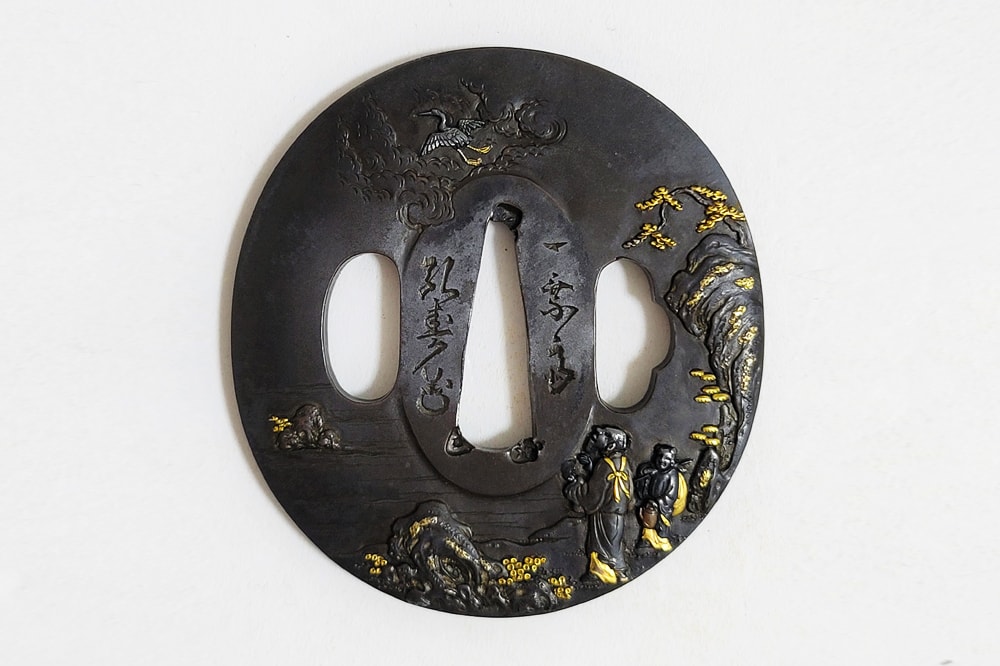
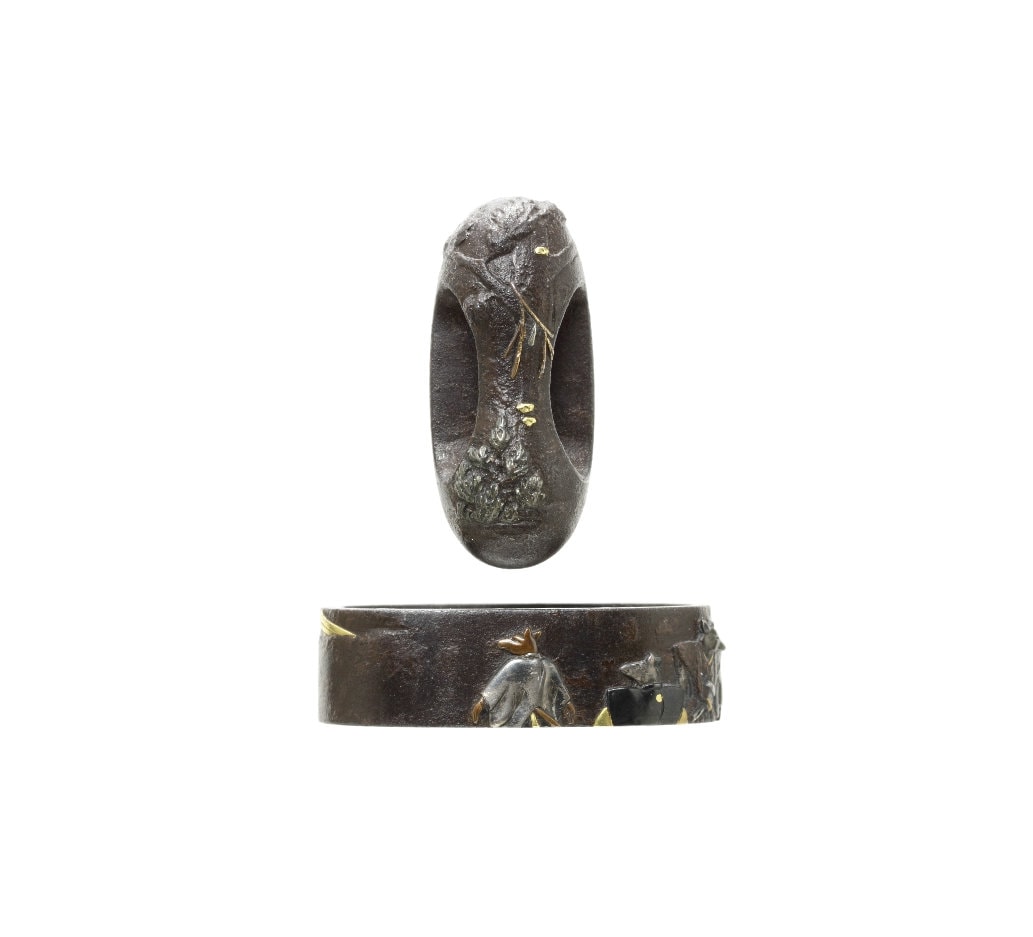
Kosei's technical command reflects the convergence of three lineages: the Hamano school's naturalism, the Omori school's structural discipline, and the Goto family's dignified and methods. His preferred materials are grounds enriched with polychrome inlay using gold, silver, and , often finished with reverse gilding ('). Compositions range from matched sets of saddled horses rendered with gold crests in the Goto manner, to the Twelve Months of Birds and Flowers -- an hereditary treasure of the Hachisuka house -- based on poetic designs from Fujiwara no Teika's . In his later years, works such as with shishi motifs employ kezuritsugi construction combining gold and to create visual variation. The , frequently executed in solid gold (), display richly modeled sculptural carving (yobori) of full, ample form.

The consistently characterizes Kosei's production as embodying a dignified style modeled after Goto taste, yet enlivened by the innovative character associated with . His works are described as possessing "high dignity" and "an elegant, courtly taste," with motifs treated in a "taut, crisp expression" that demonstrates "the full range of his abilities." Even in pieces that strongly emulate the Goto family style, the assessments note skill "well worth close attention" and a "chic, sophisticated design sense" with an "urbane, polished finish" -- qualities that distinguish Kosei as a consummate synthesizer of the major mid- metalworking traditions.

Kantei

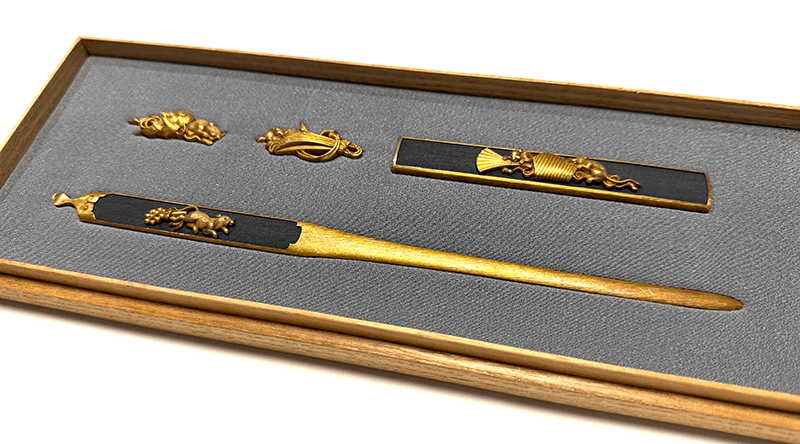
3 descriptive axes: material (shakudo nanako above all, with solid gold and suaka, and his variegated gold-and-shakudo spliced fields) x technique (Goto-style high relief and iro-e backed with gilt, applied suemon and gold-crest work, with iro-e inlay and three-dimensional katachibori on the menuki) x themes (decorous Goto-style subjects: the lion, often biting a peony, the saddled horse, the flowers-and-birds of the twelve months, the spring herbs and the jewel). With only seven accepted pieces, his idiom is fundamentally the Goto-style house ground rather than a separated personal hand; the one individual tell the records single out is his spliced gold-and-shakudo ground, which they call fresh and refined.

Horie Okinari, a late- metalwork artist, came up through more than one house. The say he first entered the Hamano school under Hamano Masayuki and signed Masuyuki; when his master died in Meiwa 6 (1769), in his twenties, he changed gates and entered Omori Hidehide, who licensed him one character of the house name so that he signed Hidetoshi, and he also became an associate-pupil of the Goto-line carver Ozaki Naomasa, taking the name Okinari only after he set up on his own. He was later retained by the Hachisuka lords of Awa and trained many pupils. His accepted work is a Goto-style body of decorous three-piece and two-piece sets and a paired : a field carved in high relief with iro-e and backed with gilt, into which he carries touches of his Hamano origin and of the Ishiguro school, leavened with the freshness of .

Diagnostic discriminators

his accepted work is fundamentally the universal Goto-style house ground (shakudo nanako, high relief, iro-e, gilt back), so this is NOT a feature that separates him from the house; the one individual tell the records single out is that he splices gold and shakudo nanako edge-to-edge, cut as 金赤銅削継 on the cited lion three-piece set and as 金割継魚子地 on a second lion two-piece set, giving the field a variation they call chic and unaffected (変化があり / 洒落た造形 / 垢ぬけている). The two pieces use the two different words for the same splicing, so the citation here is to the 削継 piece only; counting both spliced grounds the recurrence is 2/7. It is low-n and flagged as such; with so few pieces this is offered as his recurring refinement rather than a securely census-rated discriminator

Material (grounds)

above all, the standard Goto field, with solid gold used for the most lavish and for some plates; on two of the sets he splices gold and edge-to-edge into a variegated field that the records call fresh and refined.

Technique

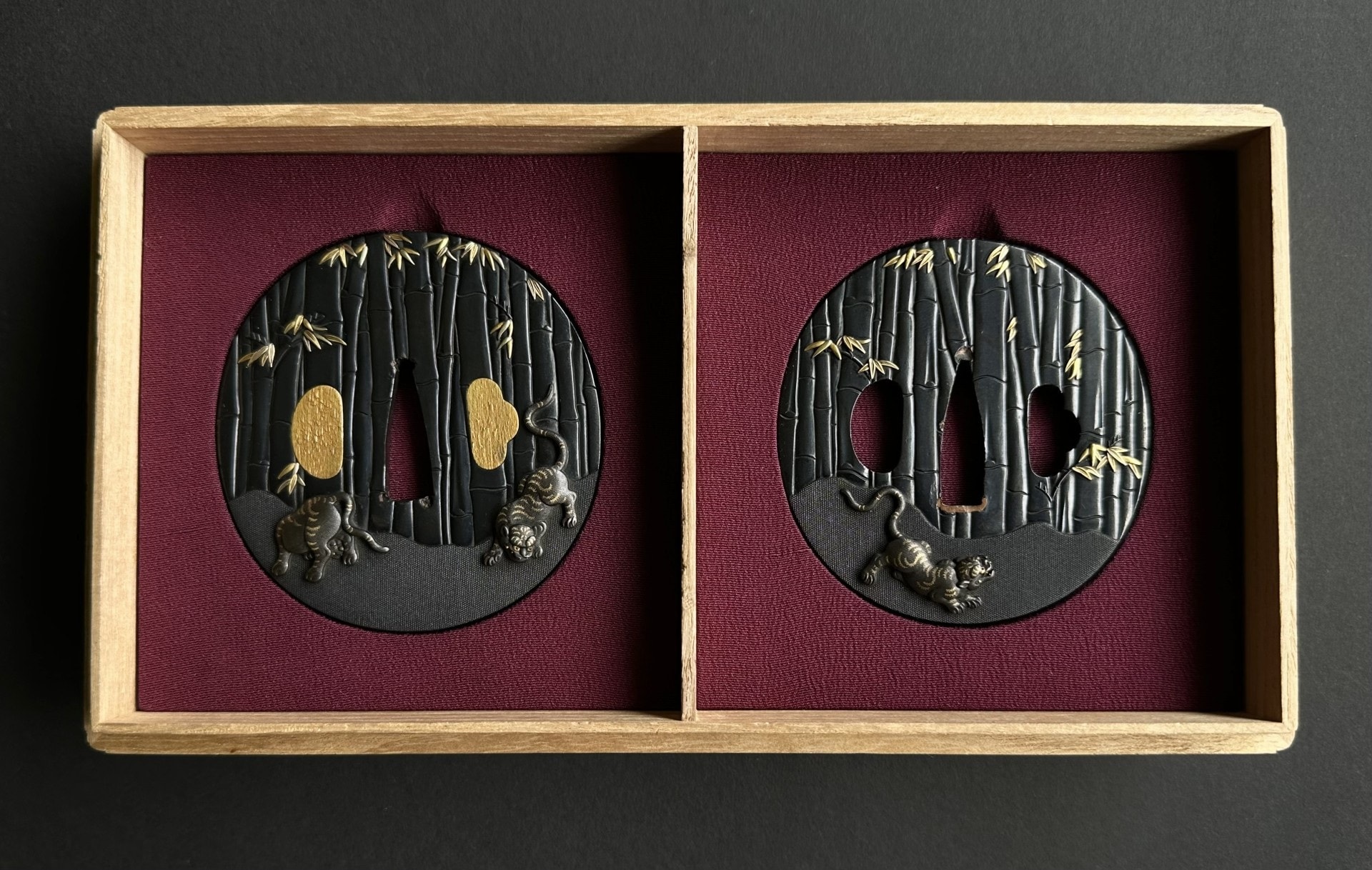
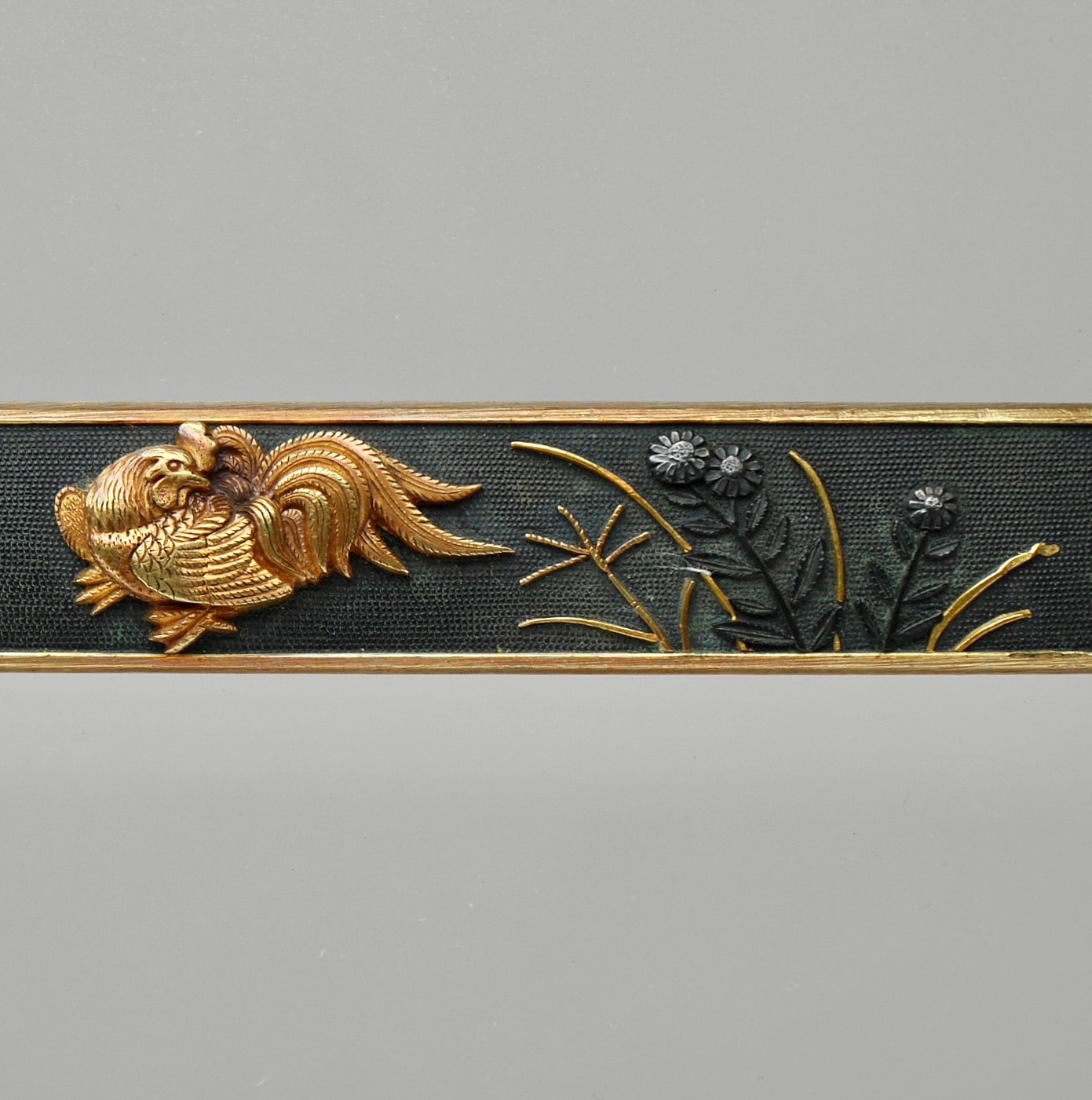
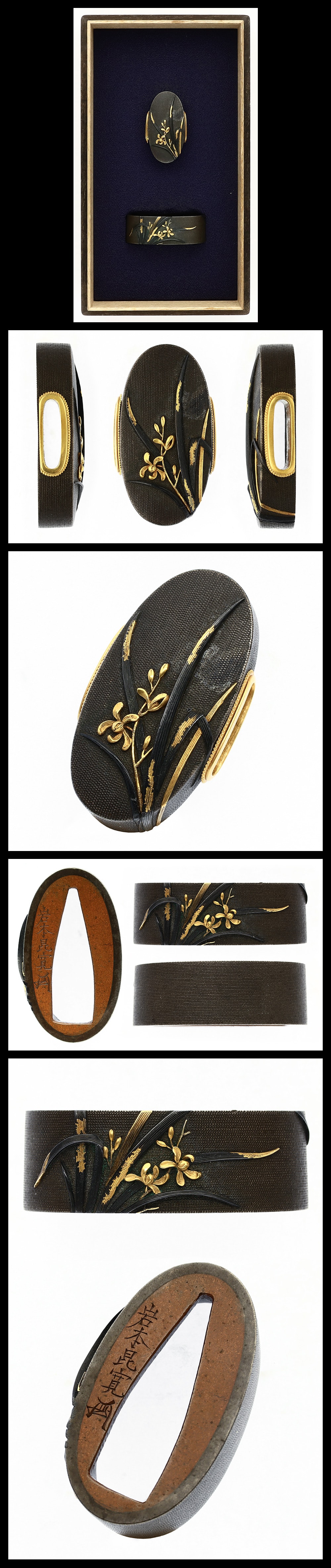
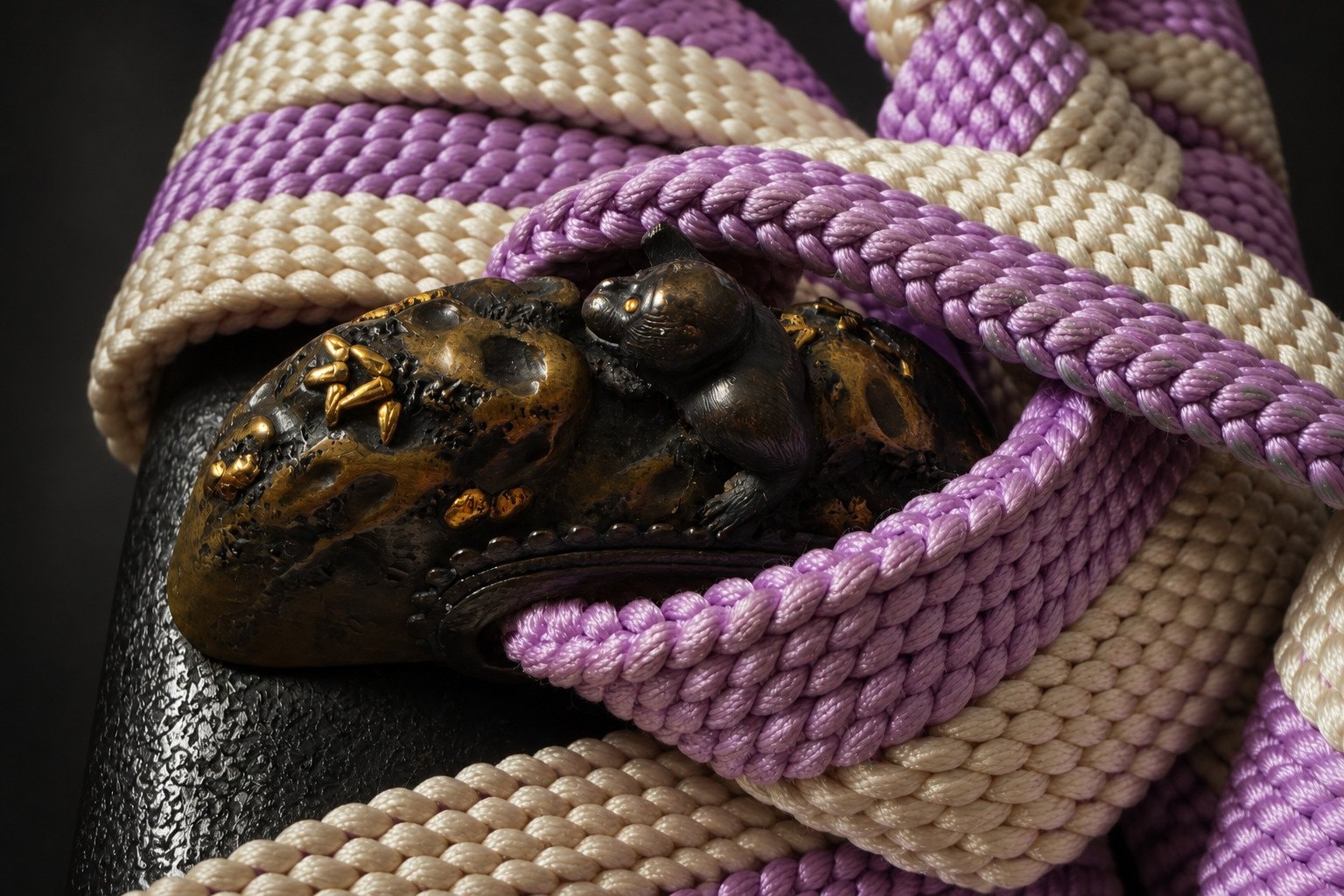
His hand is the Goto-style high relief and iro-e backed with gilt, with applied and the gold-crest work of formal -bori; the are worked in three-dimensional , and he adds iro-e inlay and a fine , carrying touches of Hamano and the Ishiguro school into the orthodox ground.

Themes (Goto-style subjects)

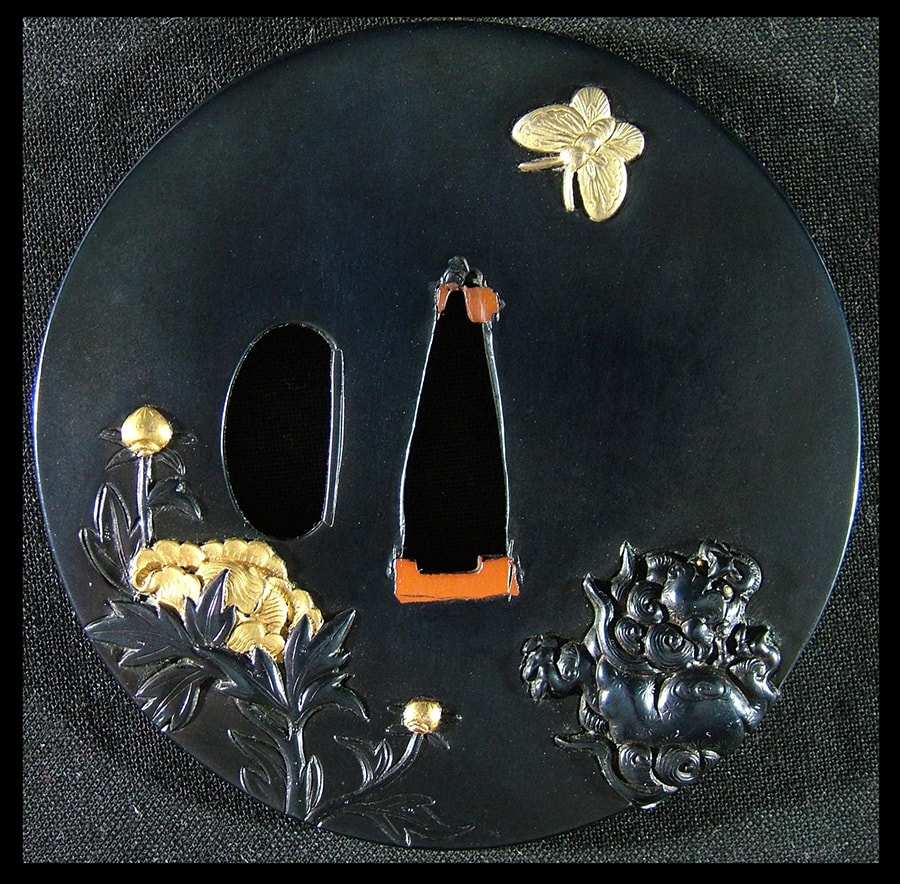
His subjects are the decorous Goto-style repertoire: the lion above all, given a strong relief and often shown biting a peony, with the saddled horse, the flowers-and-birds of the twelve months set to Teika's monthly , the spring seven-herbs, and the jewel among his three-piece set themes.

The lion and formal Goto subjects

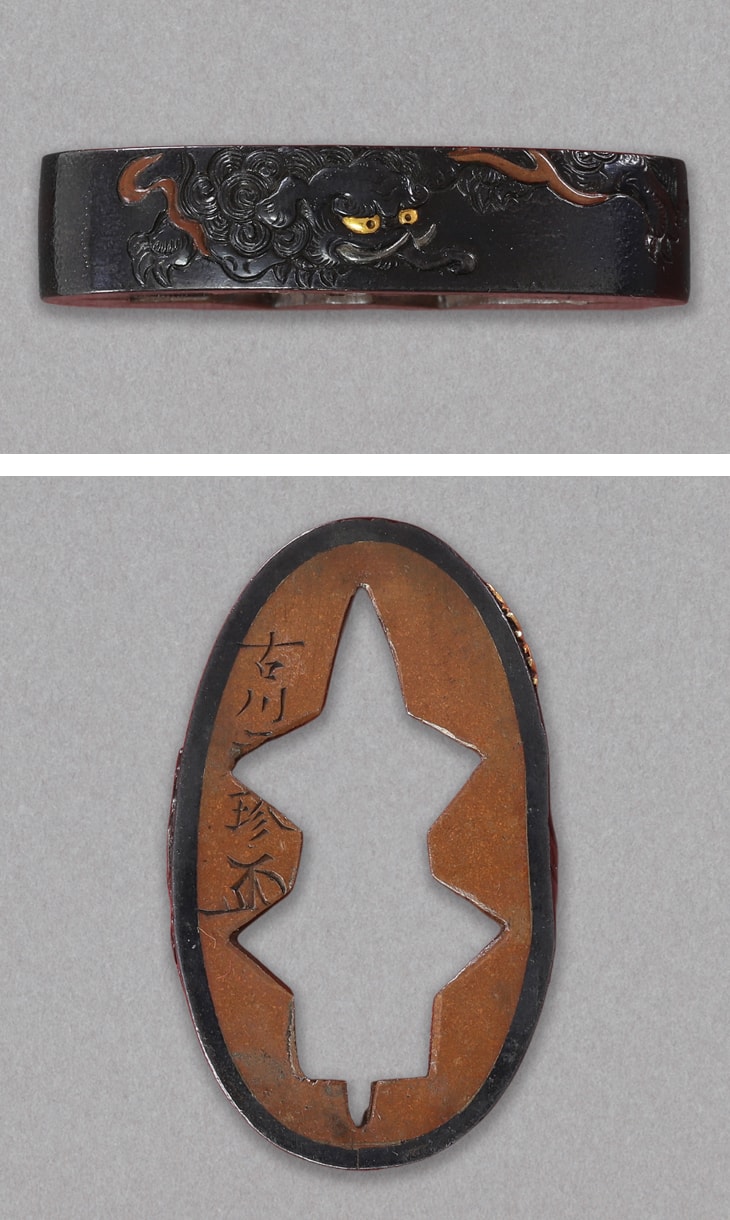
The lion, given a powerful high-relief modeling and often shown biting a peony, the recurring set-piece of his accepted three-piece and two-piece sets.

Flowers-and-birds and other subjectsless firmly established

The flowers-and-birds of the twelve months, designed to Fujiwara no Teika's monthly , and the saddled horse, treated in the Goto-style high relief and gilt-backed manner.

Full iconography

Signature chronology

Placement
Recorded signatures

Documentary note

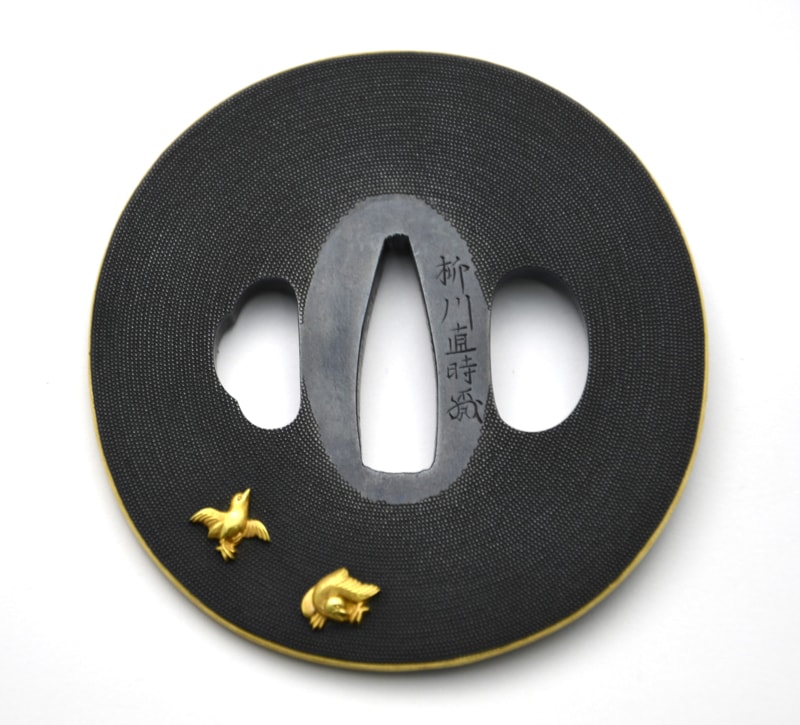
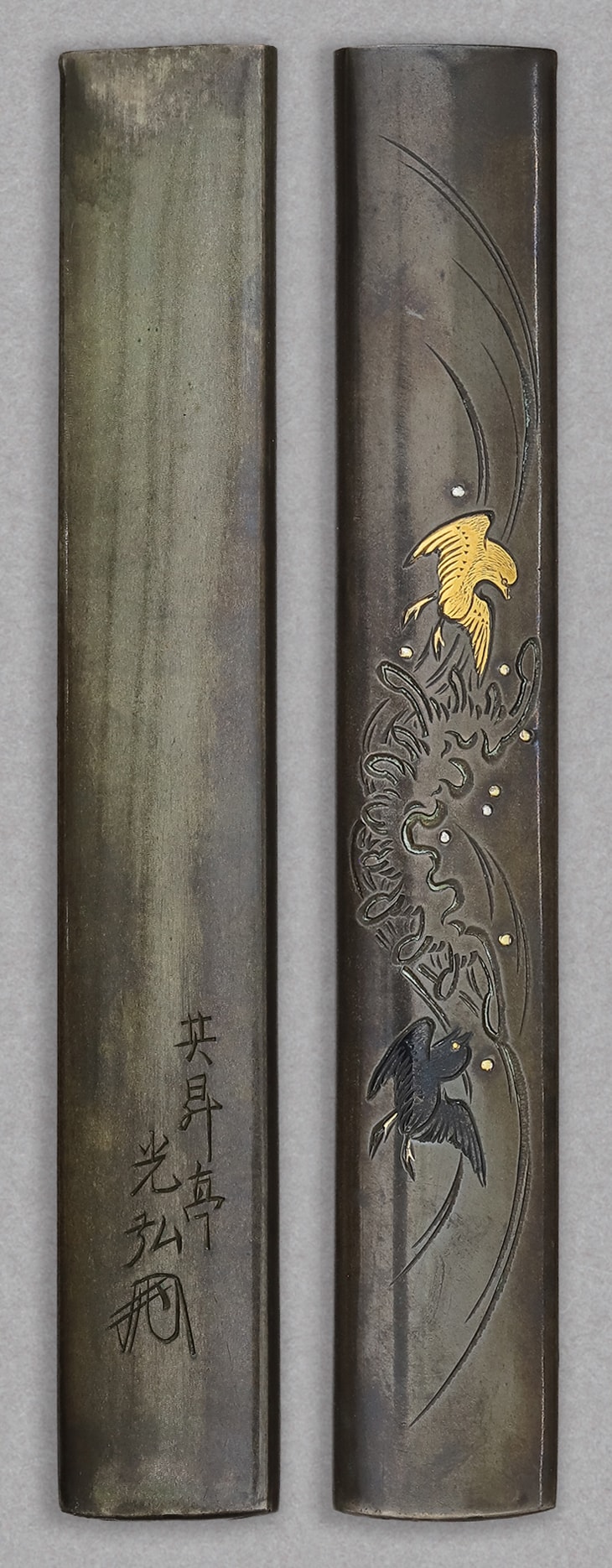
He signs the four characters of his full name Horie Okinari with a , which the records call a five-character , on most pieces; on the light-edge he cuts the bare given name Okinari (a toshiri-), and across the pair he splits it as a (Oki / nari). One is age-dated to the sixty-sixth year and one to the seventy-third, and another set gives his seventy-second year. His earlier names Masuyuki (under Hamano Masayuki) and Hidetoshi (the licensed name under Omori Hidehide) are recited in the biography of nearly every but are never cut inside a signature run in this group, so they are documentary, not observed signatures here. NOTE: the directory files this maker under the Murakami (Muramachibori) school (NS-Murakami), but the name no Murakami connection at all; they consistently trace him through the Hamano school, the Omori gate, and the Goto-line carver Ozaki Naomasa, so the school is authored from the corpus and the directory tag is flagged as unsupported.

Scholarship

One record reads his Goto-style ground as leavened, in its composition and modeling, with the freshness of machibori; this single setsumei is the only one in the group to name the machibori touch explicitly, so the reading is scoped to that piece.

Designations

Kokuhō—
Jūyō Bunkazai—
Jūyō Bijutsuhin—
Gyobutsu—
Tokubetsu Jūyō—
Jūyō Tōken7

Elite Standing

0.05 across 7 designated works

Top 23% among makers

Provenance

1 documented provenance across certified works by Horie Okinari

Provenance Standing

1 works held in elite collections across 1 documented provenances

Top 82% among makers

Raw score: 1.88 / 10

Work Types

Distribution across 7 ranked works

Other
343%
Mitokoromono
229%
Kozuka
114%
Tsuba
114%

Signatures

Signature types across 7 ranked works

Currently Available

Lineage

Horie Okinari
Student
  1. 1.Horie Okiyoshi堀江興吉1designated

Omori School

Other artisans of the Omori school

  1. 1.Teruhide英秀15designated
  2. 2.Chizuka Hisanori遅塚久則9designated
  3. 3.Terumitsu英満4designated
  4. 4.Hidetomo秀知2 for sale2designated
  5. 5.Horie Okiyoshi堀江興吉1designated
  6. 6.Hidetoshi秀寿2designated
  7. 7.Kazutomo一知1designated
  8. 8.Mitsutoki満辰1designated

Horie Okinari

Horie Okinari(堀江興成) was a maker of Japanese sword fittings (tōsōgu) of the Omori school, active during the act. Meiwa–Tenmei (c. 1770s-80s) period.

The work follows the Machibori tradition.

Designated works by Horie Okinari include 7 Jūyō.