NihontoWatch MonNihontoWatchBETA
MarketEncyclopedia
NihontoWatch Mon

NihontoWatchBETA

Market
Encyclopedia
Overview·Kantei·Designations·Provenance·Work Types·Signatures·Lineage·School
OverviewKanteiDesignationsProvenanceWork TypesSignaturesLineageSchool
  1. Schools
  2. Higo Kinko
  3. Hayashi
  4. Kamiyoshi
  5. Rakuju

Kamiyoshi Rakuju

楽寿

Jūyō
Vol. 50, No. 217 · Tsuba

Kamiyoshi Rakuju

楽寿

13 ranked works

ProvinceHigoEraLate Edo (1817–1884)SchoolHigo Kinko>Hayashi>KamiyoshiTraditionHigoTeacherFukanobuSpecialtiestsuba, inlayTypeTosogu MakerCodeKAM001
13Jūyō Tōken

Overview

Kamiyoshi Rakuju, also recorded as Kanki Rakuju, was the third-generation master of the Kamiyoshi lineage, a branch descending from the celebrated Hayashi Matahachi of Province. The family's founder is said to have been Kamiya Jinzaemon, who entered the service of the Hosokawa house when Hosokawa Tadatoshi took possession of . In the time of Juhei Tadamitsu, the family received the transmitted traditions of the Hayashi house by domain order and devoted itself to reviving the manner of the Kasuga school. The second generation, Juhei Kunihira Fukanobu, was born in Tenmei 6 (1786) and died in Kaei 4 (1851) at the age of sixty-six; his works are characterized by sincerity and outstanding dignity, never resorting to ostentation or novelty for its own sake. Rakuju was Fukanobu's son, born in Bunka 14 (1817) and dying in Meiji 17 (1884) at the age of sixty-eight. Both father and son enjoyed a high reputation as master craftsmen, and several collaborative works by the pair are recorded. That Juhei Tadamitsu is referred to as "the Kamiyoshi grandfather" and Fukanobu as "the Kamiyoshi father" testifies to the great importance of Rakuju's presence within this lineage.

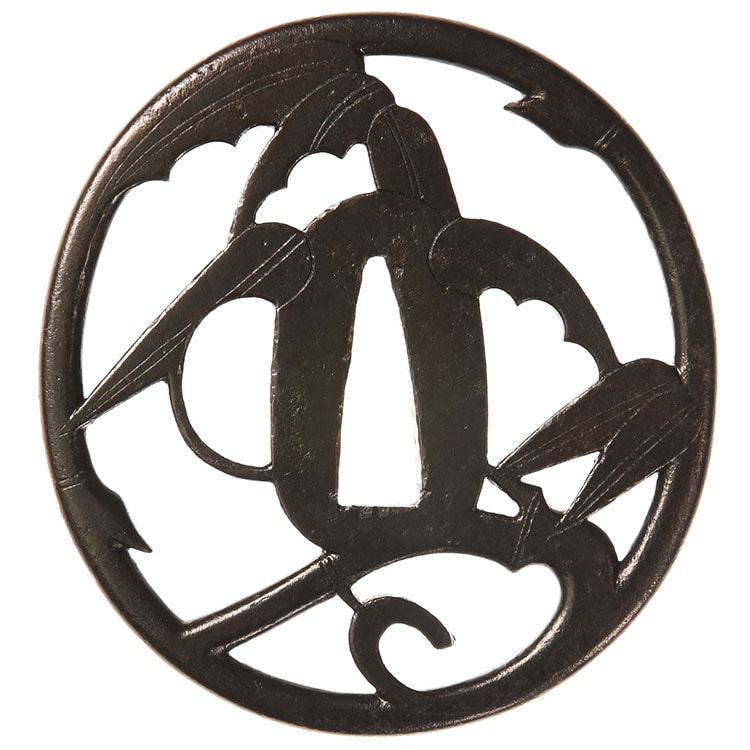
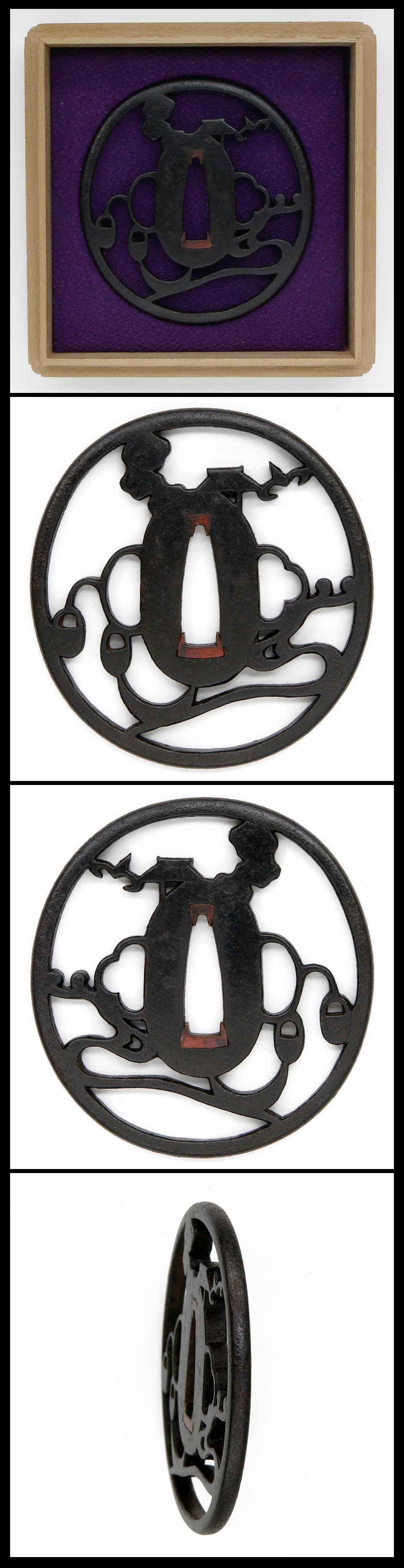
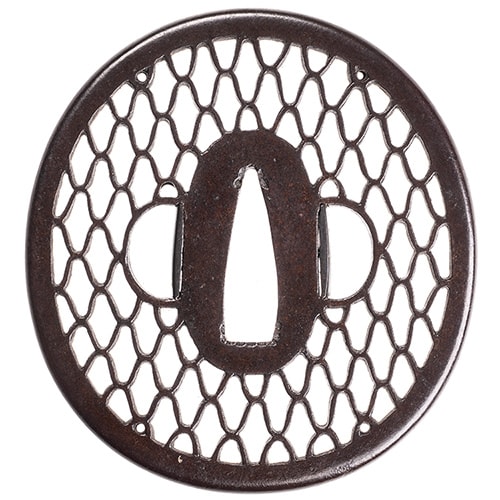
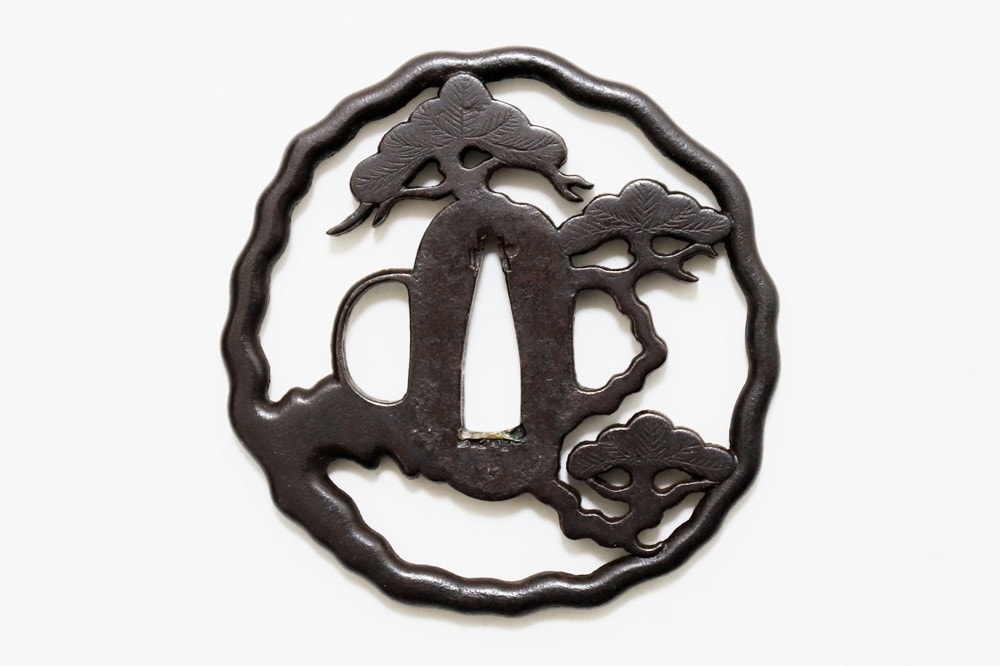
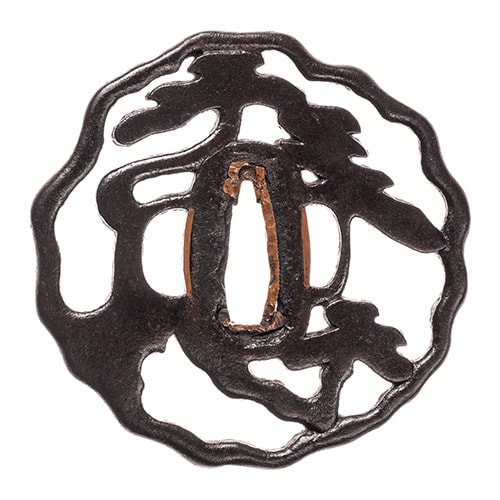
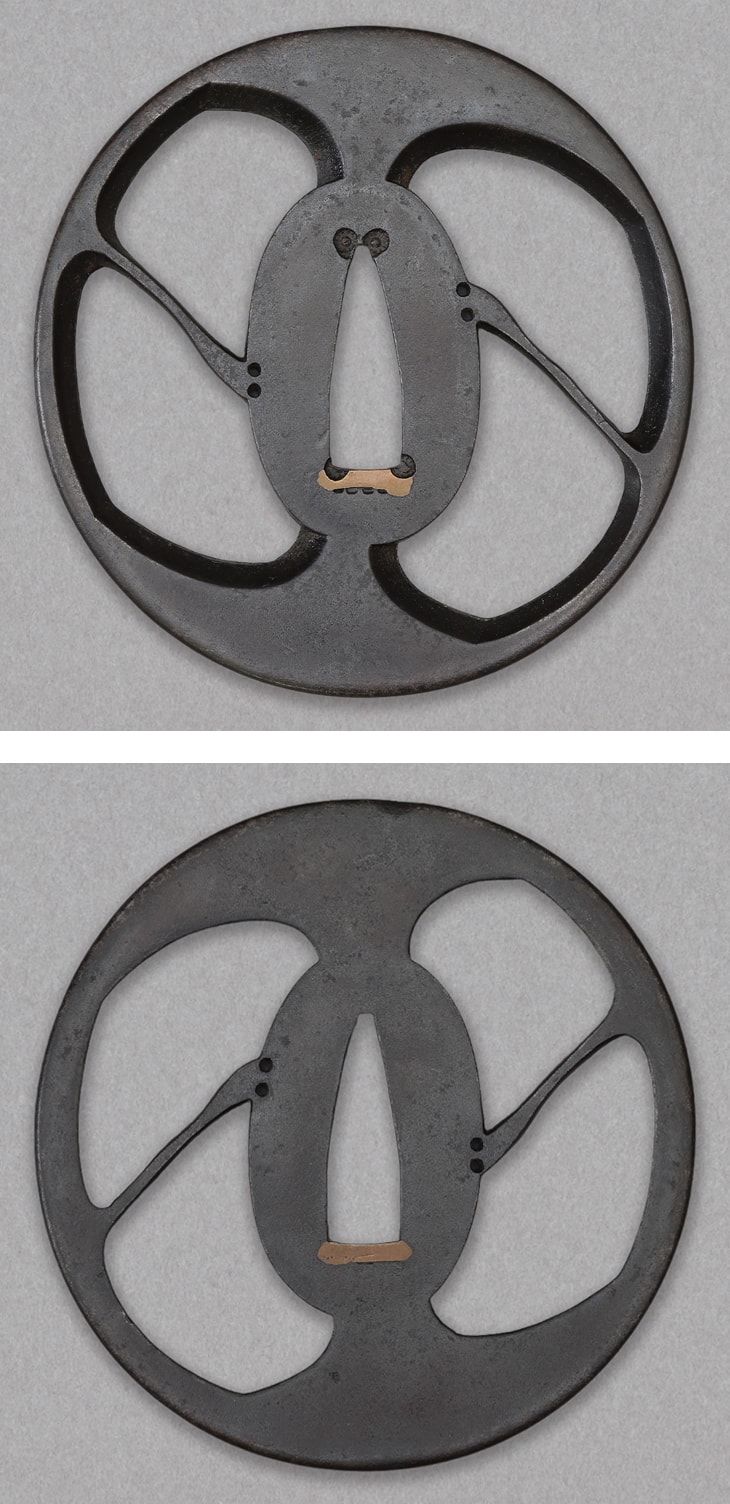
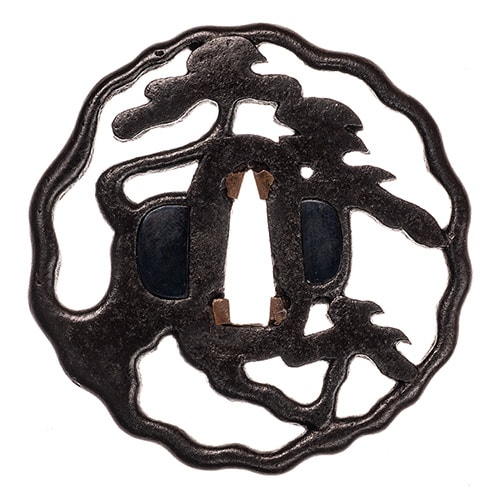
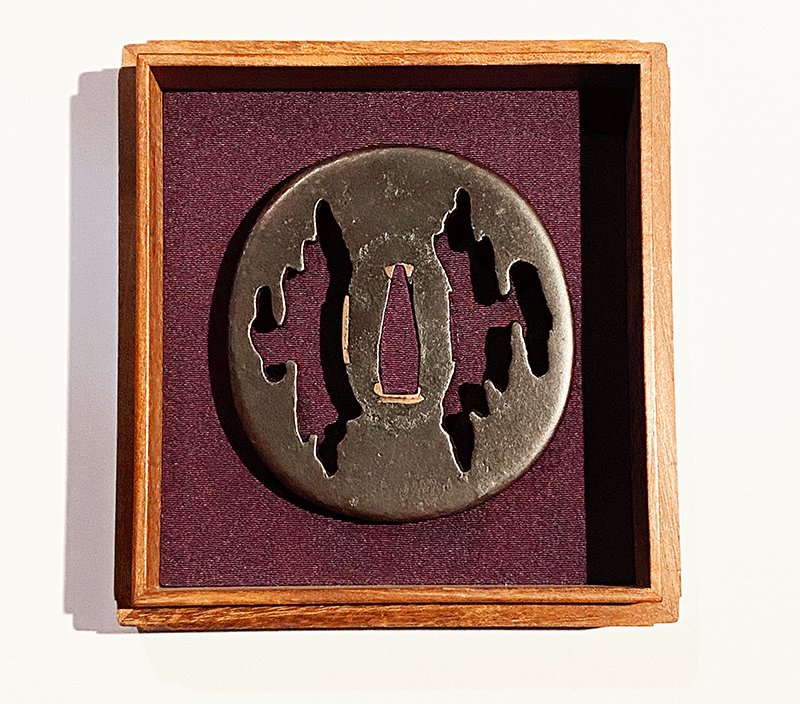
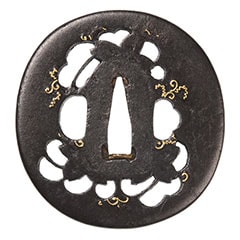
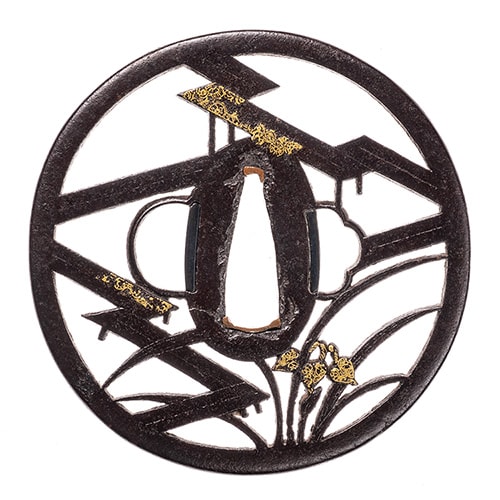
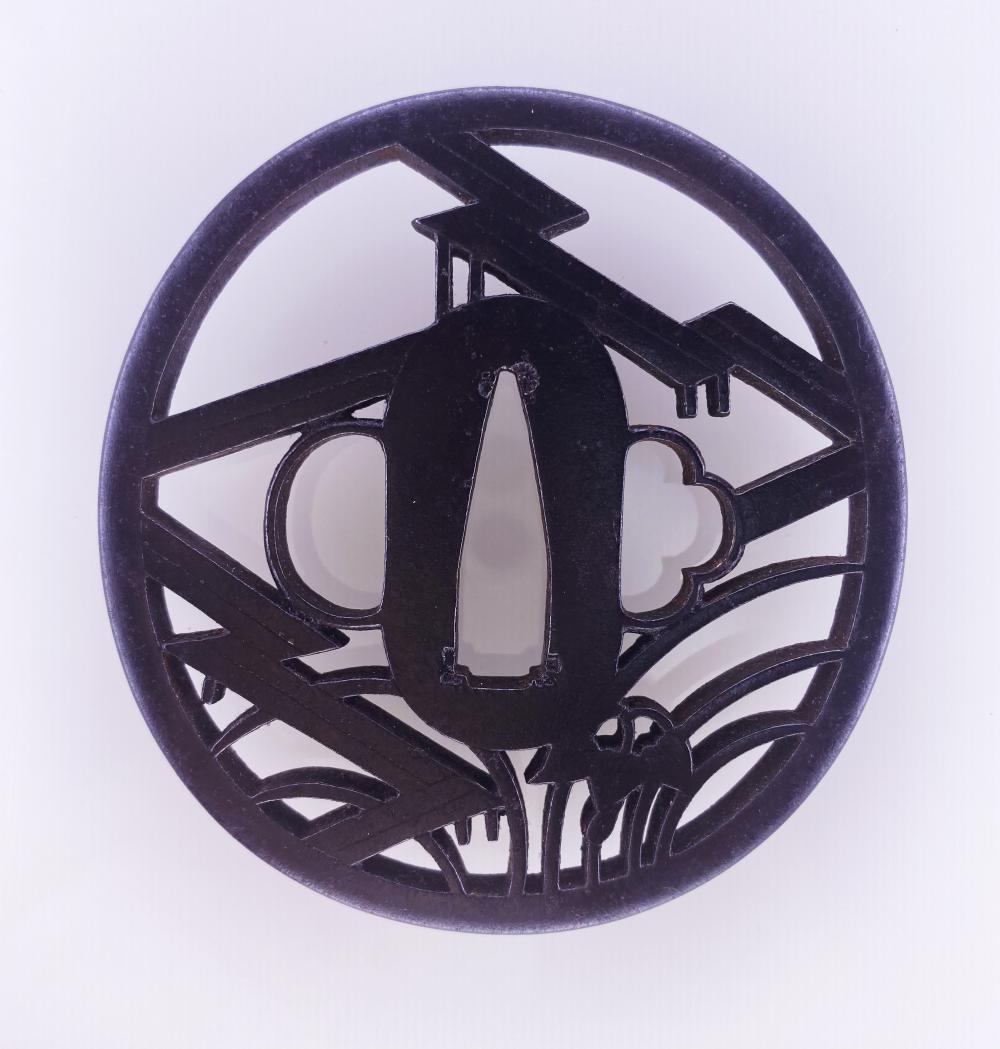
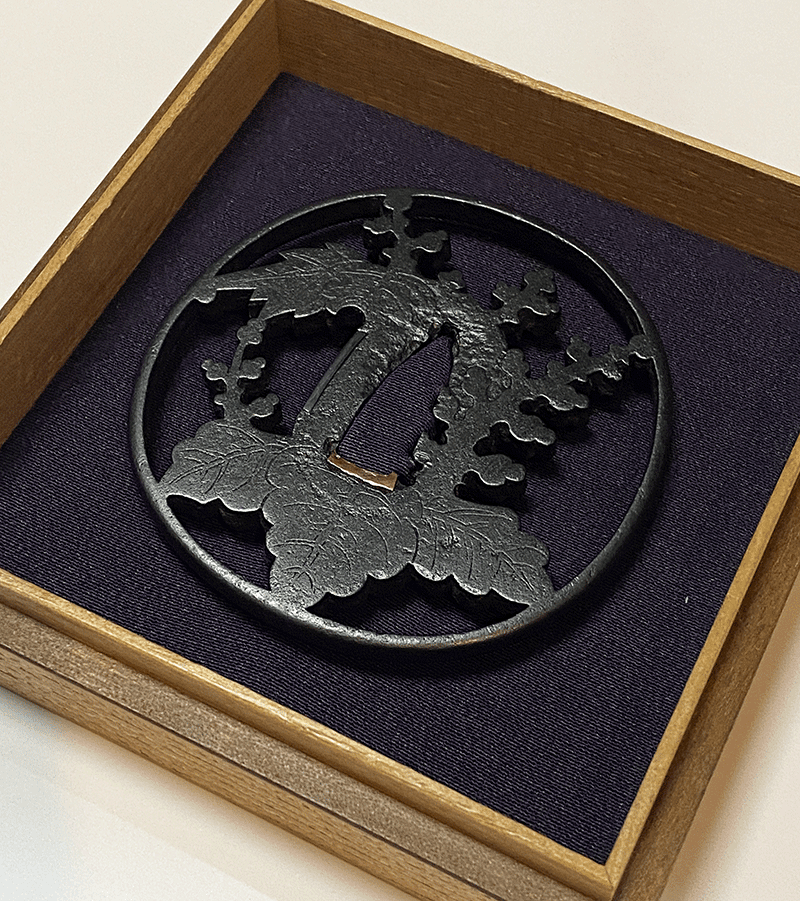
Rakuju's gold inlay was said to demonstrate such technical brilliance that he was called "a second coming of Matahachi," an expression of the highest praise within the tradition. His approaches the level of the founding master, displaying a suppleness and vigor that is both delicate and forceful. His forging of the plate metal is also excellent: the well-refined iron exhibits the purplish patina characteristic of , unctuous in appearance and lustrous, with subtly uneven clusters of texture that impart an elegant charm. He devised and successfully expressed a distinctive surface variation known as gama- ("toad-skin"), a special textural effect on the base metal that became one of his hallmarks. The Kamiyoshi family further employed a special uchikomi- (punch-chisel) treatment above and below the — characteristically two marks above and three below — which serves as a decisive identifying feature, enabling attribution of works by both Fukanobu and Rakuju even when unsigned. His openwork encompasses kage- ("shadow openwork") renderings of butterflies, rain-dragons, auspicious clouds, and warabite (bracken-hand) motifs, all drawn from patterns handed down within the Hayashi school, executed with freely controlled forms that deliberately leave chisel traces to express both refined elegance and strength.

Beyond his accomplishments as a metalworker, the Kinkoroku records that Rakuju's appraisal of metalwork was considered foremost in , and that regarding the construction of sword mountings he attained an especially deep mastery of the inner principles. Beginning with the 's personal mountings and extending throughout the domain household, most refined constructions were produced under his direction. His fully coordinated so- mountings — including celebrated copies of mountings favored by Miyamoto — are consonant with the aesthetic of the Hosokawa school of tea, combining pronounced martial character with restrained elegance. Several of his works are transmitted as former possessions of the Hosokawa family. The recurring appearance of the patron name "Ogi Masakuni" inscribed alongside Rakuju's signature on multiple designated works suggests the support of an important commissioning figure, though no other patron's name has been encountered in the manner. Rakuju stands as a representative figure in late- metalwork, an artisan whose spirited resolve to rival Matahachi yielded works of elevated and refined character.

Kantei

3 descriptive axes for an iron master: material (the well-forged iron plate with its purple Higo patina) x technique (ji-sukashi and kage-sukashi openwork finished with gold scroll, cloth and withered-tree inlay) x themes (the openwork devices: fern-frond, wheel, dragon, crests). The load-bearing kantei tells are the line's hidden chisel-marks and the toad-skin surface, both of which the records say identify the Kamiyoshi hand even on unsigned guards, with the gold scroll inlay named his own specialty.

Kamiyoshi Rakuju is the third-generation head and culminating master of the Kamiyoshi line, a house descended from Hayashi Matashichi by way of the Kasuga (Hayashi) transmission. The records make him the son of the second-generation Shinshin and the grandson of the founder Jumpei (Tadamitsu), who took the Hayashi transmission by order of the domain and worked to revive the Kasuga manner; the line's progenitor is named Kamiya Jinzaemon, made a craftsman of the Hosokawa when Tadatoshi entered . His art is the forged iron guard cut in openwork: a well-forged plate the records repeatedly praise, worked to a polished, forging-grain or hammered ground that takes the lustrous purple patina, pierced as fern-frond, wheel, dragon and crest devices and finished with gold scroll and cloth inlay whose technique the liken to the rebirth of Matashichi. Said to have been born in Bunka 14 (1817) and to have died in Meiji 17 (1884) aged sixty-eight; he signs the house-and-go Kamiyoshi Rakuju and the bare go Rakuju, though many of his accepted guards are unsigned and attributed by the iron and the hidden chisel-marks.

Diagnostic discriminators

the setsumei repeatedly give the hidden chisel-marks at the nakago-ana, two above and three below, as the kime-te that is said to let the second-generation Shinshin and the third-generation Rakuju be told even when their guards are unsigned; it is therefore a Kamiyoshi-line tell shared with his father Shinshin, not a mark that separates Rakuju from his own father

the records call the toad-skin surface a distinctive variation the line worked out and brought off successfully; like the hidden chisel it is a Kamiyoshi-line tell rather than a Rakuju-only one, and the corpus also transcribes the same word as the OCR variant 墓肌, so the true rate across both spellings is higher than the matched 蟇肌 figure

the scroll-pattern gold inlay set into and around the openwork is repeatedly named his specialty (tokui to suru) and a Rakuju midokoro; it is the closest thing in the corpus to a tell of his own hand as against the line, and the records pair it with the cloth-inlay technique they liken to the rebirth of Matashichi

Material (the iron plate)

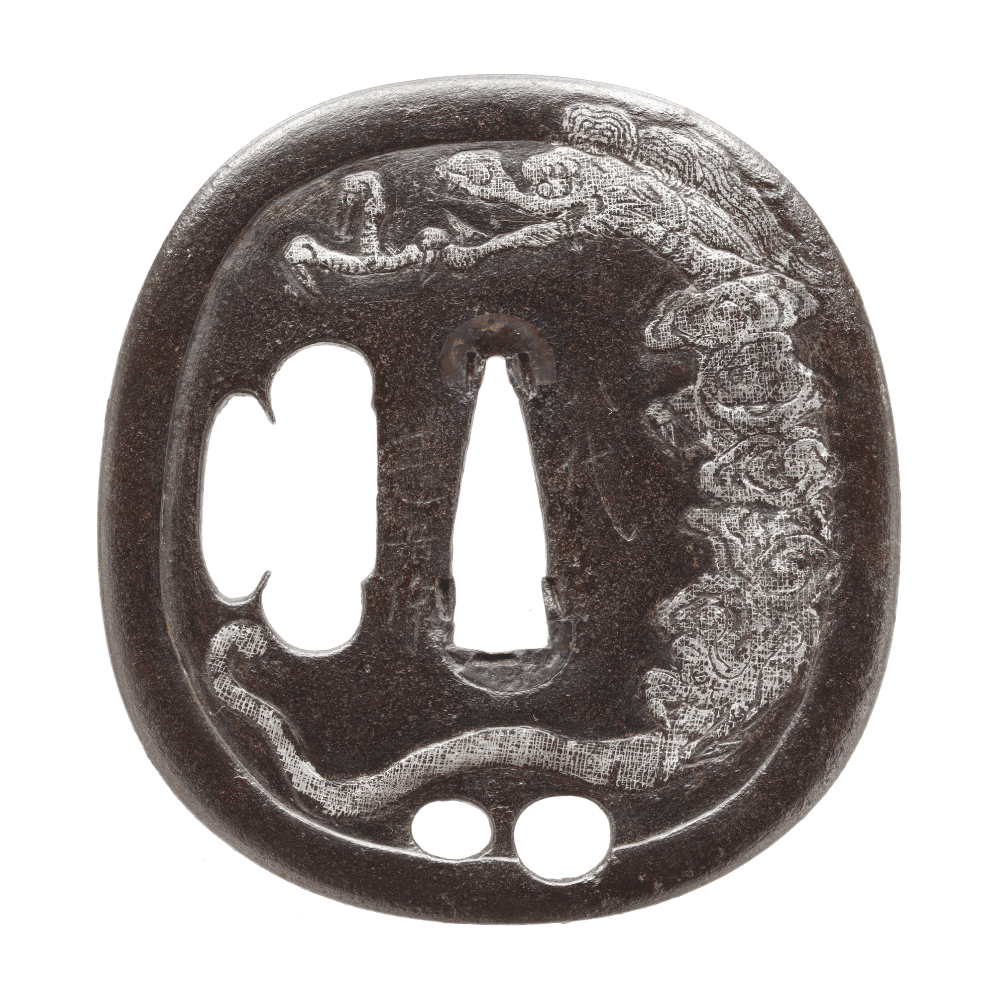
A well-forged iron plate, the rich forging the records single out as a strength of the line, worked to a polished, forging-grain or hammered ground; the patina is the lustrous, moist purple the records call particular to iron, and the field is given a faint undulating mottle that the read as quietly tasteful.

Technique

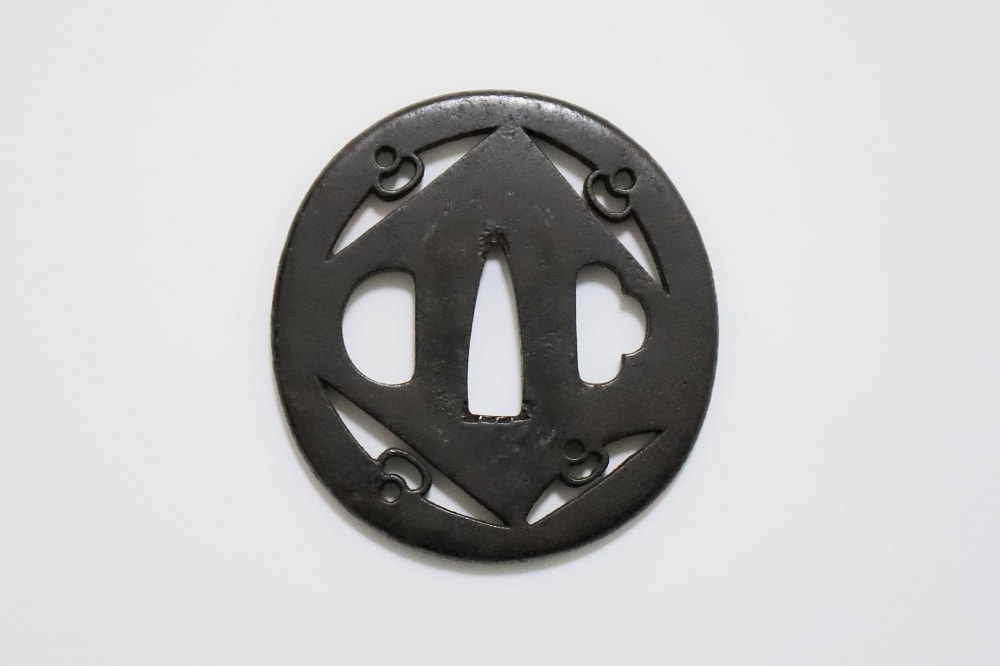
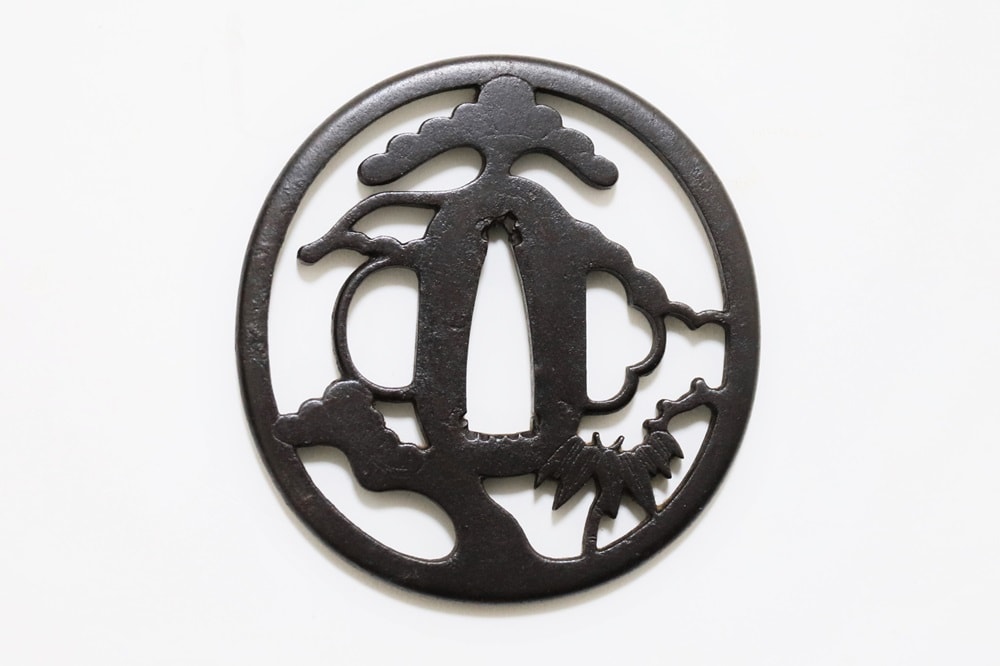
Ground and silhouette openwork above all, cut through the plate; over and within it he sets his specialty gold scroll inlay and cloth (nunome) inlay, with the Hayashi-school withered-tree inlay on the rim, hairline engraving and a sunk-line chisel finishing the pierced edges, and the guard taken to a square or round rim with twin .

Themes (openwork devices)

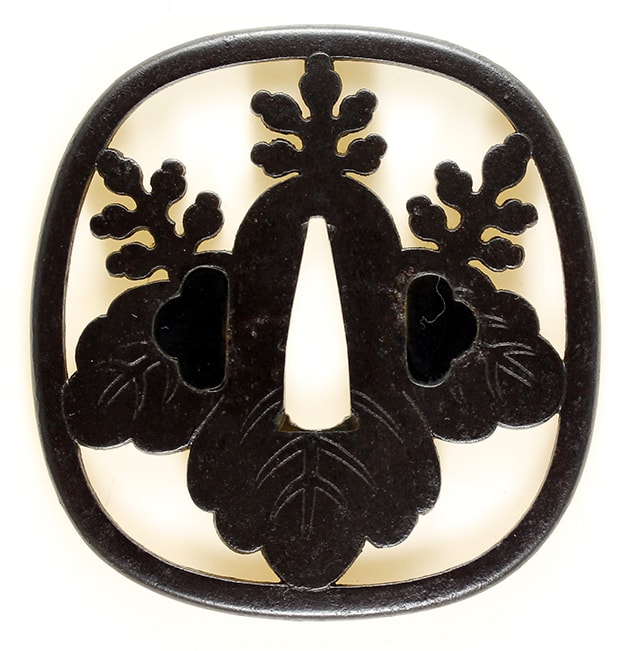
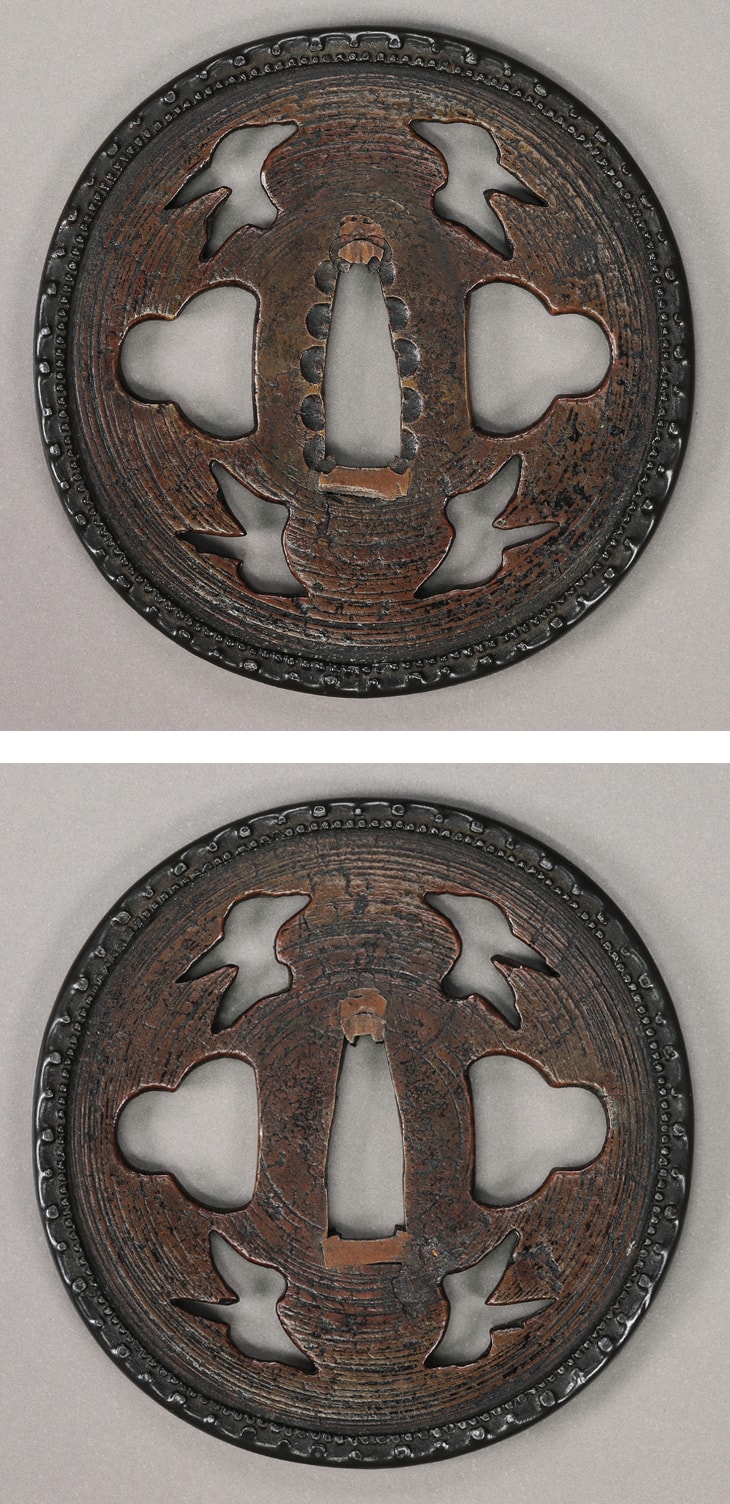
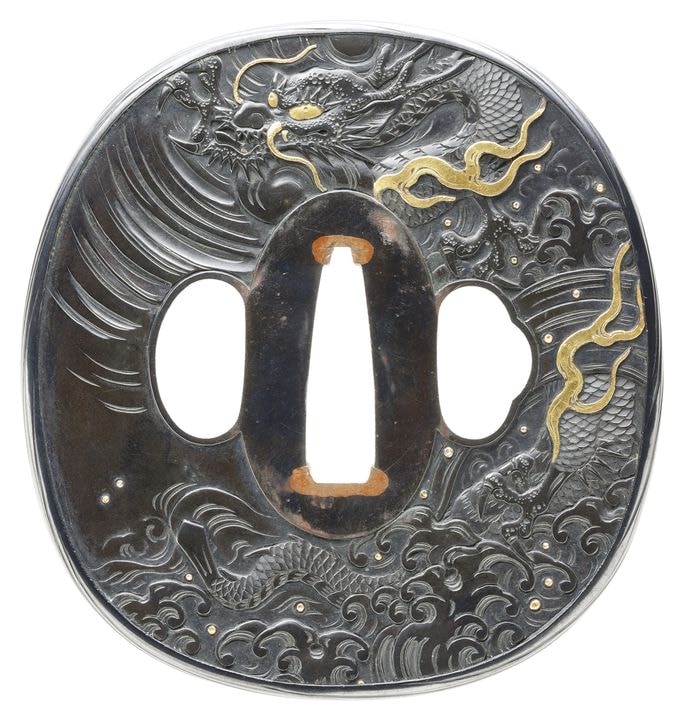
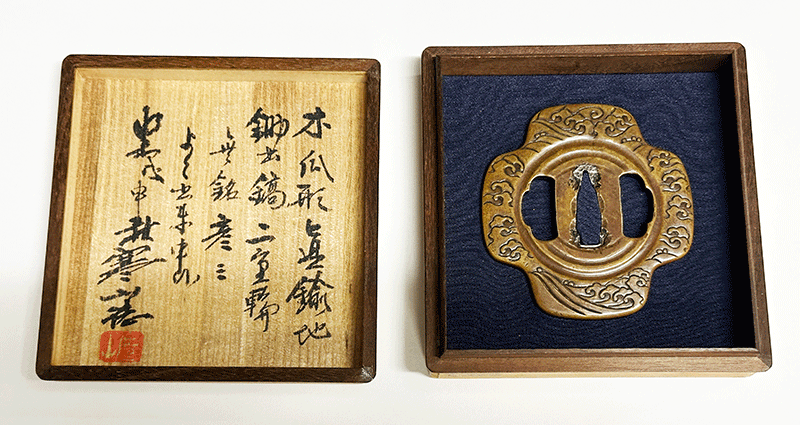
His devices are pierced through the iron: the fern-frond scroll above all, with the wheel openwork, the rain-dragon, butterflies (a Hayashi-school silhouette he reprises) and the cross-kuyo crest, several of them set against a scatter of gold scroll inlay; a single mounted ensemble carries a soft-metal kuyo-and-arabesque scheme outside his iron guards.

Openwork devices

The fern-frond, wheel and dragon openwork, with the Hayashi cross-kuyo crest and the shadow-butterfly silhouette the records call a Hayashi-school motif carried down the line, all pierced in iron and dressed with gold scroll inlay.

Full iconography

Signature chronology

Recorded signatures

Documentary note

Rakuju signs both the full house-and-go Kamiyoshi Rakuju and the bare go Rakuju, the latter often a -less gold-inlay mark, but many accepted guards are unsigned and attributed by the iron and the hidden chisel. With only some thirteen pieces, the honest position is that almost everything that separates a Rakuju guard separates the Kamiyoshi line, not Rakuju from his own father: the records make the hidden chisel-marks and the toad-skin surface the kime- of the second-generation Shinshin and the third-generation Rakuju together, and one guard in this corpus is explicitly recorded as a joint work of the two (the father lending his hand to a piece led by the son). The closest mark of Rakuju's own hand is the gold scroll inlay the records name his specialty. A patron, Ogi Masakuni, is added as a on a small number of his commissions, the only such patron name the records find on his guards. The attribution labels on unsigned pieces are not physical inscriptions.

Scholarship

The records read the moist, glossy purple patina particular to Higo iron, with a faintly undulating mottle in the field, as carrying a quiet tastefulness.

On a single fern-frond guard the record is said to name his private reverence for Matashichi, setting his openwork beside a nearly identical Matashichi design (one piece only).

Designations

Kokuhō—
Jūyō Bunkazai—
Jūyō Bijutsuhin—
Gyobutsu—
Tokubetsu Jūyō—
Jūyō Tōken13

Elite Standing

0.09 across 13 designated works

Top 15% among makers

Provenance

3 documented provenances across certified works by Rakuju

Provenance Standing

3 works held in elite collections across 3 documented provenances

Top 17% among makers

Raw score: 2.09 / 10

Work Types

Distribution across 13 ranked works

Tsuba
1185%
Other
215%

Signatures

Signature types across 13 ranked works

Currently Available

Lineage

TeacherFukanobu
Rakuju

Kamiyoshi School

Other artisans of the Kamiyoshi school

  1. 1.Fukanobu深信3designated
  2. 2.Masatada正忠1designated

Rakuju

Rakuju(楽寿) was a maker of Japanese sword fittings (tōsōgu) of the Kamiyoshi school in Higo province, active during the Late Edo (1817-1884) period.

The work follows the Higo tradition.

Designated works by Rakuju include 13 Jūyō.