NihontoWatch MonNihontoWatchBETA
MarketEncyclopedia
NihontoWatch Mon

NihontoWatchBETA

Market
Encyclopedia
Overview·Kantei·Designations·Work Types·Signatures·School
OverviewKanteiDesignationsWork TypesSignaturesSchool
  1. Schools
  2. Egawa
  3. Sorin

Egawa Sorin

宗隣

Jūyō
Vol. 40, No. 175 · Mitokoromono

Egawa Sorin

宗隣

10 ranked works

SchoolEgawaTraditionKinkoTypeTosogu MakerCodeEGA002
10Jūyō Tōken

Overview

Katsura Sorin, commonly known as Seikichi, was born in Mito in An'ei 2 (1773) under the original surname ; he is the individual as the first-generation Toshimasa. He went to and studied under Yokoya Eisei, where he was recognized for his promise by Katsura Eiju, a senior fellow disciple. At Eiju's earnest request, Sorin was adopted into the Katsura house, succeeded to that family, inherited Eiju's common name Saichiro, and -- continuing in the footsteps of his adoptive father -- became a retained craftsman (kakae-ko) to the Arima family, of Kurume Domain. He was a remarkably long-lived artist: dated signatures are known from when he was seventy-five, eighty-two (Ansei 2, 1855), and even eighty-eight. He used both the and Katsura surnames and signed variously as "Katsura Sorin," " Sorin," and "Egawasai Katsura Sorin," always appending his .

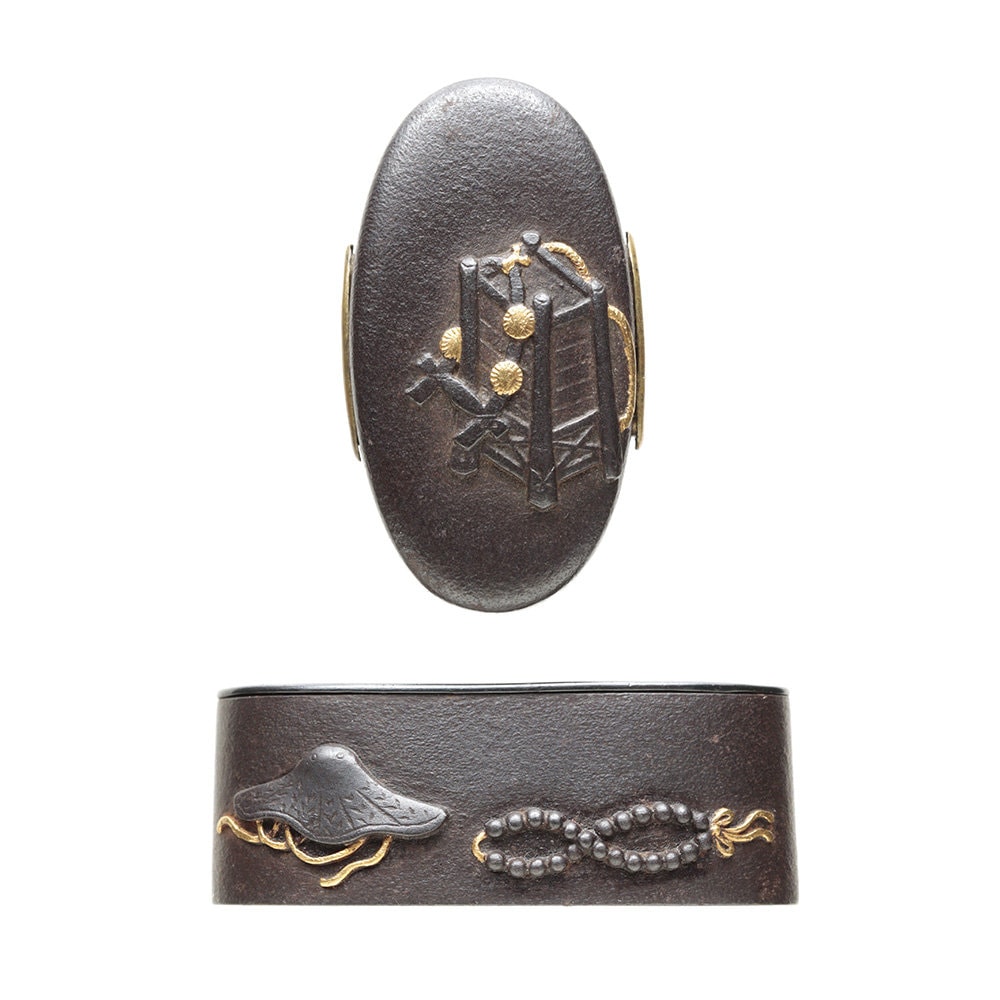
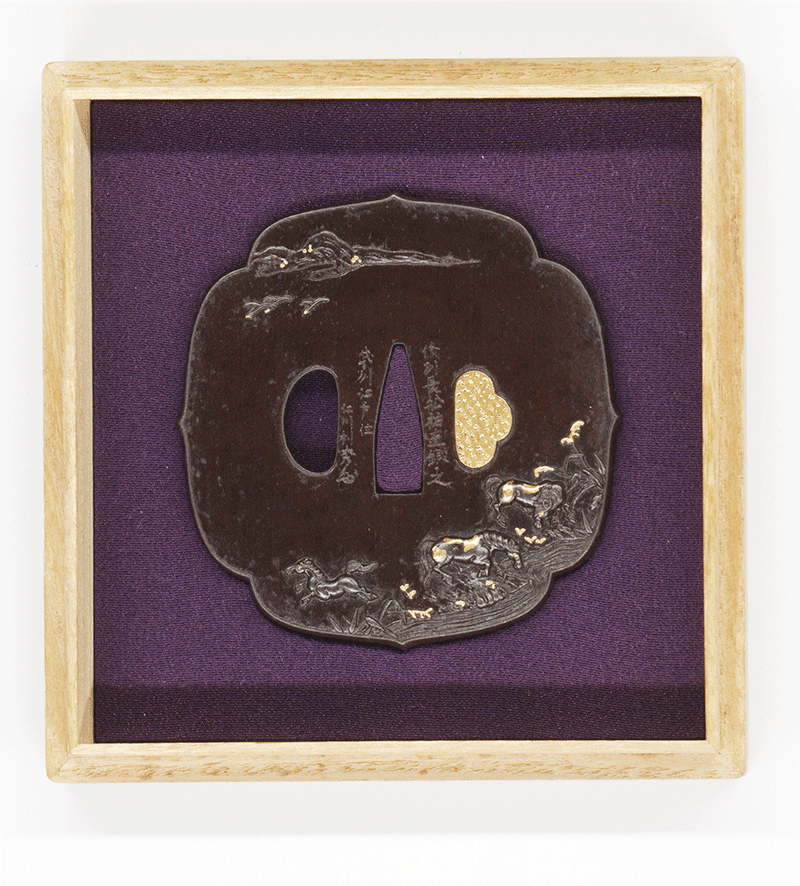
Sorin's work is characterized by (high-relief carving) of abundant volume and richly modeled weight, executed on finely finished grounds of , silver, or gold. His polychrome employing gold, silver, and is minute and careful, superbly depicting both powerful motion and stillness. In his , he conceived compositions in which obverse and reverse are expressed straightforwardly as the near and far aspects of a landscape, skillfully exploiting openwork to heighten narrative quality. Firm nikubori modeling, delicate carving of iron grounds for water ripples and drifting haze, and fluent gold inlay on complementary fittings demonstrate mastery across materials. His ensembles are notable for the sophisticated contrast between iron and soft-metal kodugu, each technique brought to full effect within a unified artistic vision.

Sorin drew extensively upon literary and courtly subjects -- the Rokkasen (Six Immortal Poets), episodes from Monogatari such as Narihira's , and celebrated landscapes including Noji no Tamagawa and Noda no Tamagawa. His works overflow with an elegant, courtly sensibility, and his compositions, though sumptuous in effect, avoid any sense of disorder through the skillful placement of mist and the deliberate orchestration of space. The regards his finest productions as works in which his "true merits are fully realized," with individual pieces singled out as the (finest) among his oeuvre. Even works inscribed at advanced ages display exceptionally fresh workmanship, clearly manifesting Sorin's sustained level of technique and artistic sensibility across a career of extraordinary length.

Kantei

3 descriptive axes: material (soft-metal grounds, above all shakudo and silver nanako, with oborogin, shibuichi, solid gold and suaka) x technique (high relief with colour inlay, round-relief katabori, sukidashi-takabori and applied-device inlay) x themes (courtly classical allusions and a distinctive tiger). The grounds and hand here are the Yokoya machibori house idiom and are foundation, not discriminators. With ten pieces still drawn thinly across many one-off subjects, the records single out very little that parts him from the wider Yokoya field; the one per-piece subject they call his own is the water-drinking tiger seen from his own viewpoint, and even that is low-n. The load-bearing identity markers are documentary: his two interchangeable signature names (the birth-name Egawa Toshimasa and the adopted-house Katsura / Egawa Sorin) which the records identify as one man, and his favoured Egawasai go prefixed to the Sorin signature.

This is one metalwork artist who signed two names across his career. Common name Seikichi, he was born in Mito in Anei 2 (1773), his birth family name . He signed his birth name Toshimasa early and, on being adopted into the Katsura house of his senior in the school Katsura Eiju, took the name Katsura Sorin (also Sorin) with the favoured go Egawasai later; the records state this -man identity outright, that Toshimasa is the person as Katsura Sorin and that the Toshimasa who later took the name Katsura Sorin is one man. He went to and studied under Yokoya Eisei, then like Eiju became a retained craftsman of the Arima family, lords of the Kurume fief. Because of this double descent he used the and Katsura surnames interchangeably. A long-lived soft-metal artist of the Yokoya school, he is recorded at seventy-five in a Kaei-dated piece, eighty-two in an Ansei 2 piece, and an age-eighty-eight signature is known, with dated pieces at seventy-eight, eighty and eighty-one in this corpus. He is a kinko (soft-metal) carver, not an iron- smith: his pieces are worked above all in and silver grounds with and iro-e, although he also made a small number of iron . A 2026 duplicate-merge consolidated his birth-name ( Toshimasa) pieces, formerly held under a separate code, back under this single maker_id, so the corpus now runs to ten pieces, all , spanning both of his signature names; the profile is scoped honestly and thinly to that one hand.

Diagnostic discriminators

two of the ten pieces here are tiger sets, and one setsumei says the so-called water-drinking tiger is depicted from Sorin's own viewpoint, the relief firm and the inlay technique well alive. This is the only per-piece subject the records call his own, but it rests on just two pieces (low-n), so it is offered as a tendency, not a hard discriminator. The comparand rate of 0 against the wider Yokoya field is an art-historical inference, not stated in the setsumei

Material (soft-metal grounds)

Soft-metal grounds in the Yokoya manner: above all the and silver ground, with , a gold-bearing used for a more refined effect, solid gold for round-relief work, and for some components. One hundred-flowers guard uses a gold-bearing ground to give the piece dignity; he also worked a small number of iron ground worked in relief.

Technique

High relief finished with colour inlay above all, with round-relief katabori on the , on the matched , and applied-device inlay with colour inlay on the matching sets; gold, silver and inlay are used in the colour scheme, the modelling thick and weighty and the inlay dense.

Themes (subjects)

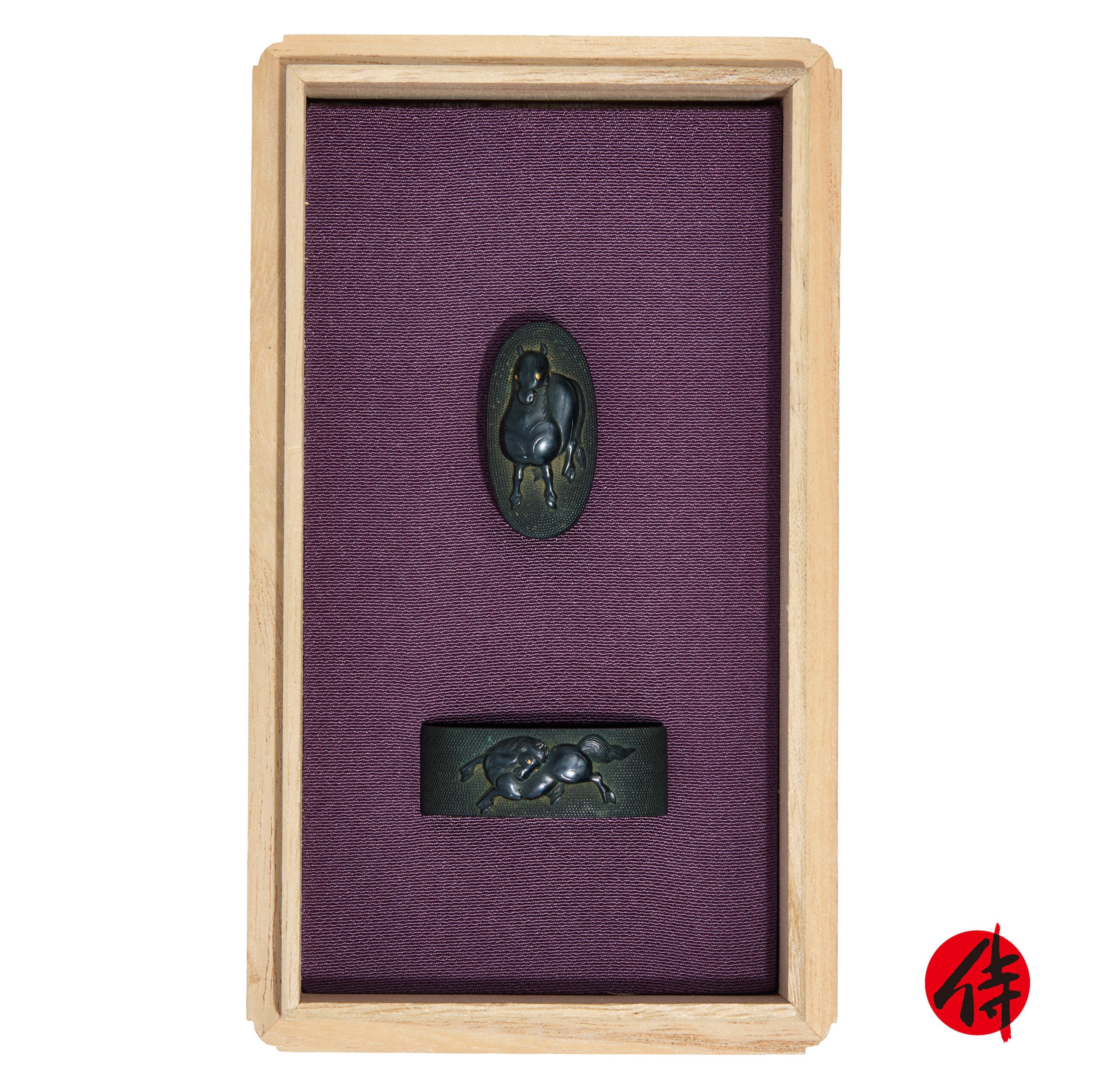
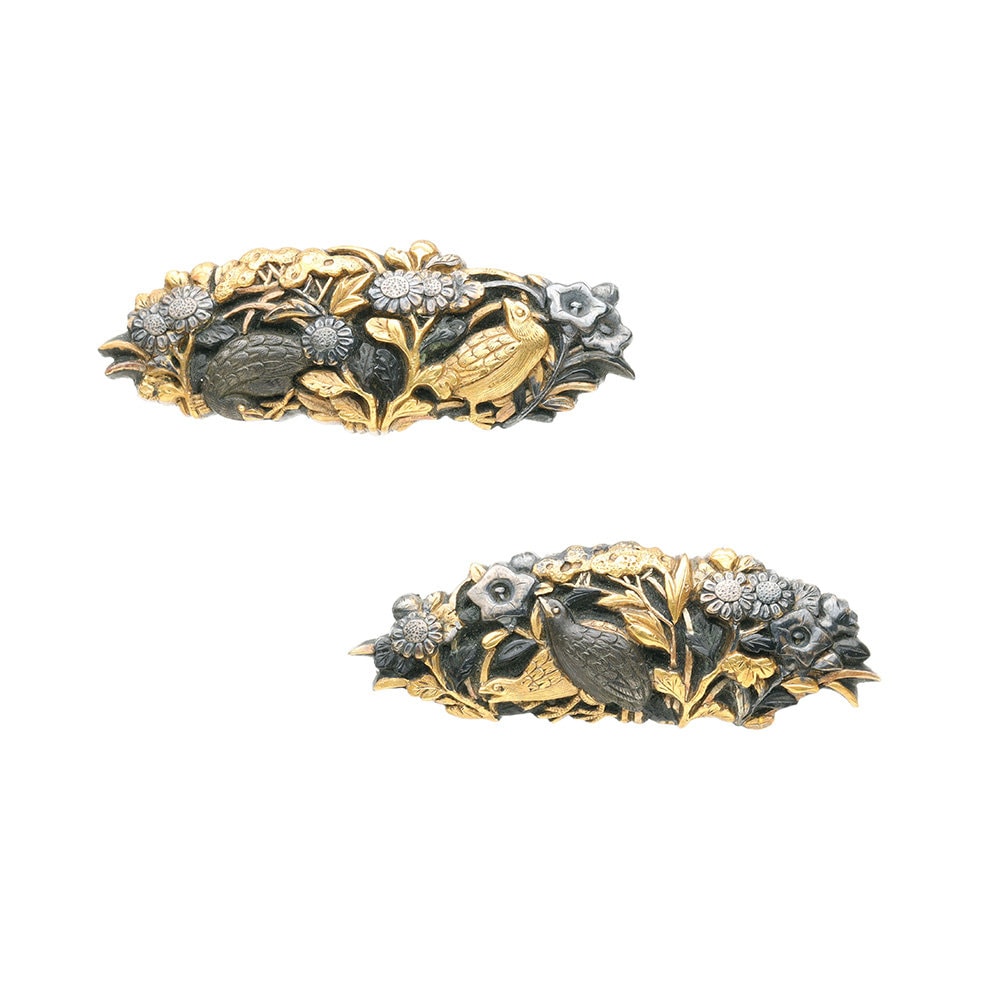
Two strains run through the corpus. The first is courtly classical allusion: the Six Poetic Immortals set pairing the five poets in solid-gold katabori with an Ariwara-no-Narihira eastern-journey , the famous-place Noji-no-Tamagawa with its bush-clover, the rustic-house-and-plover scene read as the Noda-no-Tamagawa of Noin's poem, a hundred-flowers all-over composition, the Narihira and Nunobiki-waterfall scenes from the Tales of , and the waves-and-flocking-plovers read as the Kokinshu poem of plovers at Sashide-no-iso. The second is a tiger: the water-drinking tiger the records say he depicted from his own viewpoint, cut in strong relief with detailed inlay. The Yokoya house peony-and-lion and a finely observed insect set also appear.

Courtly classical allusionless firmly established

Subjects drawn from and the Tales of : the Six Immortals, the Tamagawa famous places with bush-clover and plover, the hundred flowers, and the flocking plovers over waves, worked in high relief and colour inlay on grounds.

The tigerless firmly established

The tiger, including the water-drinking tiger the records call his own conception, cut in firm relief with dense colour inlay.

Full iconography

Signature chronology

Placement
Dated signatures
Recorded signatures

Documentary note

His most reliable identity markers are documentary rather than stylistic, because the grounds and carving in this corpus are the shared Yokoya house idiom, and with ten one-off subjects the records give no recurring stylistic separator. He is one man under two signature names: he signed his birth name Toshimasa early (four pieces here, one splitting it as the -Toshimasa on a ) and his adopted-house name Katsura Sorin / Sorin later, the records stating outright that Toshimasa is the person as Katsura Sorin and that the Toshimasa who later took the name Katsura Sorin is one artist. The 2026 duplicate-merge folded the birth-name pieces back under this single maker_id, which is why both names now appear in one corpus. For the Sorin name he signs the and Katsura surnames interchangeably, so a piece may read Sorin or Katsura Sorin for the hand, and his favoured go Egawasai is prefixed to the Sorin signature on five of the ten pieces, most fully as Egawasai Katsura Sorin with a . One carries a dated 1852 signature preceded by the homage legend after a Somin design, naming the Yokoya founder Somin whose line he descends from through Eisei. On one mounting the - carries a 紋祐乗光理 (Goto Mitsumasa) signature, which is an appraisal / co-signer mark on that component, not Sorin's own hand. With the corpus still thin and stylistically continuous with the Yokoya school, this profile is scoped honestly to the signature facts and does not claim a generation-parting discriminator the do not support.

Scholarship

On one piece the insect set is read as based on accurate drawing-from-life, the twenty-two insects shown in motion and at rest with fine detail; it is the only place the records comment on his naturalism, so it is a single-source note scoped to that one mounting.

One setsumei reads the tiger tsuba as a witty composition in which front and back are made the foreground and background of one scene, the openwork strengthening its narrative quality.

Designations

Kokuhō—
Jūyō Bunkazai—
Jūyō Bijutsuhin—
Gyobutsu—
Tokubetsu Jūyō—
Jūyō Tōken10

Elite Standing

0.07 across 10 designated works

Top 19% among makers

Work Types

Distribution across 10 ranked works

Other
660%
Tsuba
330%
Mitokoromono
110%

Signatures

Signature types across 10 ranked works

Currently Available

Egawa School

Other artisans of the Egawa school

  1. 1.Muneyoshi宗義1 for sale1designated

Sorin

Sorin(宗隣) was a maker of Japanese sword fittings (tōsōgu) of the Egawa school.

The work follows the Kinko tradition.

Designated works by Sorin include 10 Jūyō.