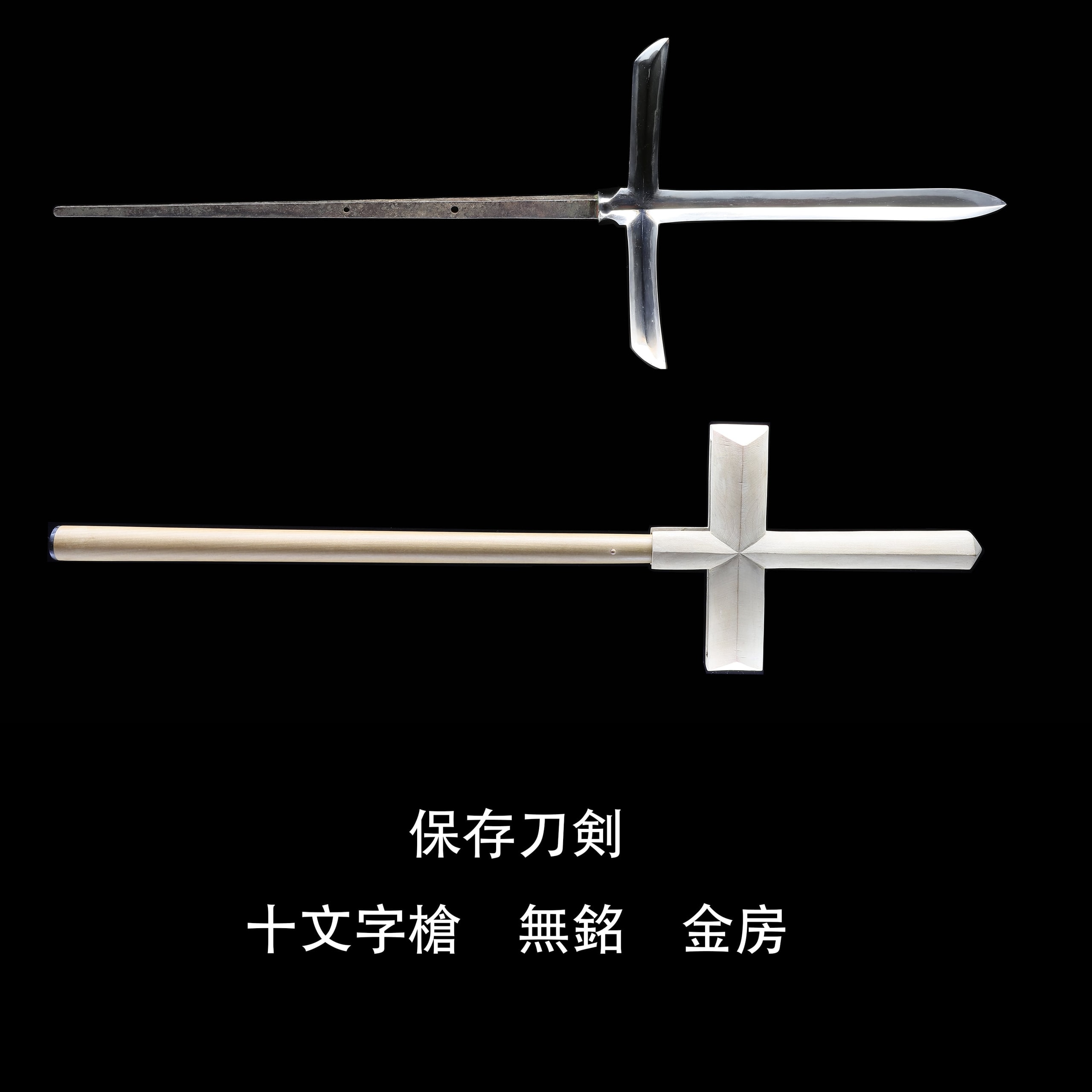
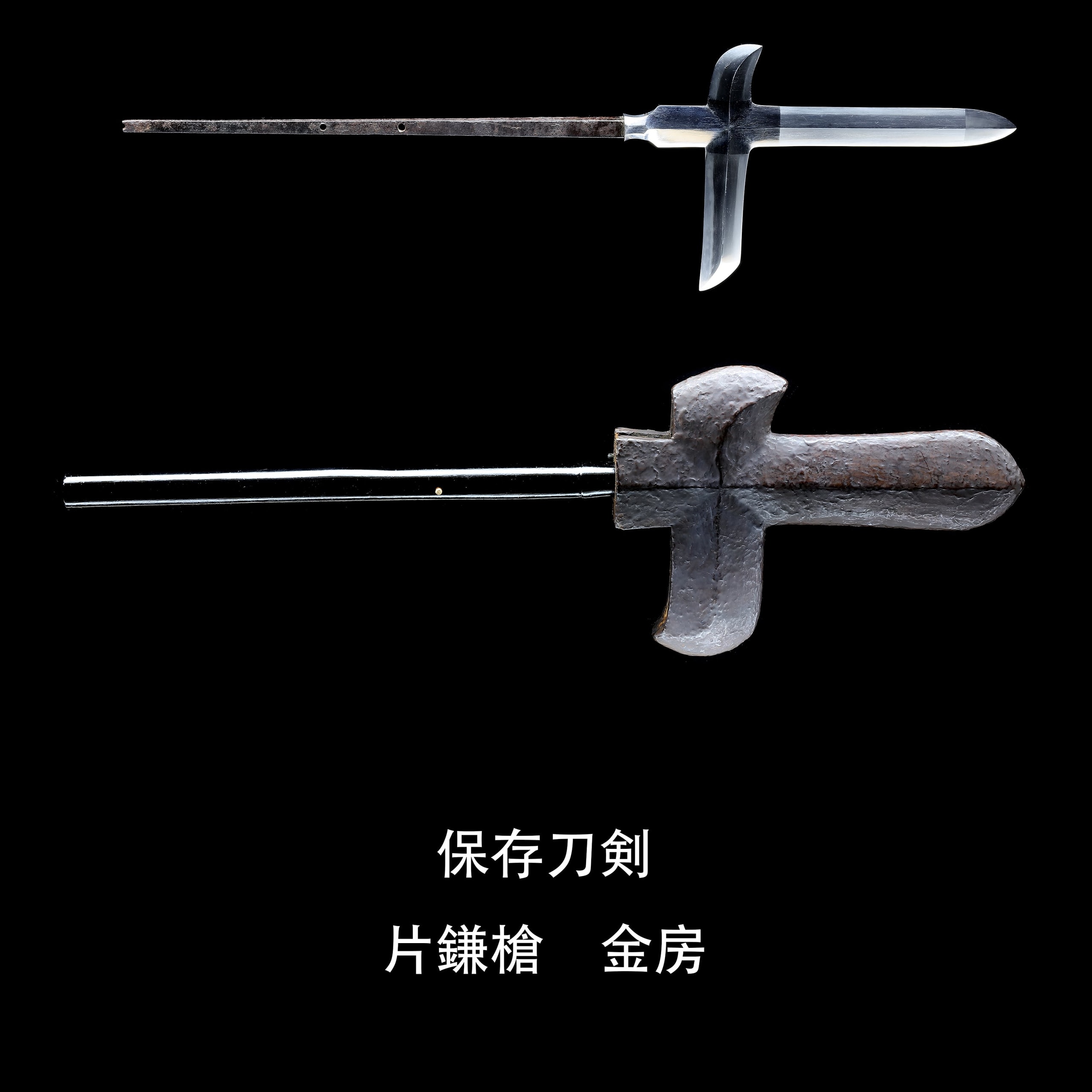
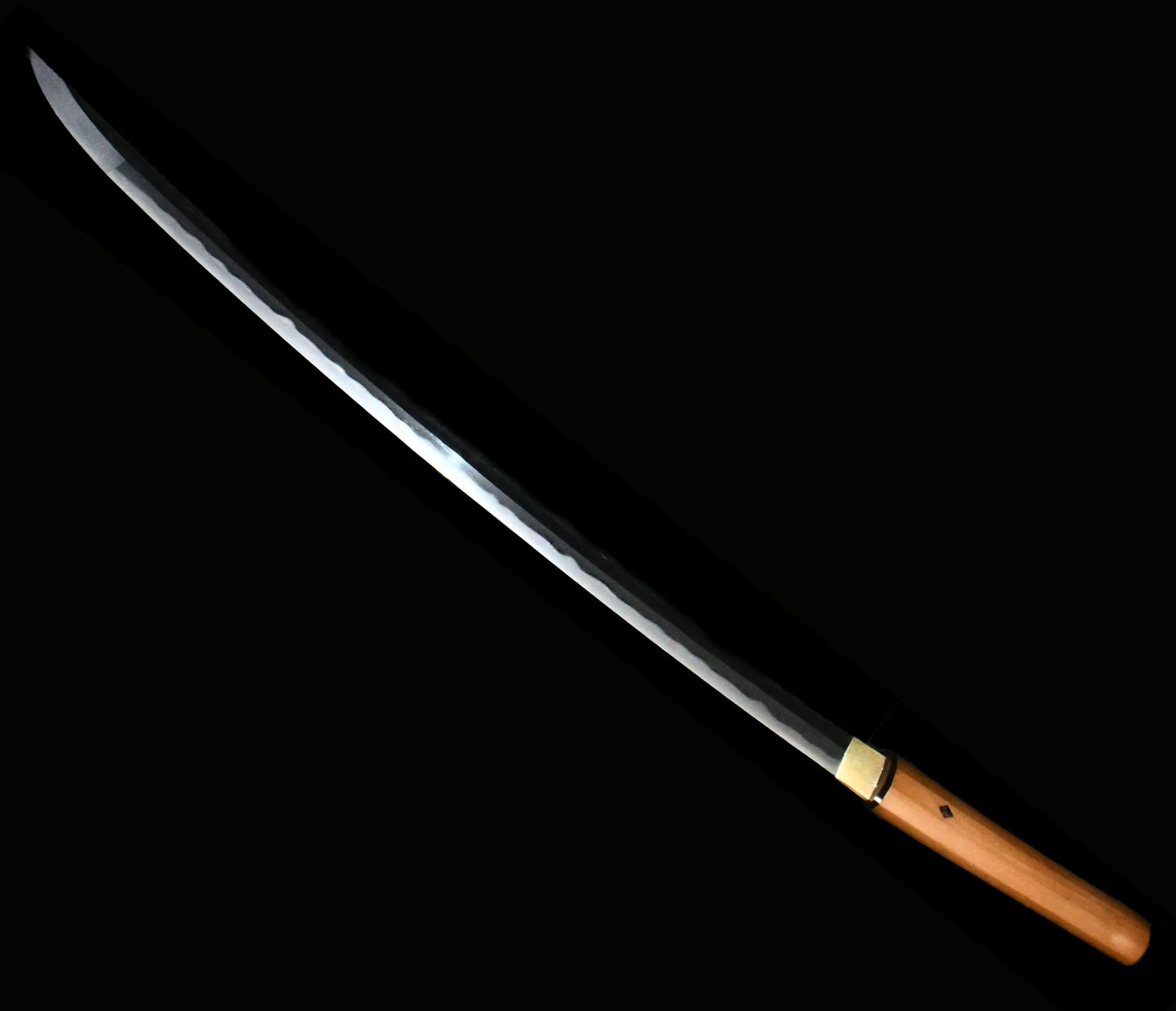
Masatsugu signs his blades in full, Nanto-ju Kanabo Hyoe-no-jo Masatsugu, cut as a long inscription toward the of an unshortened tang, and he is the smith the published sources name "the best-known Masatsugu within the school" (同派の中で最も名の知られた政次) of the Kanabo group, a school that rose in Nara in the late period. The Kanabo line worked in Nanto, the old name for Nara, from the close of the era into the early period, and many of its smiths signed simply under the school name; Masatsugu is set apart from them as its representative hand. The reference works place his dated pieces from the Eisho era onward, and the published sources are candid that the group's relationship to any of the five Yamato traditions cannot be established. That uncertainty is itself the key to him, because his work does not behave like Yamato work at all. Rather than the upright and restrained of and its neighbors, his blades take the broad, robust shape of the late- fighting sword, and the published sources liken the Kanabo manner to the of and , blades that share, in their words, the broad-bodied form with of that age.
The hand that runs through every one of his designated blades is a -based great , and it is the first thing by which he is known. Over a base of he sets of several kinds at once, angular and mixed in with and entering freely, the line broad and unquiet. On his of the fifteenth session the temper is exactly this, a carrying angular and small with deep and along it, while on the of the twenty-fourth session the widens and the opens at the hips with drawn through the . The takes a tightened cast rather than a soft one, and the published sources, describing the school at large, observe that the Kanabo temper is a -based great in which the tends to sit subdued. Masatsugu's own line is the more controlled and luminous version of that family habit, deep in where many of his fellows are merely dull, and it is on this account that the published sources judge his fifteenth-session to show a superior workmanship among the smiths of the school.
His is the second half of the recognition, and it carries the trace of Yamato even where the rest of the blade has left the tradition behind. The forging is an that flows and tends to , standing a little under the polish, and on the boldest of his it loosens further into large grain shot with . gathers over it, and on the long onaginata of the twenty-fifth session a whitish rises in the , the pale reflection that the late Yamato and steels throw up. Across the broader temper run and , with breaking the and starting here and there in the on his most active pieces. The is constant and diagnostic: it turns in on every one of his blades, resolving to a on the and of the early sessions, to a pointed return on the long onaginata, and on the latest it is swept frequently with and run down somewhat long before it returns.
What survives of him is dominated not by or but by polearms, and this is the most particular fact of his record. The Kanabo school left a conspicuous number of , and the published sources read that abundance straightforwardly as production for the warrior-monks of the seven great temples of Nara, beginning with Kofukuji, whose armories needed staff weapons in quantity. Two of his four designated blades are themselves , and the longest is a commanding piece the published sources call "exceptionally long, and moreover excellent in its workmanship" (極めて長大であり、しかも出来が優れている). The school also tempered a quieter manner that does not appear among his designated work, a tight- into which and enter well, which the published sources actually name as the most common Kanabo ; on Masatsugu's own surviving blades that is held in reserve and the -based prevails throughout. The thirty-eighth-session , preserved together with its vermilion-lacquered mounting, the published sources call "a typical example of Masatsugu" (政次の一典型), the mounting itself made to suit the blade.
What distinguishes him is best stated through his own grounded traits rather than by contrast with the schools around him. The broad fighting shape with its large , the flowing standing , the many-formed with its deep and tight , and the unfailing together form a recognizable whole that belongs to no single Yamato tradition and looks instead toward the late and Seki smiths working in the decades. Within the Kanabo group itself, where the run of work is competent but plain, his is the hand the published sources single out as the soundest and most accomplished, the standard against which the rest of the school is measured. His relation upward into the five Yamato traditions remains, by the published record's own admission, an open question, and that very detachment from the old lineages is part of what makes his work legible at sight.
Four of Masatsugu's blades stand on the official designation record, all of them at the level, and they are the realistic measure of what a collector might one day encounter. His record holds at the level and rises no higher, and the surviving designated pieces are held privately, their owners largely unrecorded in the catalogue, so no roll of famous houses can honestly be set against his name. He is rated Jo in the Fujishiro ranking, a solid standing for a provincial late- smith, and his Toko Taikan valuation sits in the middle of the range. A blade of his comes to market only from time to time and chiefly among his , the form in which he is most often met, and an example with its original mounting intact, as the thirty-eighth-session piece survives, is rarer still. For a collector drawn to the late Yamato schools and to the armed religious houses of Nara that sustained them, a designated Masatsugu, broad and forthright and tempered in his unmistakable , is among the more attainable ways to hold a securely attributed work of the best Kanabo hand.