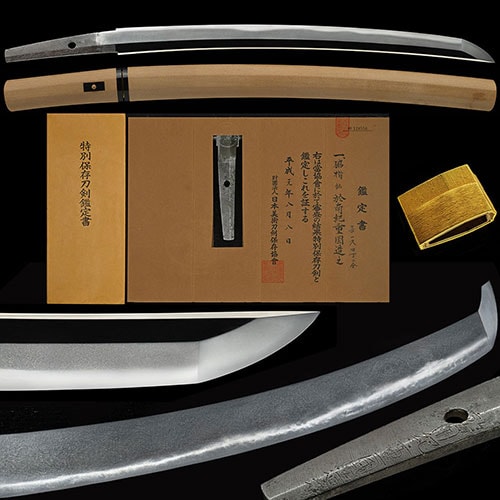
Nanki Shigekuni signs his blades "made at Nanki", and the published sources read that signature as biography. He was, they record, a smith originally of Yamato Province, a later offshoot of the group; in the Keicho era he entered the service of Tokugawa Ieyasu and forged at Sunpu, and in Genna 5 (1619) he moved in attendance upon Tokugawa Yorinobu when that lord was enfeoffed at Wakayama in . His common name was Kuro-saburo, and one signature reads from the Monju temple of Mt. Meiko in Kishu, Monju Kuro-saburo Shigekuni, tying the line back to its Yamato Monju root. The published commentary does not flatten this descent into one manner. "His workmanship divides broadly into two", it says, and names the two blade after blade: a -revival made in private admiration of the upper masters, Go Yoshihiro above all, and the hereditary Yamato- he carried as "his house art", which the sources say "calls up Kanenaga".
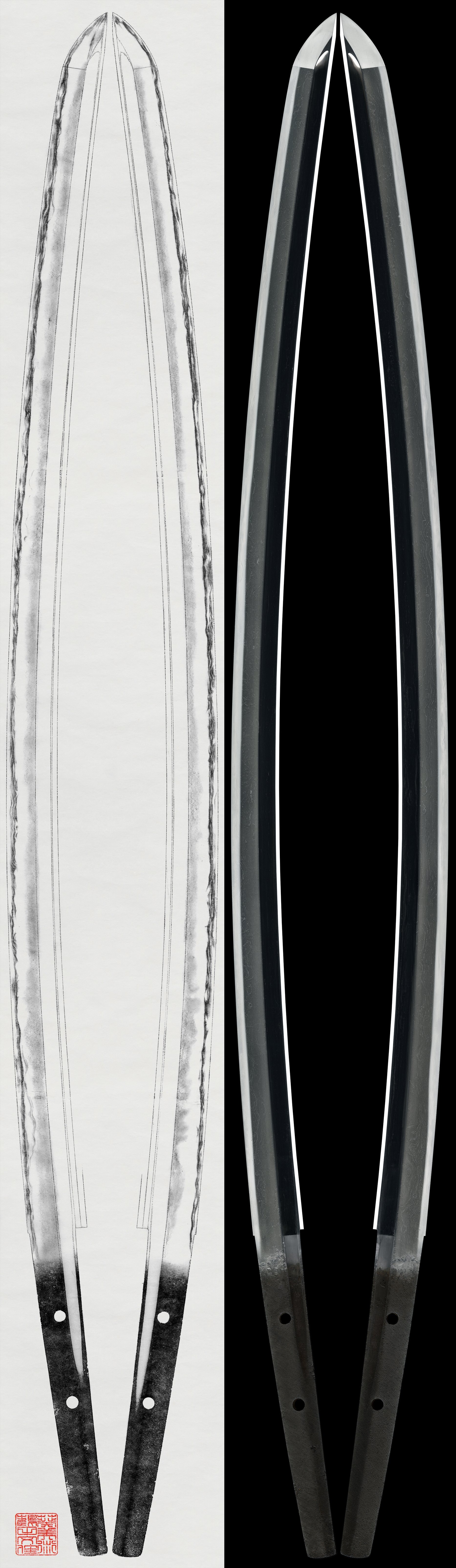
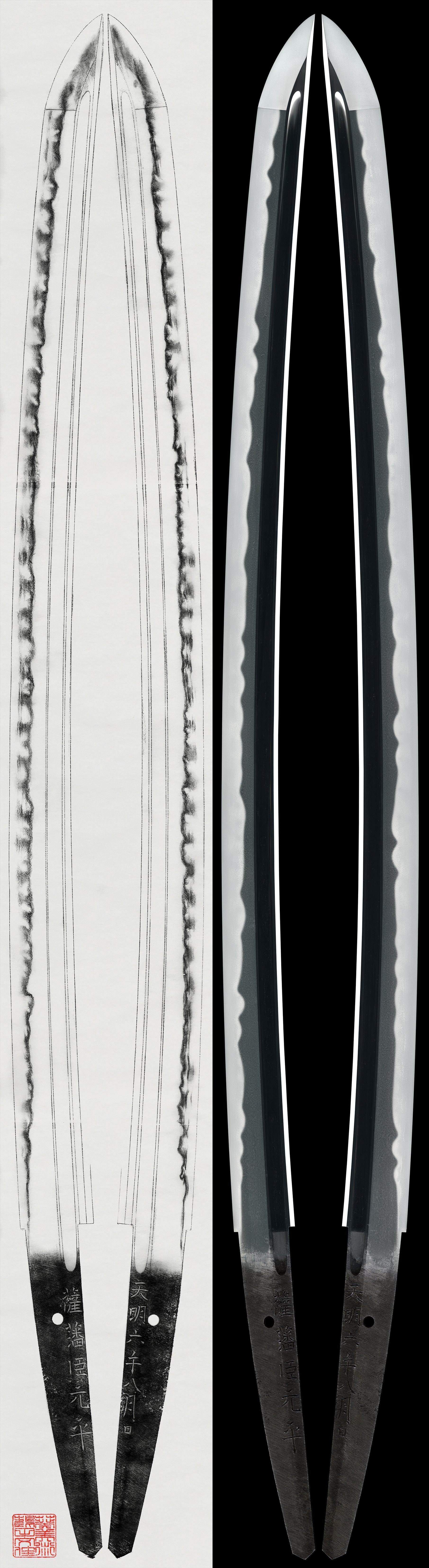
The first of the two manners is the one the names as his typical and outstanding work. Over a flowing that mixes and stands somewhat into a that lifts, the sits thick and the enters frequently, the steel clear. Upon that he forges a shallow or small , mixing in and at times a pointed character, widening the temper distinctly from above the ; the is deep, the thick and at times breaking up, and across the whole of it the and run freely, the bright and clear. The runs and turns in a small or , swept with . Among the Tokugawa-house smiths who set out in these years to revive the manner, his is the most active edge: the and that cover his blades run heavier than in any of his fellows, and it is exactly this clear bright character of and that the published sources single out, "the bright clarity of and is in particular his true province". On one the commentary notes the turning in spirals through the edge, a tell it calls a recurring feature of his work.
In either manner the is one flowing , the thick and the well entered, the steel clear; the published record returns to this as the constant beneath both his hands. It is a standing, lifting grain, not a fine close , and it carries flowing more heavily than anything else he makes, the genetic Yamato trait that persists through both manners. The -side blades show the inheritance plainly: a , at times or , with small mixing above the and the fraying into , , and , the ending or and swept with . The -lean grain and the are the marks of the descent, near his ancestor Kanenaga and all but absent in the and smiths who revived without that Yamato blood.
The scholarship reads beyond the two manners to a third, which is where Shigekuni becomes himself. Taking a - base and adding the , the commentary records, he established on that a manner of his own; the finest of these the calls his "", the high point, singling out the excellence of the and the bright clarity of and . The side it elsewhere calls a Go-, a copy in the manner of Go, "what is called a Go-", a vigorous make whose too is clear and superb. Almost all of his blades are signed, in two registers, the long signature on the pieces and a two-character Shigekuni cut with a fine chisel, the latter rare on first-generation work; the lumps the later Nanki generations under one attribution, marking the explicit pieces where it can. On one whose mixes and -like elements the commentary catches "a hint of the Monju manner" and reads in it "a forerunner of the of the second generation and after", the line opening toward the Kishu that descends from him.
The sources draw his distinction by his own traits rather than by what his models lack. Against the masters he admired, the bright, heavily -laden and and the freely running and are read as his own register, vigorous and clear; one early short sword the commentary calls the finest of this smith, the bright and the activity abundant. Against the Yamato of his descent the flowing , the -lean grain, the and the declare the blood that surfaces in even his blades, where the wide high and the swept betray, the sources say, his native Yamato temperament. Looking the other way, the reads in his work, where the is burned across the and turns round, bright in and , a manner that "runs in one vein toward Kotetsu", and supposes that Kotetsu drew upon this very class of his work; the resemblance, traced to a master of the next generation, closes his lineage forward as Go and Kanenaga close it back.
Fujishiro grades him Sai-jo , and the weight of designation behind his name sits high among smiths: one of his blades is an Important Cultural Property, with six in the tier and a further forty-four at , some fifty in the and ranks together, and the official record holds his work as wholly signed, fifty-nine pieces, none . The provenance recorded against his blades runs back to the house he served: examples descended in the Kishu Tokugawa family at Wakayama, and the Tokugawa Ieyasu and Tokugawa Yorinobu under whom he forged stand in the histories of his swords, with the Imperial Family among later holders. Several dated Genna 8 (1622) survive bearing the possessor marks of Yorinobu's senior retainers, one made to the order of Kageyama Tosa-no-kami Munenobu, an elder of the Kishu domain, another carrying the mark of Tsuzuki Toichi, "a senior retainer of Yorinobu since the days". The published sources observe that his blades, "for some reason, are for the most part shortened", so that an among them is rare and counted a point of value. A signed Shigekuni is not among the unobtainable names; an example reaches the market from time to time, more often a than a , while most of what survives is held in old and private collections, a Kishu landmark when one appears.